What are the Key Facts Related to Saint Narahari Tirtha? - History | UPSC Learning
Topics
0 topics • 0 completed
🔍
No topics match your search
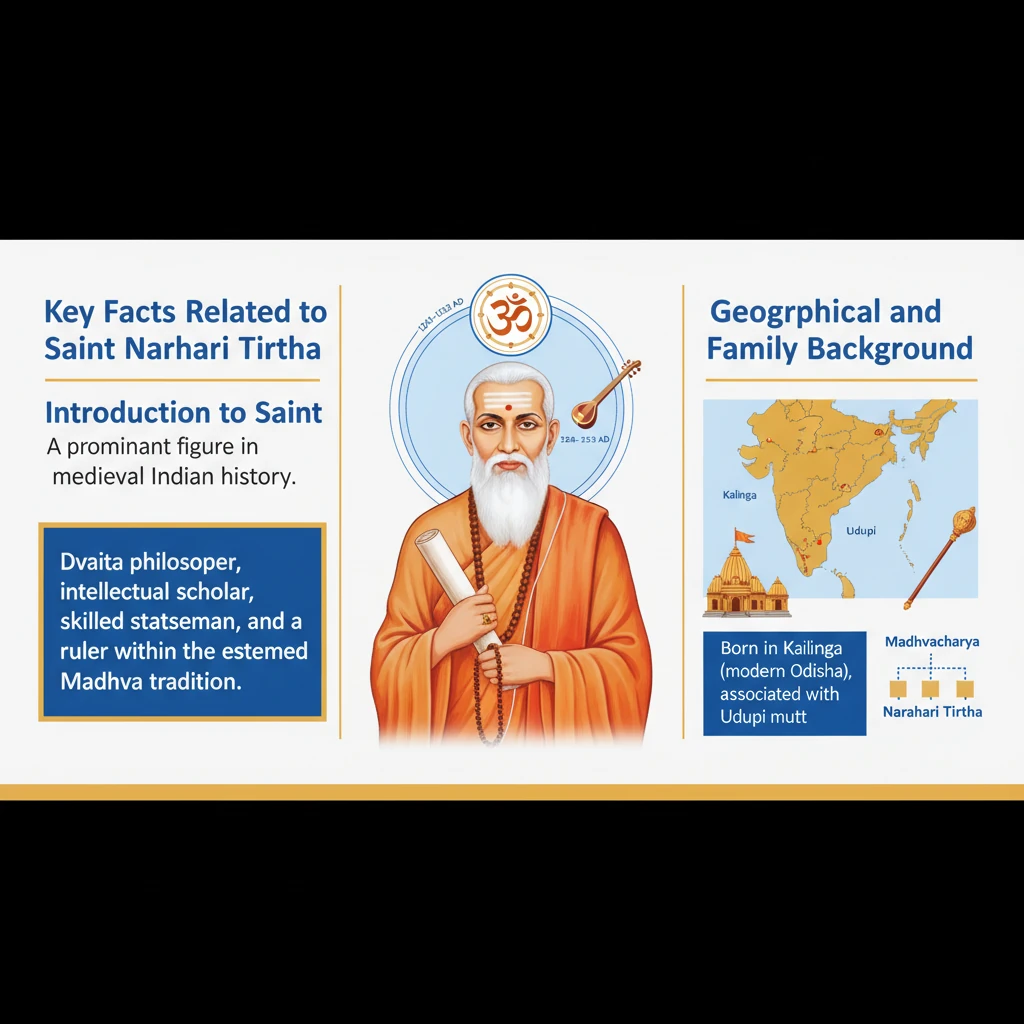
What are the Key Facts Related to Saint Narahari Tirtha?
Medium⏱️ 5 min read
history
📖 Introduction
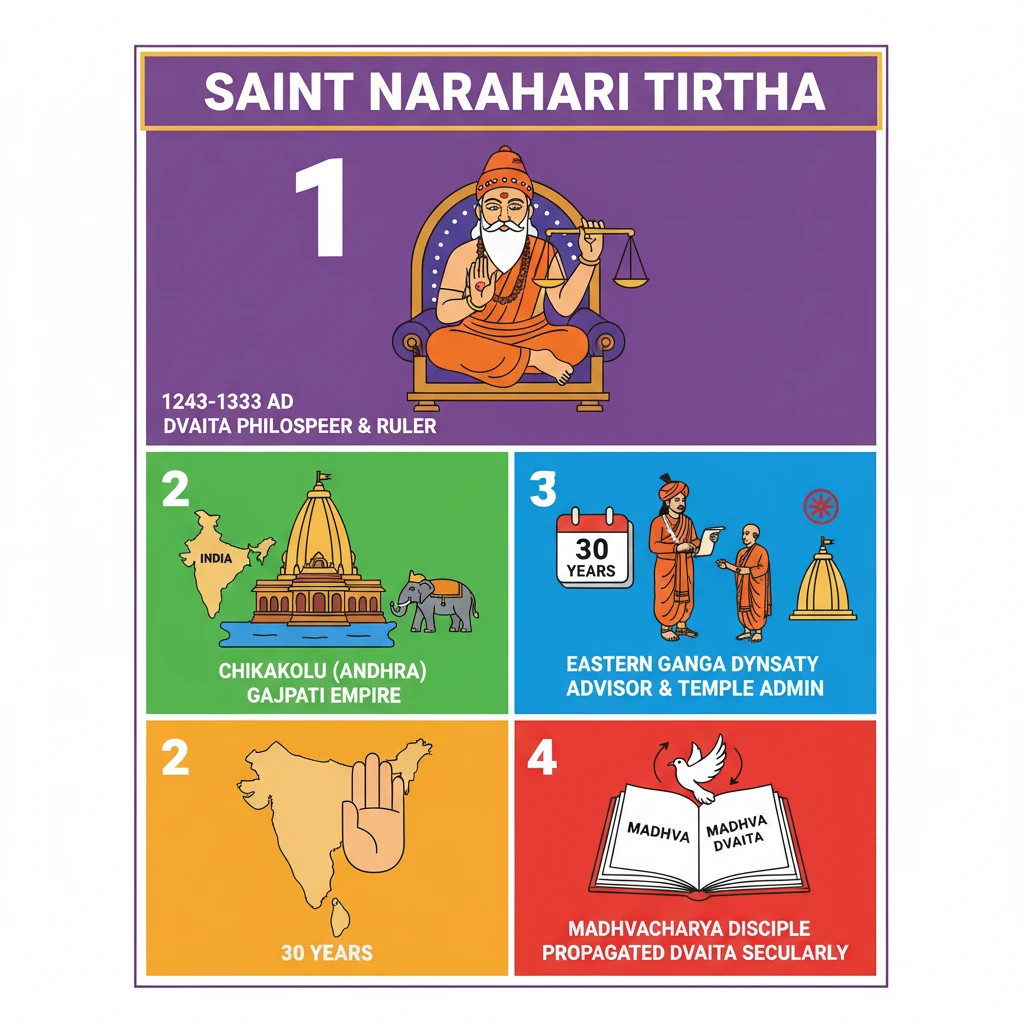
<h4>Introduction to Saint Narahari Tirtha</h4><p><strong>Saint Narahari Tirtha</strong> (<strong>1243-1333 AD</strong>) was a prominent figure in medieval Indian history, known for his multifaceted contributions.</p><div class='info-box'>He was a renowned <strong>Dvaita philosopher</strong>, an <strong>intellectual scholar</strong>, a skilled <strong>statesman</strong>, and a <strong>ruler</strong> within the esteemed <strong>Madhva tradition</strong>.</div><h4>Geographical and Family Background</h4><p>He originated from <strong>Chikakolu</strong>, which is identified with modern-day <strong>Srikakulam</strong> in <strong>Andhra Pradesh</strong>.</p><p><strong>Narahari Tirtha</strong> was born into an <strong>aristocratic family</strong>, deeply rooted in the powerful <strong>Gajapati empire</strong> of <strong>Odisha</strong>.</p><h4>Role in the Eastern Ganga Dynasty</h4><p>For a significant period, <strong>Narahari Tirtha</strong> served and assisted the kings of the <strong>Eastern Ganga Dynasty</strong>.</p><div class='info-box'>His service to the dynasty spanned over <strong>30 years</strong>, demonstrating long-term commitment and influence.</div><p>He played a crucial role in guiding the rulers to adhere to <strong>Sanātana Dharma</strong> principles.</p><p>Furthermore, he was instrumental in establishing a structured <strong>executive system</strong> specifically for managing <strong>temple affairs</strong>.</p><p>Evidence of his significant efforts and contributions is well-documented in various <strong>inscriptions</strong> found at the revered <strong>Simhachalam</strong> and <strong>Srikurmam</strong> temples.</p><h4>Religious Contributions and Dvaita Philosophy</h4><p><strong>Narahari Tirtha</strong> was a dedicated follower and direct disciple of <strong>Madhvacharya</strong>.</p><div class='key-point-box'><strong>Madhvacharya</strong> is widely recognized as the original proponent and founder of the <strong>Dvaita philosophy</strong>.</div><p>He actively propagated <strong>Madhvacharya's Vaishnavism</strong> throughout the region.</p><p>His approach ensured the firm establishment of this tradition in a <strong>non-interfering</strong> and notably <strong>secular manner</strong>.</p><p>His profound influence was vital in successfully maintaining the rich <strong>religious and cultural traditions</strong> of the region.</p><h4>Titles and Honors</h4><p>In recognition of his diverse and significant contributions, <strong>Narahari Tirtha</strong> was bestowed with several prestigious titles of honor.</p><div class='info-box'>These esteemed titles include <strong>“Yoka Sarakaraou Ati Nipunah”</strong> and <strong>“Yo Avati Kalinga-Bhu Samabhavan”</strong>.</div><div class='exam-tip-box'>UPSC Insight: Understanding figures like <strong>Narahari Tirtha</strong> is crucial for <strong>Mains GS Paper 1</strong> (Indian History and Culture) and <strong>Prelims</strong> for factual questions on medieval saints and philosophical traditions. Focus on his dual role as a <strong>statesman</strong> and <strong>religious propagator</strong>.</div>
💡 Key Takeaways
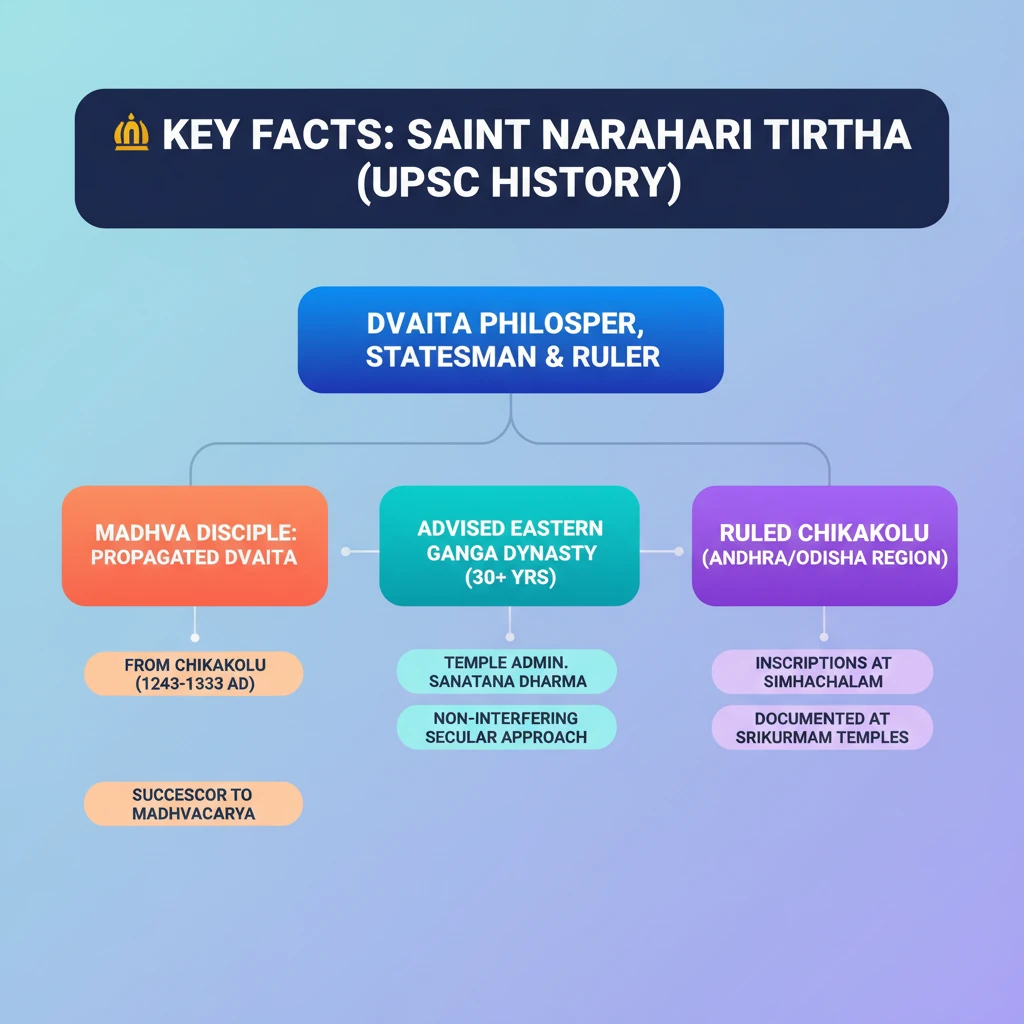
- •Saint Narahari Tirtha (1243-1333 AD) was a Dvaita philosopher, statesman, and ruler in the Madhva tradition.
- •He hailed from Chikakolu (modern Srikakulam) in Andhra Pradesh, within the Gajapati empire of Odisha.
- •Served the Eastern Ganga Dynasty for over 30 years, advising on Sanātana Dharma and structuring temple administration.
- •A direct disciple of Madhvacharya, he significantly propagated Dvaita Vaishnavism in a non-interfering, secular manner.
- •His contributions are historically documented through inscriptions found at Simhachalam and Srikurmam temples.
🧠 Memory Techniques
95% Verified Content
📚 Reference Sources
•General historical texts on Eastern Ganga Dynasty and Dvaita philosophy