Antyodaya Diwas 2024 - History | UPSC Learning
Topics
0 topics • 0 completed
🔍
No topics match your search
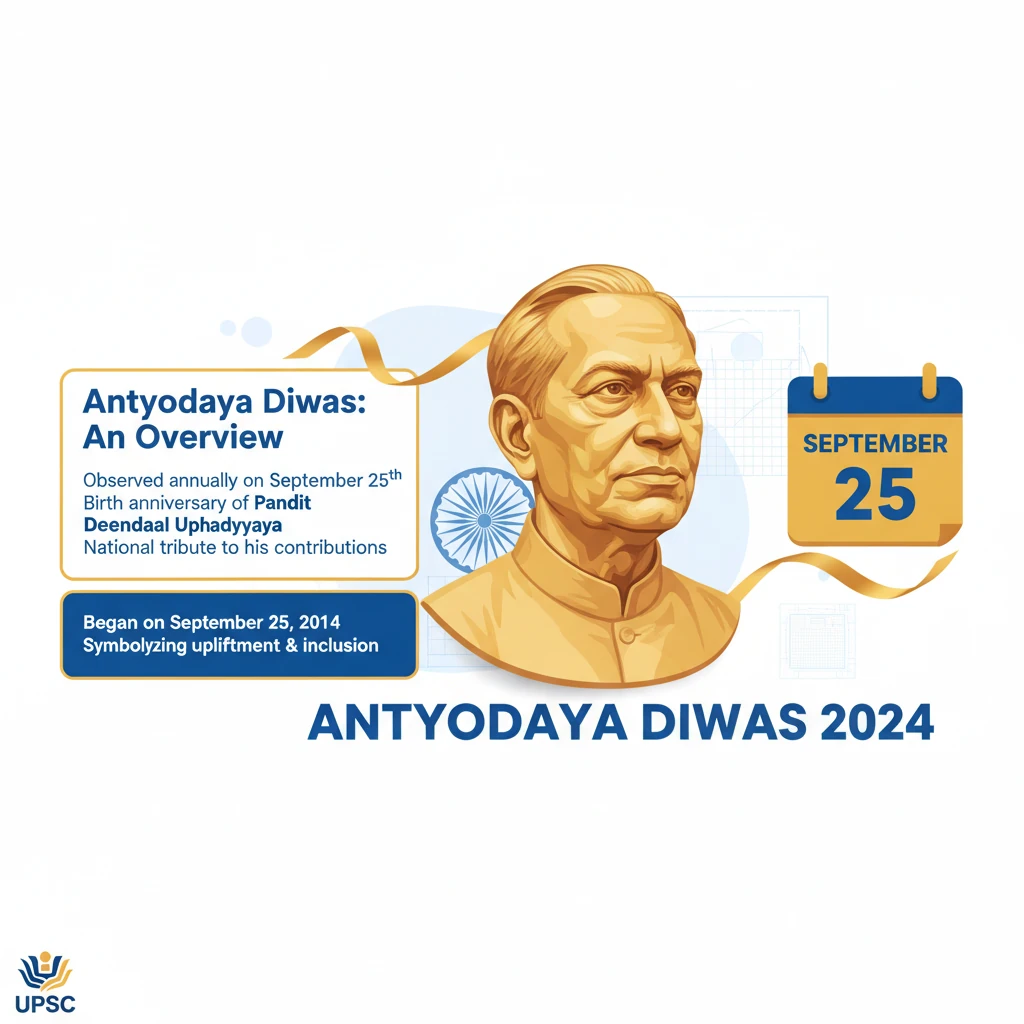
Antyodaya Diwas 2024
Medium⏱️ 7 min read
history
📖 Introduction
<h4>Antyodaya Diwas: An Overview</h4><p><strong>Antyodaya Diwas</strong> is observed annually on <strong>September 25th</strong> to commemorate the birth anniversary of <strong>Pandit Deendayal Upadhyaya</strong>. This day serves as a national tribute, recognizing his profound contributions to Indian politics and society.</p><p>The observance of <strong>Antyodaya Diwas</strong> officially began on <strong>September 25, 2014</strong>, symbolizing a commitment to his ideals of upliftment and inclusive growth.</p><div class='info-box'><p><strong>Antyodaya Diwas 2024</strong>: Observed on <strong>September 25, 2024</strong>.</p><p><strong>Purpose</strong>: To remember and celebrate the life and contributions of <strong>Pandit Deendayal Upadhyaya</strong>.</p></div><h4>Pandit Deendayal Upadhyaya: Architect of Antyodaya</h4><p><strong>Pandit Deendayal Upadhyaya</strong> was a prominent philosopher, economist, sociologist, historian, and political activist. His core philosophy revolved around <strong>Antyodaya</strong>, a concept deeply embedded in Indian thought.</p><div class='info-box'><p><strong>Antyodaya</strong>: This term literally means the 'upliftment of the last person'. It focuses on addressing the needs of the most disadvantaged and marginalized individuals in society, ensuring their welfare and progress.</p></div><p>He was also the proponent of <strong>Integral Humanism</strong>, a holistic philosophy that sought to integrate the individual with society, nation, and the universe.</p><div class='key-point-box'><p><strong>Integral Humanism</strong>: This philosophy emphasizes the simultaneous well-being of the individual and society, promoting social justice, economic equality, and self-reliance. It rejects both Western capitalism and communism, advocating for a uniquely Indian approach to development.</p></div><p>Politically, <strong>Pandit Deendayal Upadhyaya</strong> was a co-founder of the <strong>Bharatiya Jana Sangh (BJS)</strong>, which later evolved into the <strong>Bharatiya Janata Party (BJP)</strong>. He was also a key ideologue and thinker for the <strong>Rashtriya Swayamsevak Sangh (RSS)</strong>.</p><h4>Jayaprakash Narayan: The Sarvodaya Visionary</h4><p>While <strong>Antyodaya Diwas</strong> specifically honours <strong>Pandit Deendayal Upadhyaya</strong>, the broader theme of societal upliftment also connects to other significant figures like <strong>Jayaprakash Narayan (JP)</strong>. His objective was to bring about societal change in line with the ideals of <strong>Sarvodaya</strong>.</p><div class='info-box'><p><strong>Sarvodaya</strong>: A Gandhian philosophy that emphasizes the 'progress for all' or 'universal upliftment', aiming for the welfare of every individual in society without discrimination.</p></div><p><strong>Jayaprakash Narayan's</strong> political career saw him join the <strong>Indian National Congress</strong> in <strong>1929</strong>, actively participating in the <strong>Civil Disobedience Movement</strong> and the <strong>Quit India Movement</strong>. He was a staunch advocate for socialist principles.</p><ul><li>He co-founded the <strong>Congress Socialist Party</strong>, advocating for a left-wing approach within the Congress Party.</li><li>He promoted the <strong>Bhoodan Gramdan Movement</strong>, initiated by <strong>Acharya Vinoba Bhave</strong>, which advocated for voluntary land redistribution for the landless.</li><li>In <strong>1959</strong>, he proposed a <strong>decentralized political structure</strong> with a four-tier system of governance, emphasizing grassroots democracy.</li><li>He famously led the <strong>Total Revolution movement</strong> against the <strong>Emergency (1975 to 1977)</strong>, becoming a vocal critic of corruption and authoritarianism.</li></ul><p><strong>Jayaprakash Narayan</strong> passed away on <strong>October 8, 1979</strong>, and was posthumously awarded India's highest civilian honour, the <strong>Bharat Ratna</strong>, in <strong>1999</strong> for his immense contributions to public life.</p><div class='exam-tip-box'><p><strong>UPSC Insight</strong>: While <strong>Antyodaya Diwas</strong> is about <strong>Deendayal Upadhyaya</strong>, understanding <strong>Jayaprakash Narayan's</strong> contributions to <strong>Sarvodaya</strong> and social movements provides a broader context for philosophies of social justice and upliftment in India. Both figures represent different, yet complementary, approaches to national development and welfare.</p></div>
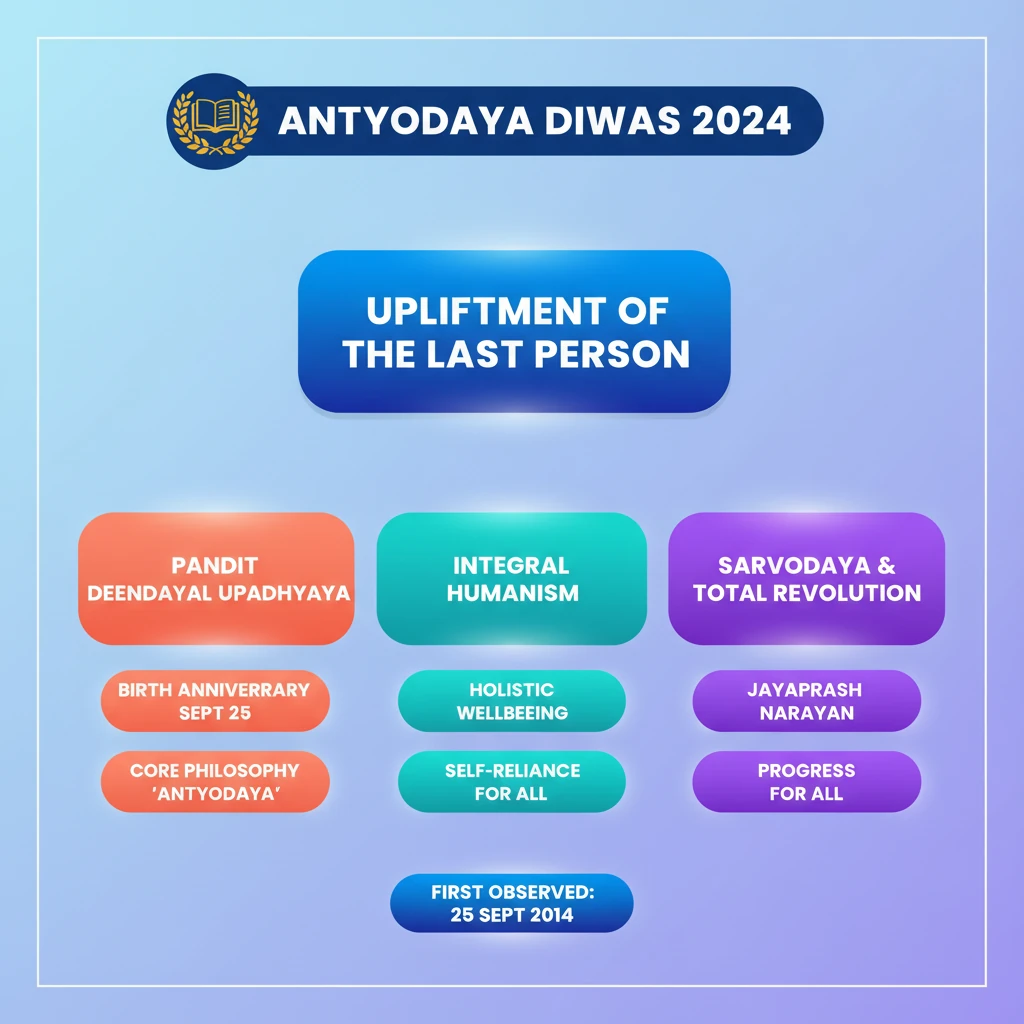
💡 Key Takeaways
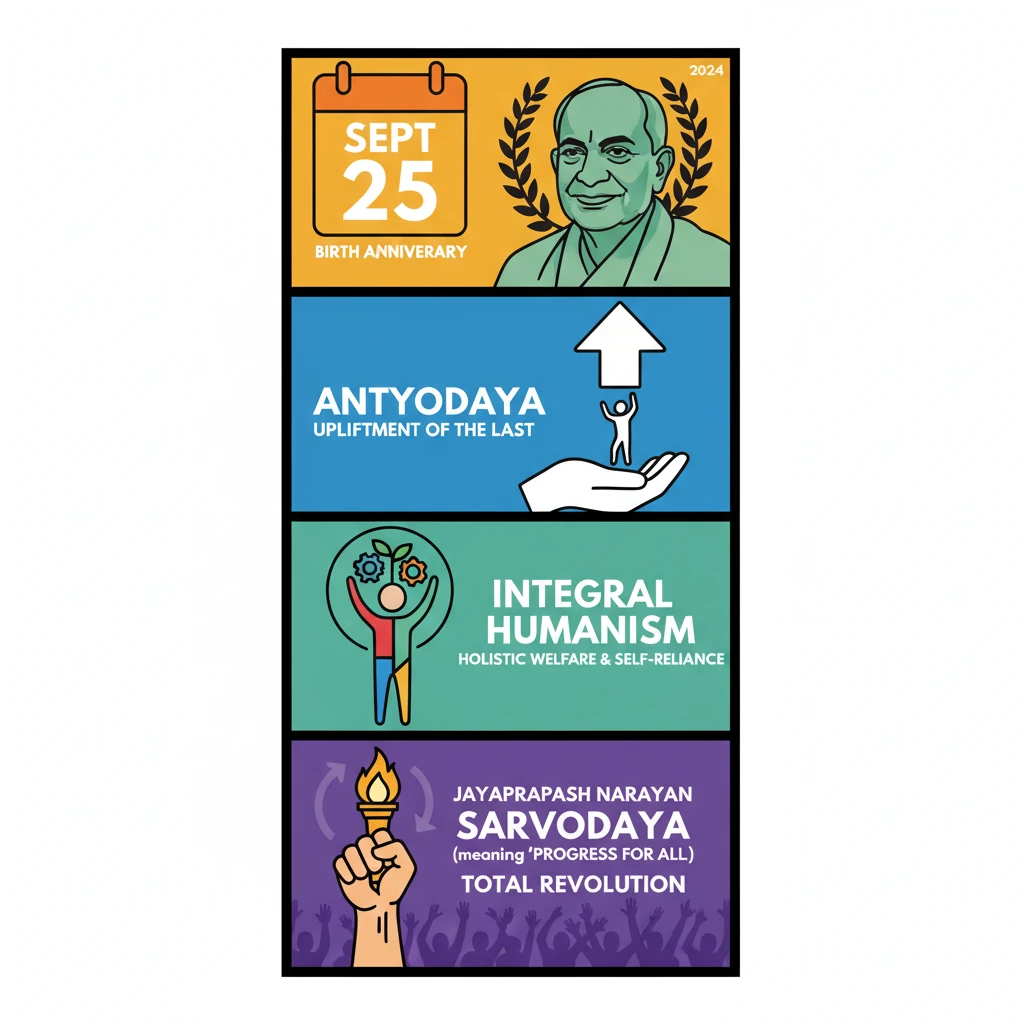
- •Antyodaya Diwas is observed on September 25th, commemorating Pandit Deendayal Upadhyaya's birth anniversary.
- •Antyodaya, meaning 'upliftment of the last person', is Deendayal Upadhyaya's core philosophy.
- •Integral Humanism is Upadhyaya's holistic philosophy for individual and collective welfare and self-reliance.
- •Jayaprakash Narayan championed Sarvodaya ('progress for all') and led the Total Revolution movement.
- •Antyodaya Diwas was first observed on September 25, 2014.
- •Both Antyodaya and Sarvodaya emphasize social justice, economic equality, and inclusive growth.
🧠 Memory Techniques
95% Verified Content
📚 Reference Sources
•Official Government of India websites (for scheme details and dates)
•Standard history and polity textbooks for UPSC preparation