What is the History and Revival Efforts of Nalanda University? - History | UPSC Learning
Topics
0 topics • 0 completed
🔍
No topics match your search
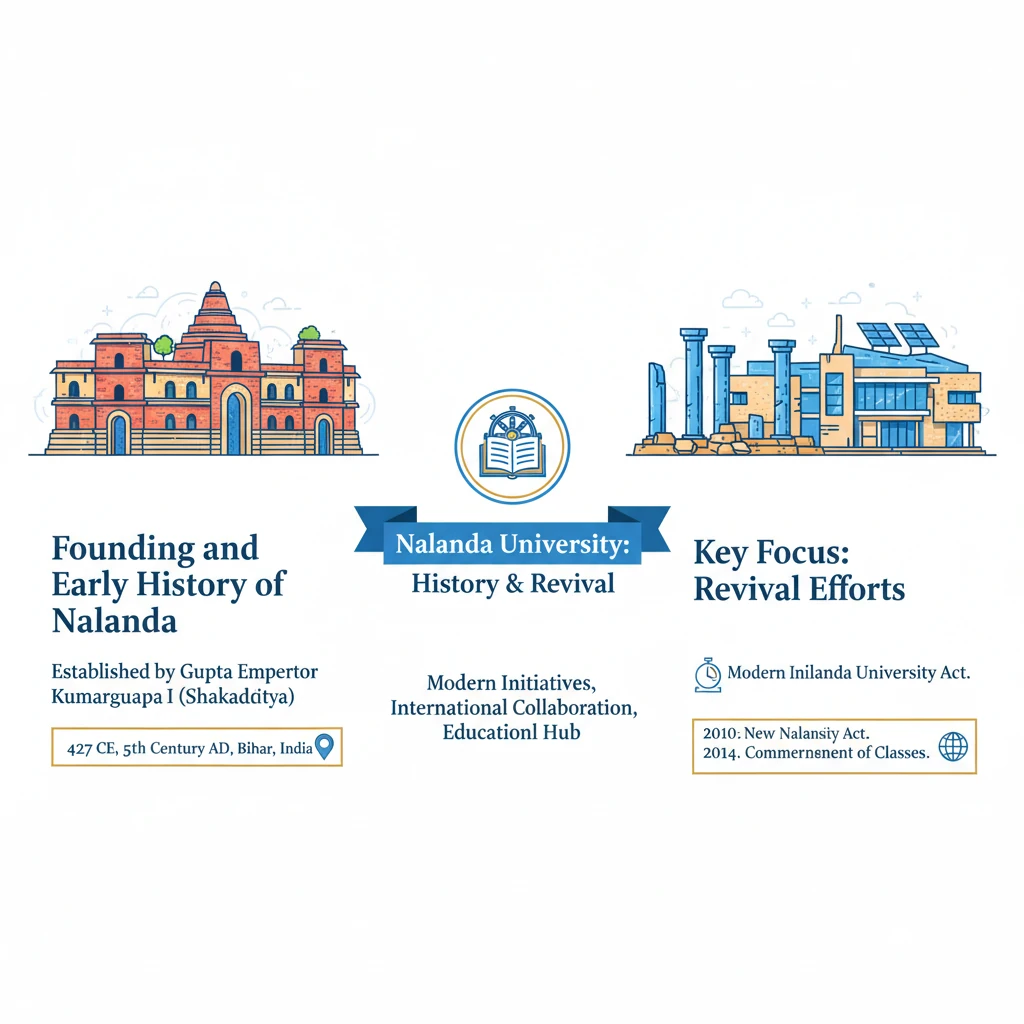
What is the History and Revival Efforts of Nalanda University?
Medium⏱️ 10 min read
history
📖 Introduction
<h4>The Genesis and Golden Age of Ancient Nalanda</h4><p>The illustrious <strong>Nalanda University</strong> was founded in <strong>427 CE</strong> by <strong>Emperor Kumaragupta I</strong> in the early <strong>5th century</strong>. Located in modern-day <strong>Bihar</strong>, it flourished for over <strong>600 years</strong>.</p><div class='info-box'><p><strong>Key Fact:</strong> Nalanda's golden era spanned from the <strong>5th century</strong> to the <strong>12th century</strong>, becoming a beacon of learning and intellectual discourse.</p></div><p>Its prominence significantly increased during the reigns of <strong>Emperor Harshavardhana</strong> and the <strong>Pala monarchs</strong>, attracting scholars and students from across Asia.</p><h4>Global Outreach and Scholarly Contributions</h4><p>The university was a global hub for learning, drawing students from countries like <strong>China, Mongolia, Tibet, Korea</strong>, and other Asian nations.</p><p>During <strong>King Harshavardhana's</strong> reign (<strong>606-647 AD</strong>), the renowned Chinese scholar <strong>Xuan Zang</strong> (also known as <strong>Hiuen Tsang</strong> or <strong>Moksadeva</strong>) visited Nalanda. He studied there for approximately <strong>five years</strong>.</p><div class='info-box'><p><strong>Xuan Zang's Legacy:</strong> He carried back numerous scriptures from Nalanda, which were later translated into Chinese, significantly influencing East Asian Buddhism.</p></div><p>Another Chinese pilgrim, <strong>I-Tsing</strong>, visited in <strong>670 AD</strong>, reporting that Nalanda housed <strong>2,000 students</strong> and was sustained by revenue from <strong>200 villages</strong>.</p><p>Archaeological findings suggest connections with the <strong>Indonesian Shailendra dynasty</strong>, with one of their kings funding a monastery within the complex.</p><p>The region's spiritual vibrancy was further enhanced as both <strong>Lord Buddha</strong> and <strong>Lord Mahavira</strong> were believed to have meditated here.</p><p>Great masters such as <strong>Nagarjuna, Aryabhatta</strong>, and <strong>Dharmakirti</strong> made profound contributions to Nalanda's rich scholarly traditions in diverse fields like philosophy, astronomy, and logic.</p><h4>Attacks and Resilience: A History of Destruction and Revival</h4><p>Nalanda faced multiple attacks throughout its history, demonstrating its resilience and the efforts to restore it.</p><ol><li><p><strong>First Attack (455-470 AD):</strong> Occurred during <strong>Emperor Samudragupta's</strong> reign of the <strong>Gupta Empire</strong>. The attackers were the <strong>Hunas</strong>, a Central Asian tribal group, primarily seeking to loot valuable resources.</p></li><li><p><strong>Restoration by Skanda Gupta:</strong> <strong>Emperor Skanda Gupta</strong> later re-established the university. It was during his rule that the famous <strong>Abhayadatta library</strong> was founded.</p></li><li><p><strong>Second Attack (Early 7th Century):</strong> Orchestrated by the <strong>Gaudas emperors of Bengal</strong>, driven by political tensions with <strong>Emperor Harshavardhana of Kannauj</strong>.</p></li><li><p><strong>Harshavardhana's Restoration:</strong> Despite significant destruction, <strong>Harshavardhana</strong> ensured the university's restoration, allowing Nalanda to continue its mission of global knowledge dissemination.</p></li></ol><h4>The Final Destruction and Rediscovery</h4><p>The university was ultimately destroyed in <strong>1193 AD</strong> by <strong>Bakhtiyar Khilji</strong>, a general of the Turkish ruler <strong>Qutbuddin Aibak</strong>, marking the end of its ancient era.</p><div class='info-box'><p><strong>Rediscovery Timeline:</strong></p><ul><li><strong>1812:</strong> Rediscovered by Scottish surveyor <strong>Francis Buchanan-Hamilton</strong>.</li><li><strong>1861:</strong> Identified as the ancient university by <strong>Sir Alexander Cunningham</strong>.</li></ul></div><h4>Modern Revival Efforts and the New Nalanda University</h4><p>The idea for Nalanda's revival gained momentum in the <strong>early 2000s</strong>, championed by figures like former President <strong>A.P.J. Abdul Kalam</strong> and the <strong>Singapore government</strong>.</p><p>Leaders of the <strong>East Asia Summit (EAS)</strong> countries also advocated for the university's return, envisioning it as a symbol of regional knowledge exchange.</p><div class='key-point-box'><p><strong>Legal Framework:</strong> The <strong>Indian Parliament</strong> passed the <strong>Nalanda University Act</strong> in <strong>2010</strong>, establishing the legal basis for the new institution.</p></div><p>The <strong>Bihar government</strong> provided a <strong>455-acre site</strong> near the ancient ruins for the new campus.</p><p>Designed by architect <strong>B.V. Doshi</strong>, the campus is <strong>eco-friendly</strong>, blending modern amenities with the spirit of the ancient institution.</p><div class='info-box'><p><strong>Academic Offerings:</strong> The university offers postgraduate programs in diverse fields including <strong>Buddhist Studies, Historical Studies, Ecology and Environmental Studies</strong>, and <strong>International Relations</strong>.</p></div><p>The campus operates as a <strong>'Net Zero' Green Campus</strong>, featuring a solar plant, water treatment and recycling facilities, and extensive water bodies, promoting self-sustainability.</p><div class='exam-tip-box'><p><strong>UPSC Insight:</strong> The ruins of <strong>Nalanda University</strong> were declared a <strong>UNESCO World Heritage Site</strong> in <strong>2016</strong>. This highlights its global cultural significance and India's commitment to heritage preservation (<strong>GS Paper I - Culture, GS Paper III - Environment</strong>).</p></div>
💡 Key Takeaways
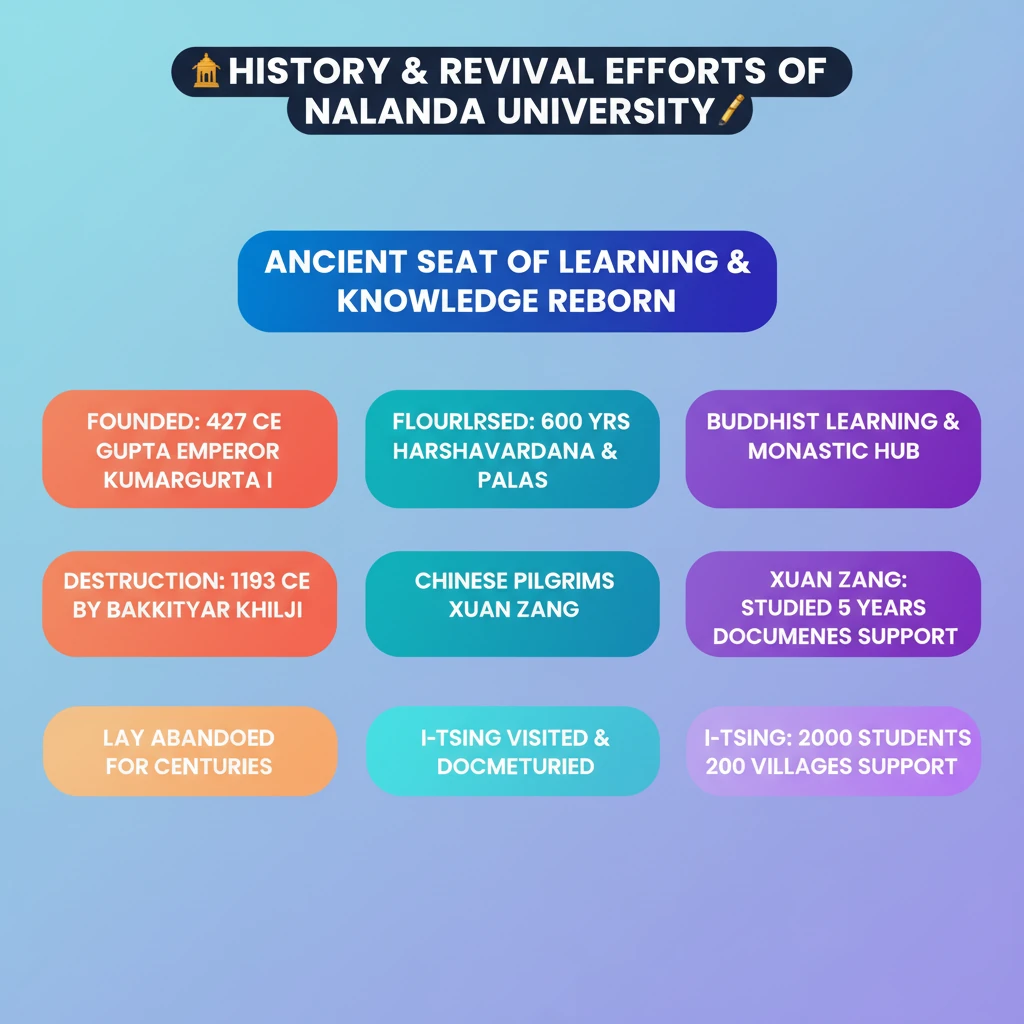
- •Ancient Nalanda was founded by Emperor Kumaragupta in 427 CE and flourished for 600 years as a global learning hub.
- •It attracted scholars like Xuan Zang and I-Tsing, offering diverse subjects and fostering international intellectual exchange.
- •Nalanda faced multiple attacks (Hunas, Gaudas) but was repeatedly restored by rulers like Skanda Gupta and Harshavardhana before its final destruction by Bakhtiyar Khilji in 1193 AD.
- •The modern Nalanda University, revived in the 21st century under the 2010 Act, aims to restore its ancient glory as a center for regional knowledge exchange.
- •The new campus is a 'Net Zero' Green Campus, emphasizing sustainability, and the ancient ruins are a UNESCO World Heritage Site since 2016.
🧠 Memory Techniques
95% Verified Content