Lal Bahadur Shastri - History | UPSC Learning
Topics
0 topics • 0 completed
🔍
No topics match your search
Lal Bahadur Shastri
Medium⏱️ 8 min read
history
📖 Introduction
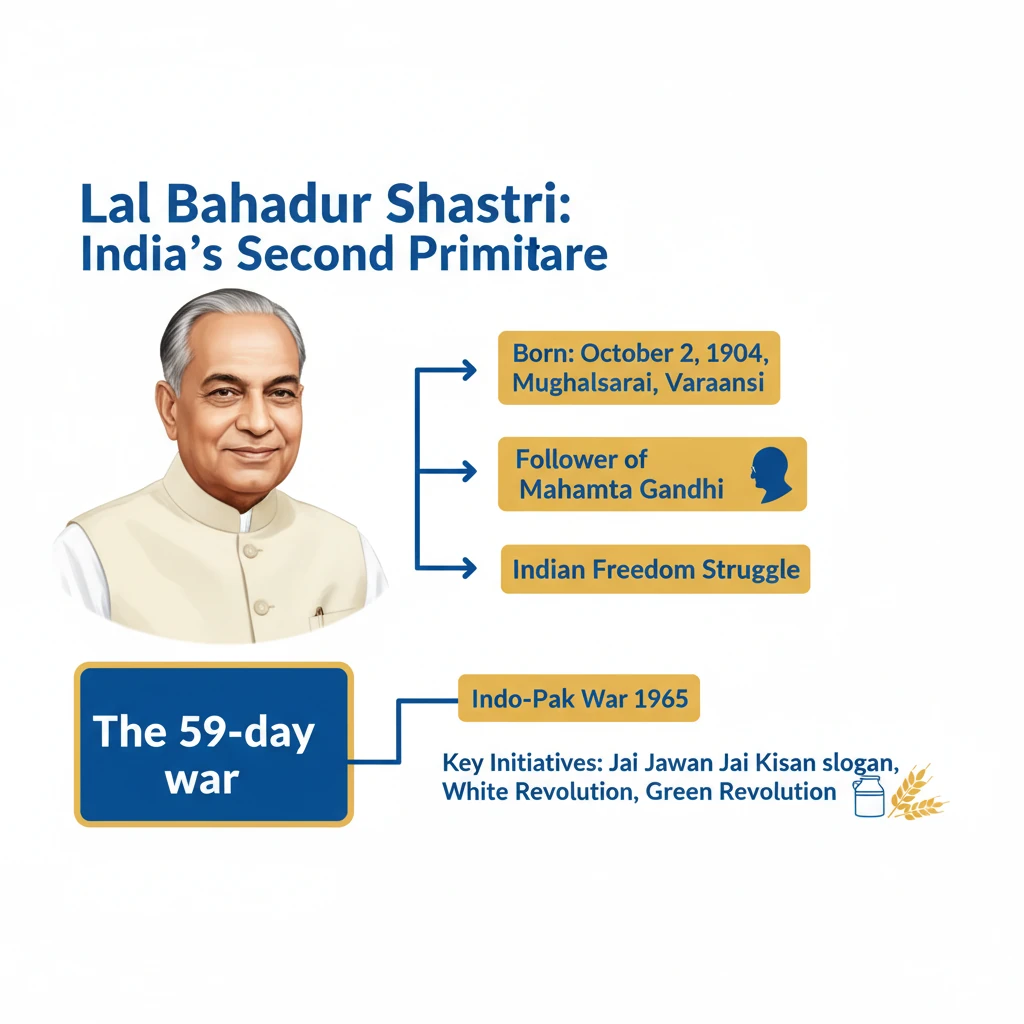
<h4>Lal Bahadur Shastri: India's Second Prime Minister</h4><p><strong>Lal Bahadur Shastri</strong>, India's <strong>Second Prime Minister</strong>, was born on <strong>October 2, 1904</strong>, in <strong>Mughalsarai</strong>, near <strong>Varanasi</strong>.</p><p>His early life and political ideology were profoundly shaped by the principles of <strong>Mahatma Gandhi</strong>, making him a significant figure in India's <strong>freedom struggle</strong>.</p><div class='info-box'><p>The <strong>59th death anniversary</strong> of <strong>Shri Lal Bahadur Shastri</strong> was recently observed, marking his lasting legacy.</p></div><h4>Ministerial Roles and Prime Ministership</h4><p>Before assuming the nation's highest office, <strong>Shastri</strong> held several crucial ministerial portfolios.</p><ul><li>He served as the <strong>Home Minister</strong>, overseeing internal security and administration.</li><li>He was also the <strong>Minister of Railways</strong>, a vital infrastructure portfolio.</li><li>Additionally, he held the position of <strong>Minister of Commerce and Industry</strong>.</li></ul><p>As <strong>Prime Minister</strong> from <strong>1964 to 1966</strong>, he demonstrated exemplary and decisive leadership.</p><div class='key-point-box'><p>His tenure as PM is most notably remembered for his strong leadership during the <strong>1965 Indo-Pak War</strong>, where India achieved a significant military and diplomatic stand.</p></div><p>During this challenging period, he famously coined the inspiring slogan, <strong>“Jai Jawan Jai Kisan”</strong> (Hail the Soldier, Hail the Farmer), which united the nation.</p><p>Following the war, <strong>Shastri</strong> signed the <strong>Tashkent Declaration</strong>, a peace agreement between <strong>India</strong> and <strong>Pakistan</strong>, in <strong>January 1966</strong>, shortly before his untimely demise.</p><h4>Savitribai Phule: Pioneer of Women's Education and Social Reform</h4><p><strong>Savitribai Phule</strong>, a towering figure in <strong>Indian social reform</strong>, was born on <strong>January 3, 1831</strong>, in <strong>Satara, Maharashtra</strong>.</p><p>She belonged to a <strong>marginalised Mali community</strong>, which further highlighted her struggle and achievements in a caste-ridden society.</p><div class='info-box'><p>Her <strong>193rd birth anniversary</strong> was observed on <strong>January 3, 2025</strong>, celebrating her enduring contributions.</p></div><p><strong>Savitribai</strong> was married to <strong>Jyotiba Phule</strong>, a renowned social reformer, who took charge of her education and became her lifelong partner in social work.</p><h4>Groundbreaking Contributions to Education and Social Justice</h4><p>Together with <strong>Jyotiba Phule</strong>, <strong>Savitribai</strong> made monumental contributions to education and the upliftment of the oppressed.</p><ul><li>In <strong>1848</strong>, they established <strong>India's first school for girls</strong> in <strong>Pune</strong>, a revolutionary step at the time.</li><li>The couple collectively started and successfully ran <strong>18 schools</strong>, expanding educational access.</li><li>They founded various <strong>educational trusts</strong> specifically aimed at uplifting the <strong>Dalit community</strong>, promoting their social and economic empowerment.</li></ul><p>Beyond education, <strong>Savitribai</strong> and <strong>Jyotirao</strong> addressed critical social issues.</p><div class='key-point-box'><p>In <strong>1863</strong>, they founded <strong>Balhatya Pratibandhak Griha</strong>, which was <strong>India’s first home</strong> dedicated to combating <strong>female infanticide</strong>.</p></div><p>This initiative also provided support and shelter to pregnant <strong>Brahmin widows</strong> and <strong>rape victims</strong>, offering them dignity and care.</p><h4>Literary Works and Influence</h4><p><strong>Savitribai Phule</strong> was also an accomplished author and poet, using her writing to advocate for social change.</p><ul><li>Her famous works include <strong>Kavya Phule</strong> (published in <strong>1854</strong>) and <strong>Bavan Kashi Subodh Ratnakar</strong> (published in <strong>1892</strong>).</li><li>She also penned the inspiring poem, <strong>“Go, Get Education”</strong>, urging the marginalized to seek knowledge.</li></ul><p>Her husband, <strong>Jyotirao Phule</strong>, a prominent <strong>19th-century social reformer</strong>, further critiqued social oppression in his influential book <strong>Gulamgiri</strong>.</p><div class='exam-tip-box'><p><strong>Jyotirao Phule</strong> also founded the <strong>Satyashodhak Samaj</strong> in <strong>1873</strong>, an organization dedicated to promoting <strong>education, equality</strong>, and abolishing <strong>untouchability</strong>, principles that <strong>Savitribai</strong> actively supported.</p></div><h4>Mahatma Gandhi and Martyrs' Day</h4><p><strong>India</strong> observes <strong>Martyrs’ Day</strong>, also known as <strong>Shaheed Diwas</strong>, annually on <strong>January 30</strong>.</p><p>This day is dedicated to commemorating the immense sacrifices of all those who laid down their lives for the nation’s <strong>independence</strong>.</p><div class='info-box'><p>The day holds special significance as it marks the assassination of <strong>Mahatma Gandhi</strong>, often referred to as <strong>Mahatma Gandhi Smriti</strong>.</p></div><p>On <strong>January 30, 1948</strong>, <strong>Mahatma Gandhi</strong> was tragically assassinated by <strong>Nathuram Godse</strong> during an evening prayer meeting at <strong>Birla House</strong> in <strong>Delhi</strong>.</p><div class='exam-tip-box'><p>It is important to note that <strong>Martyrs’ Day</strong> is also commemorated on <strong>March 23</strong> to honor the sacrifice of freedom fighters <strong>Bhagat Singh, Shivaram Rajguru</strong>, and <strong>Sukhdev Thapar</strong>, who were executed on that day.</p></div>

💡 Key Takeaways
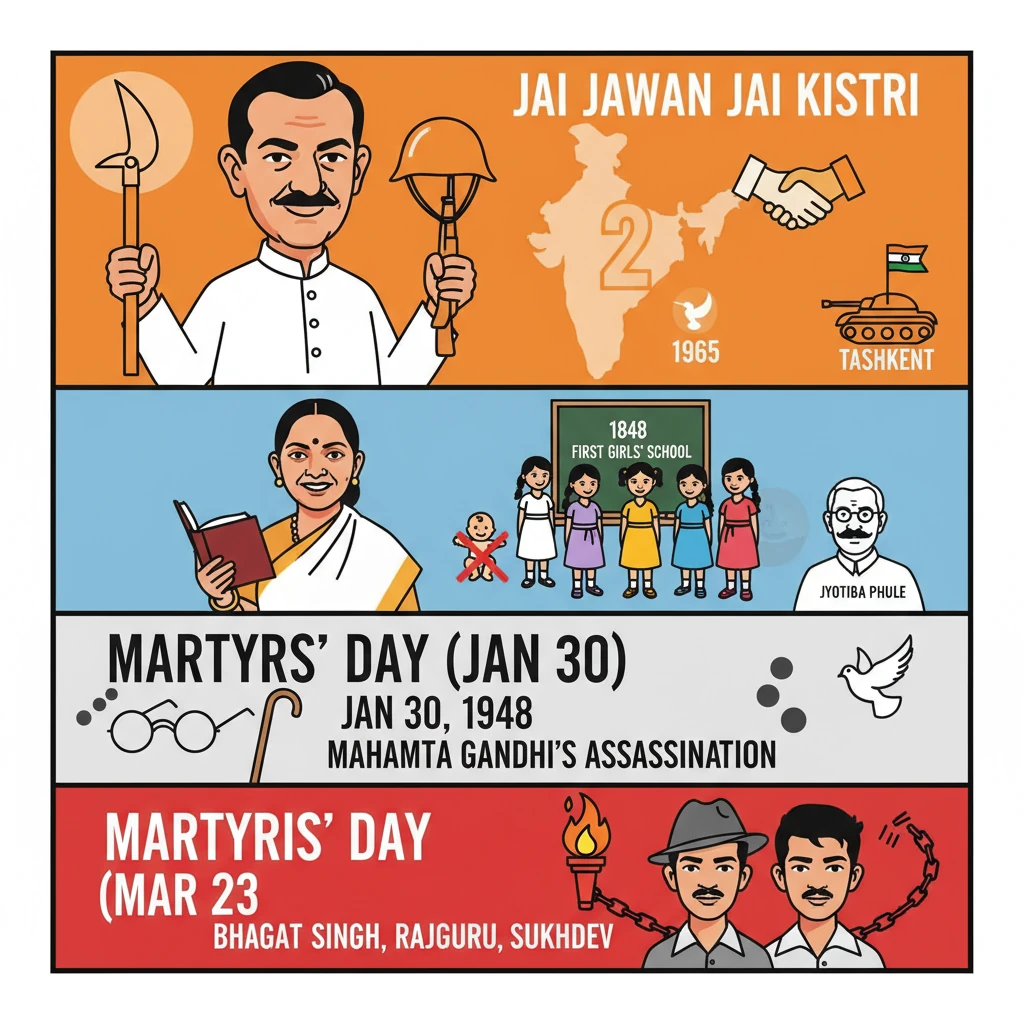
- •Lal Bahadur Shastri: Second PM, decisive leadership in 1965 war, "Jai Jawan Jai Kisan" slogan, Tashkent Declaration.
- •Savitribai Phule: Pioneer of women's education (first girls' school 1848), fought female infanticide, authored works, influenced by Jyotiba Phule.
- •Martyrs' Day (Jan 30): Commemorates Mahatma Gandhi's assassination in 1948, a symbol of sacrifice for national unity.
- •Martyrs' Day (Mar 23): Honors Bhagat Singh, Rajguru, Sukhdev.
- •These figures embody leadership, social reform, and national sacrifice, crucial for understanding India's evolution.
🧠 Memory Techniques
95% Verified Content