UNESCO World Heritage Sites Related to Buddhism in India - History | UPSC Learning
Topics
0 topics • 0 completed
🔍
No topics match your search
UNESCO World Heritage Sites Related to Buddhism in India
Medium⏱️ 6 min read
history
📖 Introduction
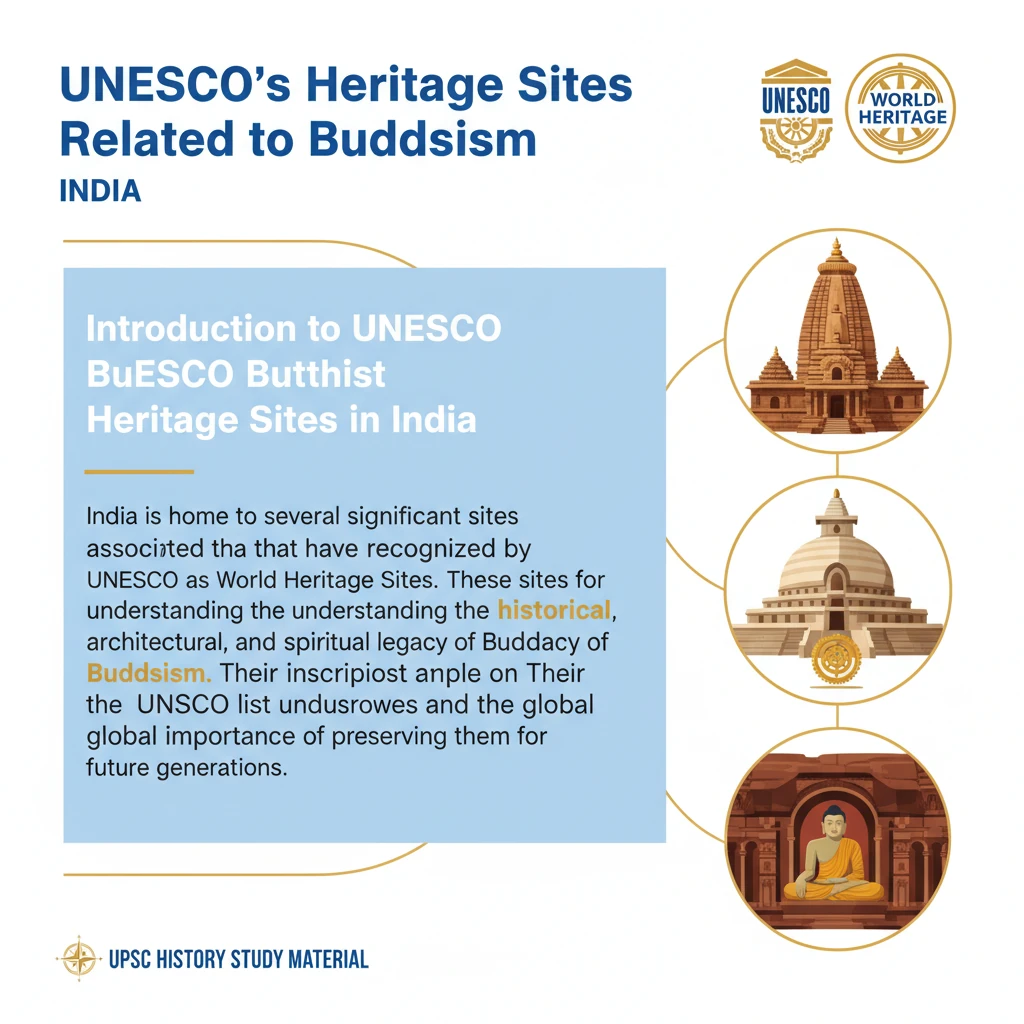
<h4>Introduction to UNESCO Buddhist Heritage Sites in India</h4><p>India is home to several significant sites associated with <strong>Buddhism</strong> that have been recognized by <strong>UNESCO</strong> as <strong>World Heritage Sites</strong>. These sites are crucial for understanding the historical, architectural, and spiritual legacy of Buddhism.</p><p>Their inscription on the <strong>UNESCO list</strong> underscores their universal value and the global importance of preserving them for future generations.</p><h4>Archaeological Site of Nalanda Mahavihara, Bihar</h4><p>The <strong>Archaeological Site of Nalanda Mahavihara</strong> is located in <strong>Nalanda, Bihar</strong>. It represents a monumental center of learning and a monastic university.</p><div class='info-box'><p><strong>Nalanda</strong> was a renowned Buddhist monastery and a prominent educational institution from the <strong>5th to the 12th century CE</strong>. It attracted scholars and students from across Asia.</p></div><div class='key-point-box'><p>The ruins showcase the architectural and artistic brilliance of the <strong>Gupta period</strong> and later eras, reflecting the development of monastic architecture.</p></div><h4>Buddhist Monuments at Sanchi, Madhya Pradesh</h4><p>The <strong>Buddhist Monuments at Sanchi</strong> are situated in <strong>Madhya Pradesh</strong>. This complex is one of the oldest and most important Buddhist sites in India.</p><div class='info-box'><p>It is famous for its <strong>Stupas</strong>, monasteries, temples, and monolithic pillars dating from the <strong>3rd century BCE to the 12th century CE</strong>. The most notable is the <strong>Great Stupa</strong> built by <strong>Emperor Ashoka</strong>.</p></div><div class='key-point-box'><p>The site provides invaluable insights into the evolution of Buddhist art and architecture, particularly the early phases of <strong>Buddhist iconography</strong>.</p></div><h4>Mahabodhi Temple Complex at Bodh Gaya, Bihar</h4><p>The <strong>Mahabodhi Temple Complex</strong> is located in <strong>Bodh Gaya, Bihar</strong>. This site holds immense spiritual significance as it is where <strong>Siddhartha Gautama</strong> attained enlightenment and became the <strong>Buddha</strong>.</p><div class='info-box'><p>The complex features the <strong>Mahabodhi Temple</strong>, the sacred <strong>Bodhi Tree</strong>, and numerous other shrines and monuments. Its current structure largely dates back to the <strong>5th-6th centuries CE</strong>.</p></div><div class='key-point-box'><p>It is a major pilgrimage site for Buddhists worldwide and a living testament to the origins of Buddhism.</p></div><h4>Ajanta Caves, Maharashtra</h4><p>The <strong>Ajanta Caves</strong> are located in <strong>Aurangabad, Maharashtra</strong>. These rock-cut Buddhist cave monuments date from the <strong>2nd century BCE to about 480 CE</strong>.</p><div class='info-box'><p>The caves are famous for their exquisite <strong>frescoes</strong> and wall paintings depicting the <strong>Jataka tales</strong> (stories of Buddha's previous lives) and Buddhist deities.</p></div><div class='key-point-box'><p>They represent a masterpiece of <strong>Buddhist religious art</strong>, influencing art and architecture across Asia.</p></div><h4>Intangible Cultural Heritage: Buddhist Chanting of Ladakh</h4><p>Beyond physical sites, <strong>UNESCO</strong> also recognizes <strong>Intangible Cultural Heritage</strong>. The <strong>Buddhist chanting of Ladakh</strong> was inscribed on <strong>UNESCO’s Representative List of Humanity’s Intangible Cultural Heritage</strong> in <strong>2012</strong>.</p><div class='info-box'><p>This chanting is a vital part of the daily life and spiritual practice of the Buddhist communities in the <strong>Ladakh region</strong>, particularly in monasteries and sacred spaces.</p></div><div class='exam-tip-box'><p>While the focus is often on tangible sites, remember that <strong>intangible heritage</strong> like chanting or traditional performing arts also holds significant <strong>UPSC relevance</strong>, especially in <strong>Art & Culture (GS Paper 1)</strong>.</p></div><h4>Dhamma Dipa International Buddhist University</h4><p>The establishment of institutions like the <strong>Dhamma Dipa International Buddhist University</strong> in <strong>Tripura</strong> further highlights India's commitment to promoting Buddhist studies and heritage.</p><div class='key-point-box'><p>Such initiatives contribute to the global understanding and preservation of Buddhist philosophy and practices.</p></div>
💡 Key Takeaways
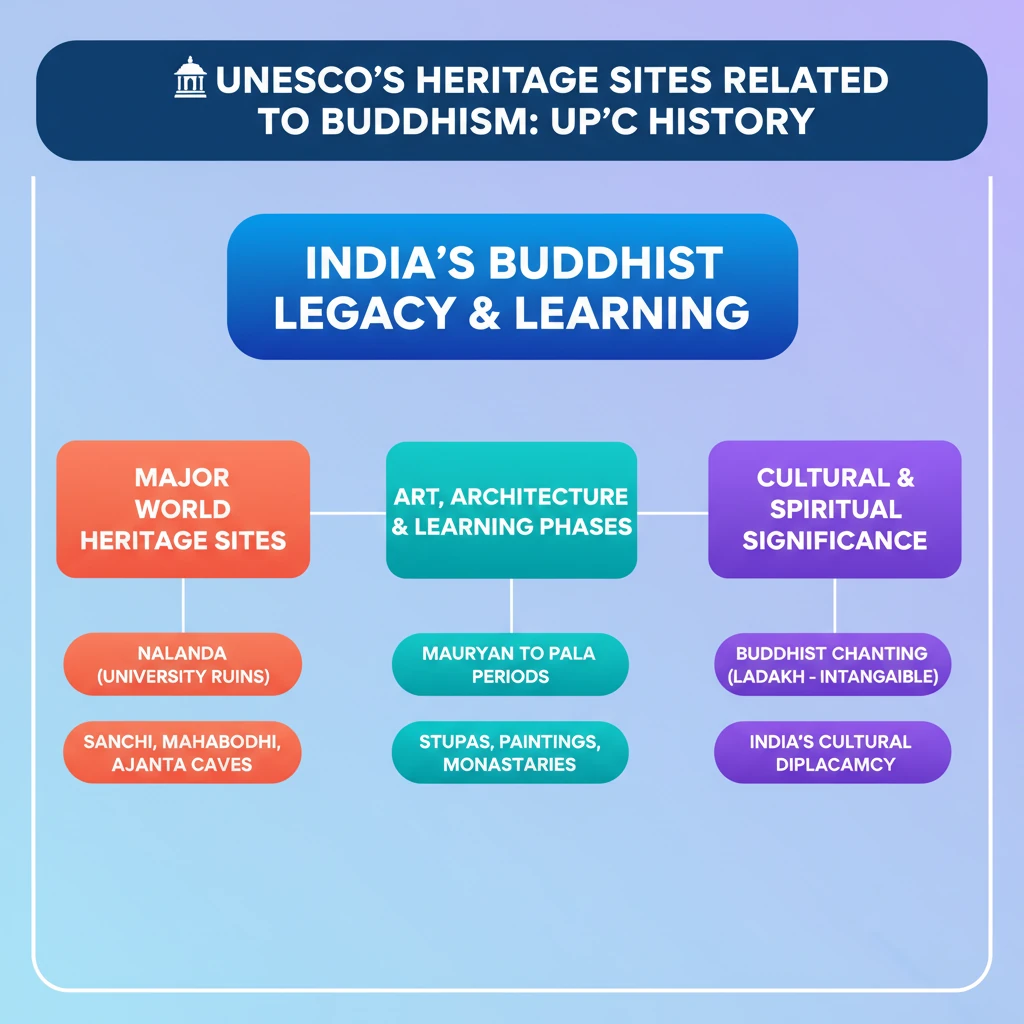
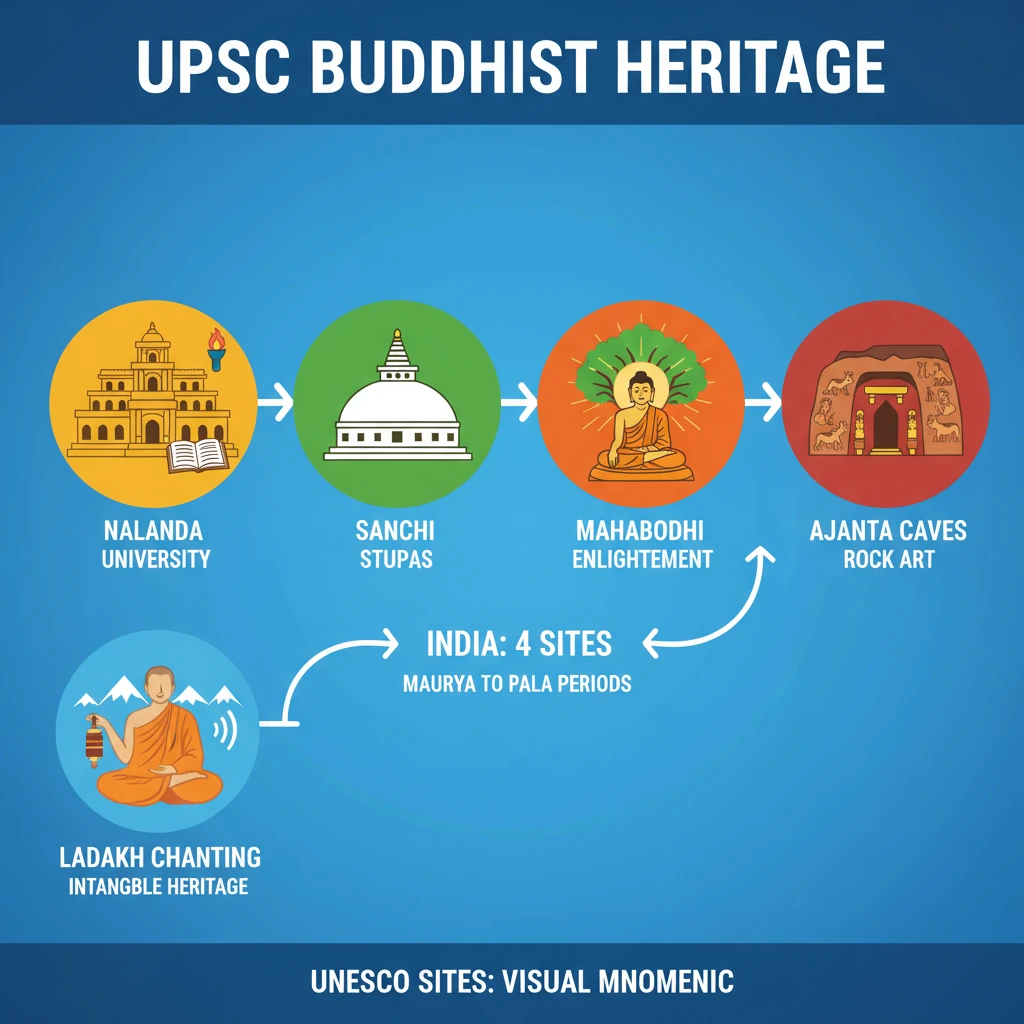
- •India has four major UNESCO Buddhist World Heritage Sites: Nalanda, Sanchi, Mahabodhi Temple, and Ajanta Caves.
- •These sites represent key phases of Buddhist art, architecture, and learning from the Mauryan to the Pala periods.
- •Nalanda was an ancient university, Sanchi is famous for its stupas, Mahabodhi is where Buddha attained enlightenment, and Ajanta for its rock-cut paintings.
- •The Buddhist chanting of Ladakh is recognized as UNESCO Intangible Cultural Heritage.
- •These sites are crucial for understanding India's historical, cultural, and spiritual legacy, and play a role in India's cultural diplomacy.
🧠 Memory Techniques
95% Verified Content
📚 Reference Sources
•UNESCO World Heritage Centre official website (for site details and dates)