Harappan Civilization: Religious Beliefs and Practices - History | UPSC Learning
Topics
0 topics • 0 completed
🔍
No topics match your search

Harappan Civilization: Religious Beliefs and Practices
Medium⏱️ 6 min read
history
📖 Introduction
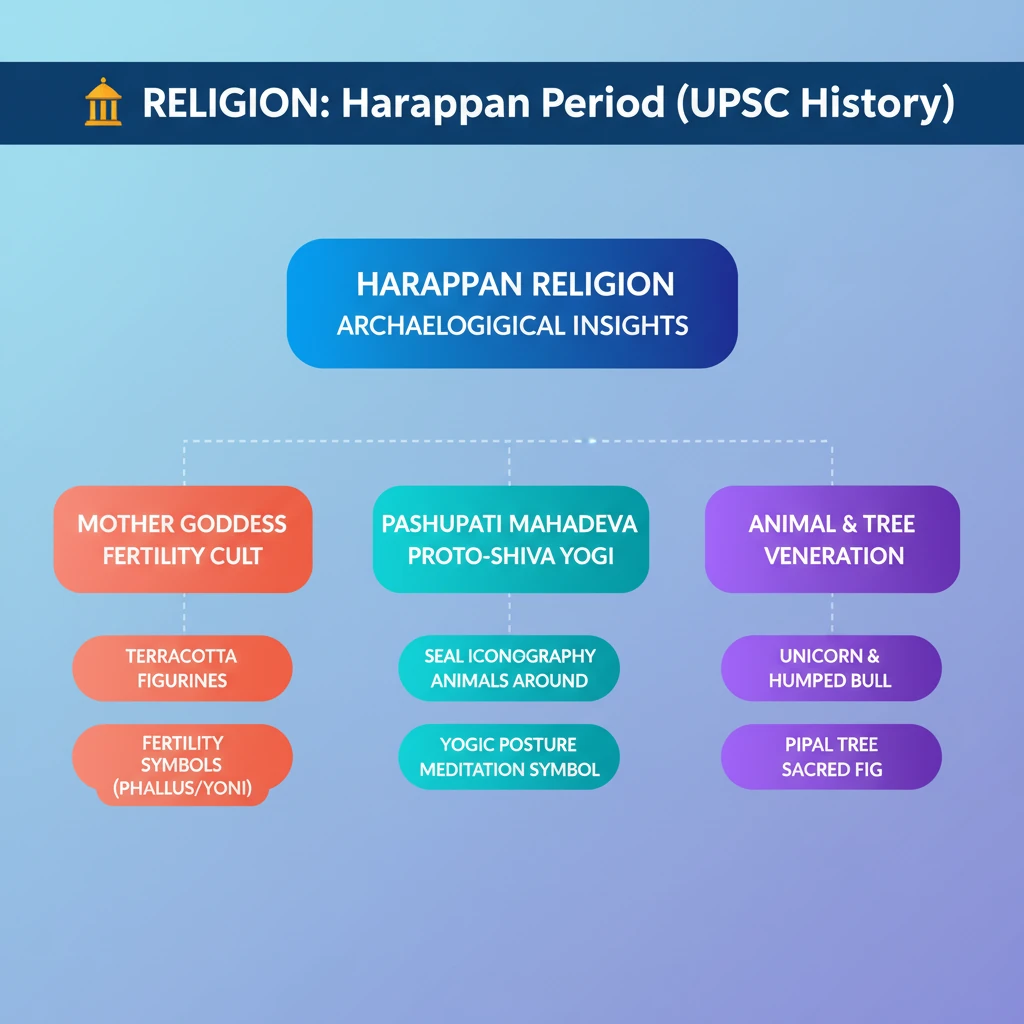
<h4>Introduction to Harappan Religious Practices</h4><p>The religious beliefs and practices of the <strong>Indus Valley Civilization</strong> (IVC) are primarily reconstructed from archaeological findings, as their script remains undeciphered. These findings offer glimpses into their spiritual world, which appears distinct from later Vedic traditions.</p><div class='exam-tip-box'><p><strong>UPSC Insight:</strong> Understanding Harappan religion is crucial for Mains GS Paper 1, especially for questions on ancient Indian history and cultural evolution. Focus on archaeological evidence and interpretations.</p></div><h4>Worship of the Mother Goddess</h4><p>Numerous <strong>terracotta figurines of women</strong> have been discovered across Harappan sites. These figures, often depicted with prominent breasts and hips, strongly suggest the worship of a <strong>fertility goddess</strong>.</p><p>This practice is thought to be similar to the veneration of fertility deities found in other ancient civilizations, such as the Egyptian goddess <strong>Isis</strong>. The abundance of these figurines indicates a widespread cult.</p><div class='info-box'><p><strong>Key Fact:</strong> The figurines are often found in domestic settings, suggesting household worship or personal devotion to the Mother Goddess.</p></div><h4>The Male Deity: Pashupati Mahadeva</h4><p>A significant discovery is a <strong>seal</strong> depicting a <strong>male deity</strong>. This figure is shown in a <strong>yogic posture</strong>, seated with knees bent and heels touching, often identified as <strong>Pashupati Mahadeva</strong>, a proto-Shiva figure.</p><p>The deity has <strong>three horned heads</strong>, symbolizing perhaps a multifaceted nature or divinity. He is surrounded by various animals, including an <strong>elephant, tiger, rhinoceros, and buffalo</strong>, suggesting a connection to nature and dominion over animals.</p><div class='key-point-box'><p><strong>Important Concept:</strong> The 'Pashupati Seal' is a cornerstone for interpreting Harappan religion, hinting at early forms of Shaivism and yoga.</p></div><h4>Fertility Cults</h4><p>Beyond the Mother Goddess, other symbols point to a strong emphasis on <strong>fertility worship</strong>. These include the presence of symbols resembling the <strong>phallus</strong> (male sex organ) and <strong>female sex organs</strong> (yoni).</p><p>Such artifacts underscore the importance of procreation, agricultural abundance, and life-giving forces in Harappan society. This focus was common in many ancient agrarian societies.</p><h4>Animal and Tree Worship</h4><p>The Harappans held a deep reverence for nature, evident in their worship of both <strong>animals and trees</strong>. Several animals appear prominently on seals and pottery, suggesting sacred status.</p><p>Among the most significant are the mythical <strong>unicorn</strong> (possibly representing a rhinoceros) and the powerful <strong>humped bull</strong>. The humped bull, in particular, may have symbolized strength, fertility, or even a deity.</p><div class='info-box'><p><strong>Notable Animals:</strong> Besides the unicorn and humped bull, other animals like goats, tigers, and elephants are frequently depicted, indicating their cultural or religious significance.</p></div><h4>Role of Amulets</h4><p>Numerous <strong>amulets</strong> have been unearthed at Harappan sites. These small, often inscribed objects were likely worn by individuals.</p><p>Their probable function was for <strong>protection</strong> against evil spirits or misfortune, or for other <strong>religious purposes</strong>, such as good luck or healing. This indicates a belief in supernatural forces and personal piety.</p>
💡 Key Takeaways
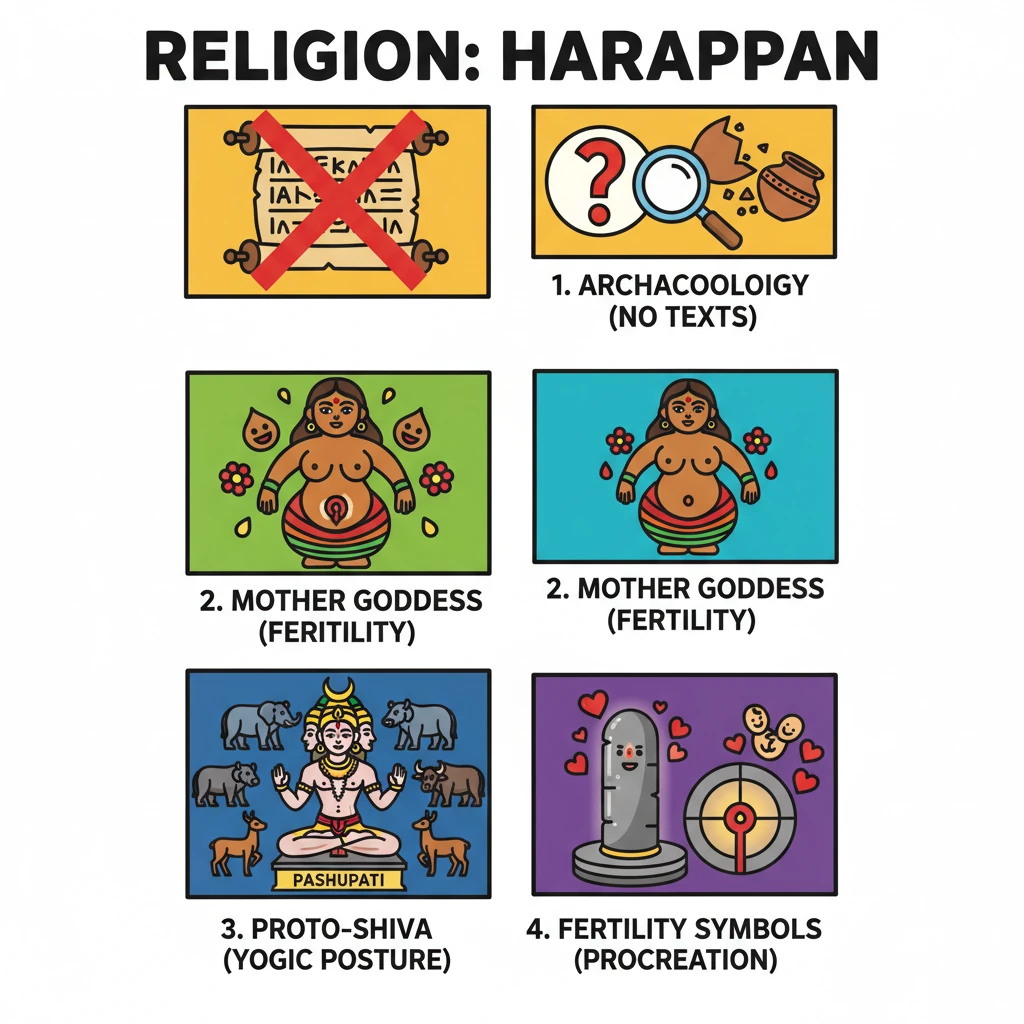
- •Harappan religion is inferred from archaeological findings, not deciphered texts.
- •Prominent worship of a Mother Goddess (fertility cult) through terracotta figurines.
- •A male deity on a seal, identified as Pashupati Mahadeva (proto-Shiva), in yogic posture, surrounded by animals.
- •Evidence of fertility symbols (phallus, yoni) indicating strong emphasis on procreation.
- •Widespread veneration of animals (unicorn, humped bull) and trees (Pipal).
- •Amulets were commonly used, likely for protection or religious purposes.
🧠 Memory Techniques
95% Verified Content
📚 Reference Sources
•NCERT Class XI: An Introduction to Indian Art (Chapter 1)
•NCERT Class VI: Our Pasts – I (Chapter 3)
•Upinder Singh: A History of Ancient and Early Medieval India