Acharya J. B. Kripalani - History | UPSC Learning
Topics
0 topics • 0 completed
🔍
No topics match your search
Acharya J. B. Kripalani
Medium⏱️ 6 min read
history
📖 Introduction
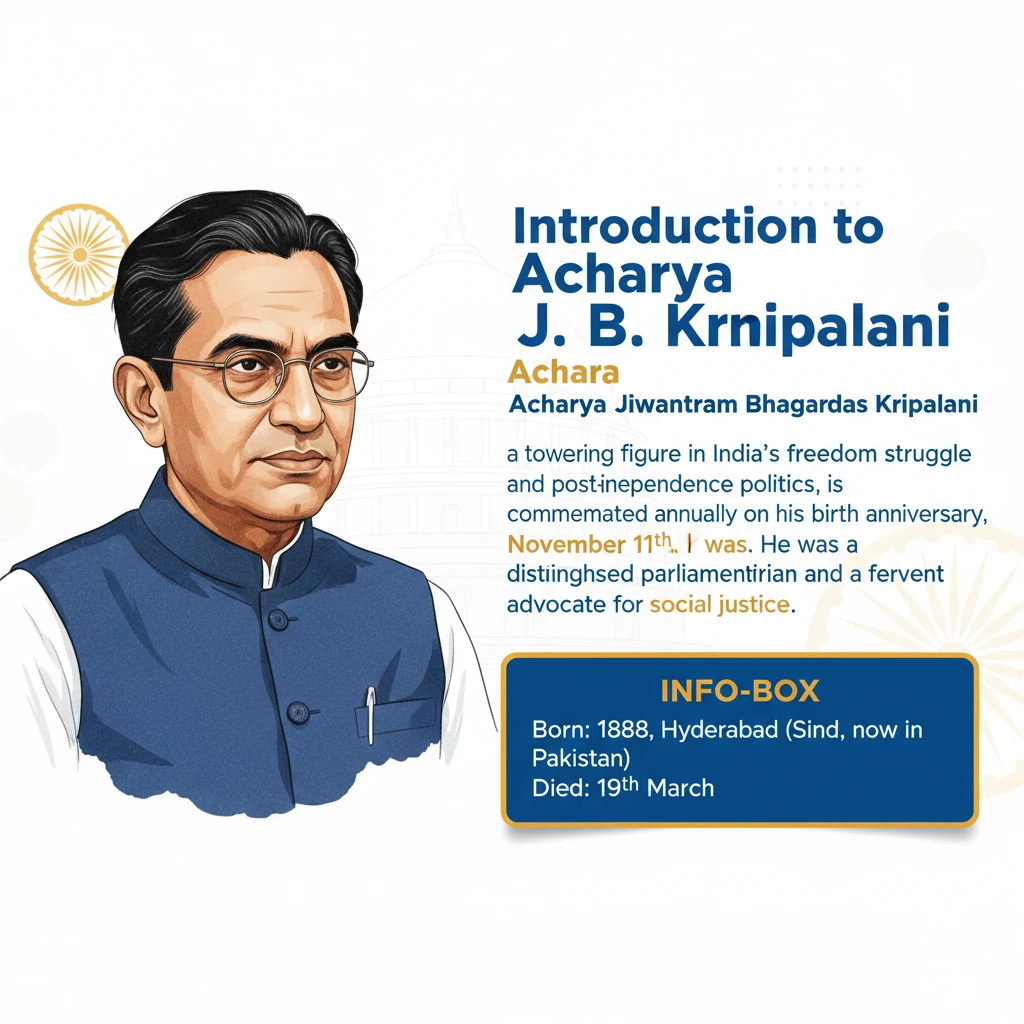
<h4>Introduction to Acharya J. B. Kripalani</h4><p><strong>Acharya Jiwantram Bhagwandas Kripalani</strong>, a towering figure in India's freedom struggle and post-independence politics, is commemorated annually on his birth anniversary, <strong>November 11th</strong>. He was a distinguished parliamentarian and a fervent advocate for <strong>social justice</strong>.</p><div class='info-box'><p><strong>Born:</strong> 1888, Hyderabad (Sind, now in Pakistan)</p><p><strong>Died:</strong> 19th March 1982</p></div><h4>Early Life and Gandhian Influence</h4><p>Born in <strong>Hyderabad (Sind)</strong> in <strong>1888</strong>, Kripalani's early life laid the foundation for his future activism. He was profoundly influenced by <strong>Mahatma Gandhi's philosophy</strong>, which shaped his commitment to non-violence and social reform.</p><div class='key-point-box'><p><strong>Key Inspiration:</strong> Deeply inspired by <strong>Mahatma Gandhi's principles</strong> of truth, non-violence, and self-reliance.</p></div><h4>Role in the Independence Movement</h4><p>Acharya Kripalani was an active participant in several pivotal movements during the Indian freedom struggle. His dedication saw him join the <strong>Congress Party</strong> in the <strong>1920s</strong>.</p><ul><li>He played a crucial role in the <strong>Champaran Satyagraha (1917)</strong>, supporting Gandhi's fight for indigo farmers.</li><li>His involvement extended to the <strong>Kheda Satyagraha (1918)</strong>, advocating for farmers against unjust tax collection.</li><li>He was also active in the <strong>Ahmedabad Mill Strike (1918)</strong>, supporting textile workers' rights.</li><li>A significant moment was his participation in the <strong>Salt Satyagraha (1930)</strong>, challenging the British salt monopoly.</li></ul><div class='exam-tip-box'><p><strong>UPSC Insight:</strong> Kripalani's participation in early Gandhian movements highlights the spread of Gandhi's influence beyond Bihar and Gujarat. Mentioning his diverse involvement adds depth to answers on the <strong>Freedom Struggle (GS-I)</strong>.</p></div><h4>Leadership in the Indian National Congress</h4><p>Kripalani's leadership capabilities were recognized within the Congress Party. He ascended to the prestigious position of <strong>President of the Indian National Congress</strong> in <strong>1946</strong>, a critical juncture leading up to India's independence.</p><div class='highlight-box'><p><strong>Crucial Role:</strong> Served as <strong>President of the Indian National Congress</strong> during the momentous year of <strong>1946</strong>, overseeing the transition to independence.</p></div><h4>Contributions to Independent India</h4><p>Post-independence, Acharya Kripalani continued to contribute significantly to nation-building. He was a member of the <strong>Constituent Assembly</strong>, instrumental in drafting the Indian Constitution.</p><ul><li>He chaired the <strong>Fundamental Rights Sub-Committee</strong>, playing a key role in shaping the rights guaranteed to Indian citizens.</li></ul><h4>Post-Independence Political Journey</h4><p>After independence, Kripalani's political journey saw him explore different avenues. He formed the <strong>Krishak Mazdoor Praja Party (KMPP)</strong> in <strong>1951</strong>.</p><p>This party later merged with the <strong>Praja Socialist Party</strong>. Subsequently, he also served as an <strong>independent Member of Parliament</strong>, continuing his public service.</p><h4>Literary and Journalistic Endeavors</h4><p>Beyond politics, Acharya Kripalani was also a prolific writer. He penned his autobiography, titled <strong>'My Times'</strong>, offering insights into his life and the era he lived through.</p><p>He also ran a weekly journal named <strong>'Vigil'</strong>, using it as a platform to express his views and engage with public discourse.</p>
💡 Key Takeaways
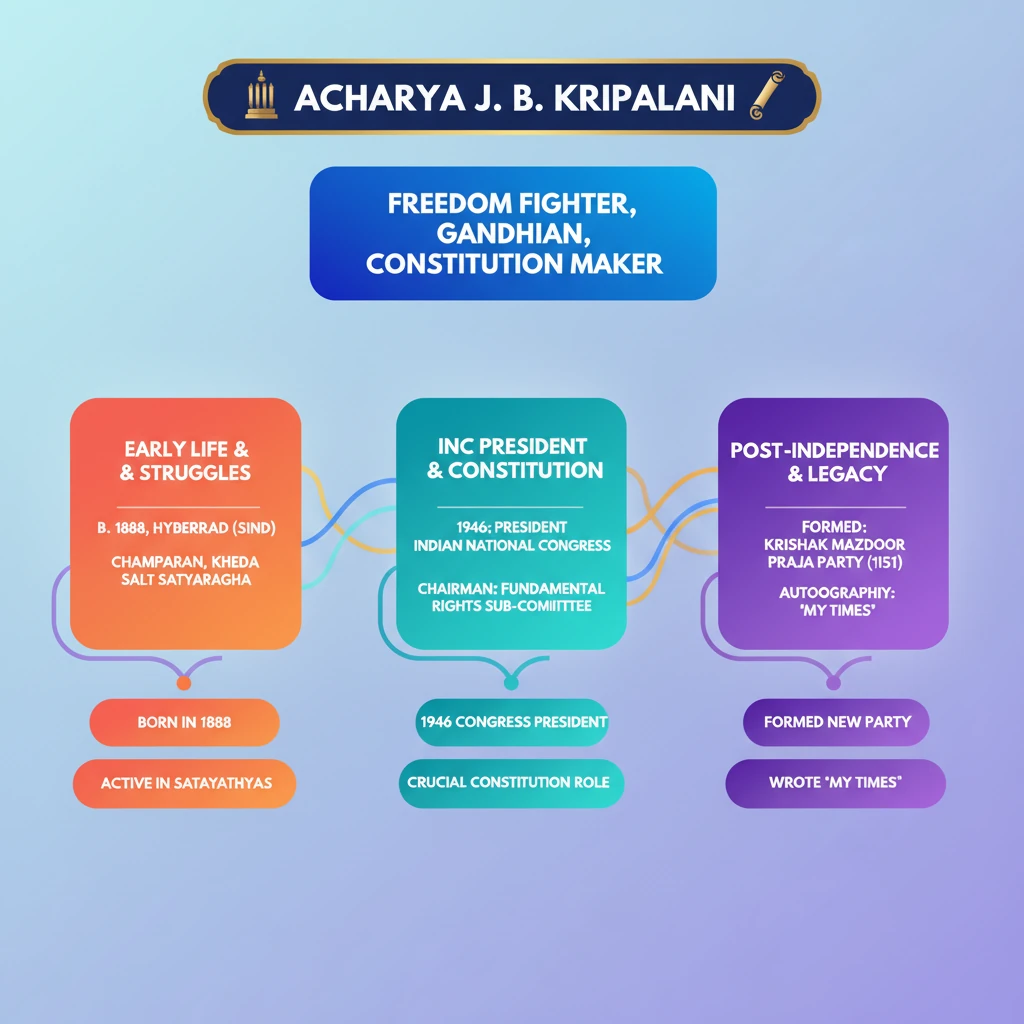
- •Acharya J. B. Kripalani was a prominent Gandhian leader, born in 1888 in Hyderabad (Sind).
- •He actively participated in major Satyagrahas: Champaran (1917), Kheda (1918), Ahmedabad Mill Strike (1918), and Salt Satyagraha (1930).
- •He served as President of the Indian National Congress in 1946, a pivotal year for independence.
- •As Chairman of the Fundamental Rights Sub-Committee, he significantly contributed to the Indian Constitution.
- •Post-independence, he formed the Krishak Mazdoor Praja Party (1951) and authored his autobiography 'My Times'.
- •His economic philosophy advocated for decentralized industrialization, rural development, and small/cottage industries.
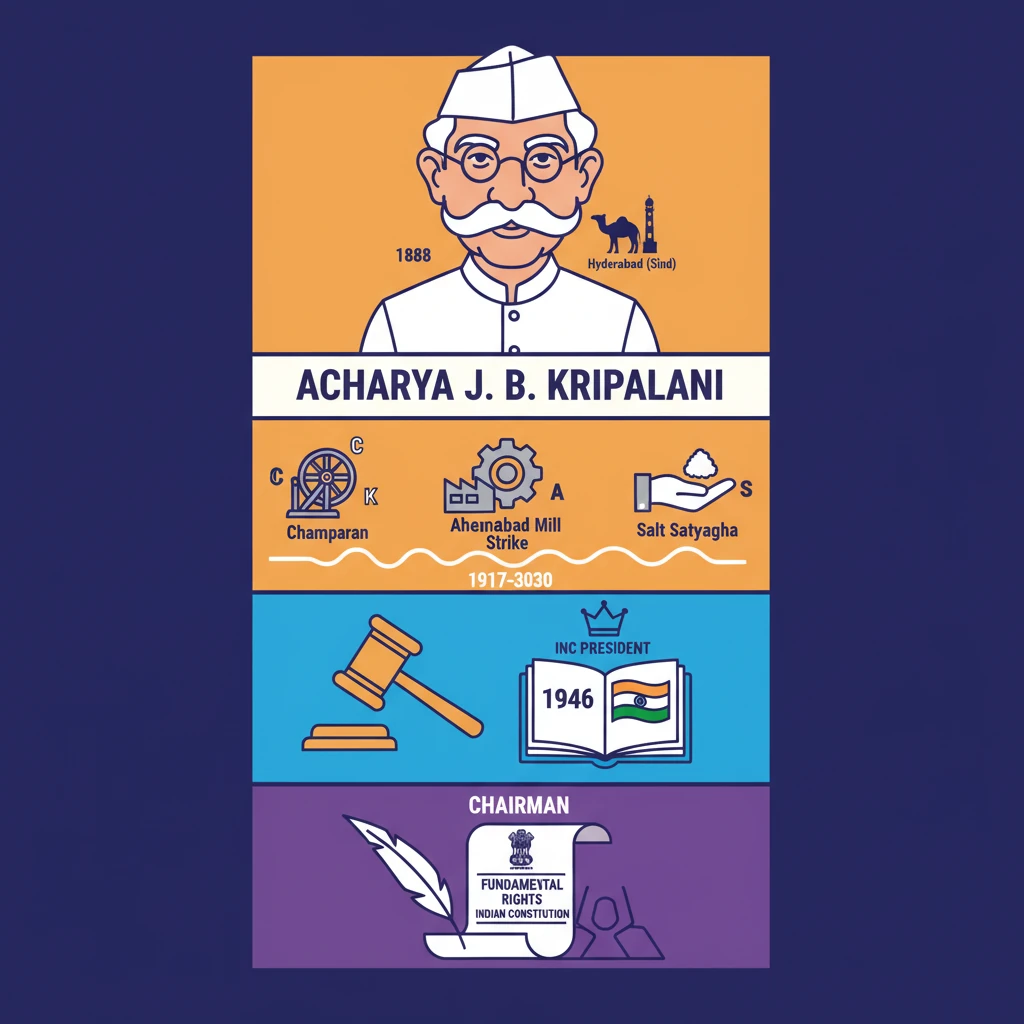
🧠 Memory Techniques
95% Verified Content