Who was C. Rajagopalachari? - History | UPSC Learning
Topics
0 topics • 0 completed
🔍
No topics match your search
Who was C. Rajagopalachari?
Easy⏱️ 4 min read
history
📖 Introduction
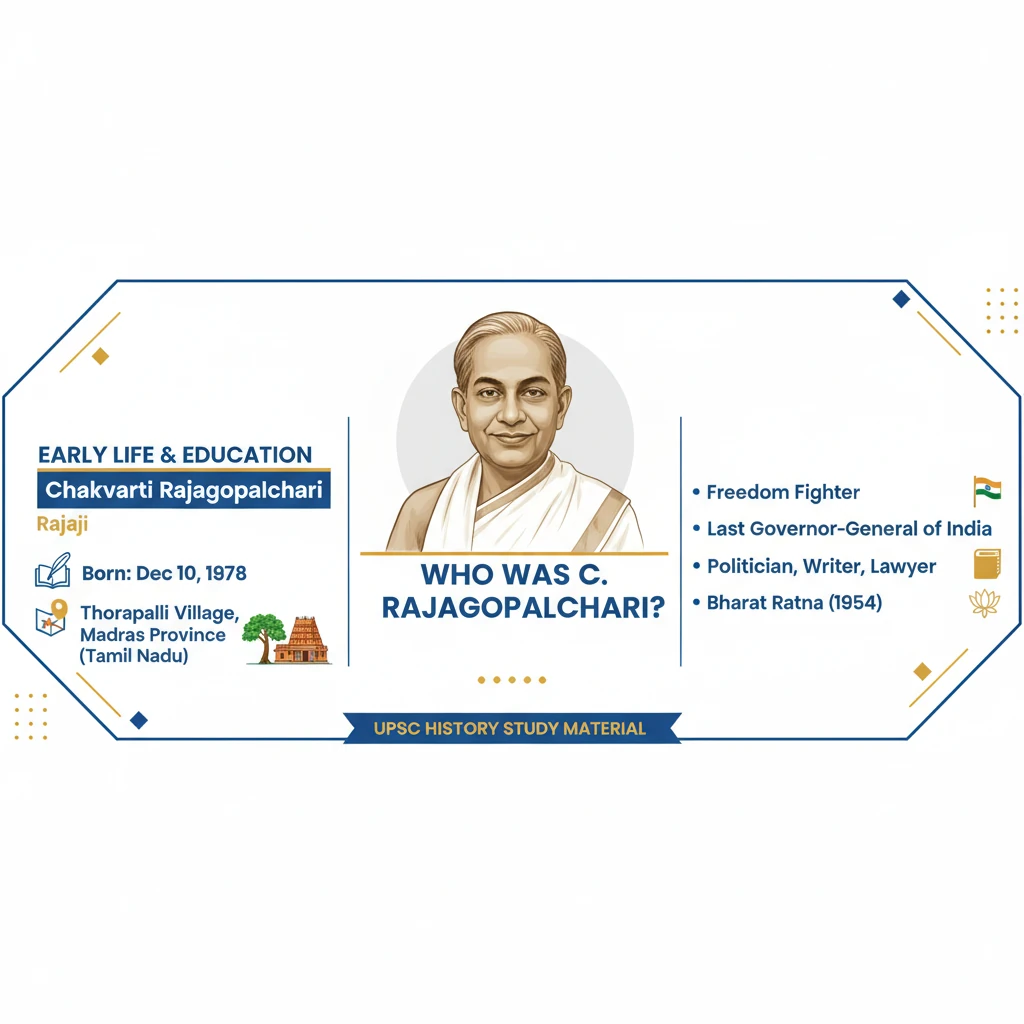
<h4>Early Life and Education of C. Rajagopalachari</h4><p><strong>Chakravarti Rajagopalachari</strong>, often referred to as <strong>"Rajaji"</strong>, was a prominent figure in India's freedom struggle and post-independence politics. He was born on <strong>December 10, 1878</strong>, in <strong>Thorapalli village</strong>, near <strong>Hosur</strong>, in the <strong>Salem district</strong> of the then <strong>Madras Province</strong> (present-day <strong>Tamil Nadu</strong>).</p><div class='info-box'><ul><li><strong>Born:</strong> December 10, 1878</li><li><strong>Place:</strong> Salem, Madras Province (now Tamil Nadu)</li></ul></div><p>His academic journey led him to pursue law. He successfully completed his <strong>Bachelor of Law</strong> degree in <strong>1899</strong>. Following his graduation, <strong>Rajagopalachari</strong> embarked on his legal career, establishing his practice in <strong>Salem</strong>.</p><h4>Political Awakening and Early Influences</h4><p><strong>Rajagopalachari's</strong> political consciousness was profoundly shaped by significant events of his time. He was particularly disturbed by <strong>Lord Curzon's</strong> controversial decision to <strong>partition Bengal</strong> in <strong>1905</strong>, which was largely based on communal lines.</p><p>This period of political turmoil also saw him draw inspiration from the fervent nationalism advocated by <strong>Lokmanya Bal Gangadhar Tilak</strong>. <strong>Tilak's</strong> powerful call for <strong>'Swaraj'</strong> (complete independence) resonated deeply with <strong>Rajagopalachari</strong>, guiding his early political leanings.</p><div class='key-point-box'><p><strong>Key Influences:</strong></p><ul><li><strong>Lord Curzon's Partition of Bengal</strong> (1905)</li><li><strong>Lokmanya Bal Gangadhar Tilak's</strong> call for <strong>complete independence</strong></li></ul></div><h4>Engagement with the Indian National Congress</h4><p>Driven by his nationalist convictions, <strong>C. Rajagopalachari</strong> formally joined the <strong>Indian National Congress (INC)</strong>. This marked his active entry into the mainstream of <strong>India's freedom struggle</strong>, where he quickly rose to prominence.</p><p>He dedicated himself to the cause of independence, participating in various movements and playing a crucial role in shaping the strategies of the <strong>Congress party</strong> during a critical juncture in Indian history.</p><h4>Contributions to Local Administration and Social Reforms</h4><p>Beyond national politics, <strong>Rajagopalachari</strong> also made significant contributions at the local level. In <strong>1917</strong>, he was elected as the <strong>Chairman of Salem Municipality</strong>, demonstrating his commitment to public service and local governance.</p><p>During his tenure, he focused extensively on implementing social welfare measures. A primary concern was the upliftment and well-being of the <strong>backward classes</strong>, for whom he initiated various reforms and programs.</p><div class='info-box'><p><strong>Municipal Role:</strong></p><ul><li><strong>Year:</strong> 1917</li><li><strong>Position:</strong> Chairman of Salem Municipality</li><li><strong>Focus:</strong> Social welfare of backward classes</li></ul></div><h4>Establishment of Ashram and Publications</h4><p>His commitment to social upliftment extended beyond municipal administration. In <strong>1930</strong>, <strong>Rajagopalachari</strong> established an <strong>Ashram</strong> in the <strong>Madras Province</strong>. This institution was dedicated to fostering social reform and community development.</p><p>The <strong>Ashram</strong> served as a hub for various activities aimed at improving societal conditions. It also played a role in disseminating his ideas and promoting social change through its publications.</p><div class='info-box'><p><strong>Ashram Details:</strong></p><ul><li><strong>Established:</strong> 1930</li><li><strong>Location:</b> Madras Province</li><li><strong>Purpose:</strong> Social upliftment</li></ul></div><p>To further its mission and reach a wider audience, the <strong>Ashram</strong> published two distinct magazines. These publications were instrumental in advocating for the causes championed by <strong>Rajagopalachari</strong> and his associates.</p><div class='info-box'><p><strong>Ashram Magazines:</strong></p><ul><li><strong>Vimochanaṁ</strong> (Tamil)</li><li><strong>Prohibition</strong> (English)</li></ul></div><div class='exam-tip-box'><p><strong>UPSC Insight:</strong> Questions on <strong>C. Rajagopalachari</strong> often focus on his diverse roles – from early nationalist to social reformer and administrator. Remember his connection to <strong>Salem</strong> and his publications for specific factual recall.</p></div>
💡 Key Takeaways
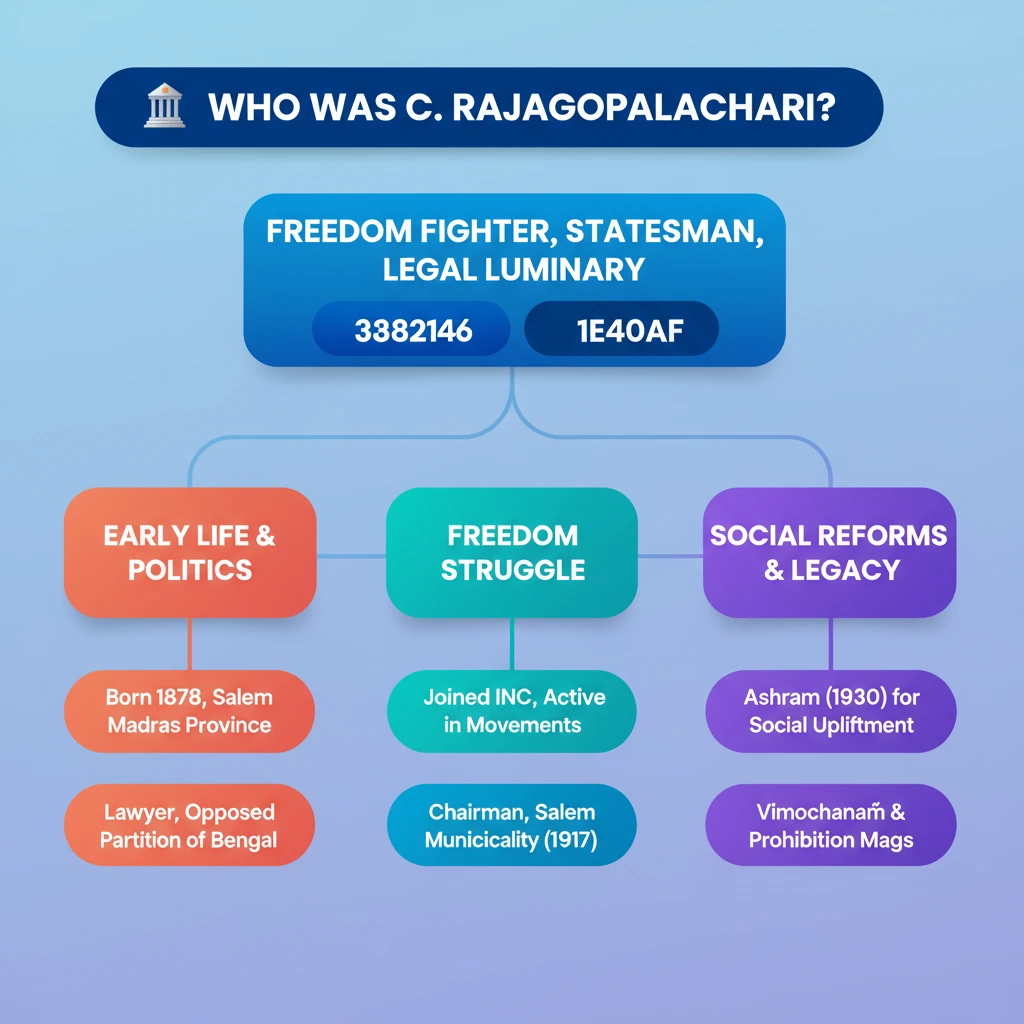
- •C. Rajagopalachari was born in Salem, Madras Province in 1878 and became a lawyer.
- •Inspired by Tilak and opposed Lord Curzon's Partition of Bengal.
- •Joined INC and actively participated in the freedom struggle.
- •Served as Chairman of Salem Municipality (1917), focusing on backward classes' welfare.
- •Established an Ashram (1930) for social upliftment, publishing Vimochanaṁ and Prohibition magazines.
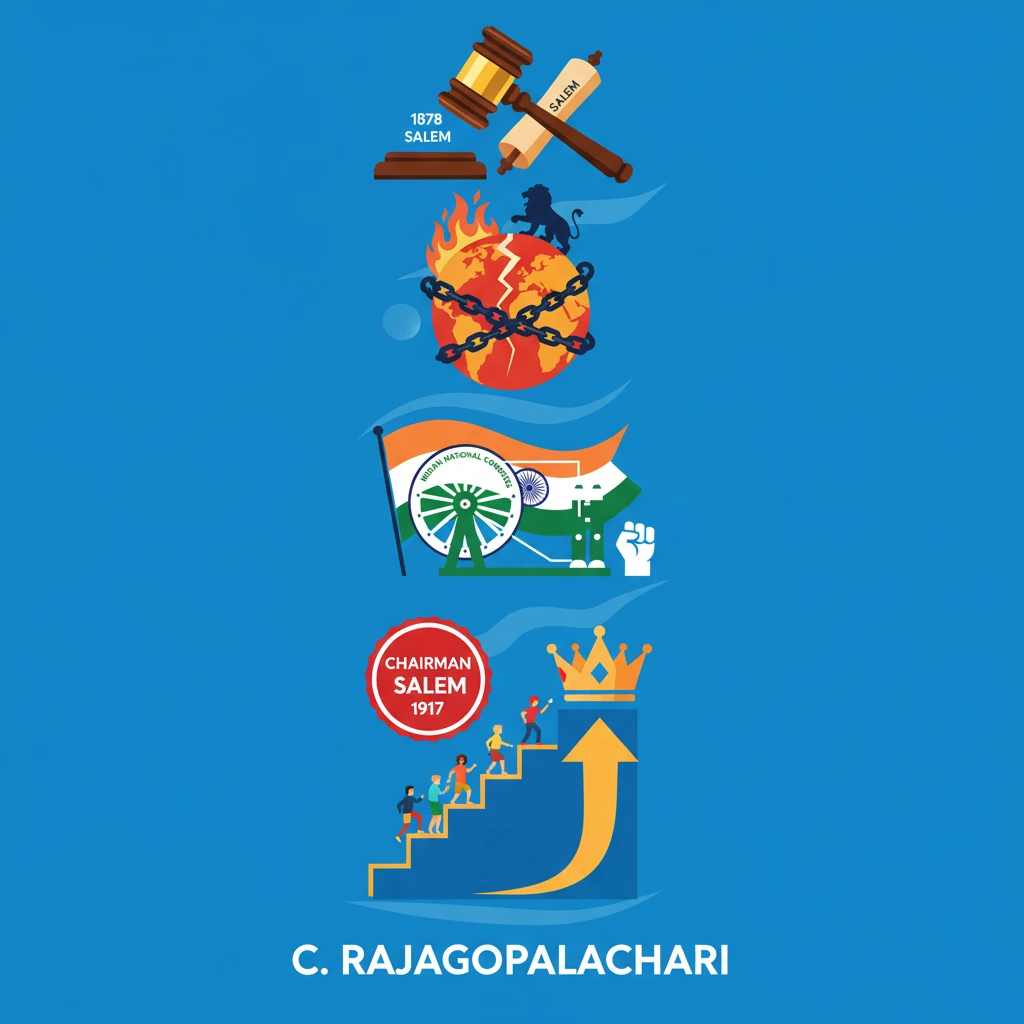
🧠 Memory Techniques
95% Verified Content