What was the Role of Sardar Patel in Integration of Princely States? - History | UPSC Learning
Topics
0 topics • 0 completed
🔍
No topics match your search
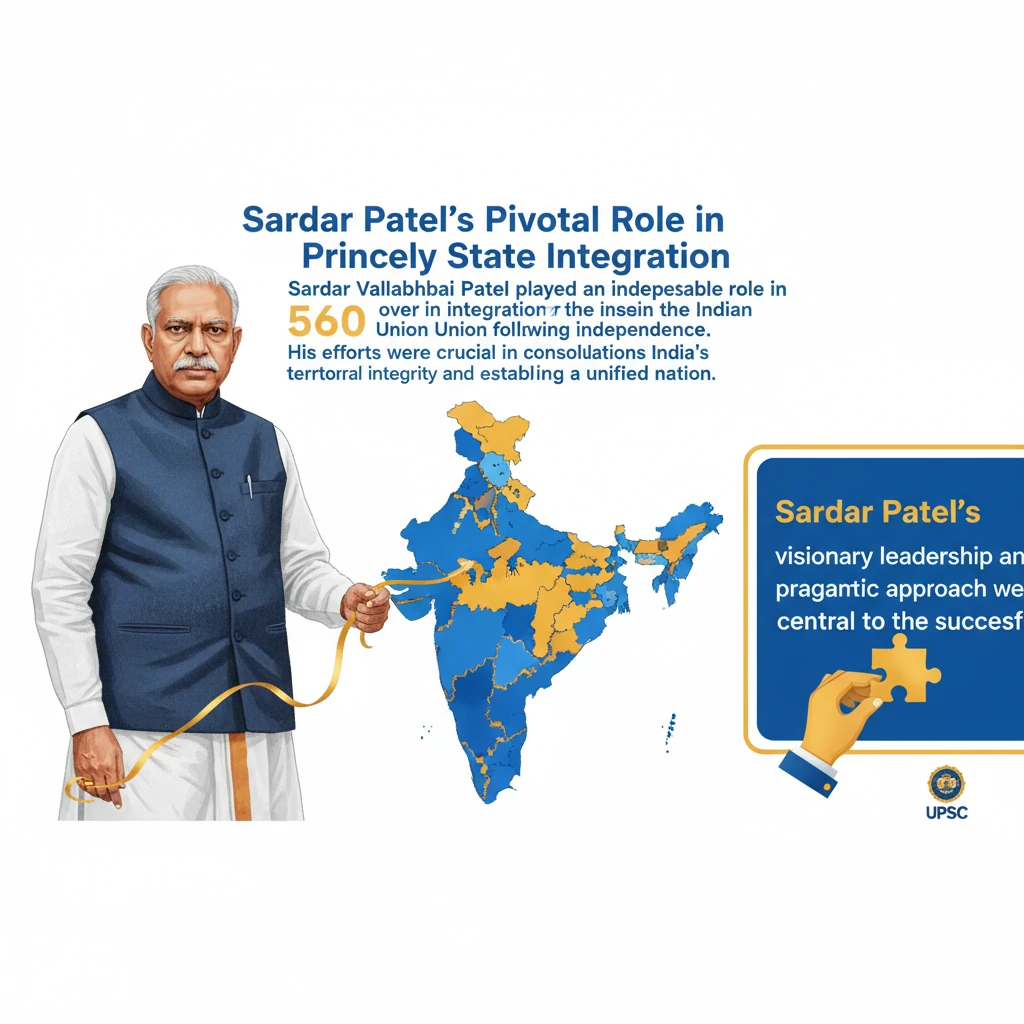
What was the Role of Sardar Patel in Integration of Princely States?
Medium⏱️ 8 min read
history
📖 Introduction
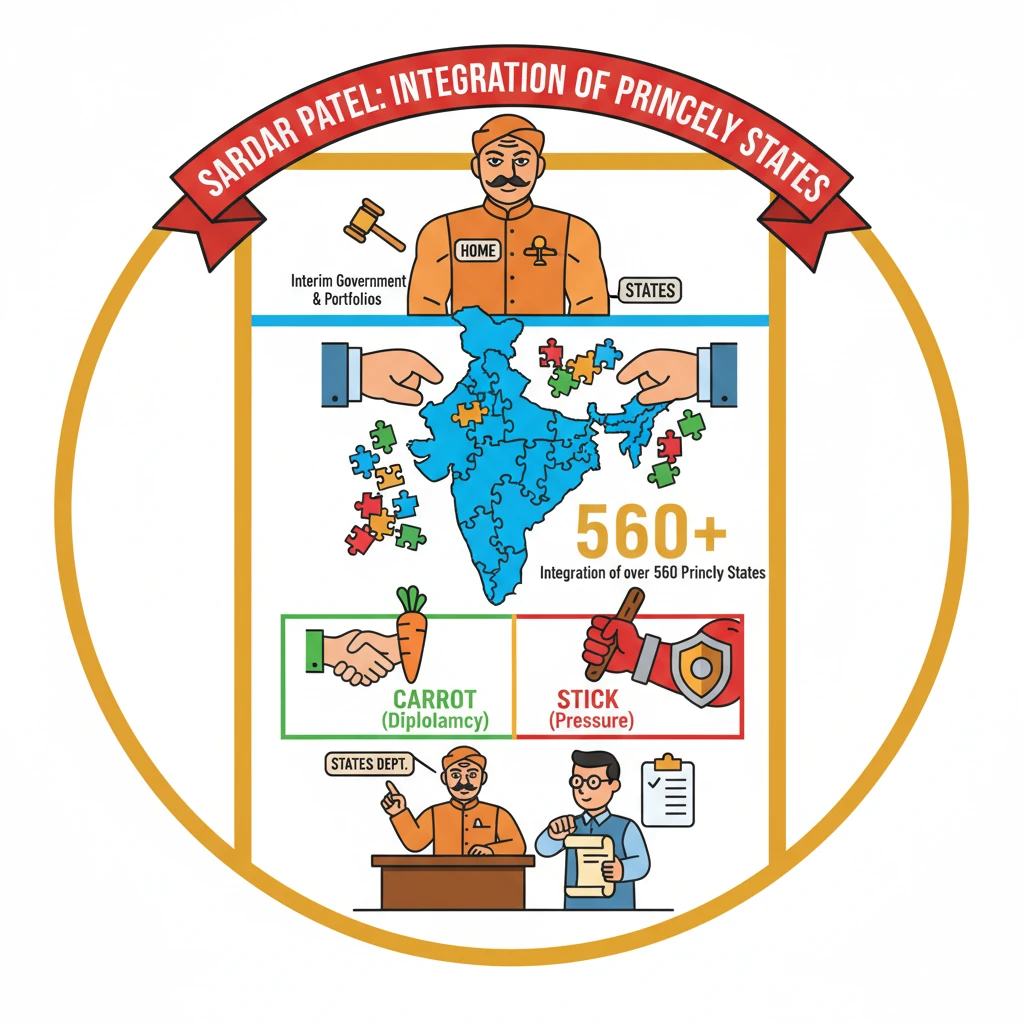
<h4>Sardar Patel's Pivotal Role in Princely State Integration</h4><p><strong>Sardar Vallabhbhai Patel</strong> played an indispensable role in the integration of over <strong>560 princely states</strong> into the Indian Union following independence.</p><p>His efforts were crucial in consolidating India's territorial integrity and establishing a unified nation.</p><div class='key-point-box'><p><strong>Sardar Patel's</strong> visionary leadership and pragmatic approach were central to the successful integration of princely states, ensuring India's unity.</p></div><h4>Role in the Interim Government (1946)</h4><p>On <strong>September 2, 1946</strong>, <strong>Sardar Patel</strong> was allocated key portfolios in the <strong>Interim Government</strong>, even before India gained full independence.</p><div class='info-box'><p>His responsibilities included <strong>Home</strong>, <strong>States</strong>, and <strong>Information & Broadcasting</strong>. This positioning was vital for his future role in state integration.</p></div><h4>Nehru's Acknowledgment of Patel's Strength</h4><p>Just weeks before India gained independence, <strong>Jawaharlal Nehru</strong> recognized Patel's significant capabilities and indispensable role.</p><div class='info-box'><p>On <strong>August 1, 1947</strong>, Nehru invited Patel to join his cabinet, famously referring to him as the <strong>"strongest pillar of the Cabinet."</strong></p></div><h4>Collaboration with Lord Mountbatten</h4><p><strong>Patel</strong> worked closely with the last Viceroy, <strong>Lord Mountbatten</strong>, to achieve the daunting task of state integration.</p><p>Their approach involved a blend of astute <strong>diplomacy</strong> and strategic <strong>pressure</strong> to persuade the princes to accede to India.</p><div class='key-point-box'><p>They effectively warned the <strong>Princely States</strong> of the inherent perils and unsustainable nature of independent existence in a newly independent India.</p></div><h4>Establishment of the States Department (1947)</h4><p>A critical administrative step was the creation of the <strong>States Department</strong> on <strong>July 5, 1947</strong>, specifically for this purpose.</p><div class='info-box'><p><strong>Patel</strong> organized this crucial department and appointed <strong>V.P. Menon</strong> as its secretary, forming a formidable team for the integration process.</p></div><p>The department's primary goal was to secure the accession of states in matters of <strong>defence</strong>, <strong>foreign affairs</strong>, and <strong>communications</strong>.</p><p>It also aimed to maintain <strong>Standstill Agreements</strong> to ensure continuity of common interests and administrative services with the newly formed Indian dominion.</p><h4>The "Carrot and Stick" Approach</h4><p><strong>Sardar Patel</strong> adopted a balanced strategy, often termed the <strong>"Carrot and Stick" approach</strong>, in negotiating the accession of states.</p><p>This involved a conciliatory and diplomatic stance, offering incentives (the "carrot") while also applying necessary pressure (the "stick") when persuasion failed.</p><div class='exam-tip-box'><p>This policy demonstrated <strong>Patel's pragmatic statesmanship</strong>, balancing reassurance with firmness to achieve the overarching goal of national unity.</p></div><h4>Appeal for Friendship and Equality</h4><p><strong>Patel</strong> extended a heartfelt invitation to the princes to join independent India as <strong>friends and equals</strong>, not as subordinate entities.</p><p>He articulated that it was far more beneficial to collaboratively create laws within a unified framework than to establish treaties as separate, smaller entities.</p><div class='key-point-box'><p>This appeal underscored the vision of a strong, united India where all regions contributed to national progress and shared sovereignty.</p></div><h4>"Police Action" in Hyderabad (1948)</h4><p>The integration of <strong>Hyderabad</strong>, one of the largest princely states, presented unique and significant challenges, ultimately leading to a decisive intervention.</p><div class='info-box'><p>This operation was referred to as <strong>"Police Action"</strong> because it was considered an <strong>internal matter</strong> of India, addressing a grave law and order situation within its borders.</p></div><p>On <strong>September 17, 1948</strong>, the <strong>Nizam</strong> of Hyderabad formally surrendered after dismissing his Prime Minister, <strong>Mir Laik Ali</strong>, and his cabinet, thereby integrating Hyderabad into India.</p>
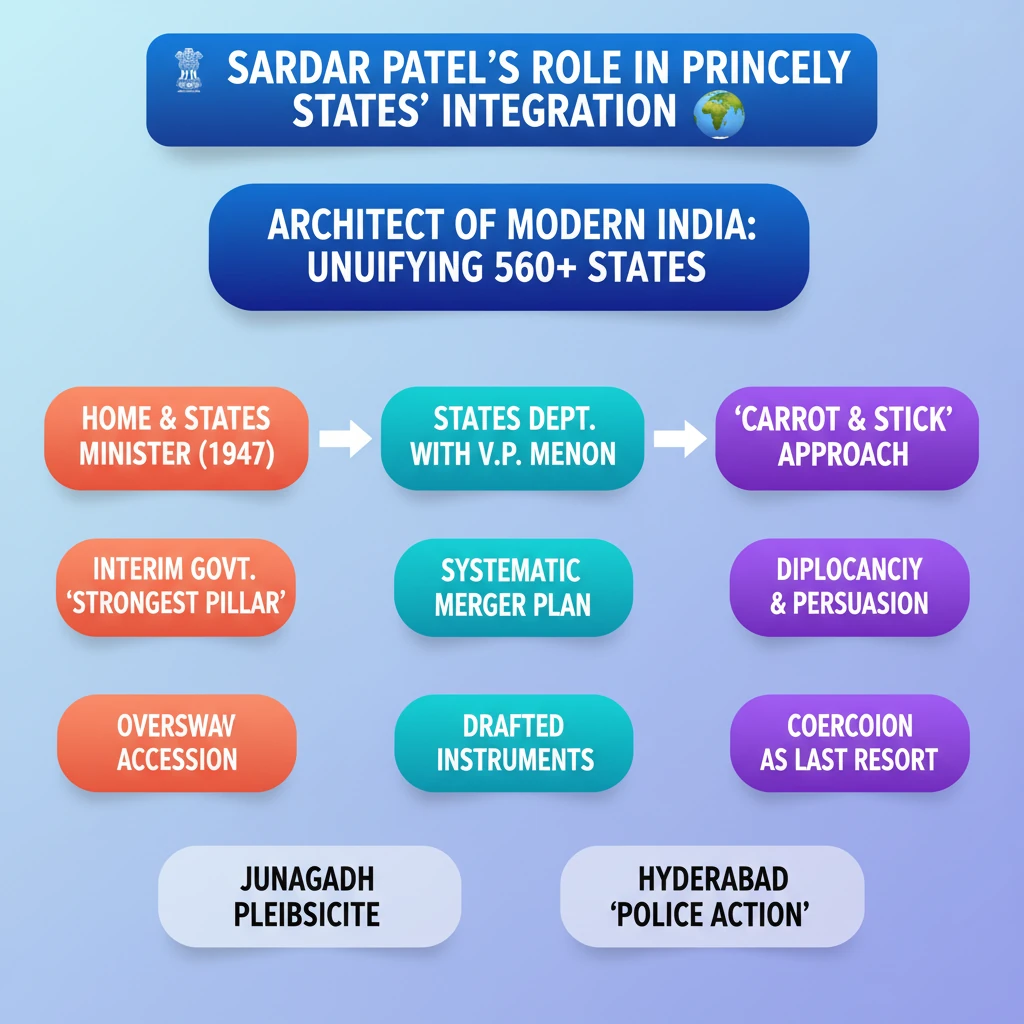
💡 Key Takeaways
- •Sardar Patel was instrumental in integrating over 560 princely states into the Indian Union.
- •His role began in the Interim Government (Home & States portfolios) and was acknowledged by Nehru as the 'strongest pillar'.
- •He established the States Department with V.P. Menon to systematically manage the accession process.
- •Patel employed a 'Carrot and Stick' approach, balancing diplomacy with firm pressure.
- •Key examples of his integration strategy include Junagadh (plebiscite) and Hyderabad ('Police Action').
- •His efforts ensured India's territorial integrity and prevented the Balkanization of the newly independent nation.
🧠 Memory Techniques
95% Verified Content