Reopening of the Assembly Hall - History | UPSC Learning
Topics
0 topics • 0 completed
🔍
No topics match your search
Reopening of the Assembly Hall
Medium⏱️ 6 min read
history
📖 Introduction
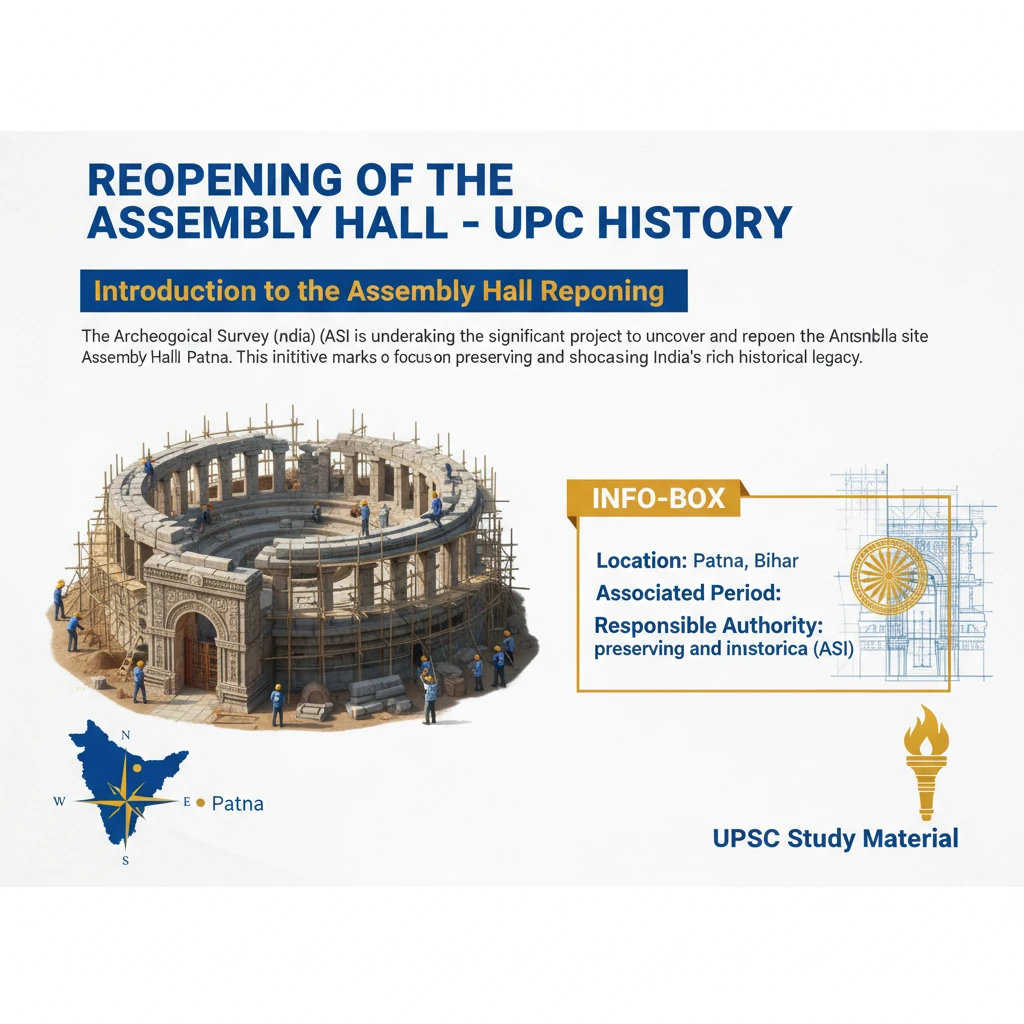
<h4>Introduction to the Assembly Hall Reopening</h4><p>The <strong>Archaeological Survey of India (ASI)</strong> is undertaking a significant project to uncover and reopen the ancient <strong>Assembly Hall</strong> site in <strong>Patna</strong>. This initiative marks a renewed focus on preserving and showcasing India's rich historical legacy.</p><div class='info-box'><p><strong>Location:</strong> Patna, Bihar</p><p><strong>Associated Period:</strong> Mauryan Empire</p><p><strong>Responsible Authority:</strong> Archaeological Survey of India (ASI)</p></div><h4>Reasons for the Reopening Initiative</h4><p>The decision to reopen the Assembly Hall is driven by two primary factors. Firstly, a noticeable <strong>recession of the water table</strong> in the Patna region has made the site more accessible for excavation and study. This natural change provides a window of opportunity for archaeological work.</p><p>Secondly, there is a growing public and academic <strong>interest in Mauryan heritage</strong>. Uncovering such sites allows for deeper insights into one of ancient India's most powerful empires, fostering a connection with the past.</p><div class='key-point-box'><p><strong>Key Drivers:</strong></p><ul><li>Receded <strong>water table</strong> in Patna</li><li>Rising public and academic interest in <strong>Mauryan heritage</strong></li></ul></div><h4>Initial Phase of Exposure and Study</h4><p>The reopening process will commence with a cautious and scientific approach. Initially, only <strong>6-7 pillars</strong> of the Assembly Hall will be exposed. This limited exposure is crucial for conducting preliminary studies.</p><p>The primary focus during this phase will be to assess the impacts of <strong>humidity and groundwater</strong> on the ancient structures. This scientific evaluation is vital for planning long-term preservation strategies.</p><div class='info-box'><p><strong>Initial Scope:</strong> Exposure of <strong>6-7 pillars</strong></p><p><strong>Study Focus:</strong> Impact of <strong>humidity</strong> and <strong>groundwater</strong></p><p><strong>Collaborating Body:</strong> Central Ground Water Board (CGWB)</p></div><p>The <strong>Central Ground Water Board (CGWB)</strong> will provide essential support for these studies. Their expertise will be instrumental in understanding the hydrological conditions affecting the site and ensuring sustainable preservation.</p><h4>Future Decisions and Balancing Act</h4><p>Following the initial studies, an <strong>expert committee</strong> will be constituted. This committee will play a pivotal role in deciding the future course of action regarding the complete reopening of the site.</p><p>The committee's decision will involve a delicate balance between <strong>preservation</strong> and <strong>public access</strong>. While making the site accessible to the public is important for education and tourism, ensuring its long-term survival remains the paramount concern.</p><div class='exam-tip-box'><p><strong>UPSC Insight:</strong> Questions on <strong>archaeological conservation</strong> often involve balancing development/tourism with preservation. The role of bodies like <strong>ASI</strong> and expert committees is frequently tested in <strong>GS Paper I (History & Culture)</strong> and <strong>GS Paper III (Environment & Conservation)</strong>.</p></div><p>The Assembly Hall is believed to have originally featured <strong>80 pillars</strong>. The full exposure of all these pillars will depend on the findings of the initial studies and the recommendations of the expert committee, ensuring minimal damage and maximum longevity.</p>
💡 Key Takeaways
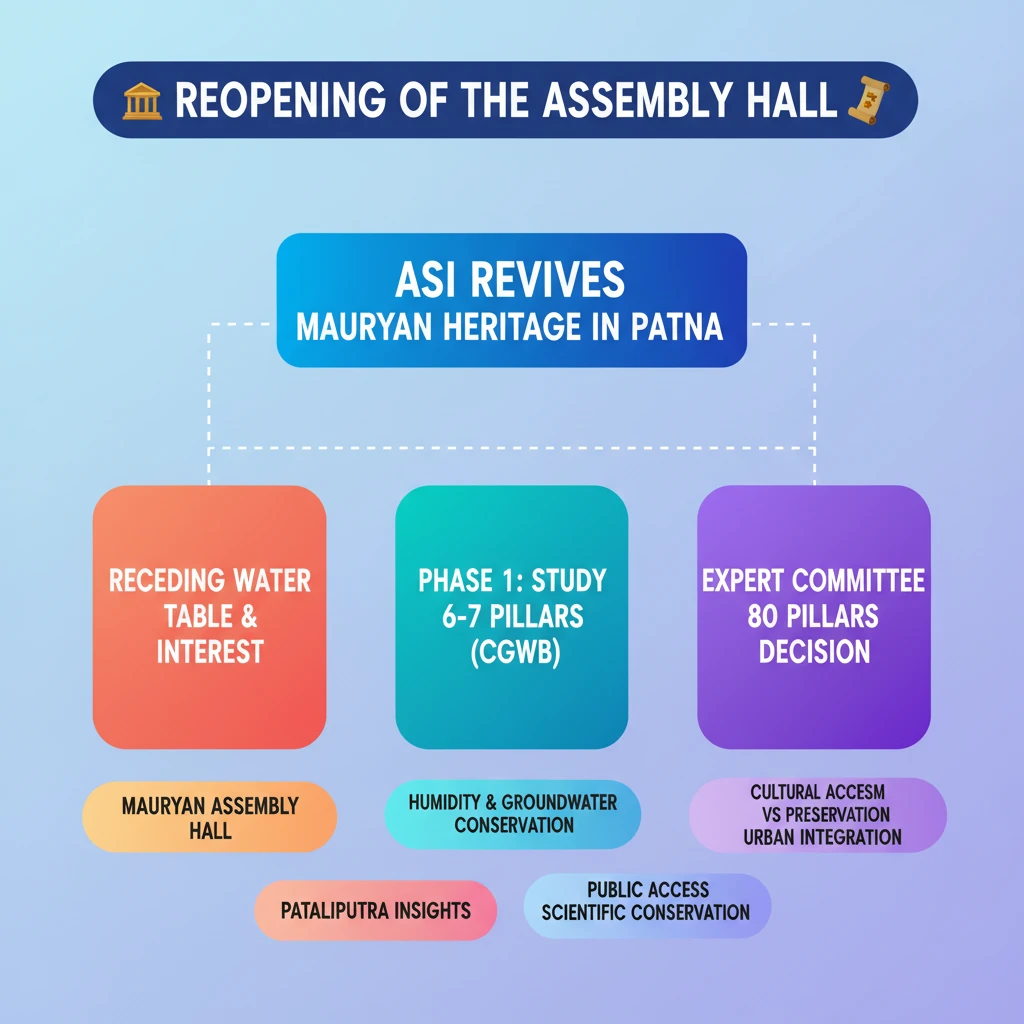
- •ASI is reopening the Mauryan Assembly Hall in Patna due to a receding water table and rising interest in Mauryan heritage.
- •Initial phase involves exposing 6-7 pillars to study humidity and groundwater impacts with CGWB support.
- •An expert committee will decide on fully reopening all 80 pillars, balancing preservation with public access.
- •The site offers insights into Mauryan architecture and administration at Pataliputra.
- •Project highlights the importance of scientific conservation, urban heritage integration, and cultural tourism.
🧠 Memory Techniques

95% Verified Content
📚 Reference Sources
•Archaeological Survey of India (ASI) official reports and publications (General context)
•NCERT Textbooks for Ancient Indian History (Mauryan period context)