What are the Key Facts About the Ikshvaku Period? - History | UPSC Learning
Topics
0 topics • 0 completed
🔍
No topics match your search
What are the Key Facts About the Ikshvaku Period?
Medium⏱️ 6 min read
history
📖 Introduction
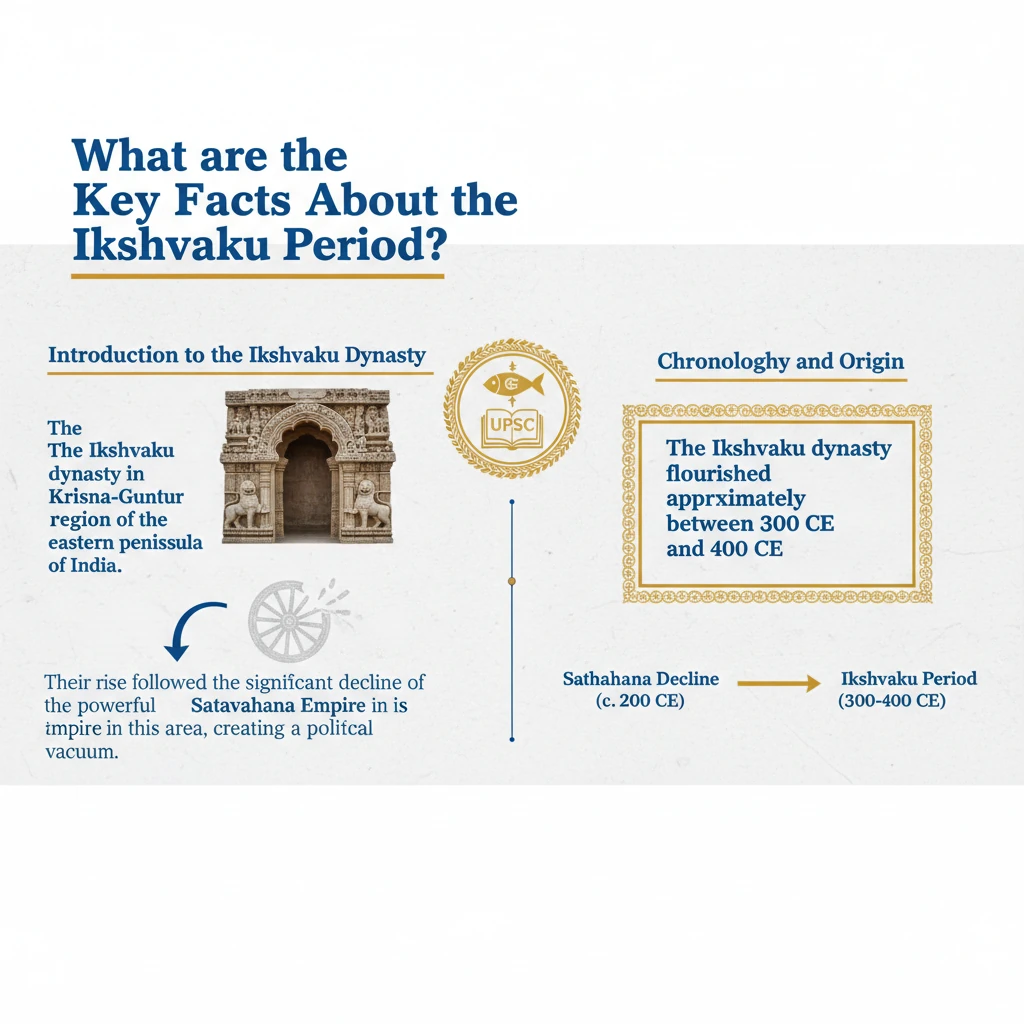
<h4>Introduction to the Ikshvaku Dynasty</h4><p>The <strong>Ikshvaku dynasty</strong> emerged in the <strong>Krishna-Guntur region</strong> of the eastern peninsula of India.</p><p>Their rise followed the significant decline of the powerful <strong>Satavahana Empire</strong> in this area, creating a political vacuum.</p><h4>Chronology and Origin</h4><div class='info-box'><p>The <strong>Ikshvaku dynasty</strong> flourished approximately between <strong>300 CE and 400 CE</strong>.</p></div><p>The dynasty is traditionally named after the legendary ancient <strong>King Ikshvaku</strong>, a revered figure in Indian mythology.</p><p>Evidence suggests their initial emergence in the <strong>Vijayapuri region</strong>, which corresponds to modern-day <strong>Bellary district, Karnataka</strong>, around the <strong>3rd century CE</strong>.</p><h4>Sources of Information</h4><p>Our understanding of the <strong>Ikshvaku period</strong> is primarily derived from several crucial historical sources.</p><ul><li><strong>Inscriptions:</strong> Numerous epigraphic records provide details about their rule and administration.</li><li><strong>Coinage:</strong> Ikshvaku coins offer insights into their economy, symbols, and deities.</li><li><strong>Archaeological Excavations:</strong> Sites like <strong>Nagarjunakonda</strong> have yielded significant material evidence.</li></ul><h4>Succession</h4><p>The <strong>Ikshvaku dynasty</strong> was eventually succeeded by the powerful <strong>Pallavas</strong>, who rose to prominence in the southern regions of India.</p><h4>Expansion and Consolidation of Power</h4><p>The <strong>Ikshvakus</strong> significantly expanded their influence under the leadership of <strong>King Kamtasiri</strong>.</p><div class='key-point-box'><p><strong>Kamtasiri's conquests</strong> were instrumental in establishing the Ikshvakus as a formidable regional power.</p></div><p>His military campaigns extended their dominion across various parts of modern-day <strong>Andhra Pradesh</strong>, <strong>Telangana</strong>, and <strong>Maharashtra</strong>.</p><h4>Cultural Contributions: Patronage of Buddhism</h4><p>The <strong>Ikshvaku dynasty</strong> was a prominent patron of <strong>Buddhism</strong> during their reign.</p><p>This patronage led to a significant flourishing of <strong>Buddhist art and architecture</strong>.</p><ul><li>Construction of magnificent <strong>stupas</strong> and <strong>monasteries</strong>.</li><li>Notable sites include <strong>Kanaganahalli</strong> and <strong>Sankaram</strong>, showcasing elaborate Buddhist complexes.</li></ul><h4>Economic Contributions: Coinage</h4><p><strong>Ikshvaku coins</strong> were widely circulated, reflecting the economic stability and cultural practices of the era.</p><div class='info-box'><p>These coins often featured a blend of <strong>Buddhist symbols</strong> and various <strong>regional deities</strong>, indicating religious syncretism.</p></div><div class='exam-tip-box'><p>Understanding the <strong>Ikshvaku period's</strong> rise after the <strong>Satavahanas</strong> and their succession by the <strong>Pallavas</strong> is crucial for tracing post-Mauryan South Indian history for <strong>UPSC Prelims</strong>.</p></div>
💡 Key Takeaways
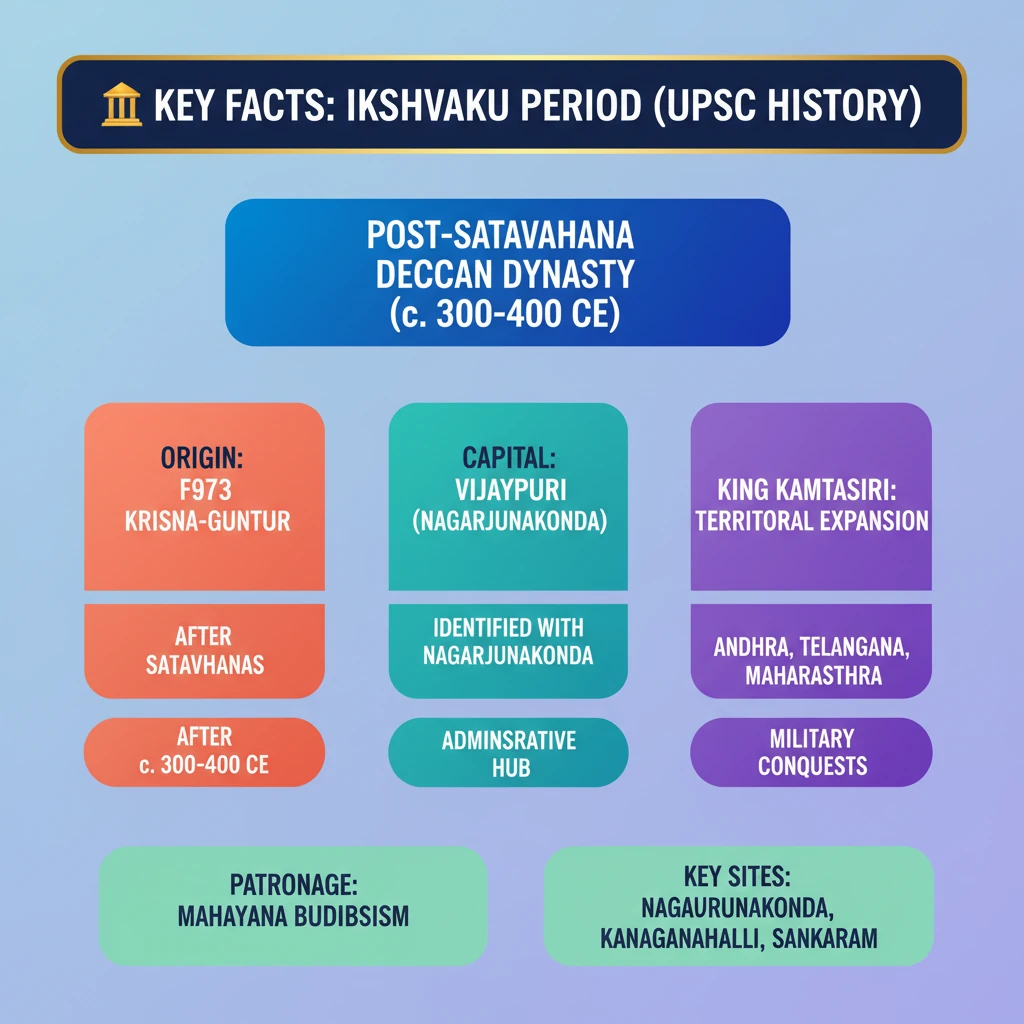
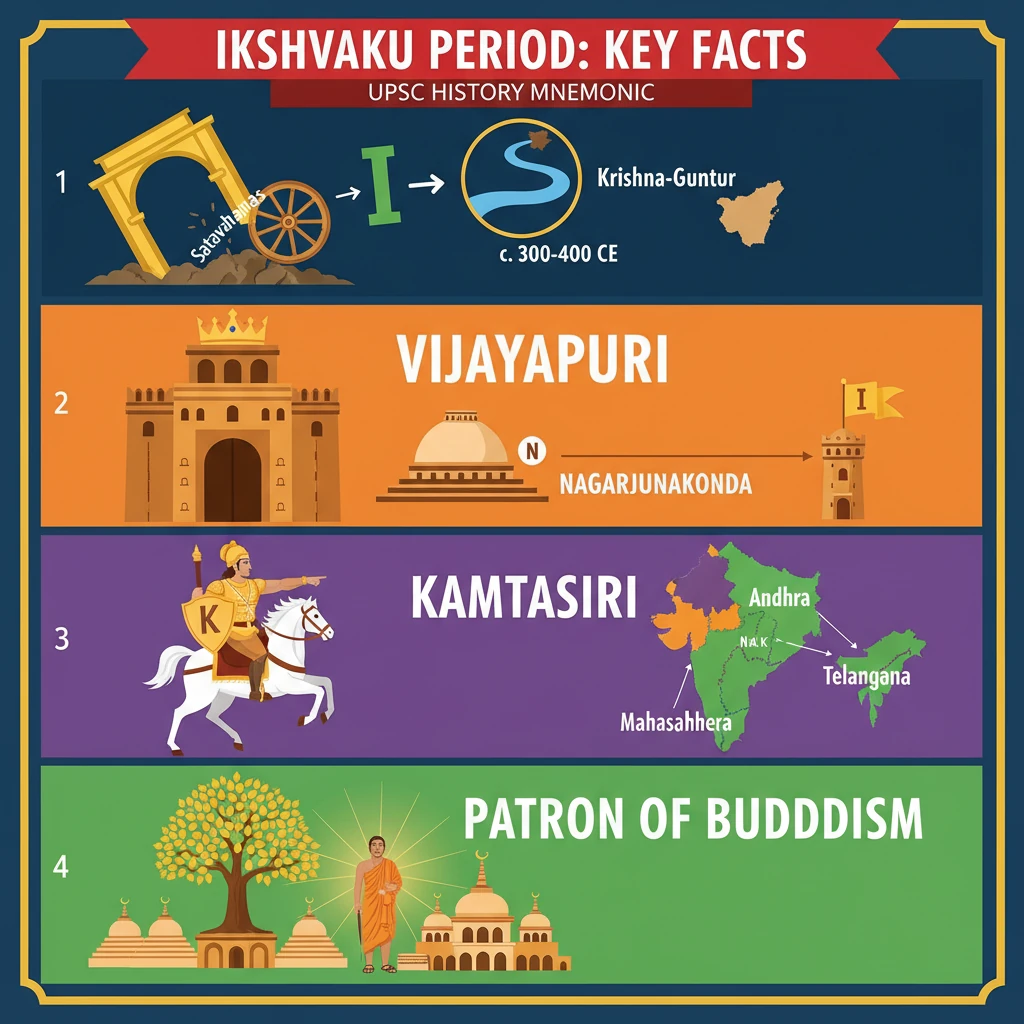
- •Ikshvakus emerged in the Krishna-Guntur region after the decline of the Satavahanas (c. 300-400 CE).
- •Their capital was Vijayapuri, often identified with Nagarjunakonda.
- •King Kamtasiri was instrumental in expanding their territory across parts of Andhra, Telangana, and Maharashtra.
- •The dynasty was a significant patron of Buddhism, leading to the construction of numerous stupas and monasteries.
- •Key Buddhist sites include Nagarjunakonda, Kanaganahalli, and Sankaram.
- •The Ikshvakus were eventually succeeded by the Pallavas.
🧠 Memory Techniques
95% Verified Content
📚 Reference Sources
•NCERT History Textbooks (Ancient India)
•A History of South India by K.A. Nilakanta Sastri