Maratha Administration under Shivaji: Central & Revenue Systems - History | UPSC Learning
Topics
0 topics • 0 completed
🔍
No topics match your search
Maratha Administration under Shivaji: Central & Revenue Systems
Medium⏱️ 8 min read
history
📖 Introduction
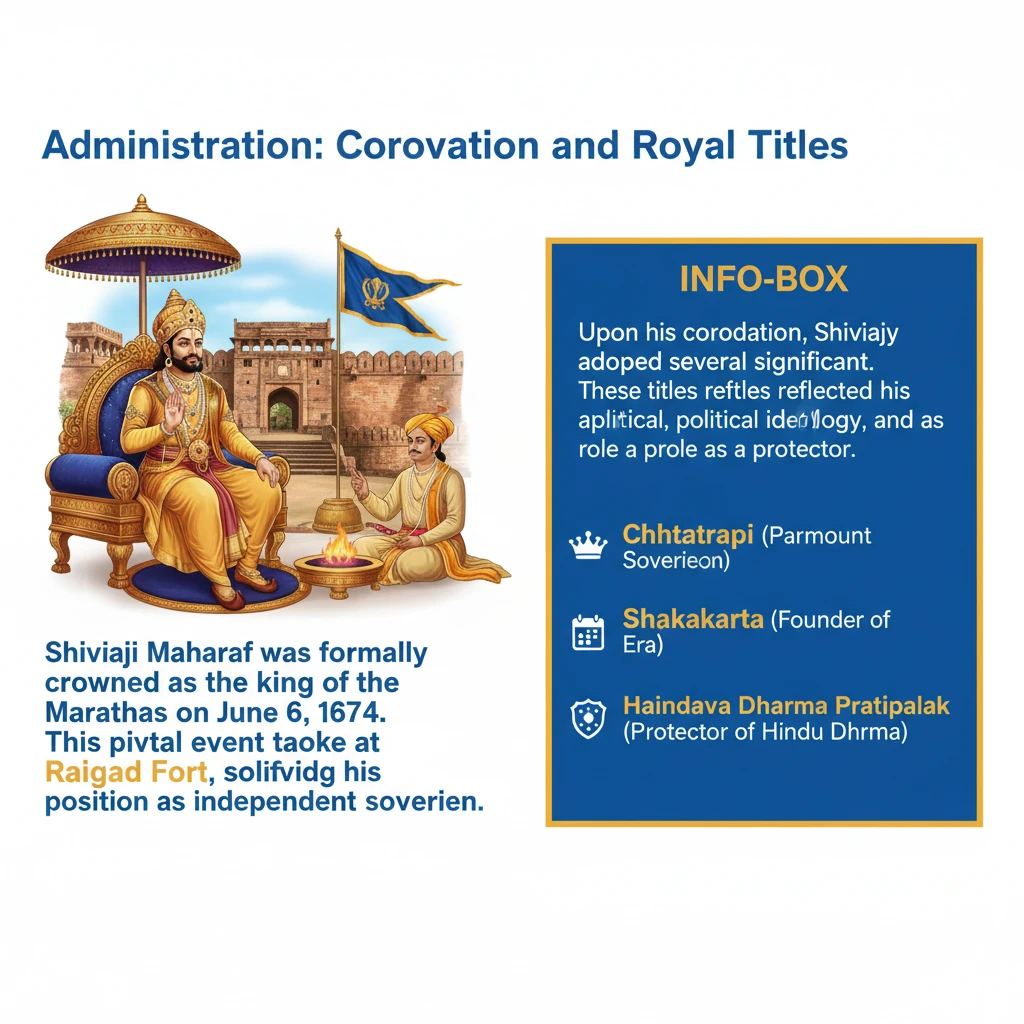
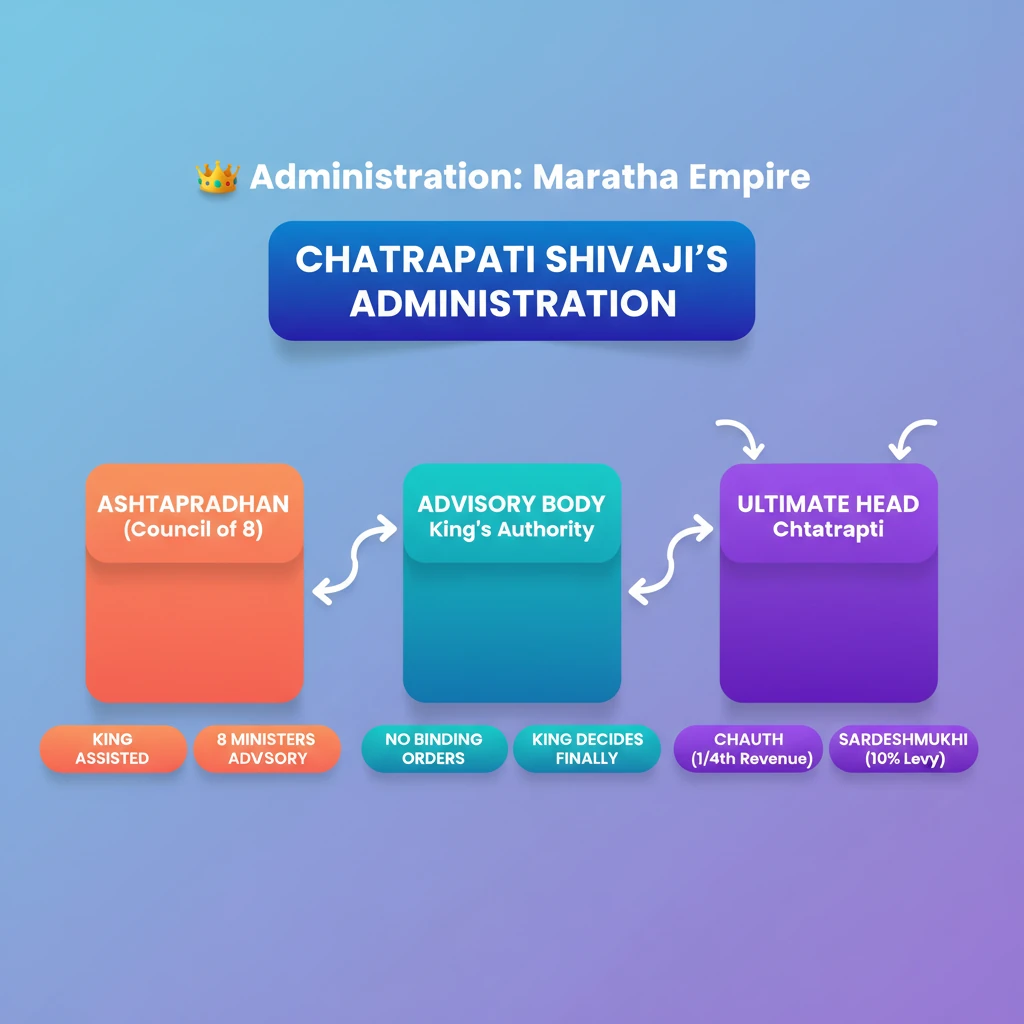
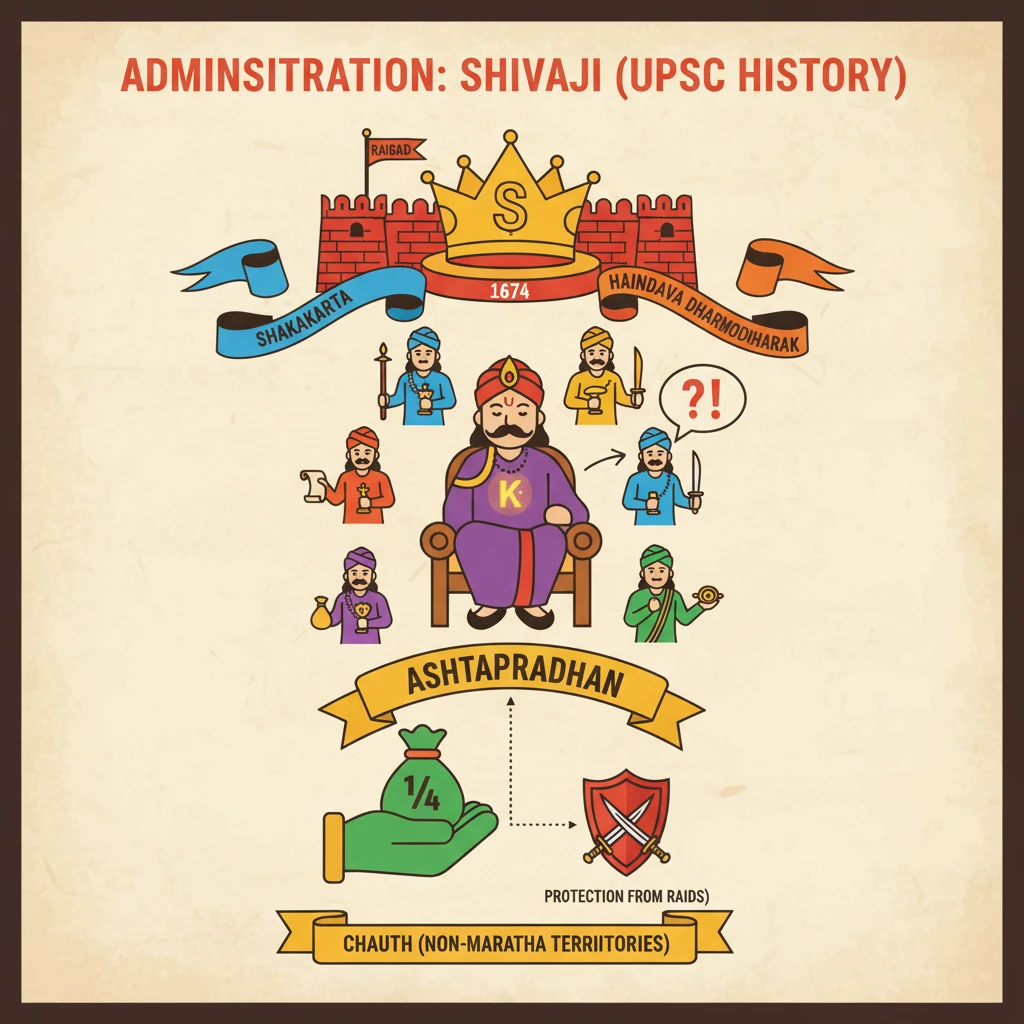
<h4>Coronation and Royal Titles</h4><p><strong>Shivaji Maharaj</strong> was formally crowned as the <strong>king</strong> of the <strong>Marathas</strong> on <strong>June 6, 1674</strong>. This pivotal event took place at <strong>Raigad Fort</strong>, solidifying his position as an independent sovereign.</p><div class='info-box'><p>Upon his coronation, <strong>Shivaji</strong> adopted several significant titles. These titles reflected his aspirations, political ideology, and role as a protector of his people and dharma.</p></div><div class='key-point-box'><p>He assumed the titles of <strong>Chhatrapati</strong> (Paramount Sovereign), <strong>Shakakarta</strong> (Founder of an Era), <strong>Kshatriya Kulavantas</strong> (Head of the Kshatriya Race), and <strong>Haindava Dharmoddharak</strong> (Protector of the Hindu Dharma).</p></div><h4>Central Administration: The Ashtapradhan</h4><p>The <strong>King</strong>, <strong>Chhatrapati Shivaji</strong>, was the supreme head of the state. He exercised ultimate authority in all administrative, military, and judicial matters.</p><p>To assist him in the complex task of governance, <strong>Shivaji</strong> established a council of eight ministers. This council was famously known as the <strong>'Ashtapradhan Mandal'</strong>.</p><div class='info-box'><p>The <strong>Ashtapradhan</strong> was not a cabinet in the modern sense, where decisions are taken by majority vote. Instead, it was an advisory council, and the final decision rested with the <strong>Chhatrapati</strong>.</p></div><div class='exam-tip-box'><p>Understanding the <strong>Ashtapradhan</strong> is crucial for <strong>UPSC Mains GS Paper 1</strong> (History) and <strong>GS Paper 2</strong> (Polity - comparison with modern cabinet systems). Note its advisory nature.</p></div><h4>Revenue Administration: Key Sources of Income</h4><p><strong>Shivaji's</strong> administration developed an effective revenue system to fund his military campaigns and state machinery. Two primary sources of income were <strong>Chauth</strong> and <strong>Sardeshmukhi</strong>.</p><div class='key-point-box'><p>These levies were crucial for maintaining the <strong>Maratha army</strong> and asserting their dominance over neighboring territories, without necessarily occupying them directly.</p></div><h4>Understanding Chauth</h4><p><strong>Chauth</strong> was a significant revenue demand that amounted to <strong>one-fourth (1/4th)</strong> of the total revenue of a territory. It was primarily collected from <strong>non-Maratha territories</strong>.</p><div class='info-box'><p>The payment of <strong>Chauth</strong> served as a safeguard. In return for this payment, <strong>Shivaji's forces</strong> guaranteed protection against raids and plunder in those specific regions.</p></div><div class='exam-tip-box'><p><strong>Chauth</strong> is often asked in <strong>UPSC Prelims</strong> as a direct definition. Remember it's <strong>1/4th</strong> and a protection levy.</p></div><h4>Understanding Sardeshmukhi</h4><p><strong>Sardeshmukhi</strong> was another important levy, representing an <strong>additional tax of 10%</strong> (or 1/10th) of the revenue. It was imposed on lands where the <strong>Marathas</strong> claimed hereditary rights.</p><div class='info-box'><p>The claim of hereditary rights was based on <strong>Shivaji's</strong> position as the <strong>Sardeshmukh</strong> (chief headman) of the entire <strong>Maratha land</strong>, justifying this extra collection.</p></div><div class='exam-tip-box'><p>Distinguish clearly between <strong>Chauth</strong> (protection from raids, 1/4th) and <strong>Sardeshmukhi</strong> (hereditary claim, 1/10th) for both <strong>Prelims</strong> and <strong>Mains</strong> answers.</p></div>
💡 Key Takeaways
- •Shivaji was crowned Chhatrapati in 1674 at Raigad, adopting titles like Shakakarta and Haindava Dharmoddharak.
- •Central administration was led by the King, assisted by the 'Ashtapradhan' (council of eight ministers).
- •Ashtapradhan was an advisory body, with the King holding ultimate authority.
- •Key revenue sources were Chauth (1/4th of revenue for protection from raids in non-Maratha territories).
- •Sardeshmukhi was an additional 10% levy on lands where Marathas claimed hereditary rights.
- •Shivaji's administration was crucial for consolidating Maratha power and funding state operations.
🧠 Memory Techniques
95% Verified Content
📚 Reference Sources
•NCERT History Textbooks (Class XI/XII)
•Standard Reference Books on Indian History (e.g., Satish Chandra, Bipin Chandra)