Vijayanagara Empire: Portuguese Relations, Trade, and Military Aid - History | UPSC Learning
Topics
0 topics • 0 completed
🔍
No topics match your search
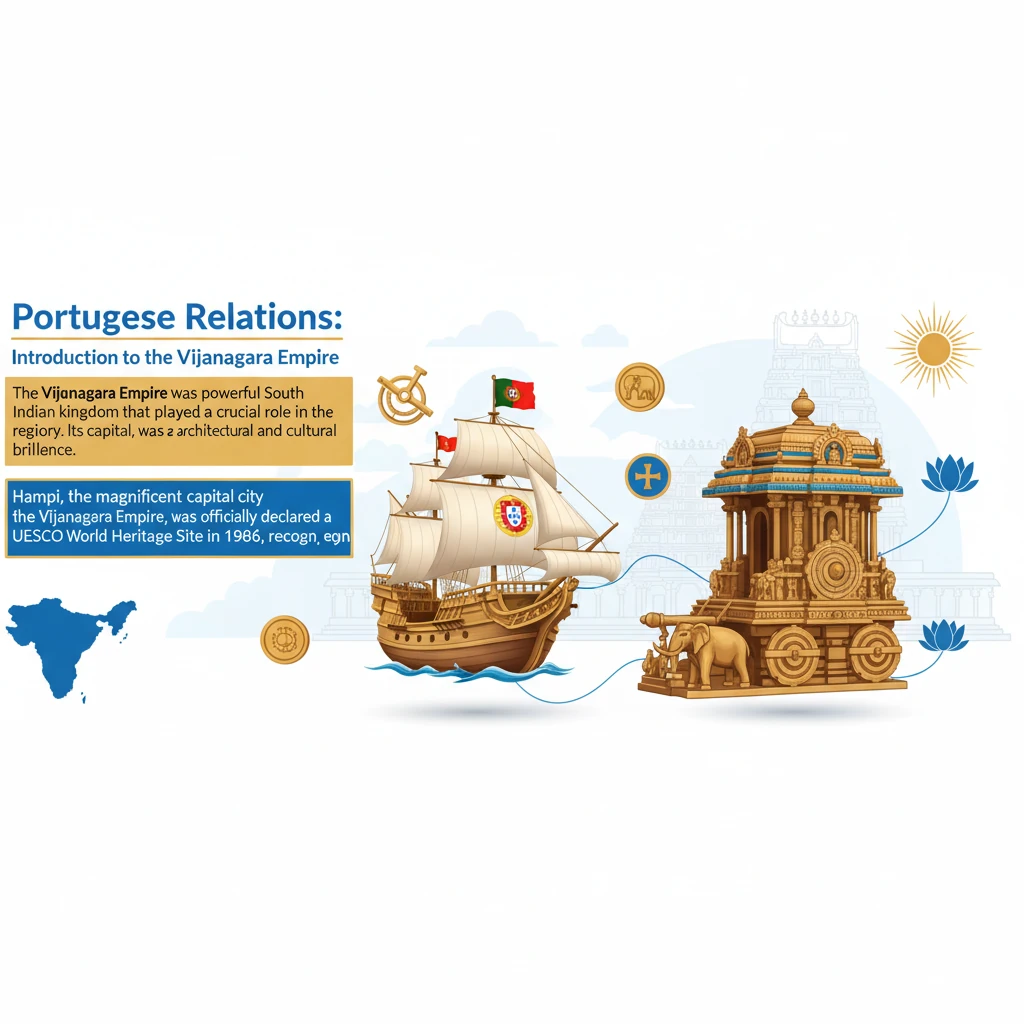
Vijayanagara Empire: Portuguese Relations, Trade, and Military Aid
Medium⏱️ 8 min read
history
📖 Introduction
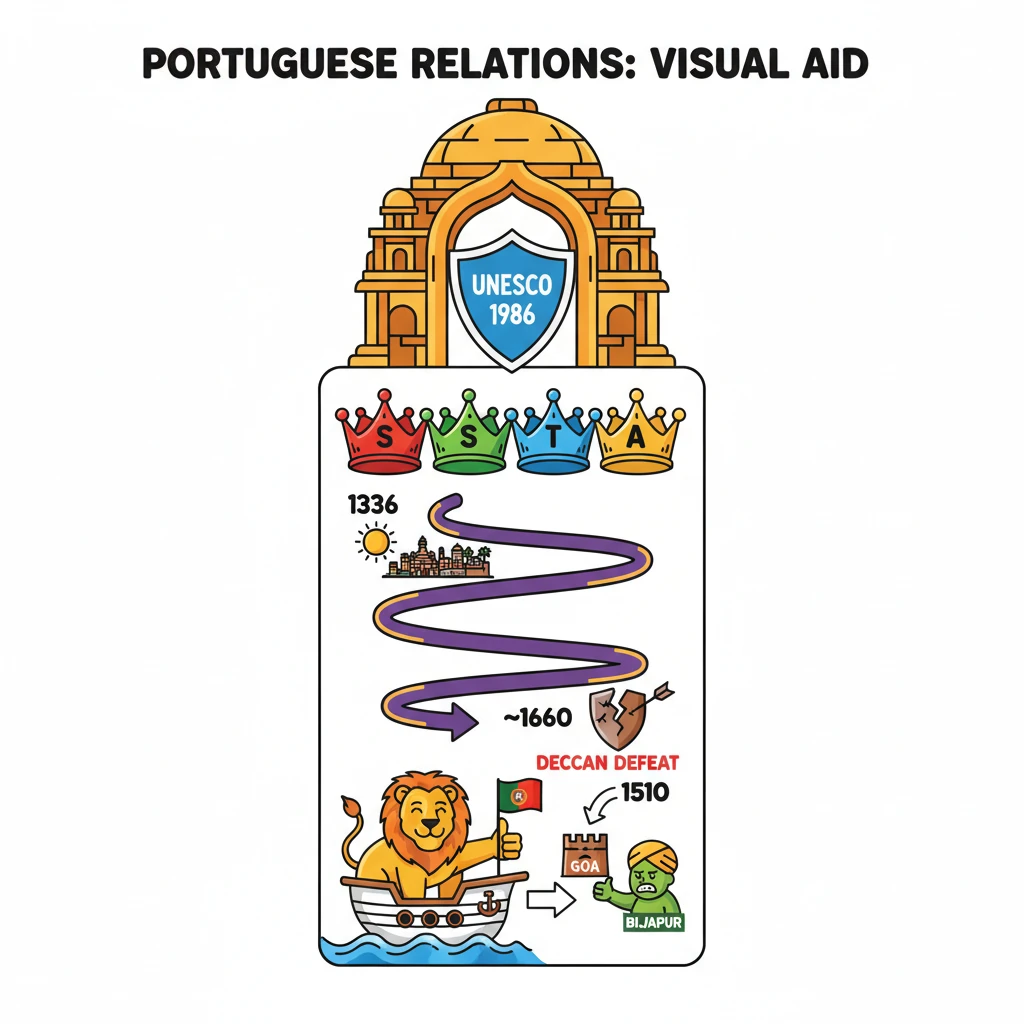
<h4>Introduction to the Vijayanagara Empire</h4><p>The <strong>Vijayanagara Empire</strong> was a powerful South Indian kingdom that played a crucial role in the region's history. Its capital, <strong>Hampi</strong>, was a center of architectural and cultural brilliance.</p><div class="info-box"><p><strong>Hampi</strong>, the magnificent capital city of the <strong>Vijayanagara Empire</strong>, was officially declared a <strong>UNESCO World Heritage Site</strong> in <strong>1986</strong>, recognizing its outstanding universal value.</p></div><h4>Dynasties of Vijayanagara</h4><p>The empire witnessed the rule of four prominent dynasties, each contributing to its legacy and expansion.</p><ul><li>The <strong>Sangama Dynasty</strong></li><li>The <strong>Saluva Dynasty</strong></li><li>The <strong>Tuluva Dynasty</strong></li><li>The <strong>Aravidu Dynasty</strong></li></ul><h4>Timeline and Decline of the Empire</h4><p>The <strong>Vijayanagara Empire</strong> flourished from its establishment in <strong>1336</strong> until approximately <strong>1660</strong>. However, its final century was marked by a gradual but significant decline.</p><p>This decline was largely precipitated by a devastating defeat at the hands of an alliance of <strong>Deccan sultanates</strong>. Following this, the capital city, <strong>Hampi</strong>, was captured, extensively looted, and subsequently destroyed.</p><h4>Early Portuguese Engagement with Vijayanagara</h4><p>The arrival of the <strong>Portuguese</strong> in India in the early 16th century led to new political and economic dynamics, particularly with powerful regional kingdoms like <strong>Vijayanagara</strong>.</p><div class="key-point-box"><p>A significant event demonstrating this interaction occurred around <strong>1510</strong>, when the <strong>Portuguese</strong> successfully captured <strong>Goa</strong>. This strategic acquisition, previously under the <strong>Sultan of Bijapur</strong>, was achieved with the crucial support and cooperation of the <strong>Vijayanagara Empire</strong>.</p></div><h4>Trade and Military Exchange</h4><p>The relationship between the <strong>Portuguese</strong> and the <strong>Vijayanagara Empire</strong> was characterized by a mutually beneficial trade and military exchange.</p><ul><li><strong>Portuguese Supplies:</strong> The <strong>Portuguese</strong> were key suppliers of essential military assets, including modern <strong>guns</strong> and high-quality <strong>Arabian horses</strong>, which were vital for the empire's cavalry.</li><li><strong>Vijayanagara Exports:</strong> In return, the <strong>Vijayanagara Empire</strong> exported a diverse range of valuable commodities, such as <strong>cotton</strong>, <strong>rice</strong>, <strong>sugar</strong>, various <strong>spices</strong>, <strong>indigo</strong>, and different types of <strong>wooden goods</strong>.</li></ul><div class="exam-tip-box"><p>Understanding these specific trade items and military alliances is crucial for <strong>UPSC Prelims</strong> and for enriching answers in <strong>UPSC Mains GS Paper 1 (History)</strong> on the economic and political impact of early European presence in India.</p></div>
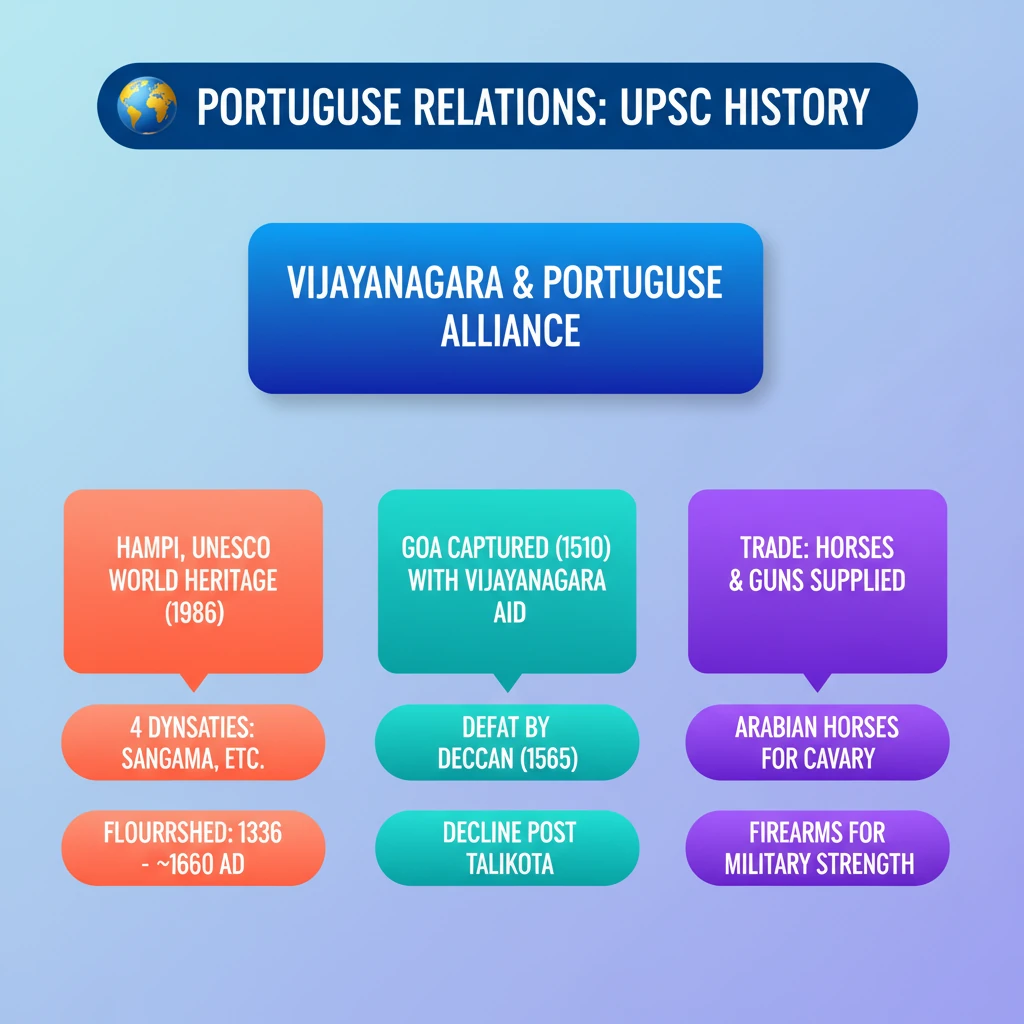
💡 Key Takeaways
- •Hampi, the capital of the Vijayanagara Empire, is a UNESCO World Heritage Site (1986).
- •Four dynasties ruled Vijayanagara: Sangama, Saluva, Tuluva, and Aravidu.
- •The empire flourished from 1336 to ~1660, declining after a major defeat by Deccan sultanates.
- •Portuguese captured Goa around 1510 from Bijapur, with crucial support from Vijayanagara.
- •Portuguese supplied guns and Arabian horses to Vijayanagara.
- •Vijayanagara exported cotton, rice, sugar, spices, indigo, and wooden goods to the Portuguese.
🧠 Memory Techniques
98% Verified Content
📚 Reference Sources
•NCERT History Textbooks (assumed general knowledge base for UPSC)
•Standard academic texts on Medieval Indian History and European Colonialism