Stratigraphical and Typological Studies of Coins - History | UPSC Learning
Topics
0 topics • 0 completed
🔍
No topics match your search
Stratigraphical and Typological Studies of Coins
Medium⏱️ 8 min read
history
📖 Introduction
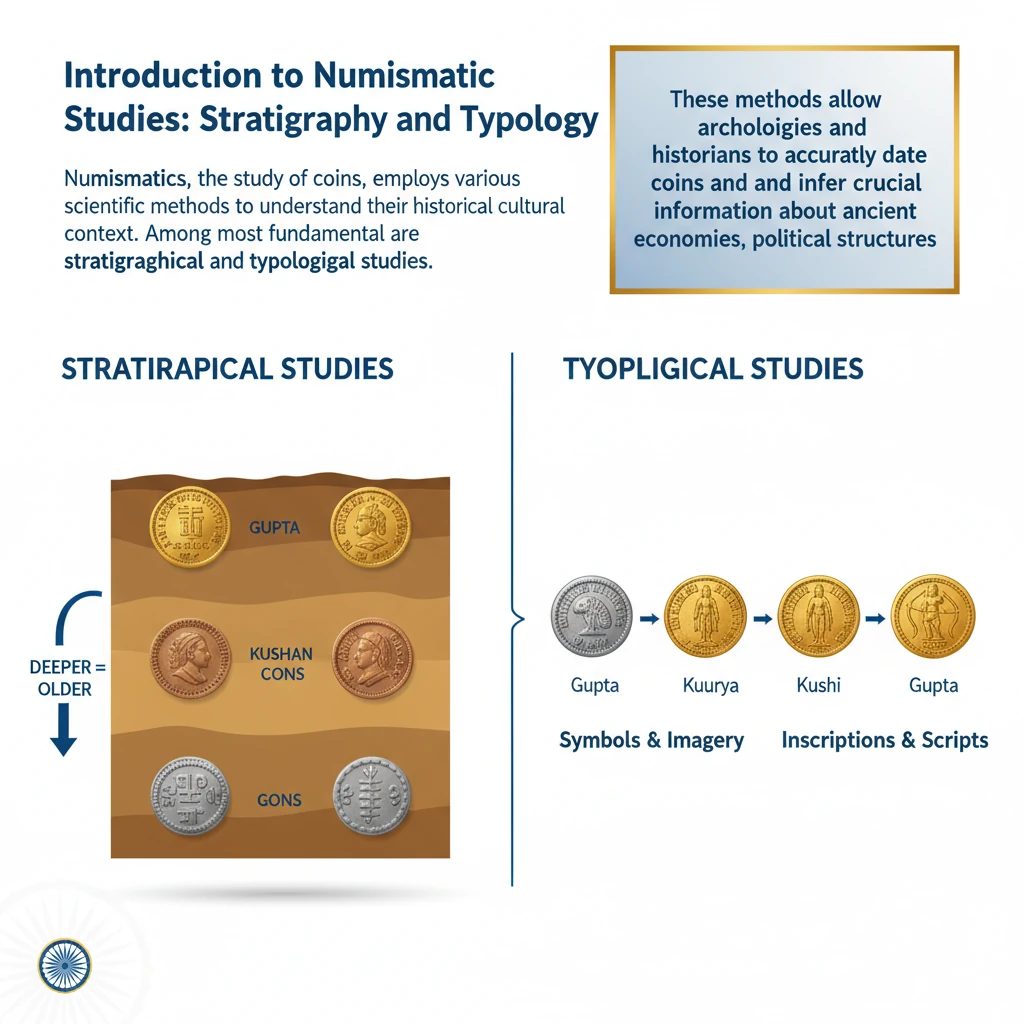
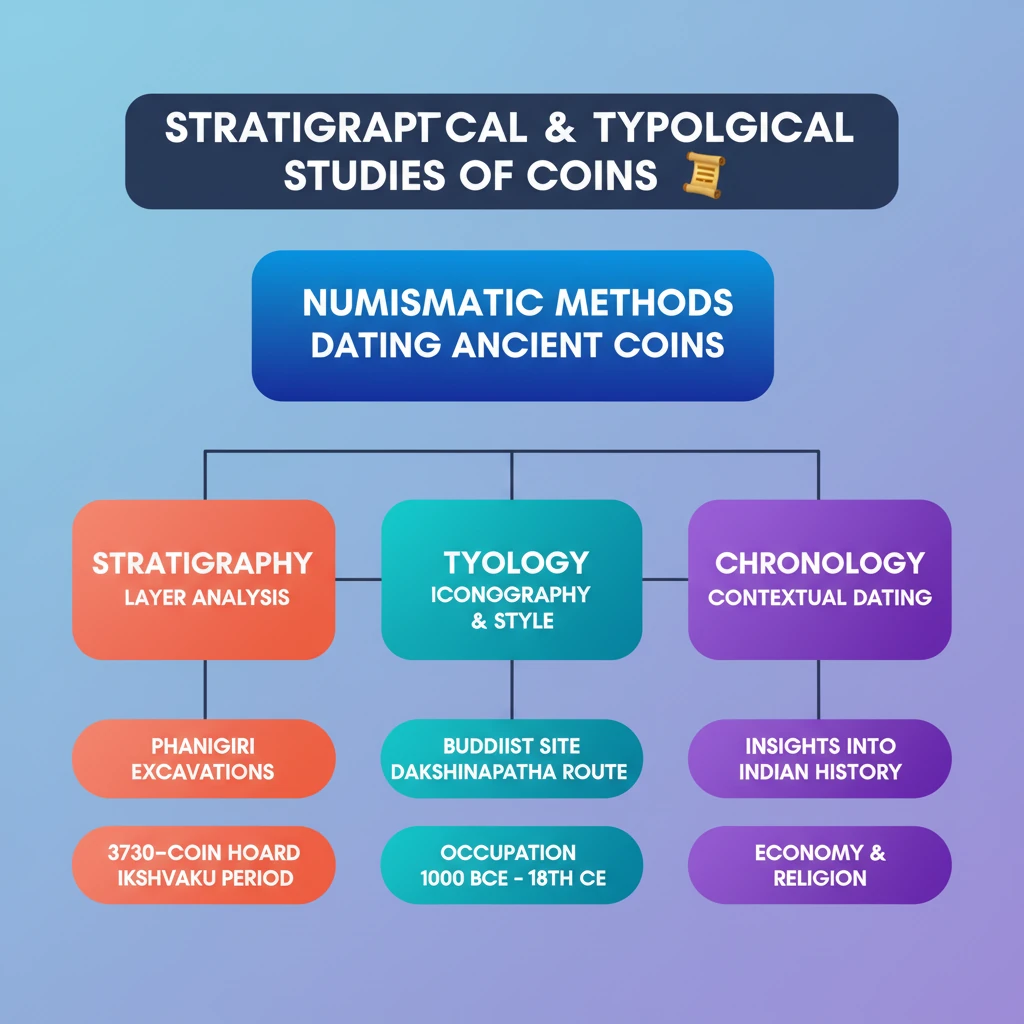
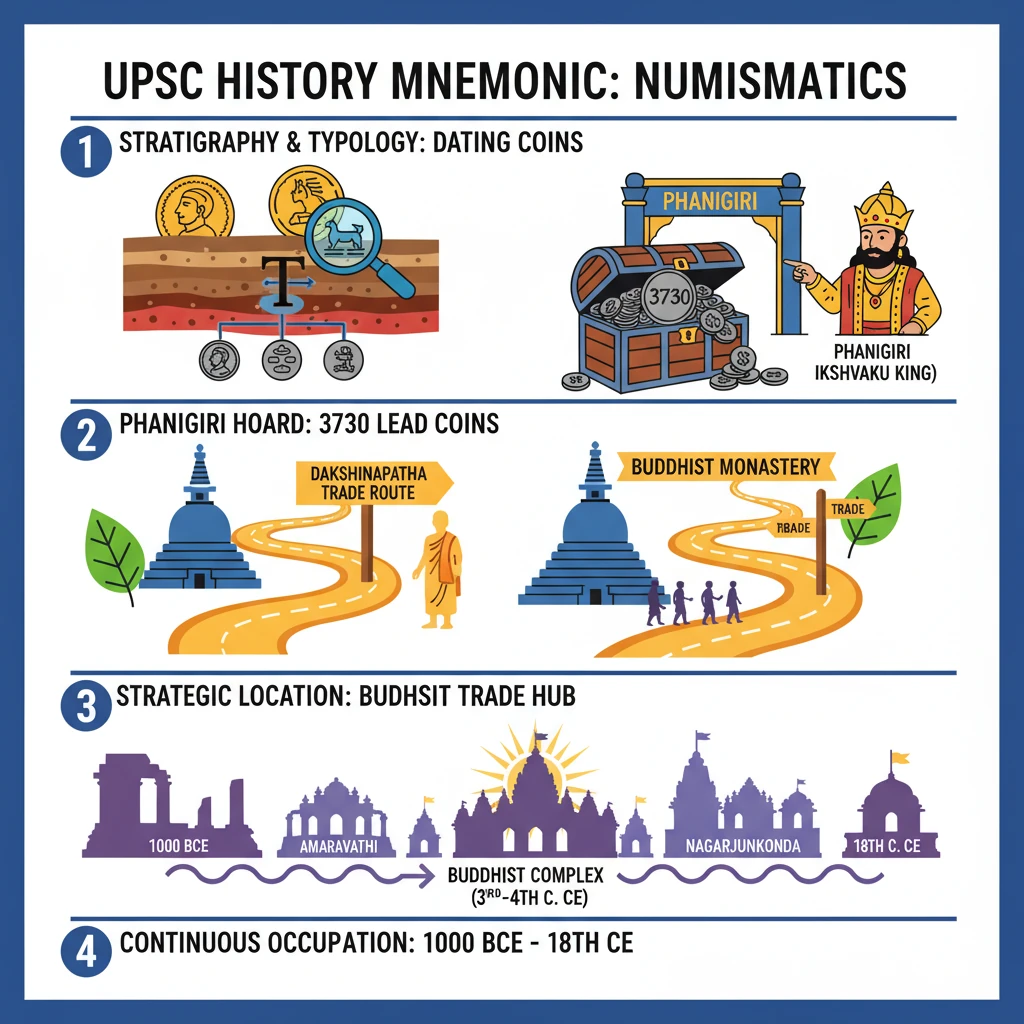
<h4>Introduction to Numismatic Studies: Stratigraphy and Typology</h4><p><strong>Numismatics</strong>, the study of coins, employs various scientific methods to understand their historical and cultural context. Among the most fundamental are <strong>stratigraphical</strong> and <strong>typological studies</strong>.</p><div class='key-point-box'><p>These methods allow archaeologists and historians to accurately date coins and infer crucial information about ancient economies, political structures, and artistic traditions.</p></div><h4>The Phanigiri Coin Hoard: A Significant Discovery</h4><p>During archaeological excavations at <strong>Phanigiri village</strong>, a remarkable hoard of coins was discovered. This find provides a practical illustration of these numismatic techniques.</p><p>The coins were found within a pot, which was carefully sealed with a shallow pot on the outside and a broken bowl base on the inside, indicating intentional burial.</p><div class='info-box'><p><strong>Hoard Details:</strong></p><ul><li><strong>Quantity:</strong> 3730 coins</li><li><strong>Average Weight:</strong> 2.3 grams each</li><li><strong>Material:</strong> Lead</li><li><strong>Obverse Symbol:</strong> Elephant</li><li><strong>Reverse Symbol:</strong> Ujjaini symbol</li></ul></div><p>Based on their appearance, material, and symbols, and critically, the archaeological layer in which they were found, these coins have been attributed to the <strong>Ikshvaku period</strong>.</p><div class='key-point-box'><p>Archaeologists conclude that all coins belong to the <strong>Ikshvaku period</strong> (<strong>3rd–4th century CE</strong>) based on both <strong>stratigraphical</strong> and <strong>typological studies</strong>.</p></div><h4>Other Artefacts Unearthed at Phanigiri</h4><p>Beyond the coin hoard, the excavations at <strong>Phanigiri</strong> brought to light a wealth of other cultural antiquities and structural remains, enriching our understanding of the site.</p><ul><li><strong>Beads:</strong> Stone and glass beads</li><li><strong>Bangle Fragments:</strong> Shell bangle pieces</li><li><strong>Decorative Elements:</strong> Stucco motifs</li><li><strong>Sculptures:</strong> Broken limestone sculptures</li><li><strong>Daily Life Items:</strong> Toy cartwheels, iron nails, pottery</li></ul><h4>Earlier Excavations and Discoveries</h4><p>The site of <strong>Phanigiri</strong> has been a subject of extensive archaeological work over several field seasons, revealing a comprehensive picture of its past.</p><p>Previous excavations uncovered a significant Buddhist monastic complex, highlighting the site's religious importance.</p><ul><li><strong>Major Structures:</strong> A <strong>Mahastupa</strong>, apsidal <strong>Chaitya Grihas</strong>, <strong>Votive stupas</strong>, pillared congregation halls, <strong>Viharas</strong>, platforms with staircases, and an octagonal stupa <strong>Chaitya</strong>.</li><li><strong>Associated Structures:</strong> A <strong>24-pillared mandapa</strong> and a <strong>circular chaitya</strong>.</li><li><strong>Cultural Materials:</strong> Terracotta beads, semi-precious beads, iron objects, shell bangle pieces, coins, stucco figures, <strong>Brahmi label inscriptions</strong>, and a <strong>holy relic casket</strong>.</li></ul><h4>Significance and Location of Phanigiri Village</h4><p><strong>Phanigiri village</strong> holds immense historical and geographical significance, situated strategically in the Deccan region.</p><p>It is located on the left bank of the <strong>Bikkeru Rivulet</strong>, a tributary of the <strong>Musi River</strong>, near <strong>Hyderabad</strong>.</p><div class='info-box'><p><strong>Etymology of Phanigiri:</strong></p><ul><li>The village name derives from a hillock on its northern side resembling a <strong>snake hood</strong>.</li><li>In <strong>Sanskrit</strong>, <strong>Phani</strong> means 'snake' and <strong>Giri</strong> means 'hillock'.</li></ul></div><p>Its location on a hilltop along the ancient trade route known as <strong>Dakshinapatha</strong>, which connected northern and southern India, made it a crucial hub.</p><div class='key-point-box'><p>This strategic position fostered its development as an important <strong>Buddhist monastery</strong>, facilitating cultural and economic exchange.</p></div><h4>Historical Occupation of Phanigiri</h4><p>The site of <strong>Phanigiri</strong> boasts a long and vibrant history of human occupation, spanning millennia.</p><p>It was continuously inhabited by various communities from the <strong>pre/proto-historic</strong>, <strong>early historic</strong>, <strong>early medieval</strong>, and <strong>Asaf Jahi period</strong> (<strong>1724-1948 CE</strong>).</p><div class='info-box'><p><strong>Period of Vibrant Life:</strong> From <strong>1000 BCE</strong> to the <strong>late 18th century CE</strong>.</p></div><p>The evolved <strong>Buddhist monastery</strong> at <strong>Phanigiri</strong> is considered to surpass the grandeur and scale of other renowned monasteries like <strong>Amaravathi</strong> and <strong>Vijayapuri</strong> (<strong>Nagarjunakonda</strong>) in <strong>Andhra Pradesh</strong>.</p><p>The early historic site was first discovered and protected during the <strong>Nizam's period</strong> and subsequently excavated by <strong>Sri Khaja Mahamad Ahmad</strong> from <strong>1941 to 1944</strong>.</p><h4>Other Buddhist Sites in the Region</h4><p>The region surrounding <strong>Phanigiri</strong> is rich in Buddhist heritage, with several other significant sites nearby.</p><ul><li><strong>Nearby Buddhist Sites:</strong> <strong>Vardhamanukota</strong>, <strong>Gajula Banda</strong>, <strong>Tirumalagiri</strong>, <strong>Nagaram</strong>, <strong>Singaram</strong>, <strong>Aravapalli</strong>, <strong>Ayyavaripalli</strong>, <strong>Arlagaddagudem</strong>, and <strong>Yeleswaram</strong>.</li></ul>
💡 Key Takeaways
- •Stratigraphical and Typological studies are core numismatic methods for dating and classifying ancient coins.
- •The Phanigiri excavations revealed a significant 3730-coin lead hoard attributed to the Ikshvaku period (3rd–4th century CE).
- •Phanigiri was a major Buddhist monastery strategically located on the ancient Dakshinapatha trade route.
- •The site shows continuous occupation from 1000 BCE to the late 18th century CE, with a vibrant Buddhist complex surpassing Amaravathi and Nagarjunakonda.
- •Archaeological finds at Phanigiri, including coins and structural remains, provide invaluable insights into ancient Indian history, economy, and religious practices.
- •Numismatic evidence helps reconstruct political, economic, and cultural aspects of ancient dynasties like the Ikshvakus.
🧠 Memory Techniques
95% Verified Content