What are the Key Facts Regarding Punishments for Offences Under Sati Commission of Sati (Prevention) Act, 1987? - History | UPSC Learning
Topics
0 topics • 0 completed
🔍
No topics match your search
What are the Key Facts Regarding Punishments for Offences Under Sati Commission of Sati (Prevention) Act, 1987?
Medium⏱️ 6 min read
history
📖 Introduction
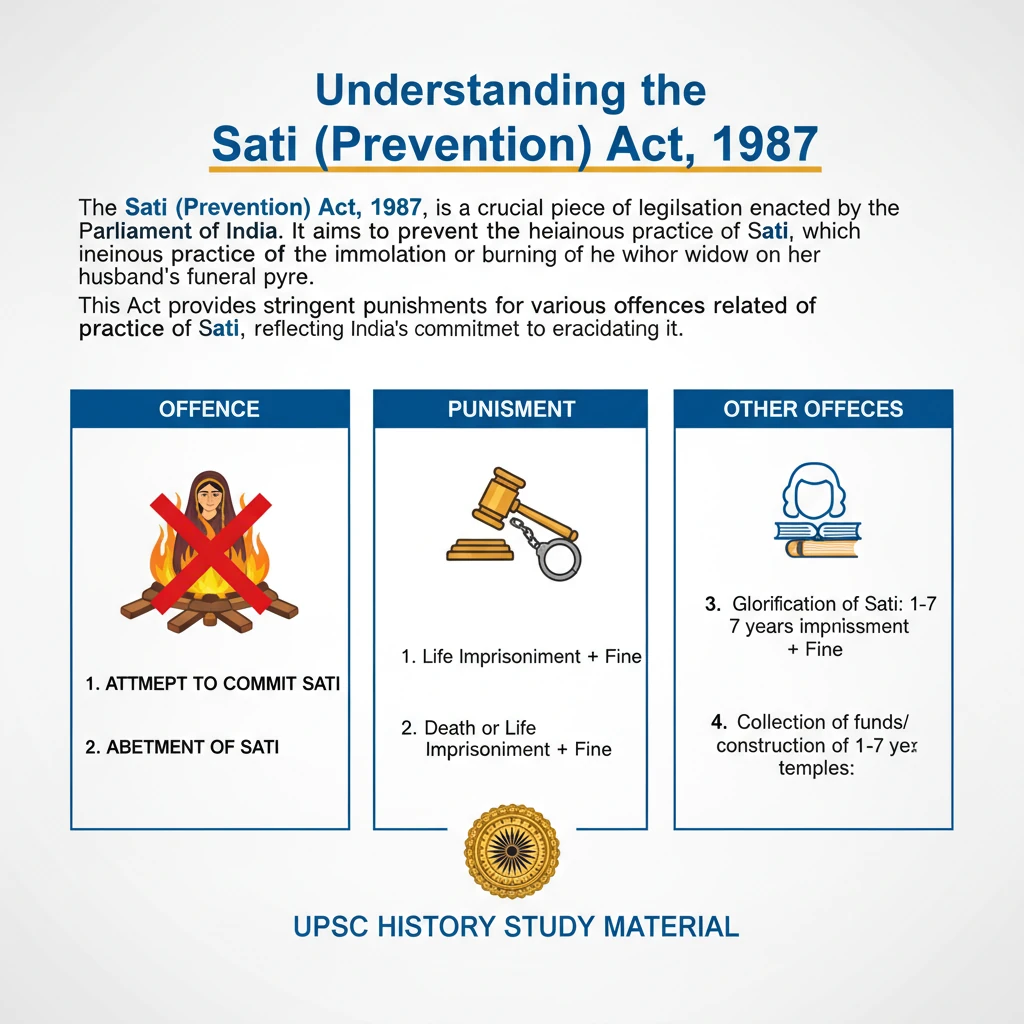
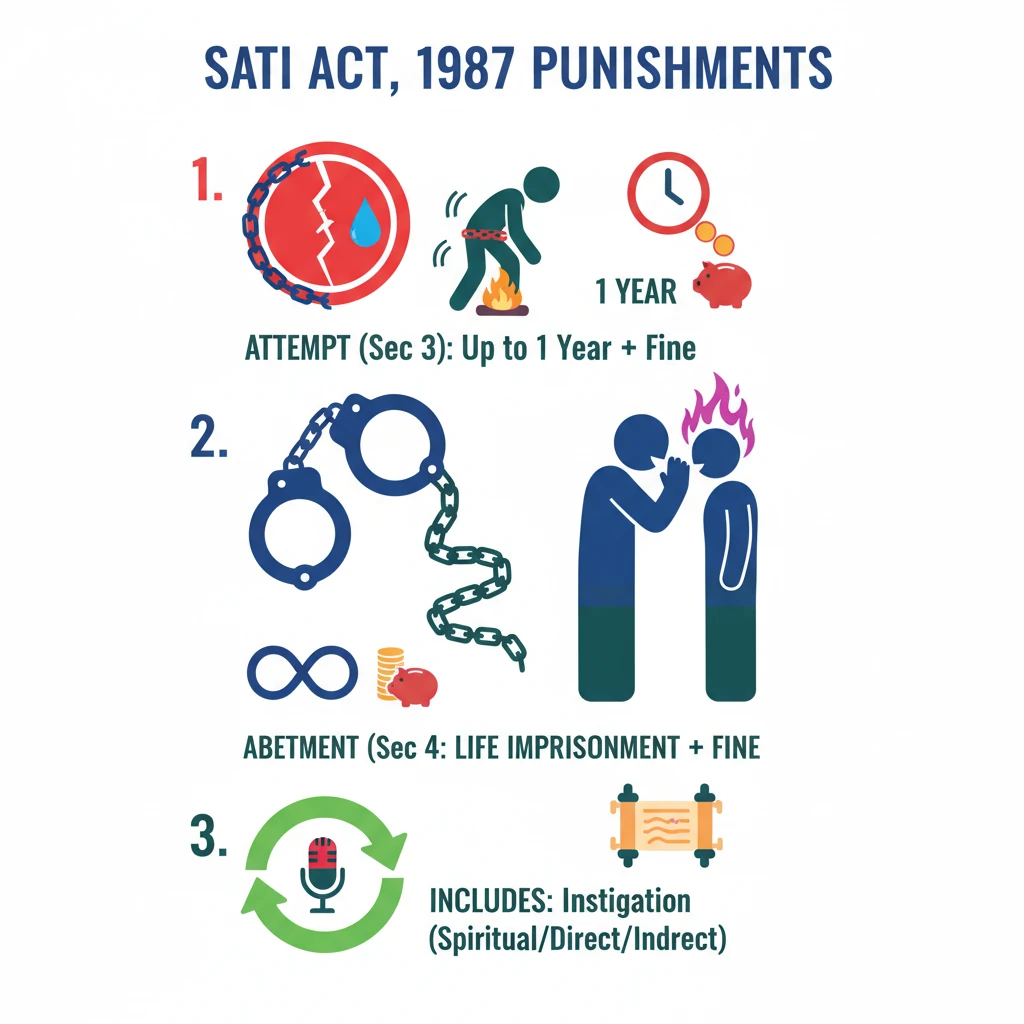
<h4>Understanding the <strong>Sati (Prevention) Act, 1987</strong></h4><p>The <strong>Sati (Prevention) Act, 1987</strong>, is a crucial piece of legislation enacted by the Parliament of India. It aims to prevent the heinous practice of <strong>Sati</strong>, which involves the immolation or burning of a widow on her husband's funeral pyre.</p><p>This Act provides stringent punishments for various offences related to the practice of <strong>Sati</strong>, reflecting India's commitment to eradicating this social evil and upholding human dignity.</p><h4>Punishment for <strong>Attempt to Commit Sati</strong></h4><p><strong>Section 3</strong> of the <strong>Sati (Prevention) Act, 1987</strong>, specifically addresses the act of attempting to commit <strong>Sati</strong>. It criminalizes any individual who takes direct action towards performing <strong>Sati</strong>.</p><div class='info-box'><p><strong>Penalty for Attempt to Commit Sati:</strong></p><ul><li>Up to <strong>one year of imprisonment</strong>.</li><li>A <strong>fine</strong>.</li><li>Or <strong>both</strong>.</li></ul></div><p>This provision ensures that even the initiation of such a practice is met with legal consequences, acting as a deterrent.</p><h4>Punishment for <strong>Abetment of Sati</strong></h4><p>The Act also targets those who encourage or facilitate the practice of <strong>Sati</strong>. <strong>Section 4</strong> deals with the offence of <strong>abetment of Sati</strong>, recognizing that such a practice often involves external pressure or instigation.</p><div class='info-box'><p><strong>Penalty for Abetment of Sati:</strong></p><ul><li><strong>Life imprisonment</strong>.</li><li>A <strong>fine</strong>.</li></ul></div><p><strong>Abetment</strong> can be direct or indirect, encompassing any act that leads a person to commit <strong>Sati</strong>. This includes psychological persuasion or creating an environment where <strong>Sati</strong> is seen as honorable.</p><div class='key-point-box'><p><strong>Example of Abetment:</strong> Convincing a widow or woman that committing <strong>Sati</strong> would bring spiritual benefits for her or her deceased husband, or improve the family’s well-being, falls under the definition of <strong>abetment</strong>.</p></div><div class='exam-tip-box'><p>For <strong>UPSC Mains GS-I (Social Issues)</strong>, understanding the specific sections and their punishments demonstrates a comprehensive grasp of legal frameworks against social evils. Highlight the distinction between 'attempt' and 'abetment' in your answers.</p></div>
💡 Key Takeaways
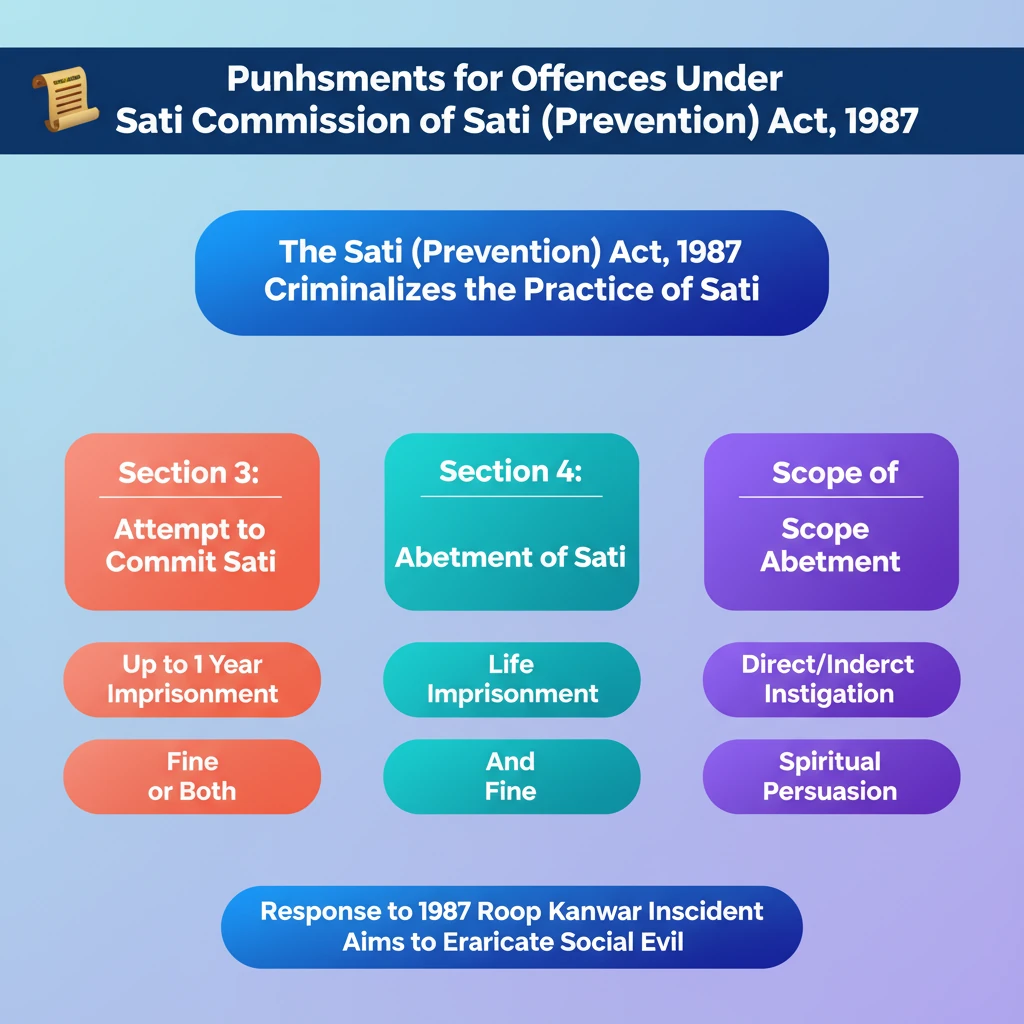
- •The Sati (Prevention) Act, 1987, criminalizes the practice of Sati.
- •Section 3 punishes 'attempt to commit Sati' with up to one year imprisonment, a fine, or both.
- •Section 4 punishes 'abetment of Sati' with life imprisonment and a fine.
- •Abetment includes direct or indirect instigation, such as spiritual persuasion.
- •The Act was a response to the Roop Kanwar incident of 1987 and aims to eradicate this social evil.
- •It reflects India's commitment to human rights, gender equality, and social justice.
🧠 Memory Techniques
98% Verified Content
📚 Reference Sources
•Drishti IAS Study Material (provided source text)
•Indian Penal Code (IPC) - relevant sections for context on abetment