What was the Sati System - History | UPSC Learning
Topics
0 topics • 0 completed
🔍
No topics match your search
What was the Sati System
Easy⏱️ 7 min read
history
📖 Introduction
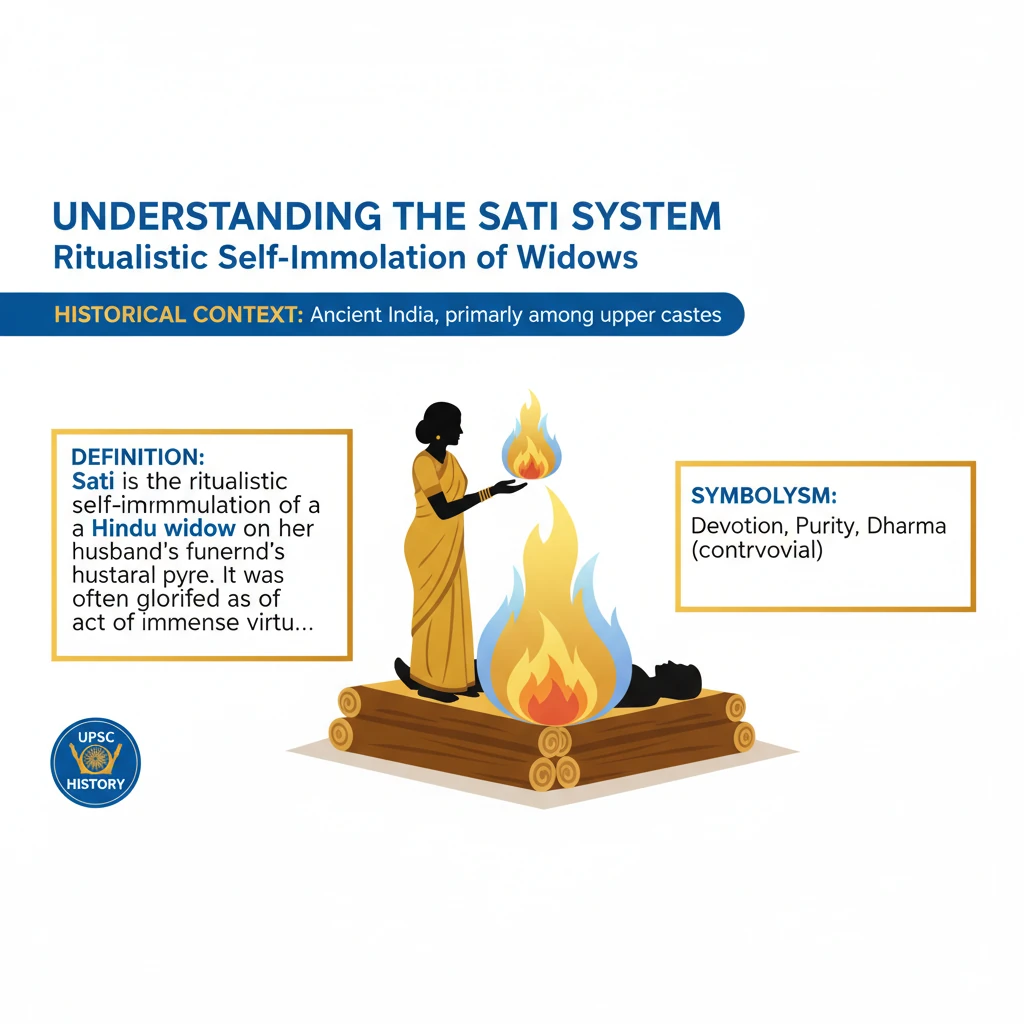
<h4>Definition of Sati System</h4><p><strong>Sati</strong> refers to the historical practice where a <strong>widow immolated herself</strong> on the cremation pyre of her deceased husband. This act was often driven by social pressure or religious belief.</p><div class='key-point-box'><p>After the immolation, a <strong>memorial stone</strong> and often a shrine were erected for the woman, and she was sometimes worshipped as a <strong>Goddess</strong>, signifying a complex interplay of grief, devotion, and social ritual.</p></div><h4>First Epigraphical Evidence of Sati</h4><p>The earliest known epigraphical evidence of <strong>Sati</strong> has been discovered from the <strong>Eran Pillar Inscription</strong>. This inscription is located in <strong>Eran, Madhya Pradesh</strong>.</p><div class='info-box'><p>The inscription dates back to <strong>510 AD</strong> and mentions the practice in relation to <strong>Bhānugupta</strong>. This provides crucial historical proof of its existence.</p></div><div class='exam-tip-box'><p>The <strong>Eran Pillar Inscription (510 AD)</strong> is a key factual detail for UPSC Prelims, especially for ancient Indian history. Remember the location: <strong>Eran, Madhya Pradesh</strong>.</p></div><h4>Early Efforts to Abolish Sati</h4><p>Various rulers and empires made efforts to curb the practice of <strong>Sati</strong> even before the British colonial period. These efforts highlight a long-standing societal debate.</p><ul><li><strong>Mughal Empire:</strong> In <strong>1582</strong>, Emperor <strong>Akbar</strong> issued orders to his officials across the empire to prevent the forced immolation of women.</li><li><strong>Akbar's Reforms:</strong> He also provided incentives like <strong>pensions, gifts, and rehabilitation</strong> to widows to discourage them from performing <strong>Sati</strong>.</li><li><strong>Sikh Empire:</strong> <strong>Sikh Guru Amar Das</strong>, during the <strong>15th-16th centuries</strong>, strongly condemned the practice of <strong>Sati</strong>, reflecting early religious opposition.</li><li><strong>Maratha Empire:</strong> The <strong>Marathas</strong> also took steps to ban <strong>Sati</strong> in their territories, indicating a regional awareness and action against the custom.</li></ul><h4>Colonial Powers and Sati Abolition</h4><p>Several European colonial powers in India also recognized the severity of <strong>Sati</strong> and implemented bans in their respective territories.</p><div class='info-box'><p>The <strong>Dutch, Portuguese, and French</strong> colonial administrations prohibited <strong>Sati</strong> within their colonies in India, demonstrating a collective disapproval of the practice.</p></div><h4>British Abolition of Sati</h4><p>The most significant legislative step against <strong>Sati</strong> came during the British colonial rule. This marked a pivotal moment in social reform.</p><div class='key-point-box'><p><strong>British Governor-General William Bentinck</strong> officially declared the practice of <strong>Sati illegal</strong> and punishable by criminal courts under the <strong>Bengal Sati Regulation, 1829</strong>. This made it a criminal offense.</p></div><h4>Other Legal Initiatives for Women's Position</h4><p>The movement against <strong>Sati</strong> was part of broader efforts to improve the position of women in Indian society. Other social evils were also targeted through legislation.</p><ul><li><strong>Female Infanticide:</strong> The <strong>Bengal Regulations of 1795 and 1804</strong> made infanticide illegal, equating it with murder.</li><li><strong>Registration Mandate:</strong> An <strong>1870 act</strong> further required parents to register all births and mandated verification of female infants for several years in areas prone to secret infanticide.</li><li><strong>Widow Remarriage:</strong> Driven by the relentless efforts of <strong>Pandit Ishwar Chandra Vidyasagar</strong>, the <strong>Hindu Widows’ Remarriage Act, 1856</strong> was passed.</li><li><strong>Legal Recognition:</strong> This act legalized the marriage of widows and recognized children from such marriages as legitimate, providing crucial social and legal support.</li></ul>
💡 Key Takeaways
- •Sati was the practice of a widow immolating herself on her husband's funeral pyre, often leading to her worship as a goddess.
- •First epigraphical evidence: Eran Pillar Inscription (510 AD) in Madhya Pradesh.
- •Early opposition: Mughal Emperor Akbar (1582), Sikh Guru Amar Das (15th-16th century), Maratha Empire, and other European colonial powers.
- •British abolition: Governor-General William Bentinck declared Sati illegal via the Bengal Sati Regulation, 1829, making it a criminal offense.
- •Other reforms for women: Bengal Regulations of 1795 & 1804 against female infanticide, and Hindu Widows’ Remarriage Act, 1856 (due to Ishwar Chandra Vidyasagar's efforts).
🧠 Memory Techniques

98% Verified Content
📚 Reference Sources
•Standard textbooks on Modern Indian History (e.g., Bipan Chandra, Spectrum)
•Academic articles on the history of Sati and social reforms in India