What are the Journey of Marathas after Shivaji? - History | UPSC Learning
Topics
0 topics • 0 completed
🔍
No topics match your search
What are the Journey of Marathas after Shivaji?
Easy⏱️ 5 min read
history
📖 Introduction
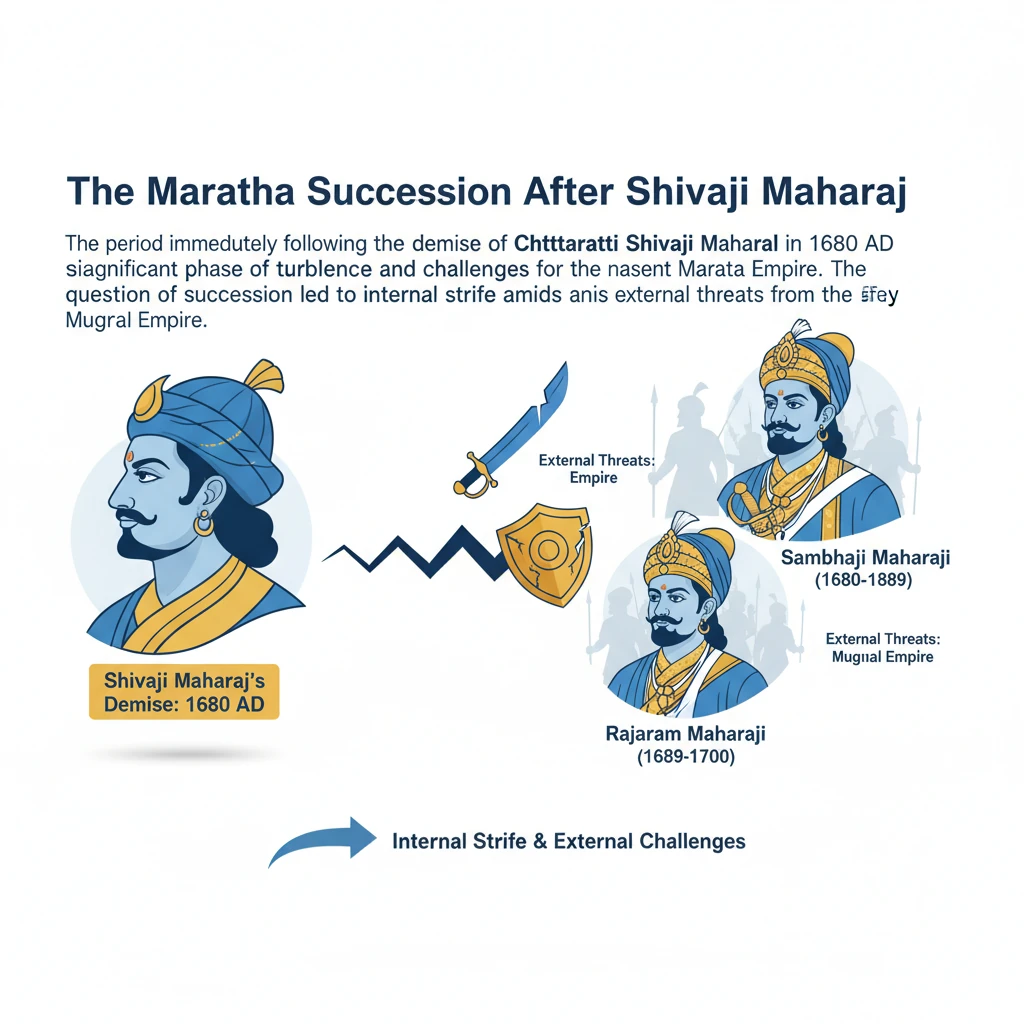
<h4>The Maratha Succession After Shivaji Maharaj</h4><p>The period immediately following the demise of <strong>Chhatrapati Shivaji Maharaj</strong> in <strong>1680 AD</strong> marked a significant phase of turbulence and challenges for the nascent <strong>Maratha Empire</strong>. The question of succession led to internal strife amidst external threats from the <strong>Mughal Empire</strong>.</p><div class='info-box'><p><strong>Shivaji Maharaj's Demise:</strong> <strong>Chhatrapati Shivaji Maharaj</strong> passed away in <strong>1680 AD</strong>, leaving behind a strong, yet young, Maratha state.</p></div><h4>Sambhaji Maharaj's Ascension and Reign</h4><p>Upon <strong>Shivaji's</strong> death, his elder son, <strong>Sambhaji</strong>, ascended to the throne. His reign was characterized by continuous warfare against the <strong>Mughals</strong> and efforts to consolidate the Maratha territories.</p><p>However, <strong>Sambhaji's</strong> rule was tragically cut short. He was captured by the <strong>Mughals</strong> and subsequently executed in <strong>1689 AD</strong>, a major blow to the Maratha cause.</p><div class='info-box'><p><strong>Sambhaji Maharaj's Reign:</strong> <strong>1680 AD - 1689 AD</strong>.</p><p><strong>Key Event:</strong> Captured and executed by <strong>Mughal Emperor Aurangzeb</strong> in <strong>1689 AD</strong>.</p></div><h4>The Era of Rajaram Maharaj and Regency</h4><p>Following <strong>Sambhaji's</strong> untimely death, the leadership of the <strong>Maratha Empire</strong> fell to <strong>Chhatrapati Rajaram Maharaj</strong>, <strong>Shivaji's</strong> younger brother. He initially ruled as a regent for <strong>Sambhaji's</strong> young son, <strong>Shahu</strong>, who was a captive of the <strong>Mughals</strong>.</p><p><strong>Rajaram's</strong> reign was primarily a period of intense resistance against the <strong>Mughal</strong> onslaught. He moved his capital to <strong>Gingee</strong> and continued the struggle, ensuring the survival of the Maratha spirit despite immense pressure.</p><div class='key-point-box'><p><strong>Chhatrapati Rajaram Maharaj:</strong> <strong>Shivaji's</strong> younger son, led the Marathas after <strong>Sambhaji's</strong> death. Crucial in maintaining Maratha resistance during the <strong>Mughal-Maratha War (War of 27 Years)</strong>.</p></div><div class='exam-tip-box'><p>UPSC often asks about the challenges faced by the <strong>Marathas</strong> immediately after <strong>Shivaji's</strong> death and the role of subsequent rulers in preserving the empire. Focus on the continuity of resistance.</p></div>
💡 Key Takeaways
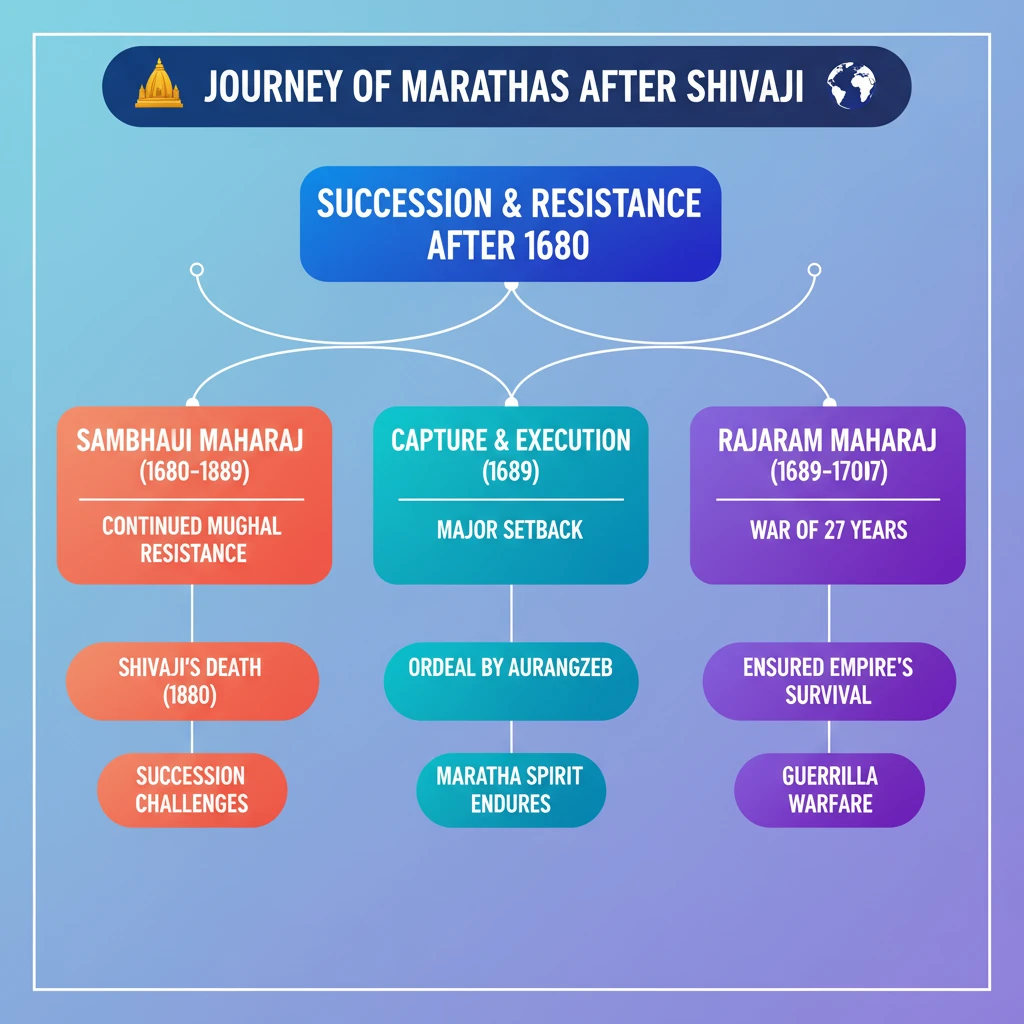
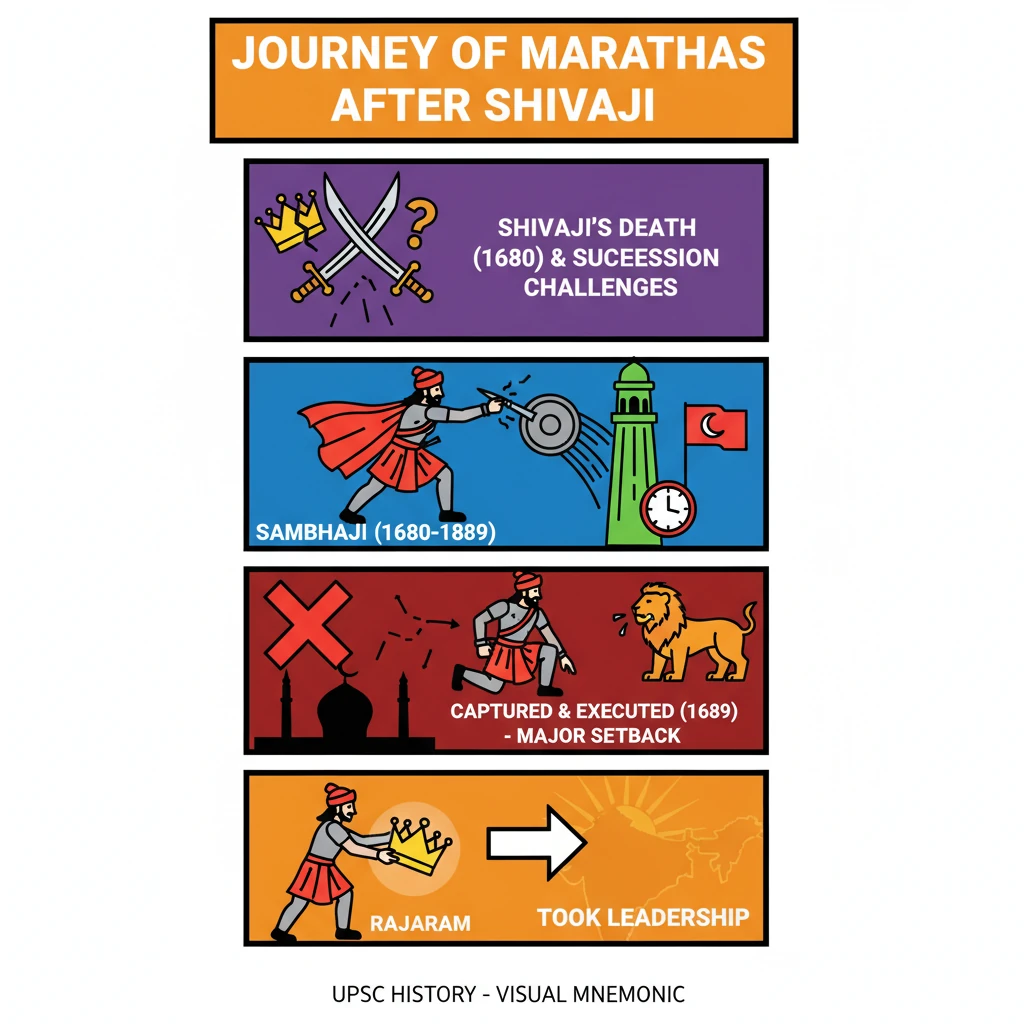
- •Shivaji's death in 1680 led to immediate succession challenges.
- •Sambhaji Maharaj ruled from 1680-1689, continuing resistance against Mughals.
- •Sambhaji was captured and executed by Mughals in 1689, a major setback.
- •Rajaram Maharaj, Shivaji's younger brother, took leadership after Sambhaji.
- •Rajaram led the Maratha resistance during the 'War of 27 Years' (1689-1707), ensuring the empire's survival.
🧠 Memory Techniques
95% Verified Content
📚 Reference Sources
•Standard Indian History textbooks for UPSC (e.g., Bipin Chandra, Satish Chandra for cross-verification of facts)