Dr. Rajendra Prasad - History | UPSC Learning
Topics
0 topics • 0 completed
🔍
No topics match your search
Dr. Rajendra Prasad
Medium⏱️ 8 min read
history
📖 Introduction
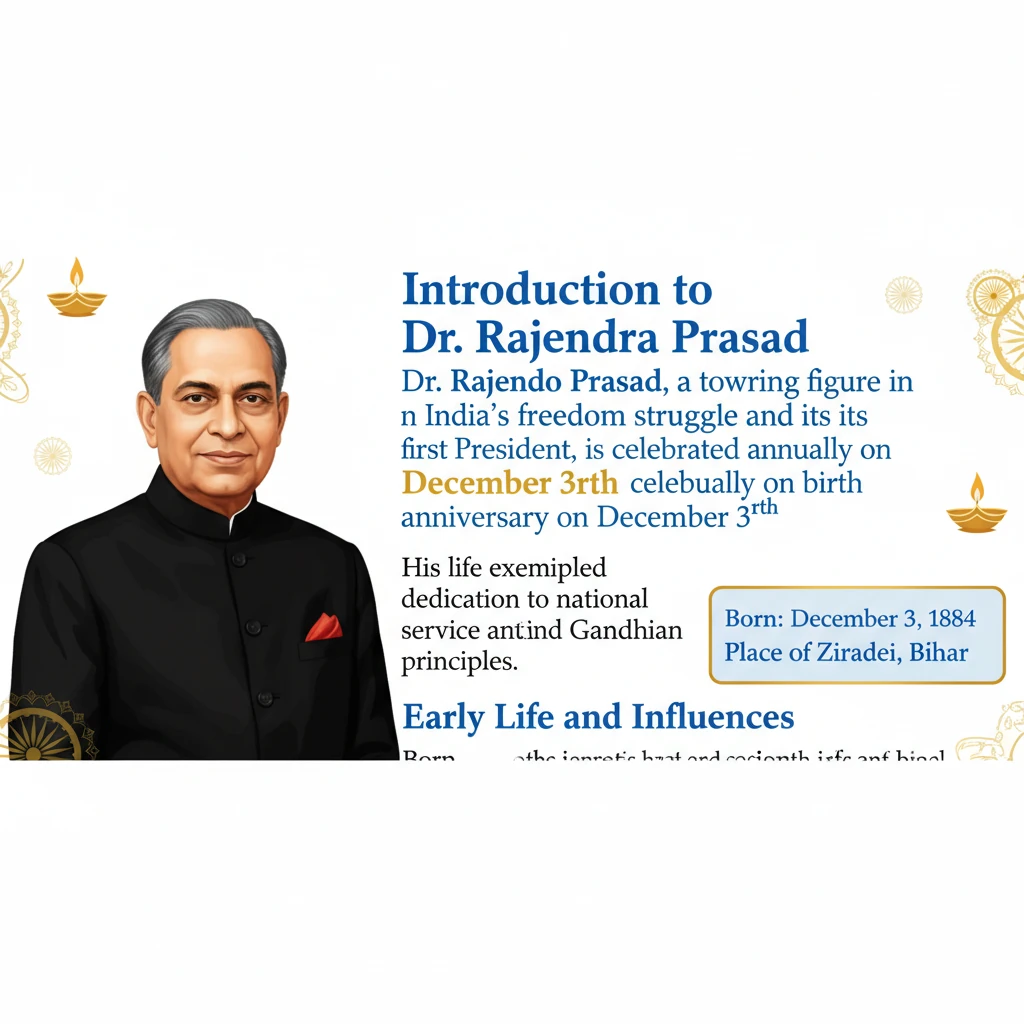
<h4>Introduction to Dr. Rajendra Prasad</h4><p><strong>Dr. Rajendra Prasad</strong>, a towering figure in India's freedom struggle and its first President, is celebrated annually on his birth anniversary on <strong>December 3rd</strong>. His life exemplified dedication to national service and adherence to Gandhian principles.</p><div class='info-box'><p><strong>Born:</strong> December 3, 1884</p><p><strong>Place of Birth:</strong> Ziradei, Bihar</p></div><h4>Early Life and Influences</h4><p>Born in <strong>Bihar</strong>, <strong>Rajendra Prasad</strong> was deeply influenced by <strong>Mahatma Gandhi's</strong> philosophy. He adopted a simple lifestyle, reflecting Gandhi's views on social equality and the eradication of <strong>caste</strong> and <strong>untouchability</strong>.</p><h4>Role in the Freedom Struggle</h4><p><strong>Dr. Rajendra Prasad</strong> made significant sacrifices for India's independence. He abandoned his promising legal career in <strong>1920</strong> to fully commit to the <strong>Independence movement</strong>.</p><p>His unwavering commitment led to multiple imprisonments. He was incarcerated during the pivotal <strong>Salt Satyagraha</strong> in <strong>1931</strong> and again during the momentous <strong>Quit India Movement</strong> in <strong>1942</strong>.</p><div class='key-point-box'><p><strong>Key Leadership Roles:</strong></p><ul><li>Presided over the <strong>Bombay session</strong> of the <strong>Indian National Congress</strong> in <strong>1934</strong>.</li><li>Became <strong>Congress President</strong> in <strong>1939</strong> after <strong>Subhash Chandra Bose's</strong> resignation.</li></ul></div><h4>Contribution to Constitutional Making</h4><p><strong>Dr. Rajendra Prasad's</strong> leadership was crucial during the formation of independent India's foundational document. He was appointed <strong>President of the Constituent Assembly</strong> in <strong>1946</strong>.</p><p>In this role, he guided the complex process of drafting the <strong>Indian Constitution</strong>, ensuring broad consensus and democratic principles were upheld.</p><div class='info-box'><p><strong>Key Committees Led:</strong></p><ul><li><strong>National Flag Committee</strong></li><li><strong>Rules of Procedure Committee</strong></li><li><strong>Finance and Staff Committee</strong></li></ul></div><h4>Literary Contributions</h4><p>Beyond his political and administrative roles, <strong>Dr. Rajendra Prasad</strong> was also a prolific writer. His literary works offer insights into the freedom struggle and his personal reflections.</p><div class='info-box'><p><strong>Notable Literary Works:</strong></p><ul><li><strong>Champaran Mein Champaran</strong> (1922)</li><li><strong>India Divided</strong> (1946)</li><li><strong>Atmakatha</strong> (Autobiography, 1946)</li><li><strong>Bapu ke Kadmon Mein</strong> (1954)</li></ul></div><h4>Presidency and Enduring Legacy</h4><p>In <strong>1950</strong>, <strong>Dr. Rajendra Prasad</strong> was elected as <strong>India's First President</strong>. He served for an unprecedented period of over <strong>12 years</strong>, retiring in <strong>1962</strong>.</p><p>He holds the unique distinction of being the <strong>only President to be re-elected</strong>, serving two full terms (1950-1957 and 1957-1962).</p><div class='highlight-box'><p>For his exceptional service to the nation, <strong>Dr. Rajendra Prasad</strong> was awarded the <strong>Bharat Ratna</strong>, India's highest civilian honor, in <strong>1962</strong>.</p></div><div class='exam-tip-box'><p><strong>UPSC Insight:</strong> Questions on <strong>Dr. Rajendra Prasad</strong> often focus on his multifaceted contributions – his role in the <strong>freedom struggle</strong>, his leadership in the <strong>Constituent Assembly</strong>, and his tenure as <strong>President</strong>. Emphasize his adherence to <strong>Gandhian principles</strong> in your answers.</p></div>
💡 Key Takeaways
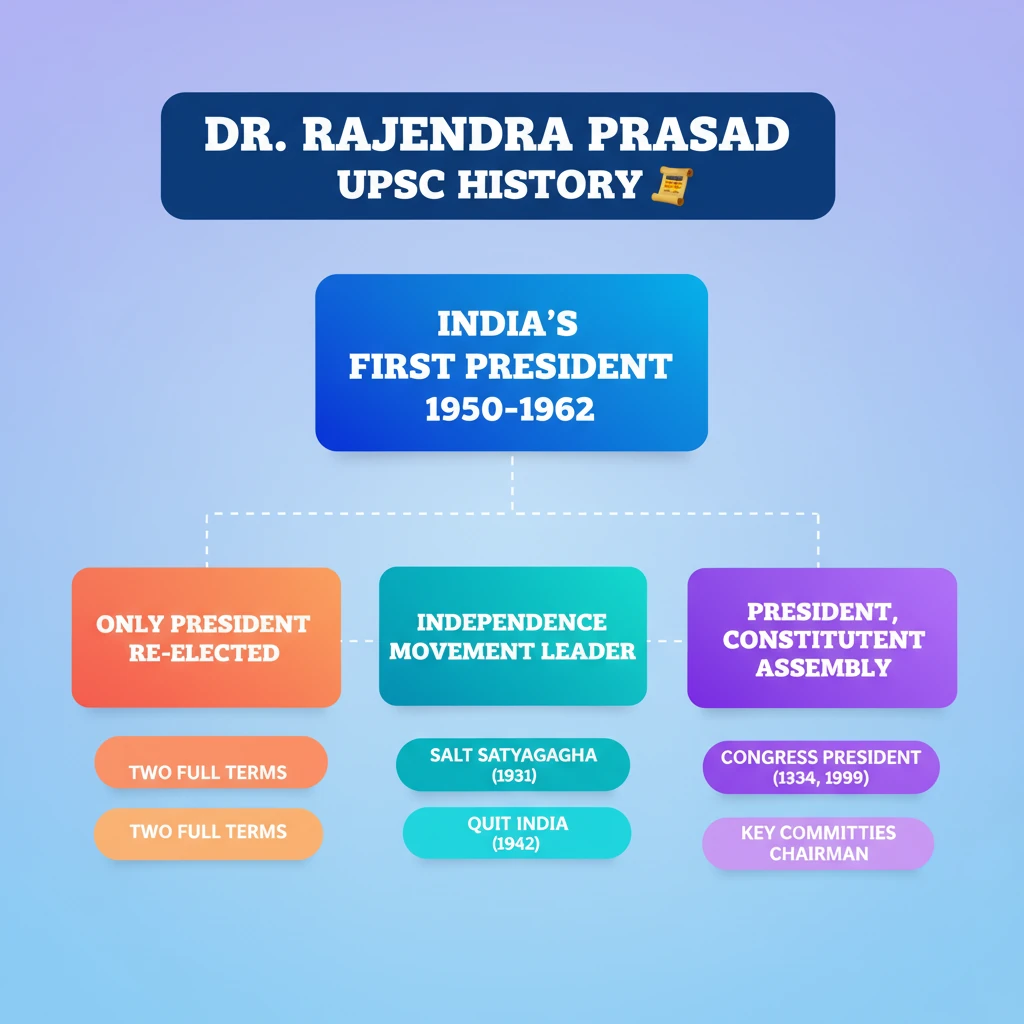
- •Dr. Rajendra Prasad was India's first President, serving over 12 years (1950-1962).
- •He was the only President to be re-elected, serving two full terms.
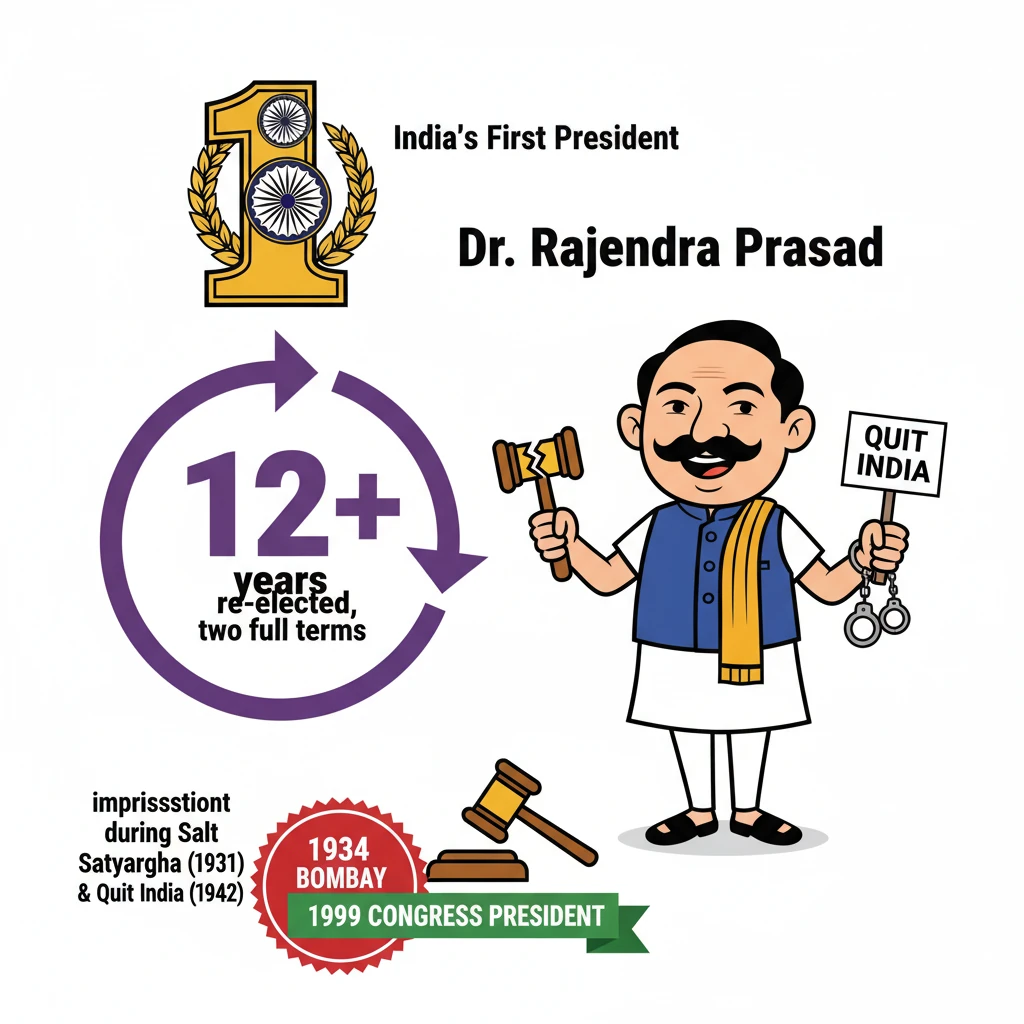
- •He abandoned his legal career in 1920 to join the Independence movement, being imprisoned during Salt Satyagraha (1931) and Quit India Movement (1942).
- •He presided over the Bombay session of Congress (1934) and became Congress President in 1939.
- •Crucially, he was the President of the Constituent Assembly (1946) and led key committees.
- •Awarded Bharat Ratna in 1962 for his exceptional service.
🧠 Memory Techniques
95% Verified Content