Bhakti Saints of Medieval India - History | UPSC Learning
Topics
0 topics • 0 completed
🔍
No topics match your search
Bhakti Saints of Medieval India
Medium⏱️ 10 min read
history
📖 Introduction
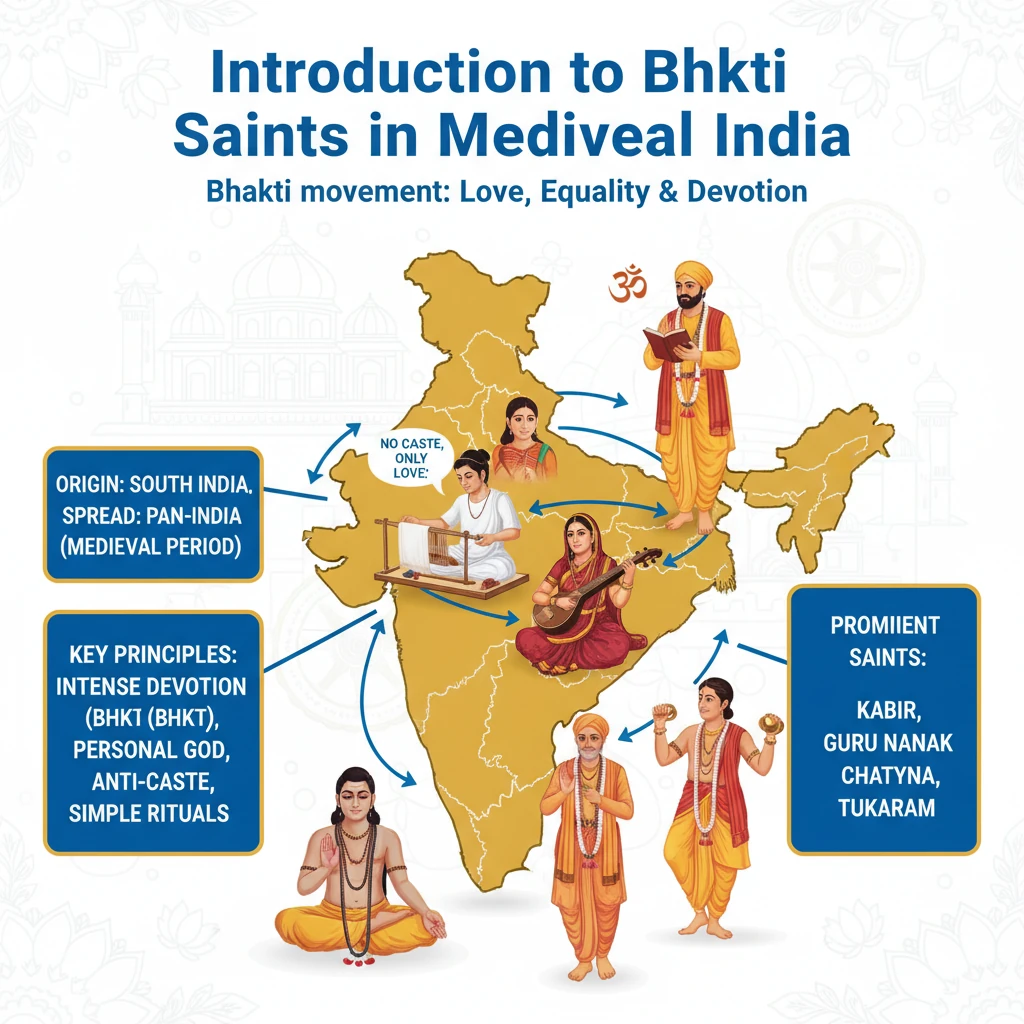
<h4>Introduction to Bhakti Saints in Medieval India</h4><p>The <strong>Bhakti movement</strong> was a significant religious and social reform movement that originated in <strong>South India</strong> and spread across the subcontinent during the <strong>medieval period</strong>. It emphasized intense devotion (<strong>Bhakti</strong>) to a personal God, transcending rigid caste systems and elaborate rituals.</p><p>This movement saw the rise of numerous saints who preached messages of love, equality, and spiritual liberation through simple devotion, often in <strong>vernacular languages</strong>.</p><h4>Early Bhakti Saints: Alvars and Nayanars (7th-8th Century)</h4><p>The Bhakti tradition gained prominence in <strong>South India</strong> with the <strong>Alvar</strong> and <strong>Nayanar</strong> saints. These devotional poets and mystics expressed their love for Vishnu and Shiva, respectively.</p><div class='info-box'><p>The <strong>Alvars</strong> were devotees of <strong>Lord Vishnu</strong>, with <strong>Thondaradipodi</strong>, <strong>Nammalvar</strong>, and <strong>Andal</strong> (the only female Alvar) being prominent figures. The <strong>Nayanars</strong> were devotees of <strong>Lord Shiva</strong>, including figures like <strong>Appar</strong>, <strong>Sambandar</strong>, and <strong>Sundarar</strong>.</p></div><h4>Adi Shankara and the Advaita Philosophy (8th Century)</h4><p>While not a Bhakti saint in the devotional sense, <strong>Adi Shankara</strong>, an influential philosopher from the <strong>8th century</strong>, significantly shaped Indian thought. He propounded the doctrine of <strong>Advaita Vedanta</strong>.</p><div class='key-point-box'><p><strong>Advaita Vedanta</strong> emphasizes the ultimate oneness of the individual soul (<strong>Atman</strong>) with the ultimate reality (<strong>Brahman</strong>), advocating knowledge as the path to liberation.</p></div><h4>Philosophical Foundations: Ramanujacharya (12th Century)</h4><p><strong>Ramanujacharya</strong>, a prominent philosopher of the <strong>12th century</strong>, offered a different philosophical perspective known as <strong>Vishishtadvaita</strong> (qualified non-dualism). He integrated devotion with philosophical inquiry.</p><p>His teachings emphasized that the individual soul is a part of Brahman and that devotion to <strong>Lord Vishnu</strong> is the primary means to attain salvation.</p><h4>Lingayat Saints (12th Century)</h4><p>The <strong>Lingayat movement</strong> emerged in <strong>Karnataka</strong> in the <strong>12th century</strong>, led by <strong>Basavanna</strong>. This movement strongly opposed the caste system, ritualism, and the authority of the Vedas.</p><div class='info-box'><p>Key <strong>Lingayat Saints</strong> include <strong>Basavanna</strong>, <strong>Allama Prabhu</strong>, and <strong>Akka Mahadevi</strong>. They advocated for social equality and personal devotion to Shiva, worshipped in the form of an <strong>Ishtalinga</strong>.</p></div><h4>Maharashtra Bhakti Tradition (13th-17th Century)</h4><p>The Bhakti movement flourished in <strong>Maharashtra</strong>, giving rise to the <strong>Varkari tradition</strong>. This regional movement centered around devotion to <strong>Vitthala</strong> (a form of Vishnu).</p><ul><li><strong>Jnaneshwar</strong> (<strong>13th cent</strong>): Author of the <strong>Jnaneshwari</strong>, a commentary on the Bhagavad Gita in Marathi.</li><li><strong>Namdev</strong> (<strong>14th cent</strong>): A poet-saint whose devotional songs (<strong>abhangs</strong>) are revered.</li><li><strong>Family of Chokhamba</strong> (<strong>13th cent</strong>): A Dalit saint family who faced caste discrimination but preached devotion.</li><li><strong>Eknath</strong> (<strong>16th cent</strong>): Known for his Marathi commentaries and devotional compositions.</li><li><strong>Tukaram</strong> (<strong>17th cent</strong>): A prominent Varkari saint whose <strong>abhangs</strong> are central to Marathi spiritual life.</li></ul><h4>Northern Bhakti Saints (14th-17th Century)</h4><p>The Bhakti movement spread to North India, evolving into diverse traditions with unique philosophical and social dimensions.</p><h5>Ramananda (14th Century)</h5><p><strong>Ramananda</strong> was a pioneering saint in <strong>North India</strong>, credited with taking the Bhakti message to the common people. He accepted disciples from all castes, including women.</p><h5>Laleshwari or Lal Ded (14th Century)</h5><p><strong>Laleshwari</strong>, also known as <strong>Lal Ded</strong>, was a female mystic of <strong>Kashmir</strong>. Her poetic verses, known as <strong>Vakhs</strong>, are a significant part of Kashmiri literature and philosophy, advocating for inner spiritual realization.</p><h5>Guru Nanak (15th-16th Century)</h5><p><strong>Guru Nanak</strong>, the founder of <strong>Sikhism</strong>, preached a message of universal brotherhood, devotion to one God (<strong>Ik Onkar</strong>), and selfless service. His teachings are compiled in the <strong>Guru Granth Sahib</strong>.</p><h5>Shankardeva (15th Century)</h5><p><strong>Shankardeva</strong> was a prominent saint from <strong>Assam</strong> who propagated <strong>Ekasarana Dharma</strong>, a monotheistic Vaishnavite tradition. He used music, drama (<strong>Ankia Naat</strong>), and poetry to spread his message.</p><h5>Tulsidas (15th Century)</h5><p><strong>Tulsidas</strong> was a great poet-saint known for his devotion to <strong>Lord Rama</strong>. His most famous work is the <strong>Ramcharitmanas</strong>, a retelling of the Ramayana.</p><div class='info-box'><p><strong>Tulsidas's</strong> works, primarily written in <strong>Brajbhasha</strong> and <strong>Awadhi</strong> dialects, significantly influenced <strong>Indian Literature</strong> and the development of the <strong>Hindi language</strong>.</p></div><h5>Chaitanya Mahaprabhu (15th-16th Century)</h5><p><strong>Chaitanya Mahaprabhu</strong> was a Bengali saint who popularized the <strong>Hare Krishna mantra</strong> and the practice of <strong>Kirtan</strong> (congregational chanting). He emphasized ecstatic devotion to <strong>Lord Krishna</strong>.</p><h5>Mirabai (15th-16th Century)</h5><p><strong>Mirabai</strong> was a Rajput princess and a devout devotee of <strong>Lord Krishna</strong>. Her devotional songs (<strong>bhajans</strong>) express her intense love and spiritual longing, often defying societal norms of her time.</p><h5>Kabirdas (16th Century)</h5><p><strong>Kabirdas</strong> was a mystic poet and saint whose works profoundly influenced the <strong>Bhakti movement</strong>. He critiqued both Hindu and Islamic orthodoxies, advocating for a universal path of devotion.</p><h5>Vallabhacharya (16th Century)</h5><p><strong>Vallabhacharya</strong> was a philosopher who founded the <strong>Pushtimarg</strong> sect of Vaishnavism. He advocated for <strong>Shuddhadvaita</strong> (pure non-dualism) and emphasized devotion to <strong>Lord Krishna</strong> through selfless love.</p><h5>Raidas (16th Century)</h5><p><strong>Raidas</strong> (also <strong>Ravidas</strong>) was a Dalit saint and contemporary of Kabir. His devotional songs and verses criticized the caste system and promoted equality, inner purity, and devotion.</p><h5>Surdas (16th Century)</h5><p><strong>Surdas</strong> was a blind poet-saint known for his devotion to <strong>Lord Krishna</strong>. His collection of poems, <strong>Sursagar</strong>, depicts the childhood pastimes of Krishna and Radha's love, written in <strong>Brajbhasha</strong>.</p><h5>Dadu Dayal (16th-17th Century)</h5><p><strong>Dadu Dayal</strong> was a saint from <strong>Rajasthan</strong> who founded the <strong>Dadu Panth</strong>. He preached a non-sectarian path to God, emphasizing inner experience and devotion over external rituals.</p>
💡 Key Takeaways
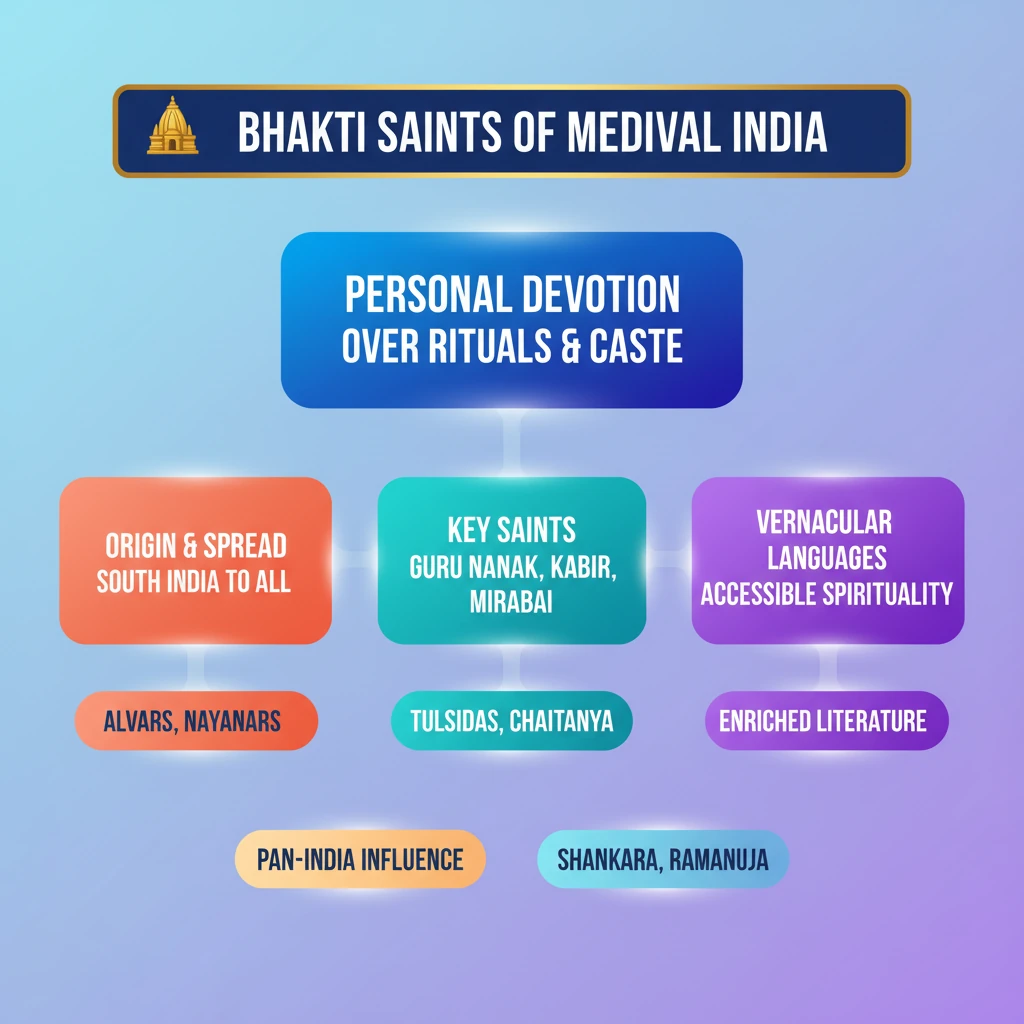
- •Bhakti movement emphasized personal devotion to God over elaborate rituals and caste distinctions.
- •It originated in South India (Alvars, Nayanars) and spread across India, influencing various regions.
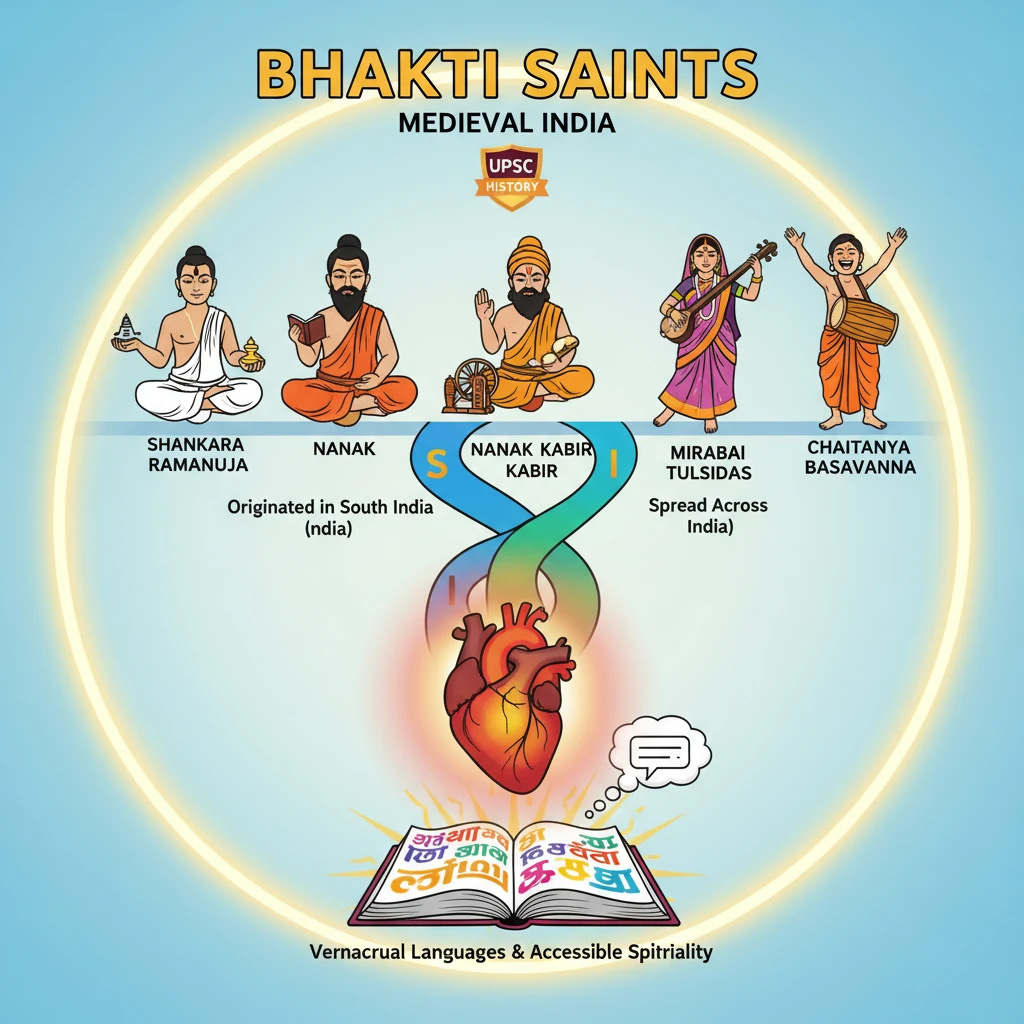
- •Prominent saints include Adi Shankara, Ramanujacharya, Basavanna, Guru Nanak, Kabir, Tulsidas, Mirabai, Chaitanya Mahaprabhu.
- •Bhakti saints used vernacular languages, significantly enriching regional literature and making spirituality accessible.
- •The movement fostered social equality, challenged orthodoxies, and left a lasting legacy on Indian culture and values.
🧠 Memory Techniques
95% Verified Content