450th Jyoti Jot Diwas of Sri Guru Amardas - History | UPSC Learning
Topics
0 topics • 0 completed
🔍
No topics match your search
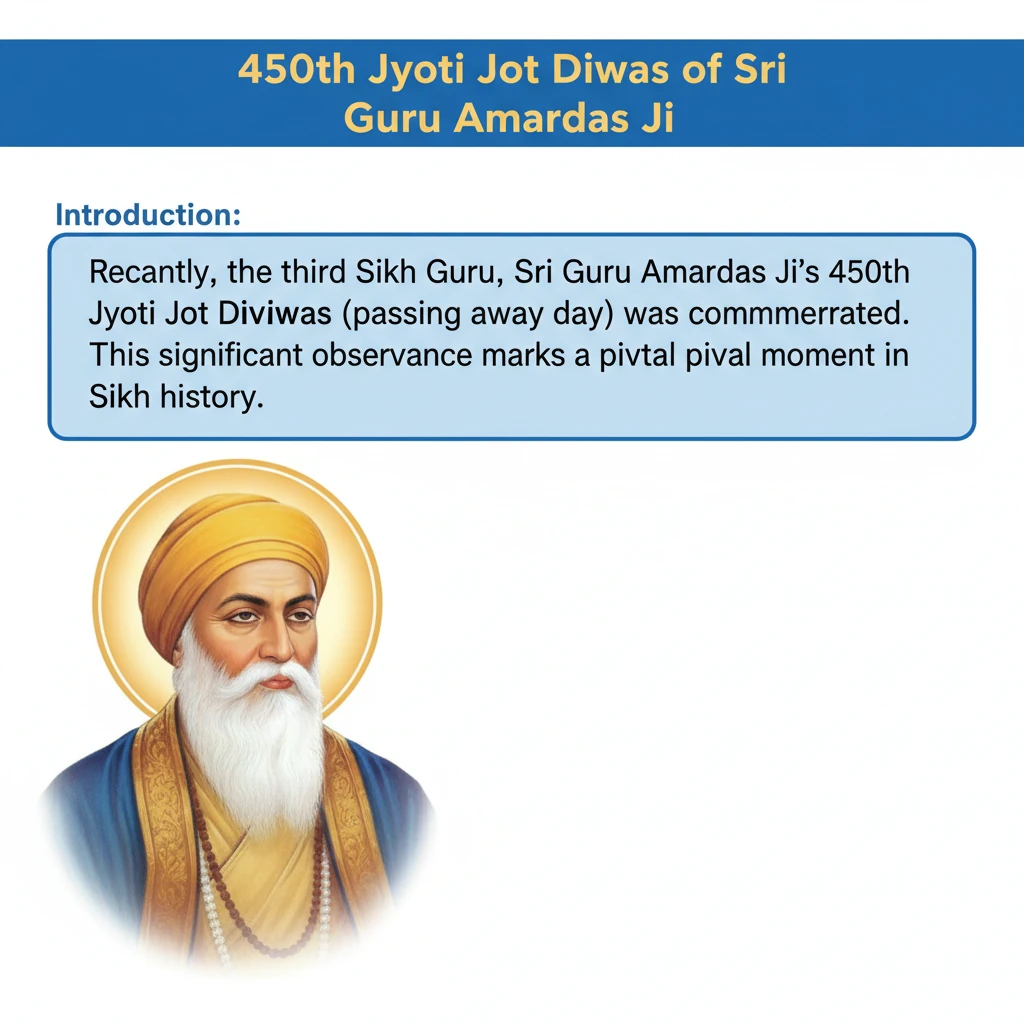
450th Jyoti Jot Diwas of Sri Guru Amardas
Medium⏱️ 7 min read
history
📖 Introduction
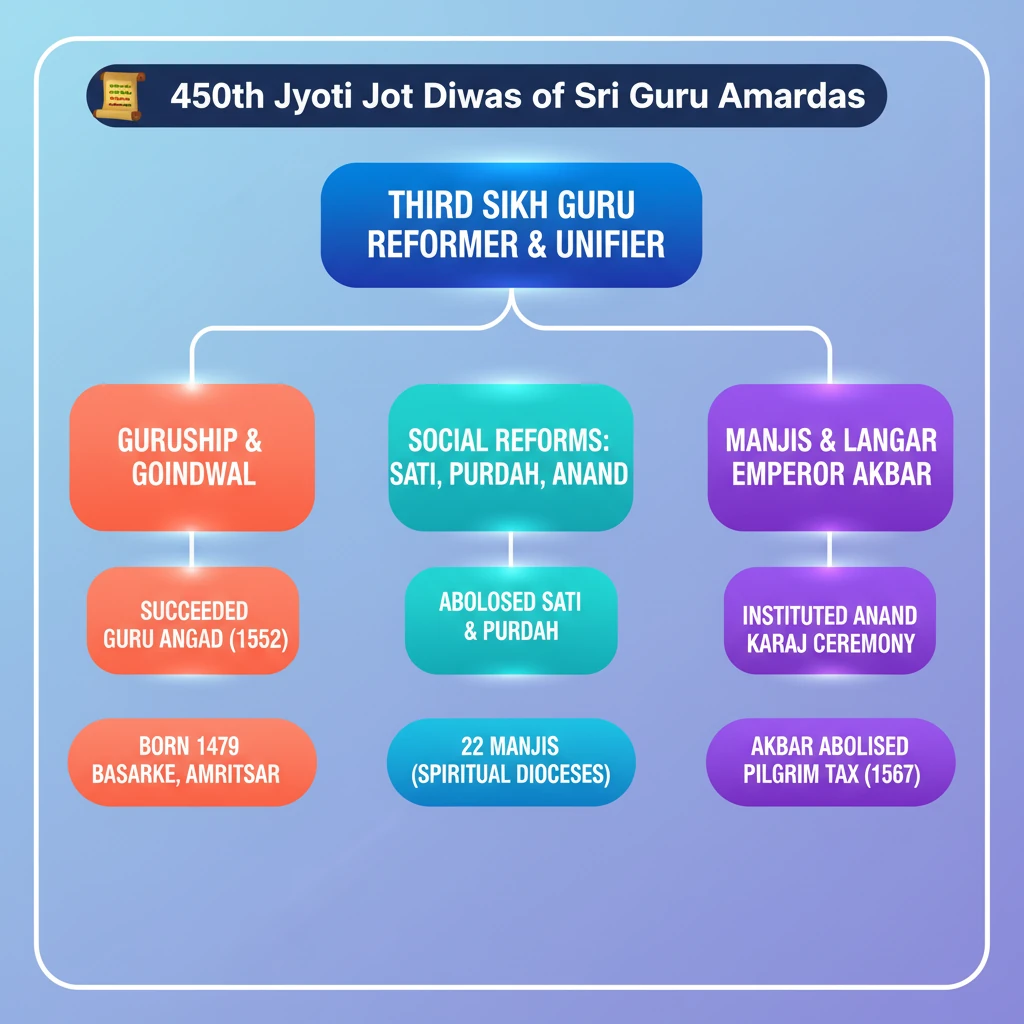
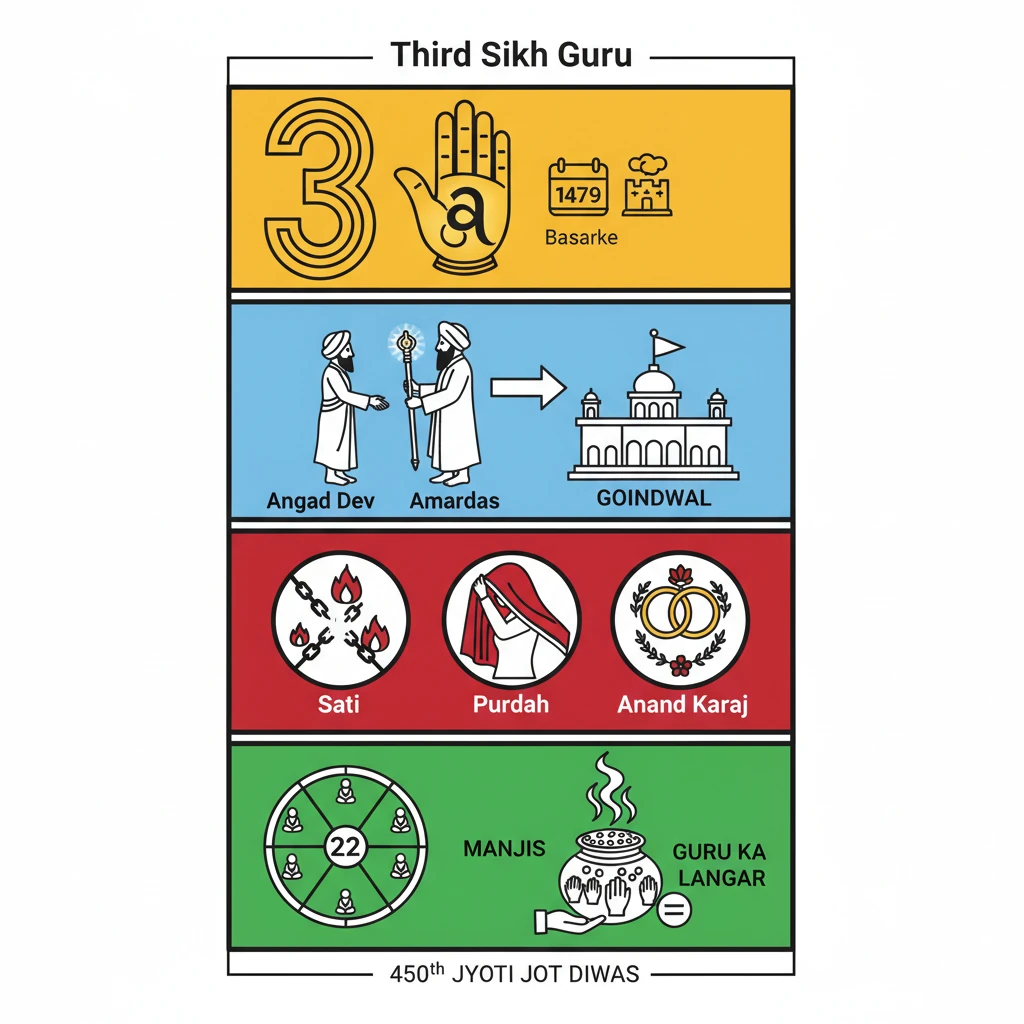
<h4>Introduction: 450th Jyoti Jot Diwas of Sri Guru Amardas Ji</h4><p>Recently, the <strong>450th Jyoti Jot Diwas</strong> (passing away day) of <strong>Sri Guru Amardas Ji</strong>, the <strong>third Sikh Guru</strong>, was commemorated. This significant observance marks a pivotal moment in Sikh history.</p><div class='info-box'><p>The term <strong>Jyoti Jot Diwas</strong> signifies the sacred day when a Sikh Guru merges with the divine light, marking their earthly departure and spiritual ascension.</p></div><h4>About Sri Guru Amardas Ji</h4><p><strong>Sri Guru Amardas Ji</strong> was born in <strong>1479</strong> at <strong>Basarke</strong> in the <strong>Amritsar district</strong>. He was raised within an <strong>orthodox Hindu family</strong> before embarking on his spiritual journey.</p><p>He was profoundly inspired by the divine hymns of <strong>Sri Guru Nanak Dev Ji</strong>. This inspiration led him to adopt <strong>Sri Guru Angad Dev Ji</strong> as his revered spiritual guide and mentor.</p><div class='info-box'><ul><li><strong>Birth Year:</strong> 1479</li><li><strong>Birthplace:</strong> Basarke, Amritsar district</li><li><strong>Inspired by:</strong> Sri Guru Nanak Dev Ji</li><li><strong>Spiritual Guide:</strong> Sri Guru Angad Dev Ji</li></ul></div><p>In <strong>March 1552</strong>, at the age of <strong>73</strong>, he was appointed as the <strong>third Sikh Guru</strong>, succeeding <strong>Guru Angad Dev Ji</strong>. He subsequently established his primary spiritual and administrative headquarters in <strong>Goindwal</strong>.</p><h4>Key Contributions of Guru Amardas Ji</h4><div class='key-point-box'><h5>Administrative and Community Reforms</h5></div><p><strong>Guru Amardas Ji</strong> played a crucial role in organizing the nascent Sikh community. He divided it into <strong>22 administrative districts</strong>, known as <strong>Manjis</strong>, to facilitate the widespread dissemination of Sikh teachings.</p><p>He significantly reinforced the tradition of <strong>‘Guru ka Langar’</strong> (communal kitchen). He insisted that all visitors partake in the communal meal before meeting him, thereby actively promoting <strong>equality</strong> and fostering a strong sense of <strong>community</strong> among all.</p><div class='key-point-box'><h5>Social Justice and Inter-faith Relations</h5></div><p>His notable interaction with the Mughal <strong>Emperor Akbar</strong> led to a significant reform: the abolition of the <strong>toll-tax</strong> (pilgrim's tax) for non-Muslims. This interaction helped solidify a respectful relationship between the Sikh community and the imperial power.</p><p>A staunch advocate for social justice, <strong>Guru Amardas Ji</strong> actively campaigned against and successfully abolished regressive social customs. Among Sikhs, he eliminated the practice of <strong>Sati</strong> (widow immolation) and the <strong>Purdah system</strong> (veiling of women).</p><div class='key-point-box'><h5>Sikh Ceremonial Practices</h5></div><p><strong>Guru Amardas Ji</strong> introduced the distinct Sikh marriage ceremony known as <strong>Anand Karaj</strong>. This ceremony remains a foundational and revered practice within the Sikh faith today.</p><div class='info-box'><ul><li><strong>Manjis:</strong> Established <strong>22 administrative districts</strong> for Sikh teachings.</li><li><strong>Guru ka Langar:</strong> Strengthened tradition, promoting <strong>equality</strong>.</li><li><strong>Emperor Akbar:</strong> Influenced abolition of <strong>pilgrim's tax</strong>.</li><li><strong>Social Reforms:</strong> Abolished <strong>Sati</strong> and <strong>Purdah system</strong> among Sikhs.</li><li><strong>Marriage:</strong> Introduced <strong>Anand Karaj</strong> ceremony.</li></ul></div><h4>Legacy and Final Years of Guru Amardas Ji</h4><p><strong>Guru Amardas Ji</strong> oversaw the construction of a sacred <strong>Baoli</strong> (step-well) at <strong>Goindwal Sahib</strong>. This structural endeavor transformed Goindwal into a significant and revered <strong>Sikh pilgrimage site</strong>.</p><p>He composed a substantial body of sacred verses, with accounts stating <strong>869 Shabads</strong> (some suggest 709), including the highly revered composition, <strong>Anand Sahib</strong>. All these sacred verses were later incorporated into the <strong>Guru Granth Sahib</strong> by <strong>Sri Guru Arjan Dev Ji</strong>.</p><div class='info-box'><ul><li><strong>Baoli Construction:</strong> At <strong>Goindwal Sahib</strong>, making it a pilgrimage site.</li><li><strong>Compositions:</strong> Authored <strong>869 verses</strong> (Shabads), including <strong>Anand Sahib</strong>.</li><li><strong>Incorporation:</strong> His Shabads were included in <strong>Guru Granth Sahib</strong> by <strong>Sri Guru Arjan Dev Ji</strong>.</li></ul></div><p><strong>Guru Amardas Ji</strong> passed away on <strong>1st September 1574</strong>, at the advanced age of <strong>95</strong>. His profound spiritual and social legacy continues to inspire the Sikh community and humanity at large.</p>
💡 Key Takeaways
- •<strong>Sri Guru Amardas Ji</strong> was the <strong>third Sikh Guru</strong>, born in <strong>1479</strong> in Basarke, Amritsar.
- •He succeeded <strong>Guru Angad Dev Ji</strong> in <strong>1552</strong> and established headquarters at <strong>Goindwal</strong>.
- •Key reforms include abolishing <strong>Sati</strong> and <strong>Purdah</strong> among Sikhs, and introducing the <strong>Anand Karaj</strong> marriage ceremony.
- •He organized the Sikh community into <strong>22 Manjis</strong> and reinforced <strong>Guru ka Langar</strong> for equality.
- •His interaction with <strong>Emperor Akbar</strong> led to the abolition of the <strong>pilgrim's tax</strong>.
- •Composed <strong>869 verses</strong>, including <strong>Anand Sahib</strong>, later incorporated into <strong>Guru Granth Sahib</strong>.
- •Passed away on <strong>1st September 1574</strong>, leaving a profound legacy of social justice and community building.
🧠 Memory Techniques
95% Verified Content