Dadabhai Naoroji - History | UPSC Learning
Topics
0 topics • 0 completed
🔍
No topics match your search
Dadabhai Naoroji
Medium⏱️ 8 min read
history
📖 Introduction
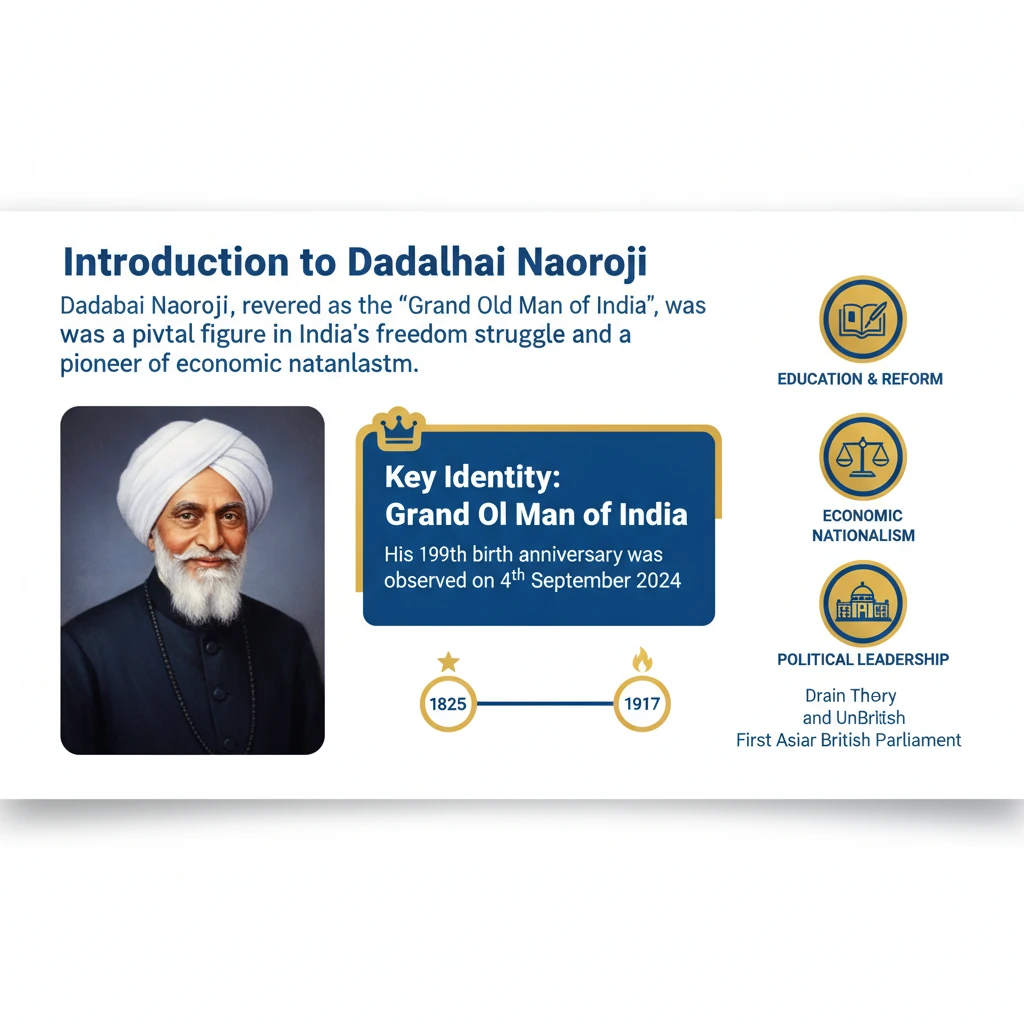
<h4>Introduction to Dadabhai Naoroji</h4><p><strong>Dadabhai Naoroji</strong>, revered as the <strong>“Grand Old Man of India”</strong>, was a pivotal figure in India's freedom struggle and a pioneer of economic nationalism.</p><p>His <strong>199th birth anniversary</strong> was observed on <strong>4th September 2024</strong>, highlighting his enduring legacy and contributions to modern India.</p><div class='key-point-box'><p><strong>Key Identity:</strong> Known as the <strong>“Grand Old Man of India”</strong>.</p><p><strong>Birth Anniversary:</strong> <strong>199th</strong> observed on <strong>4th September 2024</strong>.</p></div><h4>First Indian Member of British Parliament</h4><p>One of <strong>Naoroji's</strong> most significant achievements was becoming the <strong>first Indian to be elected to the British Parliament</strong>.</p><p>He won the <strong>Central Finsbury seat</strong> in <strong>1892</strong>, representing the <strong>Liberal Party</strong>, providing a direct voice for Indian concerns.</p><div class='info-box'><ul><li><strong>Constituency:</strong> <strong>Central Finsbury</strong></li><li><strong>Year of Election:</strong> <strong>1892</strong></li><li><strong>Political Party:</strong> <strong>Liberal Party</strong></li></ul></div><h4>Establishment of Organizations in England</h4><p><strong>Dadabhai Naoroji</strong> played a crucial role in establishing platforms in England to voice Indian grievances and advocate for reforms.</p><p>These organizations were instrumental in raising awareness about Indian issues among the British public and politicians.</p><ul><li>In <strong>1865</strong>, he co-founded the <strong>London Indian Society</strong>.</li><li>In <strong>1866</strong>, he established the <strong>East India Association</strong>, which served as a prominent forum for discussing Indian affairs.</li></ul><div class='key-point-box'><p>These bodies were vital in shaping British public opinion and lobbying for Indian rights.</p></div><h4>Leadership in the Indian National Congress</h4><p><strong>Naoroji's</strong> influence extended to India's burgeoning nationalist movement, where he served as the <strong>President of the Indian National Congress</strong> multiple times.</p><p>His presidencies spanned crucial periods, guiding the early direction and demands of the organization.</p><div class='info-box'><p><strong>Congress Presidencies:</strong></p><ul><li><strong>1886:</strong> <strong>Calcutta Session</strong></li><li><strong>1893:</strong> <strong>Lahore Session</strong></li><li><strong>1906:</strong> <strong>Calcutta Session</strong> (where he articulated the demand for <strong>Swaraj</strong> or self-rule)</li></ul></div><h4>Pioneer of the Drain Theory</h4><p><strong>Dadabhai Naoroji</strong> is widely recognized as a key proponent of the <strong>“Drain Theory”</strong>, first articulated around <strong>1867</strong>.</p><p>This theory exposed the systematic economic exploitation of India by the British, detailing how India's wealth was siphoned off to Britain without adequate returns.</p><div class='key-point-box'><p><strong>Drain Theory (1867):</strong> Argued that British rule was economically impoverishing India by draining its resources and wealth, leading to poverty.</p></div><h4>Literary Contributions</h4><p>To disseminate his economic theories and critique of British rule, <strong>Naoroji</strong> authored influential works.</p><p>His most famous book, <strong>“Poverty and Un-British Rule in India”</strong>, published in <strong>1901</strong>, became a foundational text for Indian economic nationalism.</p><div class='info-box'><p><strong>Key Publication:</strong> <strong>“Poverty and Un-British Rule in India”</strong> (<strong>1901</strong>)</p></div><h4>Other Political Advocacy</h4><p>Beyond his parliamentary role and organizational work, <strong>Naoroji</strong> engaged in various forms of political advocacy for Indian rights.</p><ul><li>He advocated for a <strong>standing committee in the British House of Commons</strong> to address protests from Indian legislative bodies.</li><li>In <strong>1893</strong>, he formed an <strong>Indian parliamentary committee</strong> in the British parliament to lobby for reforms in India.</li><li>He was appointed to the <strong>Royal Commission on Indian Expenditure</strong> in <strong>1895</strong>, where he highlighted the financial burdens imposed on India.</li></ul><div class='exam-tip-box'><p><strong>UPSC Insight:</strong> <strong>Naoroji's</strong> multifaceted contributions demonstrate his strategic approach to challenging British rule both within and outside India, using constitutional means and intellectual arguments.</p></div>
💡 Key Takeaways
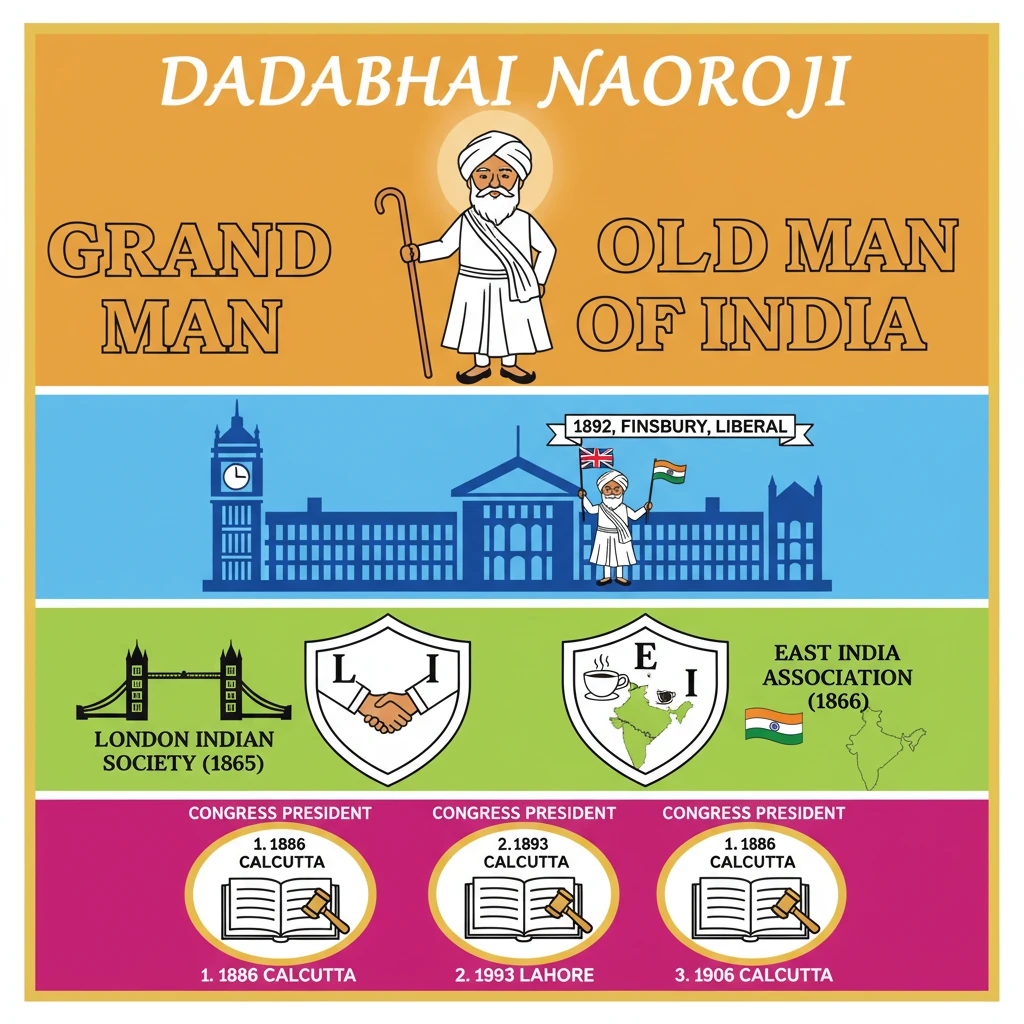
- •Dadabhai Naoroji was known as the "Grand Old Man of India".
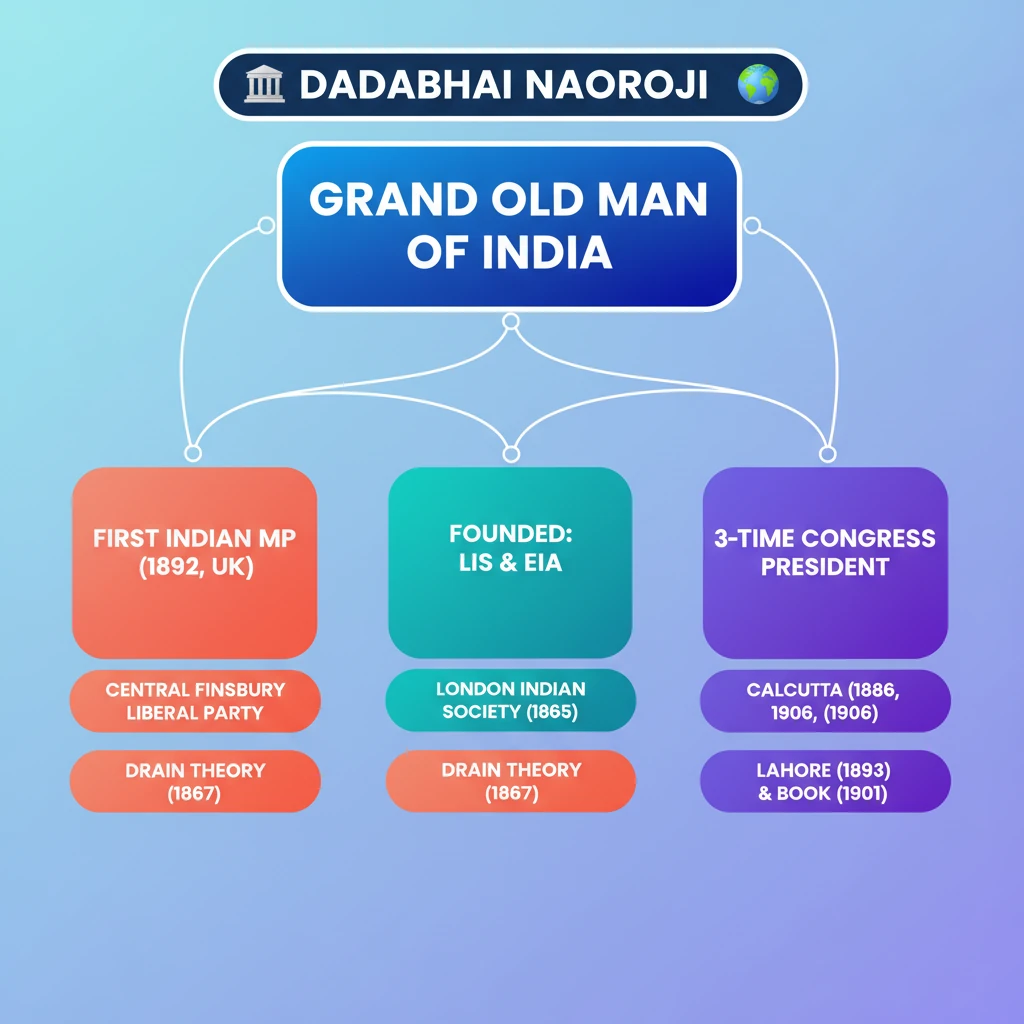
- •He was the first Indian elected to the British Parliament (1892, Central Finsbury, Liberal Party).
- •He founded the London Indian Society (1865) and East India Association (1866).
- •He served as Congress President three times (1886 Calcutta, 1893 Lahore, 1906 Calcutta).
- •He propounded the "Drain Theory" (1867) and authored "Poverty and Un-British Rule in India" (1901).
🧠 Memory Techniques
95% Verified Content