What were Surat Raids Conducted by Shivaji? - History | UPSC Learning
Topics
0 topics • 0 completed
🔍
No topics match your search

What were Surat Raids Conducted by Shivaji?
Medium⏱️ 7 min read
history
📖 Introduction
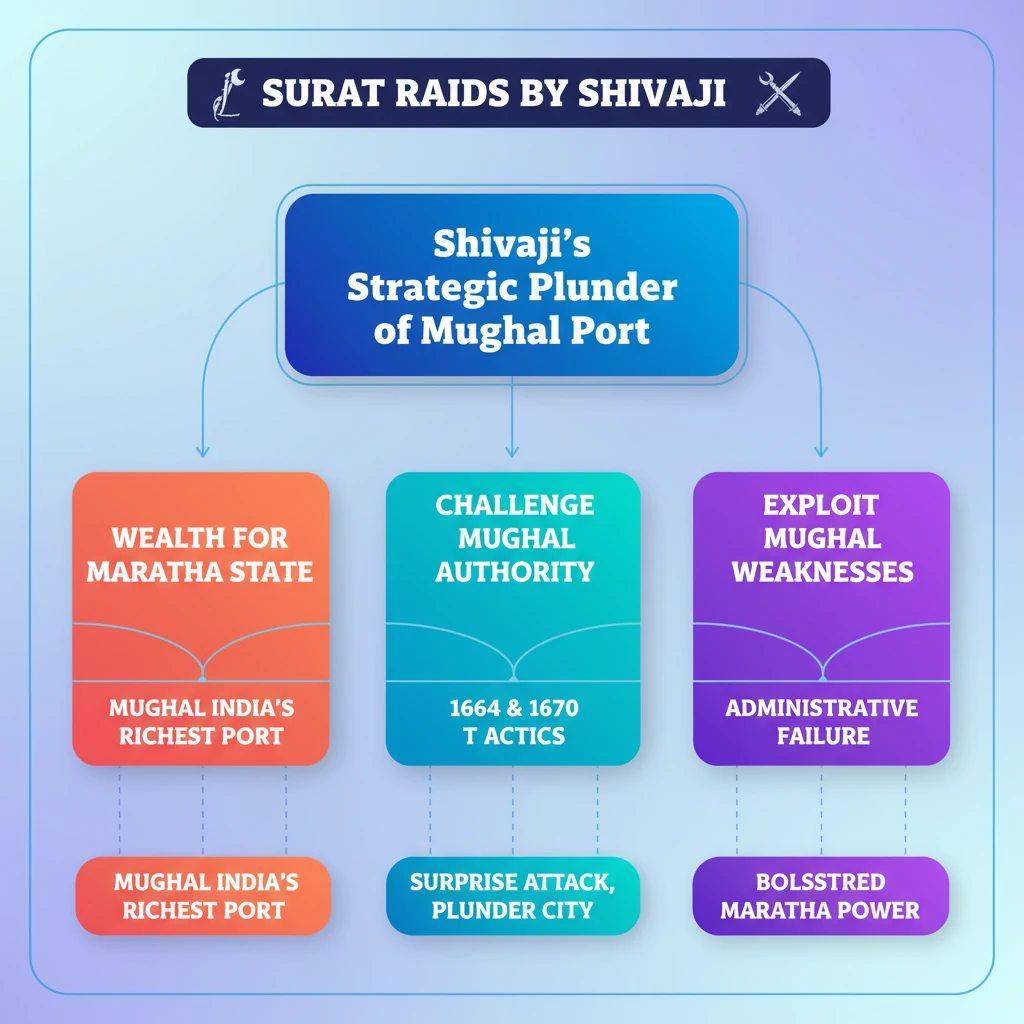
<h4>Introduction to the Surat Raids by Shivaji</h4><p>The <strong>Surat Raids</strong>, conducted by <strong>Chhatrapati Shivaji Maharaj</strong>, represent pivotal moments in <strong>Maratha history</strong> and the broader <strong>Mughal-Maratha conflict</strong>. These were not mere plunder expeditions but strategically calculated moves to undermine Mughal authority and finance the nascent <strong>Maratha Empire</strong>.</p><div class='key-point-box'><p><strong>Shivaji's</strong> raids on <strong>Surat</strong> in <strong>1664</strong> and <strong>1670</strong> demonstrated his military prowess and the effectiveness of his <strong>guerrilla warfare tactics</strong> against the mighty <strong>Mughal Empire</strong>.</p></div><h4>Strategic Importance of Surat</h4><p><strong>Surat</strong>, located on the west coast of India, was a city of immense economic and strategic value during the <strong>17th century</strong>. It served as the primary port for <strong>Mughal trade</strong> and a crucial embarkation point for pilgrims to <strong>Mecca</strong>.</p><div class='info-box'><p><strong>Surat</strong> was renowned as <strong>'the greatest emporium of the Orient and the richest jewel of the Mughal Empire'</strong>. Its wealth came from lucrative trade with Europe, Persia, and the Middle East, making it a symbol of <strong>Mughal prosperity</strong>.</p></div><h4>Objectives Behind the Raids</h4><p><strong>Shivaji's</strong> primary motivations for targeting <strong>Surat</strong> were multifaceted. He aimed to acquire substantial wealth to fund his military campaigns and the administration of his growing <strong>Maratha kingdom</strong>.</p><p>Beyond wealth, the raids served to humiliate the <strong>Mughal Emperor Aurangzeb</strong> and challenge his perceived invincibility. It was a clear demonstration that <strong>Mughal territories</strong> were vulnerable, even their most prized possessions.</p><h4>The First Surat Raid (1664)</h4><p>The <strong>First Sack of Surat</strong> occurred in <strong>January 1664</strong>. <strong>Shivaji</strong> led his forces swiftly, catching the <strong>Mughal administration</strong> and the city's governor, <strong>Inayat Khan</strong>, unprepared.</p><p>Despite resistance from some European factories (like the English and Dutch), <strong>Shivaji's forces</strong> plundered the city for several days, amassing a vast treasure. This raid severely damaged <strong>Mughal prestige</strong> and highlighted their administrative weaknesses.</p><h4>The Second Surat Raid (1670)</h4><p>Six years later, in <strong>October 1670</strong>, <strong>Shivaji</strong> launched another major assault on <strong>Surat</strong>. This raid was partly in retaliation for <strong>Aurangzeb's</strong> renewed aggression against the <strong>Marathas</strong> and to further replenish his treasury.</p><p>Once again, the <strong>Mughal defenses</strong> proved inadequate. The city was sacked, and considerable wealth was seized. The repeated failure to protect <strong>Surat</strong> underscored the growing threat posed by <strong>Shivaji</strong>.</p><h4>Impact and Significance of the Raids</h4><p>The <strong>Surat Raids</strong> had profound implications. They provided the <strong>Maratha state</strong> with much-needed financial resources, enabling <strong>Shivaji</strong> to strengthen his army and consolidate his power.</p><div class='exam-tip-box'><p>For <strong>UPSC Mains</strong>, analyze the <strong>Surat Raids</strong> not just as military events but as strategic moves that impacted <strong>Mughal-Maratha relations</strong>, <strong>economic history</strong>, and the rise of <strong>regional powers</strong>. Focus on <strong>Shivaji's strategic genius</strong>.</p></div><p>The raids significantly dented <strong>Mughal prestige</strong> and confidence, exposing their inability to protect their wealthiest cities. This encouraged other regional powers and rebels, contributing to the eventual decline of the <strong>Mughal Empire</strong>.</p>
💡 Key Takeaways
- •Surat was the wealthiest Mughal port, a 'jewel of the Mughal Empire', making it a prime target for Shivaji.
- •Shivaji conducted two major raids on Surat in 1664 and 1670.
- •The raids aimed to acquire wealth for the Maratha state and to challenge Mughal authority and prestige.
- •Shivaji employed swift guerrilla tactics, surprising Mughal forces and plundering the city extensively.
- •The raids exposed Mughal administrative and military weaknesses, contributing to their decline and bolstering Maratha power.
- •European factories in Surat were largely spared during the raids due to their fortifications and pragmatic Maratha strategy.
🧠 Memory Techniques

95% Verified Content
📚 Reference Sources
•A History of India by Romila Thapar
•Medieval India: From Sultanat to the Mughals by Satish Chandra
•Shivaji and His Times by Jadunath Sarkar
•Drishti IAS Study Material