Story of Usha Mehta and Congress Radio - History | UPSC Learning
Topics
0 topics • 0 completed
🔍
No topics match your search
Story of Usha Mehta and Congress Radio
Medium⏱️ 7 min read
history
📖 Introduction
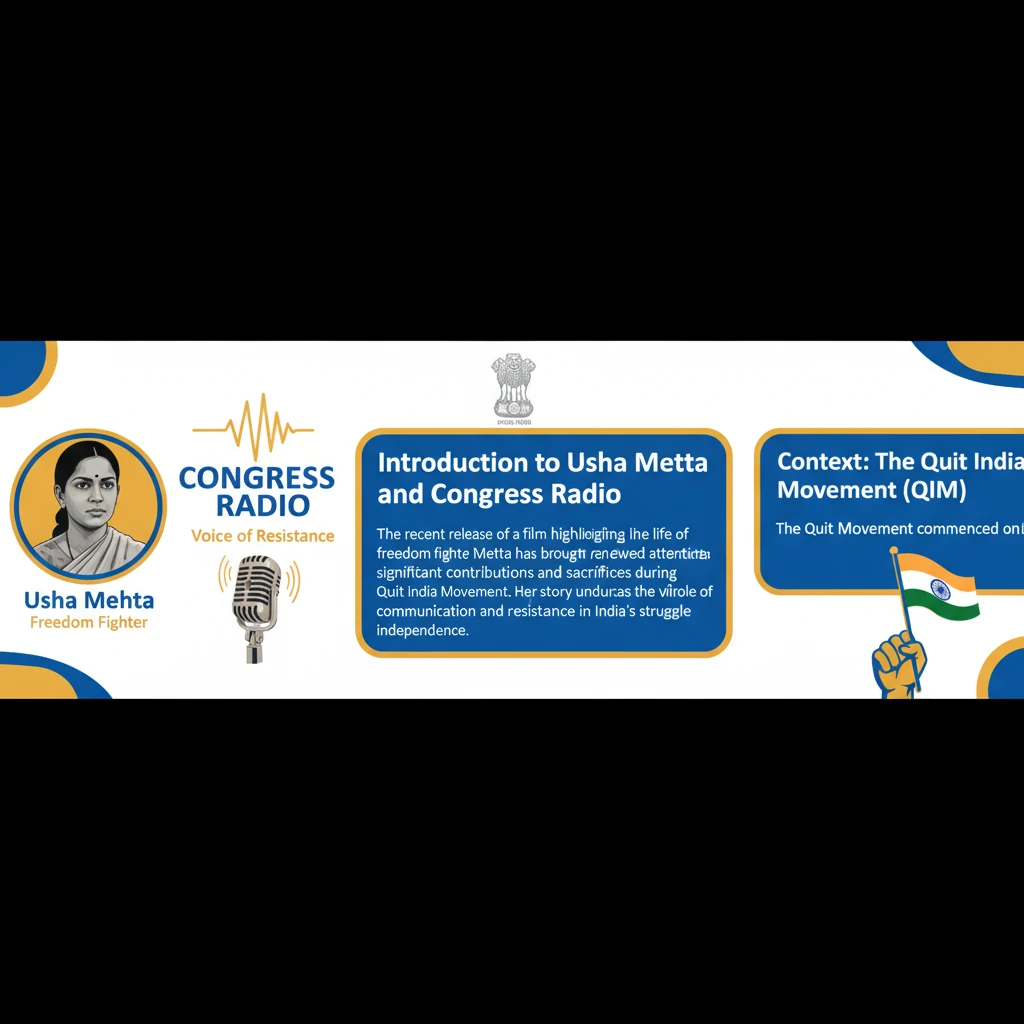
<h4>Introduction to Usha Mehta and Congress Radio</h4><p>The recent release of a film highlighting the life of freedom fighter <strong>Usha Mehta</strong> has brought renewed attention to her significant contributions and sacrifices during the <strong>Quit India Movement</strong>.</p><p>Her story underscores the vital role of communication and resistance in India's struggle for independence.</p><h4>Context: The Quit India Movement (QIM)</h4><p>The <strong>Quit India Movement</strong> commenced on <strong>August 8, 1942</strong>, following <strong>Mahatma Gandhi's</strong> powerful call to action with the iconic slogan <strong>'Do or Die'</strong>. This movement marked a period of widespread <strong>mass civil disobedience</strong> and nationwide protests.</p><p>It also saw the establishment of various <strong>parallel governance structures</strong> across the country, signifying a strong defiance against British rule.</p><div class='info-box'><p><strong>Key Event:</strong> The <strong>Quit India Movement</strong> began on <strong>August 8, 1942</strong>.</p><p><strong>Slogan:</strong> <strong>'Do or Die'</strong>, given by <strong>Mahatma Gandhi</strong>.</p></div><p>In response, <strong>British authorities</strong> initiated a massive crackdown, leading to the mass arrests of prominent leaders including <strong>Gandhi</strong>, <strong>Jawaharlal Nehru</strong>, and <strong>Sardar Patel</strong>. This severely impacted the movement's initial intensity.</p><h4>Usha Mehta's Pivotal Role in QIM</h4><p><strong>Usha Mehta</strong>, then a spirited <strong>22-year-old law student</strong>, was deeply inspired by <strong>Gandhian ideology</strong>. She chose to abandon her studies to actively participate in the independence movement.</p><div class='key-point-box'><p><strong>Usha Mehta's Vision:</strong> Recognizing the critical need to disseminate information and counter colonial censorship, <strong>Mehta</strong> conceived the idea of establishing <strong>Congress Radio</strong> as a clandestine means of communication.</p></div><h4>Establishment of Congress Radio</h4><p>Setting up <strong>Congress Radio</strong> presented numerous challenges, particularly in securing adequate funding and technical expertise. <strong>Mehta</strong>, alongside dedicated associates like <strong>Nanikram Printer</strong>, worked tirelessly to bring this vision to fruition.</p><p>Despite stringent regulatory restrictions imposed by the <strong>British authorities</strong>, <strong>Nanikram Printer's</strong> technical prowess was instrumental in creating a functional transmitter. This allowed <strong>Congress Radio's</strong> inaugural broadcast on <strong>September 3, 1942</strong>.</p><div class='info-box'><p><strong>First Broadcast:</strong> <strong>Congress Radio</strong> went on air on <strong>September 3, 1942</strong>.</p><p><strong>Key Associate:</strong> <strong>Nanikram Printer</strong>, for technical expertise.</p></div><h4>Catalysing Independence Through Broadcasts</h4><p><strong>Congress Radio</strong> quickly became a crucial and reliable source of news for Indians, effectively bypassing <strong>colonial censorship</strong>. It played a significant role in disseminating vital information regarding the progress of the <strong>Quit India Movement</strong>.</p><p>Beyond news, the station also broadcasted powerful <strong>political speeches</strong> and ideological messages. These transmissions were instrumental in strengthening the people's resolve and dedication towards achieving independence.</p><div class='exam-tip-box'><p><strong>UPSC Insight:</strong> The role of <strong>underground media</strong> like <strong>Congress Radio</strong> is crucial for understanding the diverse strategies employed during the <strong>Freedom Struggle</strong>, especially in <strong>GS Paper I (Modern Indian History)</strong>.</p></div><h4>Legal Consequences and Mehta's Enduring Legacy</h4><p>The covert operations of <strong>Congress Radio</strong> eventually drew the attention of the <strong>British authorities</strong>. This led to the arrest and subsequent trial of <strong>Usha Mehta</strong> and her associates.</p><p>Revered as <strong>'Radio-ben'</strong> for her pioneering efforts, <strong>Mehta</strong> continued to embody <strong>Gandhian principles</strong> even after India gained independence. Her unwavering commitment earned her national recognition, including the prestigious <strong>Padma Vibhushan</strong> in <strong>1998</strong>.</p>
💡 Key Takeaways
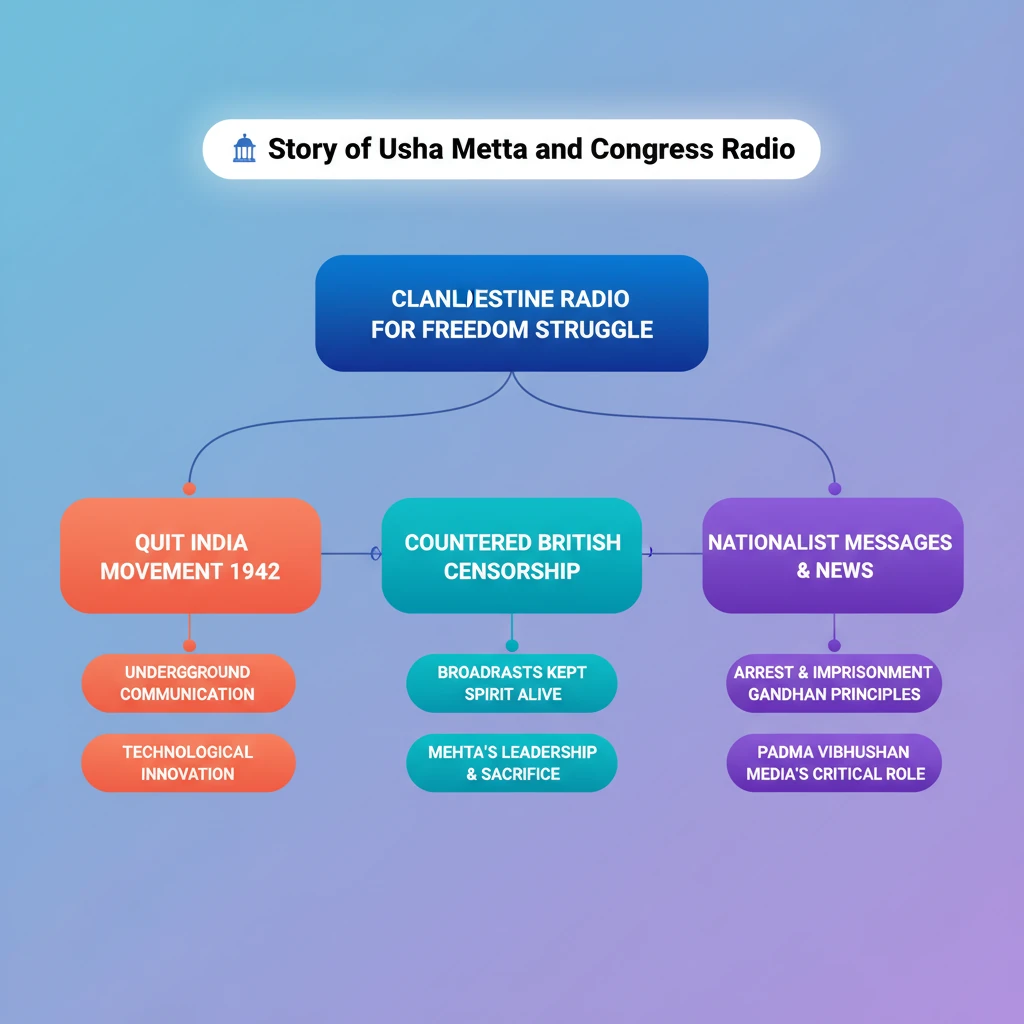
- •Usha Mehta was a key figure in the Quit India Movement, establishing the clandestine Congress Radio.
- •Congress Radio countered British censorship, broadcasting news and nationalist messages to keep the movement alive.
- •The initiative demonstrated the power of underground communication and technological innovation in resistance.
- •Mehta faced arrest and imprisonment but remained committed to Gandhian principles, earning the Padma Vibhushan.
- •Her story highlights the sacrifices of individuals and the critical role of media in India's freedom struggle.
🧠 Memory Techniques
98% Verified Content
📚 Reference Sources
•General historical accounts of the Quit India Movement
•Biographical information on Usha Mehta