Birth Anniversary of Sardar Vallabhbhai Patel - History | UPSC Learning
Topics
0 topics • 0 completed
🔍
No topics match your search
Birth Anniversary of Sardar Vallabhbhai Patel
Medium⏱️ 8 min read
history
📖 Introduction
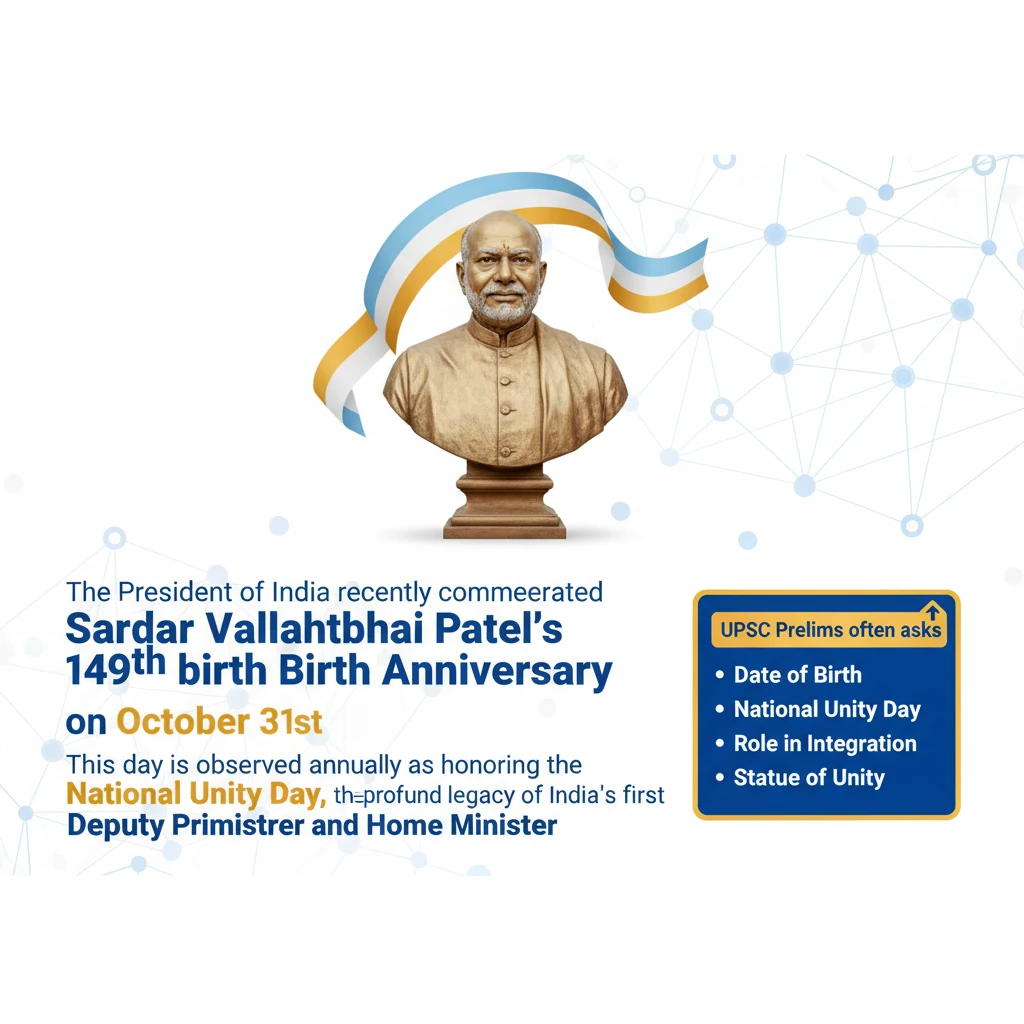
<h4>Commemoration of Sardar Vallabhbhai Patel's Birth Anniversary</h4><p>The <strong>President of India</strong> recently commemorated <strong>Sardar Vallabhbhai Patel's 149th birth anniversary</strong> on <strong>October 31st</strong>. This day is observed annually as <strong>National Unity Day</strong>, honoring the profound legacy of India’s first <strong>Deputy Prime Minister</strong> and <strong>Home Minister</strong>.</p><div class='exam-tip-box'><p><strong>UPSC Prelims</strong> often asks about important national days and the personalities associated with them. Remember <strong>October 31st</strong> as <strong>National Unity Day</strong> and its connection to <strong>Sardar Patel</strong>.</p></div><h4>What is National Unity Day?</h4><div class='info-box'><p><strong>About:</strong> <strong>National Unity Day</strong> (Rashtriya Ekta Diwas) serves as a vital reminder of the core values that <strong>Sardar Patel</strong> embodied throughout his life. These values include <strong>unity, integrity, and inclusiveness</strong>.</p></div><p>In a nation celebrated for its immense diversity in <strong>cultures, languages, and religions</strong>, this day underscores the critical importance of fostering a deep sense of <strong>solidarity</strong> among all Indian citizens.</p><p>The observance encourages citizens to reflect on the necessity of collective action to overcome national challenges, celebrate India's rich diversity, and actively promote harmony across the nation.</p><h4>Who was Sardar Vallabhbhai Patel?</h4><div class='info-box'><ul><li><strong>Birth:</strong> Born on <strong>October 31st, 1875</strong>, in <strong>Nadiad, Gujarat</strong>.</li><li><strong>Family:</strong> His family belonged to the <strong>Lewa Patidar community</strong>.</li></ul></div><p><strong>Career:</strong> <strong>Patel</strong> pursued law studies in <strong>England</strong>, where he distinguished himself by earning a prize in <strong>Roman Law</strong>. He returned to India in <strong>1913</strong> as a practicing <strong>barrister</strong>.</p><p><strong>Title and Legacy:</strong> He is widely known as the "<strong>Iron Man of India</strong>," a title bestowed upon him for his unwavering determination and firm, resolute approach to national issues. He remains revered as a powerful symbol of <strong>national unity and resilience</strong>.</p><h4>Patel's Political Rise and Role in the National Movement</h4><p><strong>Joining the National Movement:</strong> <strong>Sardar Patel</strong> was profoundly inspired by <strong>Mahatma Gandhi's</strong> ideals and subsequently joined India's freedom struggle, becoming one of its most prominent leaders.</p><div class='key-point-box'><p><strong>Key Satyagrahas:</strong></p><ul><li><strong>Kheda Satyagraha (1918):</strong> <strong>Patel</strong> played a pivotal leadership role, demanding tax exemptions for farmers in <strong>Kheda</strong> who were severely affected by crop failure due to drought.</li><li><strong>Bardoli Satyagraha (1928):</strong> He famously led the resistance movement in <strong>Bardoli</strong> against an unjust increase in land revenue taxes. His exceptional leadership during this struggle earned him the honorific title "<strong>Sardar</strong>."</li></ul></div><p><strong>Non-Cooperation and Civil Disobedience:</strong> Embracing <strong>Gandhi's vision</strong>, <strong>Patel</strong> actively participated in major campaigns, including leading actions during the <strong>Salt Satyagraha in 1930</strong>. His involvement led to multiple imprisonments.</p><p><strong>Presiding Over the Congress:</strong> In <strong>1931</strong>, <strong>Patel</strong> chaired the <strong>46th session of the Indian National Congress</strong>. During this crucial period, he skillfully navigated discussions surrounding the <strong>Gandhi-Irwin Pact</strong>.</p><p><strong>Quit India Movement (1942):</strong> <strong>Sardar Patel</strong> was a key figure in the <strong>Quit India Movement</strong>, a major phase of India's freedom struggle, and was arrested and imprisoned for his leadership.</p><h4>The Statue of Unity</h4><p>On <strong>October 31st, 2018</strong>, the monumental <strong>Statue of Unity</strong> was inaugurated. Standing at an impressive <strong>182 meters (600 feet)</strong>, it holds the distinction of being the <strong>world's tallest statue</strong>, dedicated to honoring <strong>Sardar Vallabhbhai Patel</strong>.</p><div class='info-box'><ul><li><strong>Location:</strong> Situated at <strong>Kevadia, Gujarat</strong>, on <strong>Sadhu Bet Hillock</strong>.</li><li><strong>Overlooking:</strong> It overlooks the majestic <strong>Narmada River</strong> and the <strong>Sardar Sarovar Dam</strong>, which is the second-largest gravity dam worldwide by concrete volume.</li></ul></div><p>In <strong>2020</strong>, the <strong>Statue of Unity</strong> gained international recognition by being included in the list of <strong>eight wonders of the Shanghai Cooperation Organisation (SCO)</strong>.</p>
💡 Key Takeaways
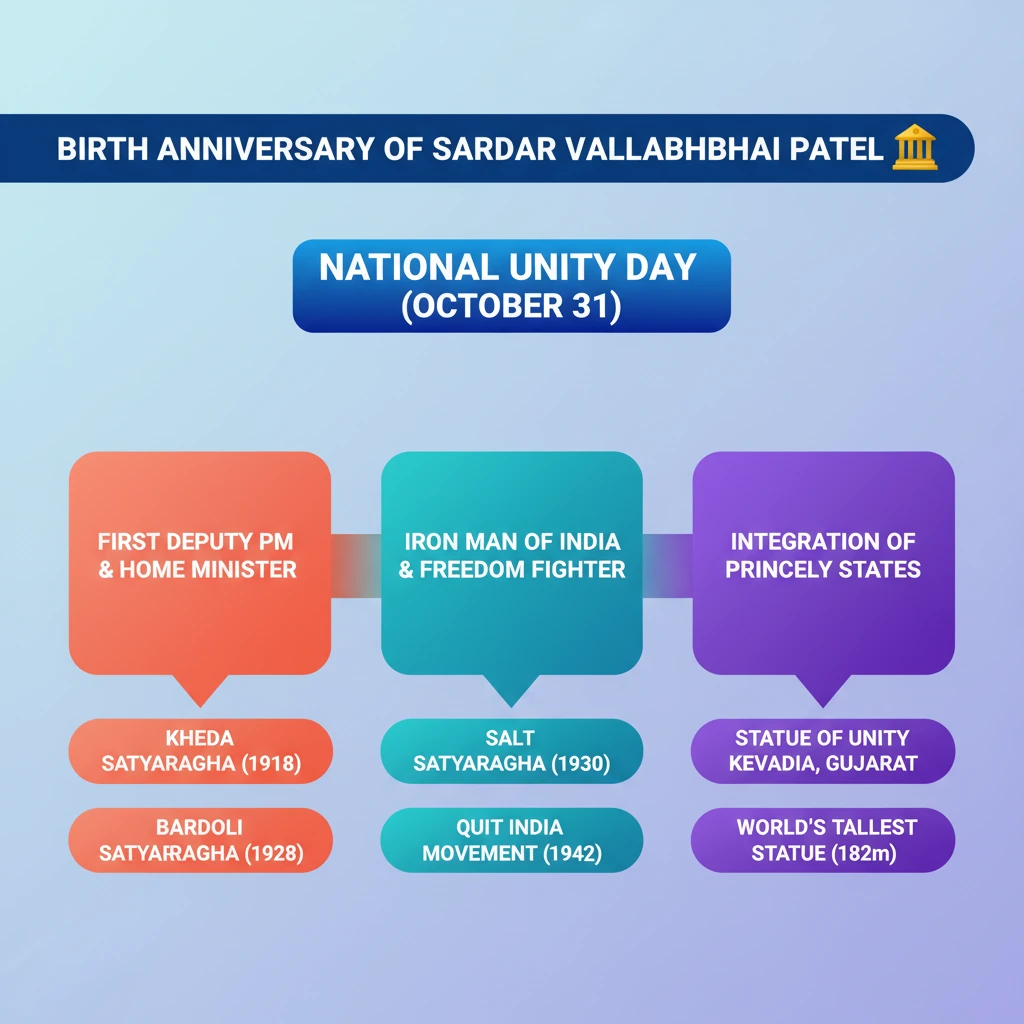
- •Sardar Vallabhbhai Patel's birth anniversary (Oct 31) is observed as National Unity Day.
- •He was India's first Deputy PM and Home Minister, known as the 'Iron Man of India'.
- •Patel played crucial roles in Kheda (1918) and Bardoli (1928) Satyagrahas.
- •He was a key leader in the Salt Satyagraha and Quit India Movement.
- •The Statue of Unity, the world's tallest, honors his legacy in Kevadia, Gujarat.
- •National Unity Day emphasizes unity, integrity, and inclusiveness in diverse India.
🧠 Memory Techniques
90% Verified Content