NCERT Chapter on Veer Abdul Hameed - History | UPSC Learning
Topics
0 topics • 0 completed
🔍
No topics match your search
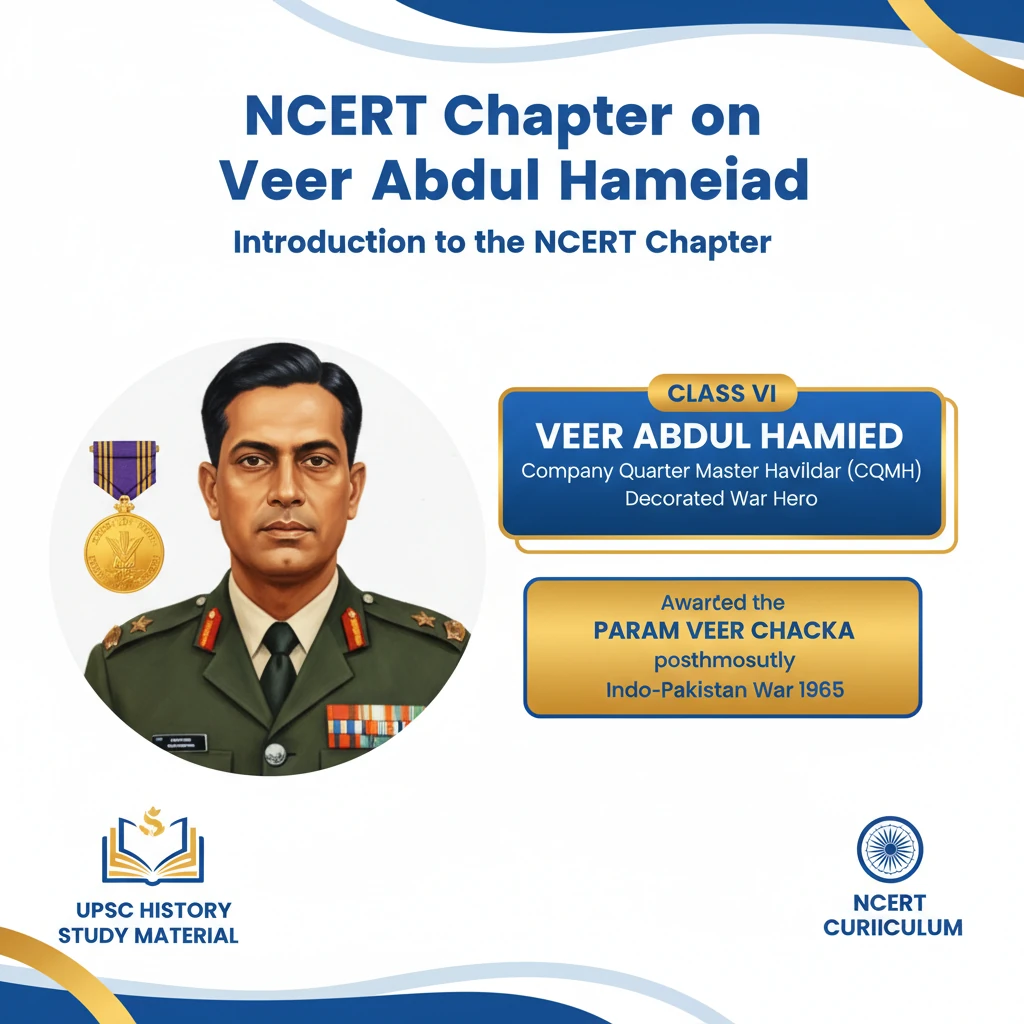
NCERT Chapter on Veer Abdul Hameed
Medium⏱️ 8 min read
history
📖 Introduction
<h4>Introduction to the NCERT Chapter</h4><p>The NCERT curriculum for <strong>Class VI</strong> now includes a chapter titled <strong>‘Veer Abdul Hameed’</strong>. This inclusion aims to honor <strong>Company Quarter Master Havildar (CQMH) Abdul Hameed</strong>, a decorated war hero.</p><div class='info-box'><p>He was awarded the <strong>Param Veer Chakra posthumously</strong> for his gallantry during the <strong>Indo-Pakistan War 1965</strong>.</p></div><div class='key-point-box'><p>The chapter's primary purpose is to inspire students with real-life examples of <strong>patriotism</strong> and unwavering <strong>devotion to duty</strong>.</p></div><h4>Poem on National War Memorial</h4><p>Alongside the chapter, a poem titled <strong>‘National War Memorial’</strong> has also been incorporated into the curriculum.</p><div class='key-point-box'><p>This poem seeks to instill a deep sense of <strong>respect for soldiers</strong> who made the ultimate sacrifice for the nation.</p></div><p>It also promotes a spirit of <strong>national pride</strong> and remembrance for their bravery.</p><div class='info-box'><ul><li>The <strong>National War Memorial</strong> stands as a testament to sacrifices made by soldiers during various conflicts, <strong>United Nations Operations</strong>, and <strong>Humanitarian Assistance and Disaster Response Operations</strong> since <strong>Independence</strong>.</li><li>It was inaugurated on <strong>25th February 2019</strong> at the <strong>India Gate complex, New Delhi</strong>.</li></ul></div><h4>Educational Reforms and Vision</h4><p>These changes in the NCERT textbook are fully aligned with the vision of the <strong>National Education Policy (NEP) 2020</strong>.</p><p>They also conform to the principles outlined in the <strong>National Curriculum Framework (NCF) 2023</strong>.</p><div class='key-point-box'><p>Both <strong>NEP 2020</strong> and <strong>NCF 2023</strong> emphasize <strong>holistic education</strong> that fosters <strong>ethical values</strong>, <strong>patriotism</strong>, and the development of <strong>responsible citizens</strong>.</p></div><div class='exam-tip-box'><p>Understanding this alignment is crucial for <strong>UPSC Mains GS-II</strong> (Education) and <strong>GS-IV</strong> (Ethics) answers, demonstrating a grasp of contemporary educational philosophy.</p></div><h4>Profile of Veer Abdul Hameed</h4><p><strong>Abdul Hameed</strong> served with distinction in the <strong>4th Grenadiers Battalion</strong> of the <strong>Indian Army</strong>.</p><p>He was a vital part of India's defense force during the pivotal <strong>Battle of Asal Uttar</strong> in the <strong>India-Pakistan War of 1965</strong>.</p><div class='info-box'><p>His unit was equipped with <strong>Recoilless Guns</strong>, specifically designed to target and neutralize enemy tanks.</p></div><h4>The Battle of Asal Uttar: A Turning Point</h4><p>The <strong>Battle of Asal Uttar</strong> took place in early <strong>September 1965</strong>, near the <strong>India-Pakistan border</strong> in <strong>Punjab</strong>, close to the town of <strong>Khem Karan</strong>.</p><p><strong>Pakistan's</strong> objective was to invade India, capture <strong>Khem Karan</strong>, and advance towards the <strong>Beas River bridge</strong> to isolate strategic areas like <strong>Amritsar</strong>.</p><div class='info-box'><ul><li>Pakistan launched its offensive with a significant number of superior <strong>Patton tanks</strong>, initially surprising and forcing Indian forces to retreat.</li><li>This engagement is recognized as one of the <strong>largest tank battles</strong> of the entire <strong>1965 India-Pakistan War</strong>.</li></ul></div><h4>Abdul Hameed's Valour at Cheema Village</h4><p><strong>Abdul Hameed</strong> was strategically positioned near <strong>Cheema village</strong>, located on the <strong>Amritsar-Khem Karan road</strong>.</p><p>He commanded a detachment equipped with <strong>Recoilless Guns</strong>, tasked with engaging enemy tanks.</p><div class='highlight-box'><p>On <strong>10th September 1965</strong>, he encountered four advancing <strong>Pakistani Patton tanks</strong>.</p><p>With incredible bravery, he successfully <strong>destroyed three</strong> of these tanks and <strong>damaged a fourth</strong>. Tragically, he was subsequently killed by fire from another enemy tank.</p></div><h4>Posthumous Recognition and Memorial</h4><p>The site of <strong>Abdul Hameed's death</strong> has been transformed into a significant <strong>war memorial</strong>.</p><div class='info-box'><p>A captured <strong>Pakistani Patton tank</strong>, with its turret lowered in submission, stands guard at the memorial's entrance.</p></div><p>This serves as a powerful tribute to the <strong>Indian soldiers</strong> who fought and sacrificed their lives in the <strong>Battle of Asal Uttar</strong>.</p><h4>Sardar Patel's Post-Independence Contributions</h4><p>While the chapter focuses on <strong>Veer Abdul Hameed</strong>, other figures like <strong>Sardar Vallabhbhai Patel</strong> are also crucial to understanding India's post-independence journey, often covered in NCERTs.</p><div class='key-point-box'><p><strong>Sardar Patel</strong> played an instrumental role in the <strong>integration of 562 princely states</strong> into the <strong>Indian Union</strong>.</p></div><p>This monumental effort secured <strong>stability</strong> and <strong>democracy</strong> for millions following the <strong>Indian Independence Act of 1947</strong>.</p><div class='info-box'><p>The <strong>Indian Independence Act of 1947</strong> allowed princely states to decide on their independence or accession to India or Pakistan.</p></div><h4>Reinforcing India's Civil Services</h4><p><strong>Patel</strong> was also pivotal in establishing the modern <strong>All India Services</strong>, which significantly strengthened the country's administrative framework.</p><div class='info-box'><p>He is affectionately remembered as the <strong>“patron saint of India’s civil servants”</strong> for his dedication to reinforcing the bureaucratic system.</p></div><p><strong>National Civil Service Day</strong> is observed annually on <strong>21st April</strong>.</p><p>This day honors <strong>Sardar Patel’s 1947 speech</strong>, where he famously referred to civil servants as <strong>“the steel frame of India”</strong>, emphasizing their dedication to public service.</p><h4>Leadership in the Constituent Assembly</h4><p>Furthermore, <strong>Sardar Patel</strong> led the <strong>Advisory Committee on Fundamental Rights, Minorities, and Tribal and Excluded Areas</strong> within the <strong>Constituent Assembly</strong>.</p><div class='exam-tip-box'><p>Knowledge of <strong>Sardar Patel's contributions</strong> is essential for <strong>UPSC Mains GS-I</strong> (Post-Independence Consolidation) and <strong>GS-II</strong> (Polity and Governance) answers.</p></div>
💡 Key Takeaways
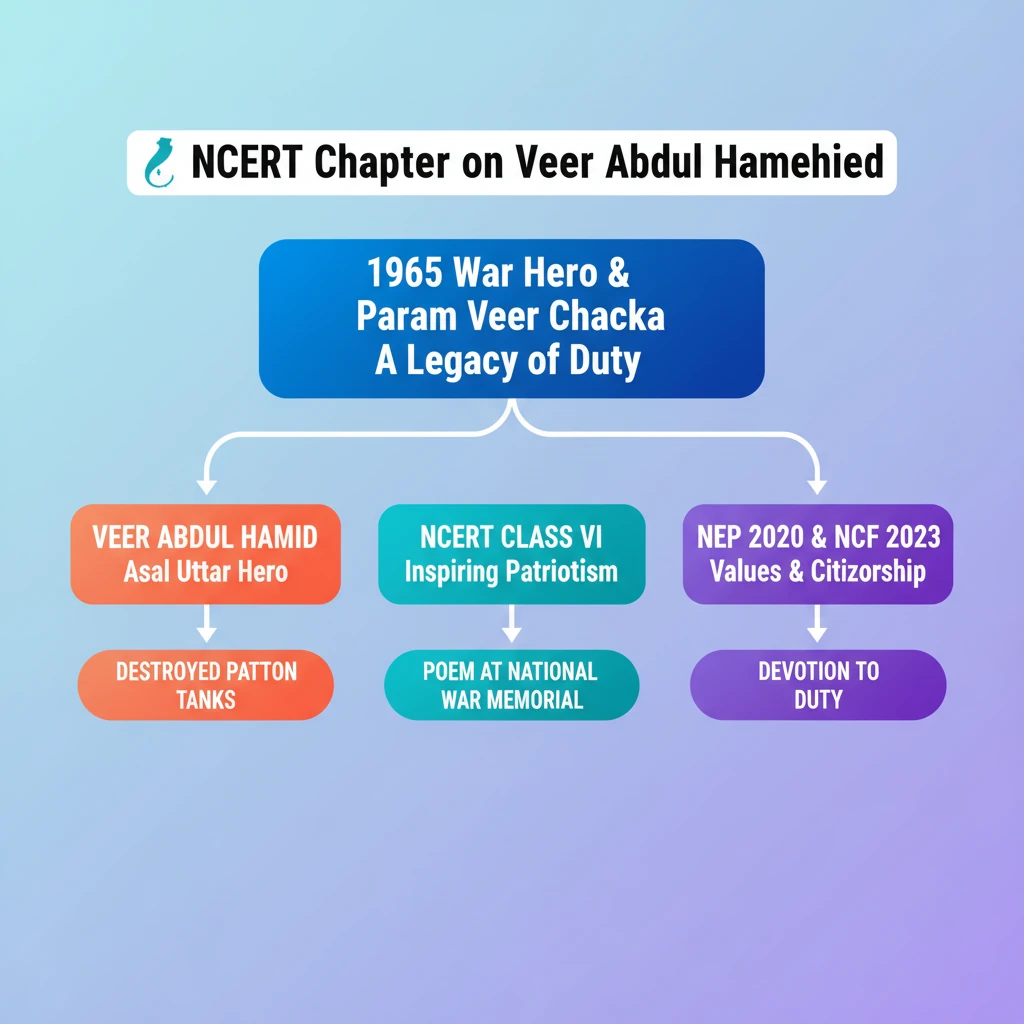
- •Veer Abdul Hameed was a 1965 Indo-Pak War hero, posthumously awarded Param Veer Chakra for destroying Pakistani Patton tanks at the Battle of Asal Uttar.
- •His story, along with a poem on the National War Memorial, is now included in Class VI NCERT to inspire patriotism and devotion to duty.
- •These curriculum changes align with NEP 2020 and NCF 2023, emphasizing holistic education, ethical values, and responsible citizenship.
- •The Battle of Asal Uttar was a crucial tank battle of the 1965 War, where India's valor, despite initial setbacks, turned the tide.
- •Sardar Patel's integration of 562 princely states and establishment of All India Services were foundational to modern India's unity and administrative strength.
🧠 Memory Techniques
95% Verified Content
📚 Reference Sources
•NCERT Class VI Curriculum (implied content)
•Government of India official communications (National War Memorial inauguration details)