Arunachal Pradesh: From NEFA to Statehood - A Historical Overview - History | UPSC Learning
Topics
0 topics • 0 completed
🔍
No topics match your search
Arunachal Pradesh: From NEFA to Statehood - A Historical Overview
Medium⏱️ 8 min read
history
📖 Introduction
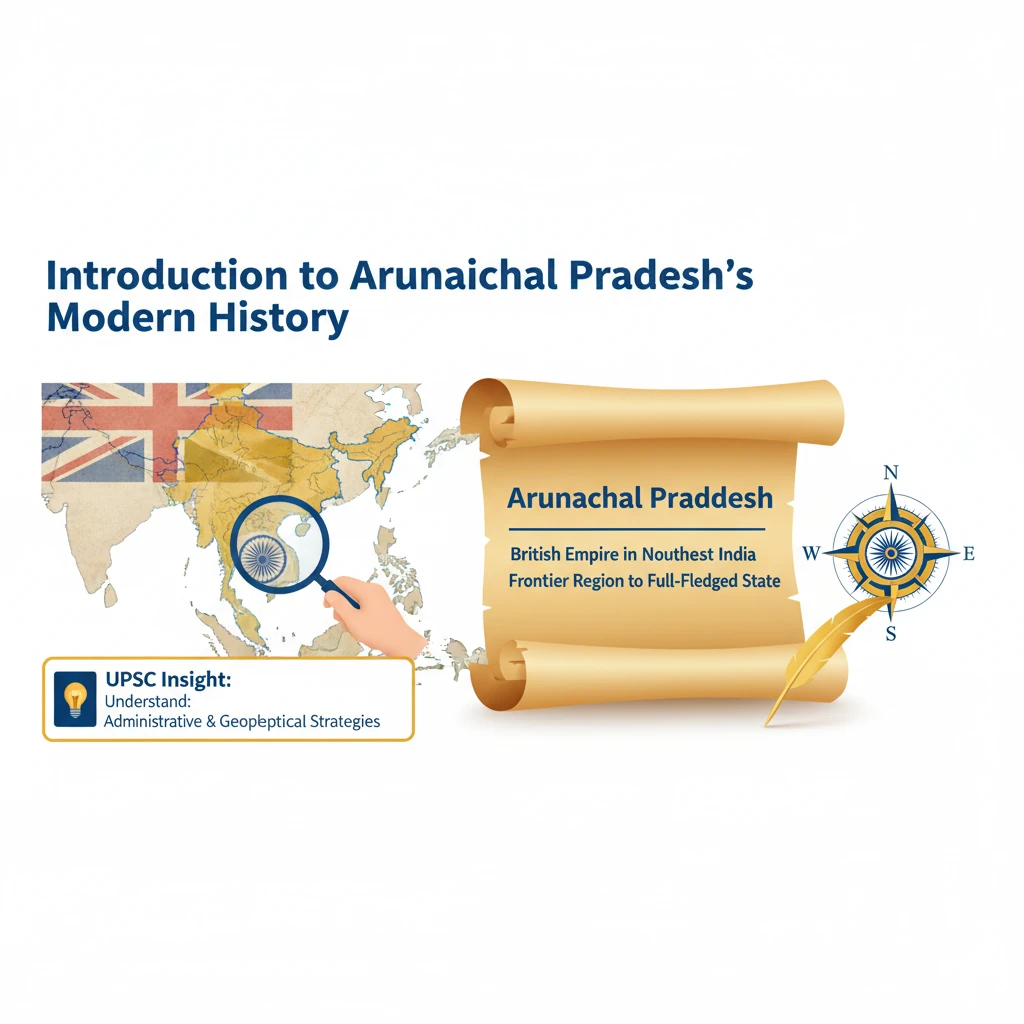
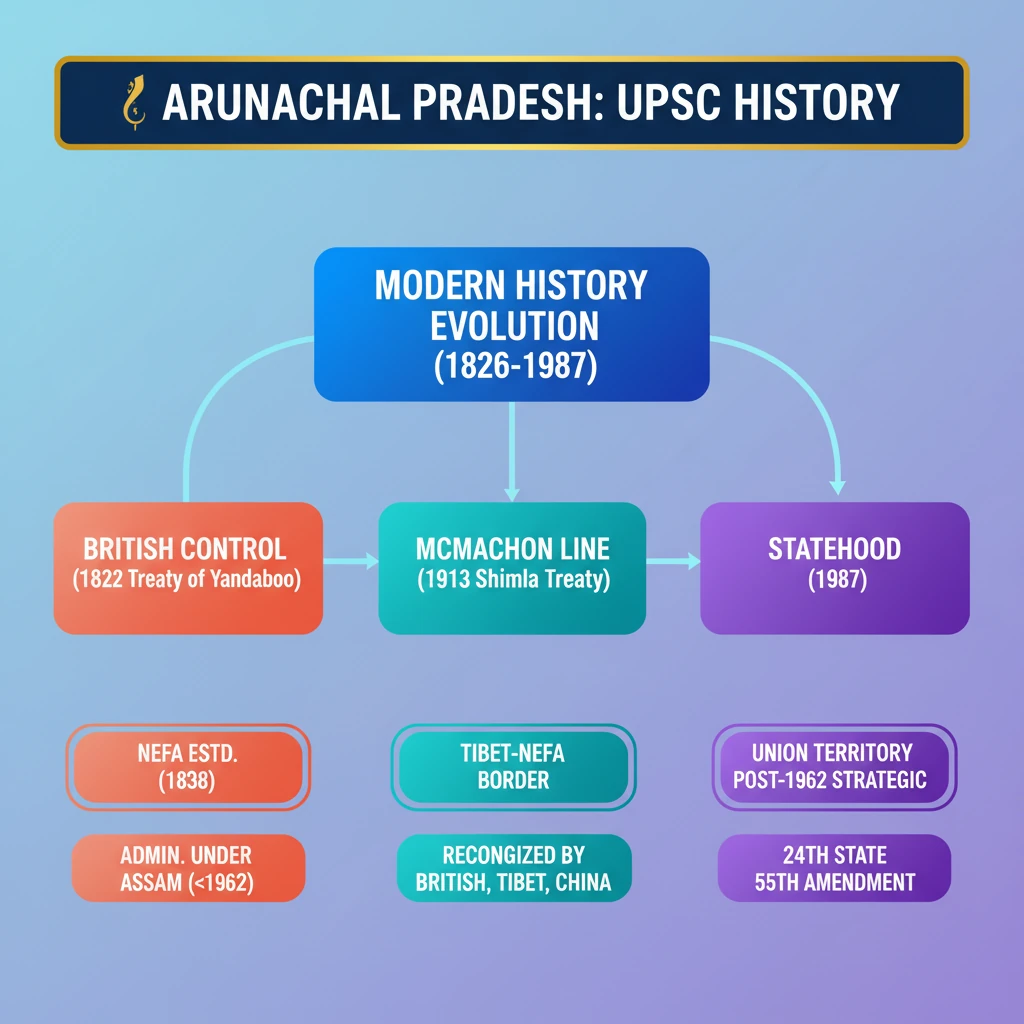
<h4>Introduction to Arunachal Pradesh's Modern History</h4><p>The modern historical narrative of <strong>Arunachal Pradesh</strong> is deeply intertwined with the administrative and geopolitical strategies of the <strong>British Empire</strong> in Northeast India.</p><p>Its journey from a loosely administered frontier region to a full-fledged state reflects significant shifts in regional power dynamics and national policy.</p><div class='exam-tip-box'><p><strong>UPSC Insight:</strong> Understanding the historical evolution of states like Arunachal Pradesh is crucial for <strong>GS Paper I (History)</strong> and <strong>GS Paper II (Polity & Governance)</strong>, especially regarding border issues and federalism.</p></div><h4>British Control and Early Administration</h4><p>The formal commencement of <strong>British control</strong> over the region that would become Arunachal Pradesh began after the <strong>First Anglo-Burmese War</strong>.</p><p>This control was solidified through the signing of the <strong>Treaty of Yandaboo</strong> in <strong>1826</strong>. This treaty marked a pivotal moment, bringing the frontier territories under British influence.</p><div class='info-box'><p><strong>Key Event:</strong> The <strong>Treaty of Yandaboo (1826)</strong> officially ended the <strong>First Anglo-Burmese War</strong>, leading to British annexation of Assam and initiating control over adjacent tribal areas.</p></div><p>Subsequently, by <strong>1838</strong>, the British established the <strong>North East Frontier Agency (NEFA)</strong>. This agency was created to administer the tribal areas along India's northeastern border, including parts of present-day Arunachal Pradesh.</p><h4>The Shimla Treaty and Border Demarcation</h4><p>A significant development in defining the region's boundaries occurred in <strong>1913</strong> with the <strong>Shimla Treaty</strong>. This treaty aimed to establish clear borders in the Himalayan region.</p><p>The <strong>Shimla Treaty</strong> delineated the boundary between <strong>Tibet</strong> and <strong>NEFA</strong>. This boundary, famously known as the <strong>McMahon Line</strong>, was recognized by <strong>China, Tibet</strong>, and the <strong>British rulers</strong> at the time.</p><div class='key-point-box'><p><strong>Important Concept:</strong> The <strong>McMahon Line</strong>, established by the <strong>Shimla Treaty (1913)</strong>, remains a point of contention in India-China relations, highlighting the historical complexities of border demarcation.</p></div><h4>Administrative Evolution: From Assam to Union Territory</h4><p>Prior to <strong>1962</strong>, <strong>Arunachal Pradesh</strong> was constitutionally under the jurisdiction of <strong>Assam</strong>. This meant its administrative affairs were managed by the Assam government.</p><p>However, due to its immense <strong>strategic significance</strong>, especially in the context of border security, the region underwent a crucial administrative transition.</p><p>After <strong>1962</strong>, it was separated from Assam and transitioned into a <strong>Union Territory</strong>, placed under a separate administration directly controlled by the Central Government.</p><h4>Attainment of Full Statehood</h4><p>The final step in its administrative evolution was the attainment of full <strong>statehood</strong>. <strong>Arunachal Pradesh</strong> achieved this milestone on <strong>20th February 1987</strong>.</p><p>It became the <strong>24th state</strong> of the <strong>Indian Union</strong>. This was facilitated through the <strong>55th Constitutional Amendment Act</strong>.</p><div class='info-box'><p><strong>Key Date:</strong> <strong>20th February 1987</strong> – Arunachal Pradesh becomes the <strong>24th state</strong> of India via the <strong>55th Constitutional Amendment</strong>.</p></div><p>This move was consistent with India's national policy of granting <strong>distinct state identities</strong> to significant <strong>tribal regions</strong>, recognizing their unique cultural and administrative needs.</p>
💡 Key Takeaways
- •Arunachal Pradesh's modern history began with British control via the 1826 Treaty of Yandaboo, leading to NEFA's establishment by 1838.
- •The 1913 Shimla Treaty defined the McMahon Line as the border between Tibet and NEFA, recognized by British, Tibetan, and Chinese authorities.
- •Before 1962, it was under Assam's jurisdiction; post-1962, it became a Union Territory due to strategic importance.
- •Achieved full statehood on February 20, 1987, as the 24th state, via the 55th Constitutional Amendment.
- •Its statehood aligned with national policy to grant distinct identities to tribal regions.
🧠 Memory Techniques

98% Verified Content
📚 Reference Sources
•NCERT History Textbooks (Class XI & XII)
•Ministry of Home Affairs, Government of India Publications
•The Constitution of India
•Official websites of Arunachal Pradesh Government