Santhal Tribe: History, Culture, and Socio-Economic Life - History | UPSC Learning
Topics
0 topics • 0 completed
🔍
No topics match your search
Santhal Tribe: History, Culture, and Socio-Economic Life
Medium⏱️ 8 min read
history
📖 Introduction
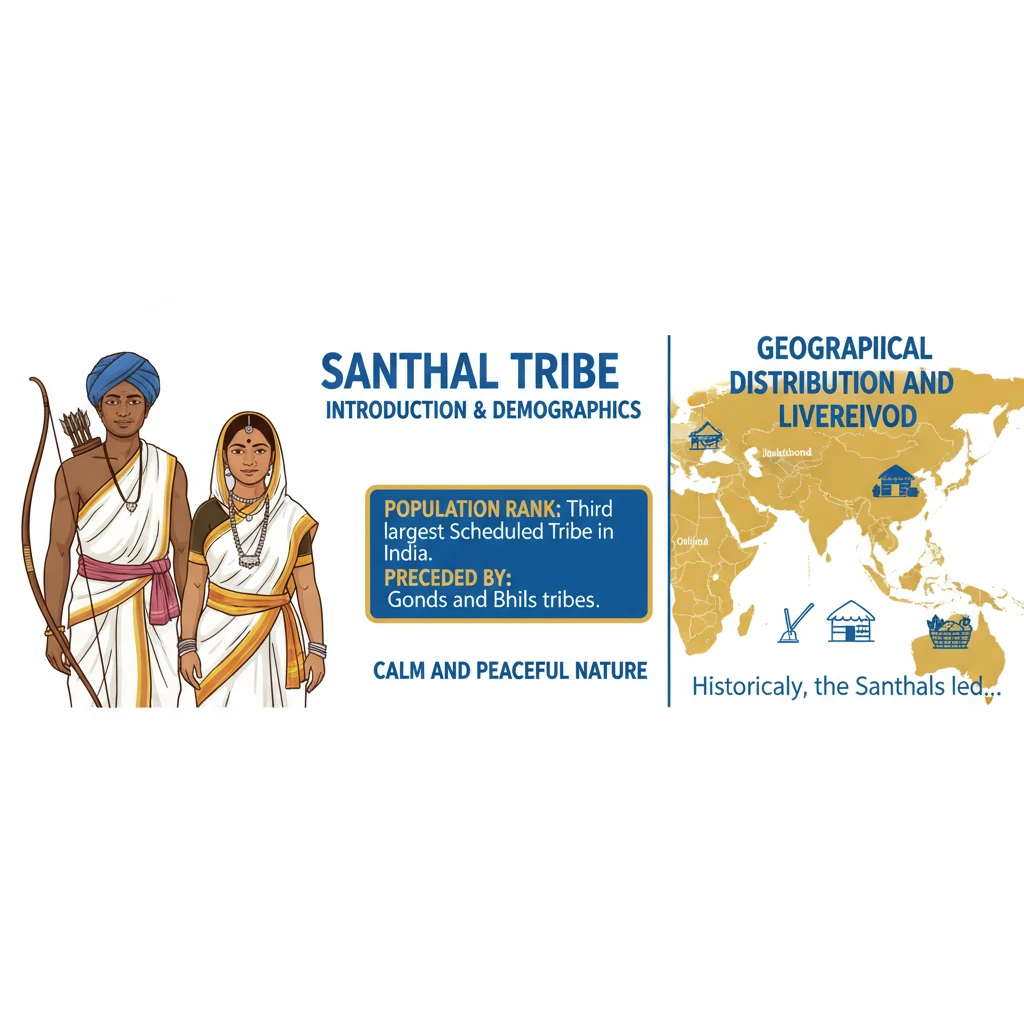
<h4>Introduction and Demographics</h4><p>The <strong>Santhal tribe</strong> holds a significant position as the <strong>third largest Scheduled Tribe</strong> in India. They are known for their generally <strong>calm and peaceful nature</strong>.</p><div class='info-box'><p><strong>Population Rank:</strong> Third largest Scheduled Tribe in India.</p><p><strong>Preceded by:</strong> Gonds and Bhils tribes.</p></div><h4>Geographical Distribution and Livelihood</h4><p>Historically, the Santhals led a <strong>nomadic life</strong> before settling in the <strong>Chota Nagpur plateau</strong>. Over time, they migrated and established communities in the <strong>Santhal Parganas</strong> regions of present-day <strong>Jharkhand</strong>, <strong>Bihar</strong>, and <strong>Odisha</strong>.</p><p>Today, their primary concentration is found across <strong>Jharkhand</strong>, <strong>Odisha</strong>, and <strong>West Bengal</strong>. Their livelihoods are diverse, encompassing <strong>cultivation</strong>, <strong>industrial labour</strong>, <strong>mining</strong>, and <strong>quarrying</strong>.</p><h4>Cultural and Linguistic Aspects</h4><p>The Santhals adhere to an <strong>animistic religious tribal religion</strong>. Their spiritual practices involve the <strong>worship of nature</strong>, typically conducted at <strong>sacred groves</strong>.</p><div class='key-point-box'><p><strong>Language:</strong> Their native language is <strong>Santhali</strong>.</p><p><strong>Script:</strong> They possess their own unique script known as <strong>‘Ol Chiki’</strong>.</p><p><strong>Constitutional Recognition:</strong> The <strong>Ol Chiki</strong> script and <strong>Santhali language</strong> are recognised under the <strong>Eighth Schedule</strong> of the Indian Constitution, signifying its national importance.</p></div><h4>Art and Lifestyle</h4><p>Santhal culture is rich in art forms. Notable among these are their distinctive <strong>Phuta Katcha pattern sarees and dresses</strong>, which are widely popular.</p><p>They observe various <strong>festivals and rituals</strong>, many of which are intricately linked to <strong>agriculture</strong> and their traditional worship practices.</p><p>Their traditional houses, called <strong>Olah</strong>, are easily identifiable. They are characterised by their <strong>large, neat, and attractive appearance</strong>, often adorned with vibrant <strong>multi-coloured paintings</strong> on their exterior walls.</p>
💡 Key Takeaways
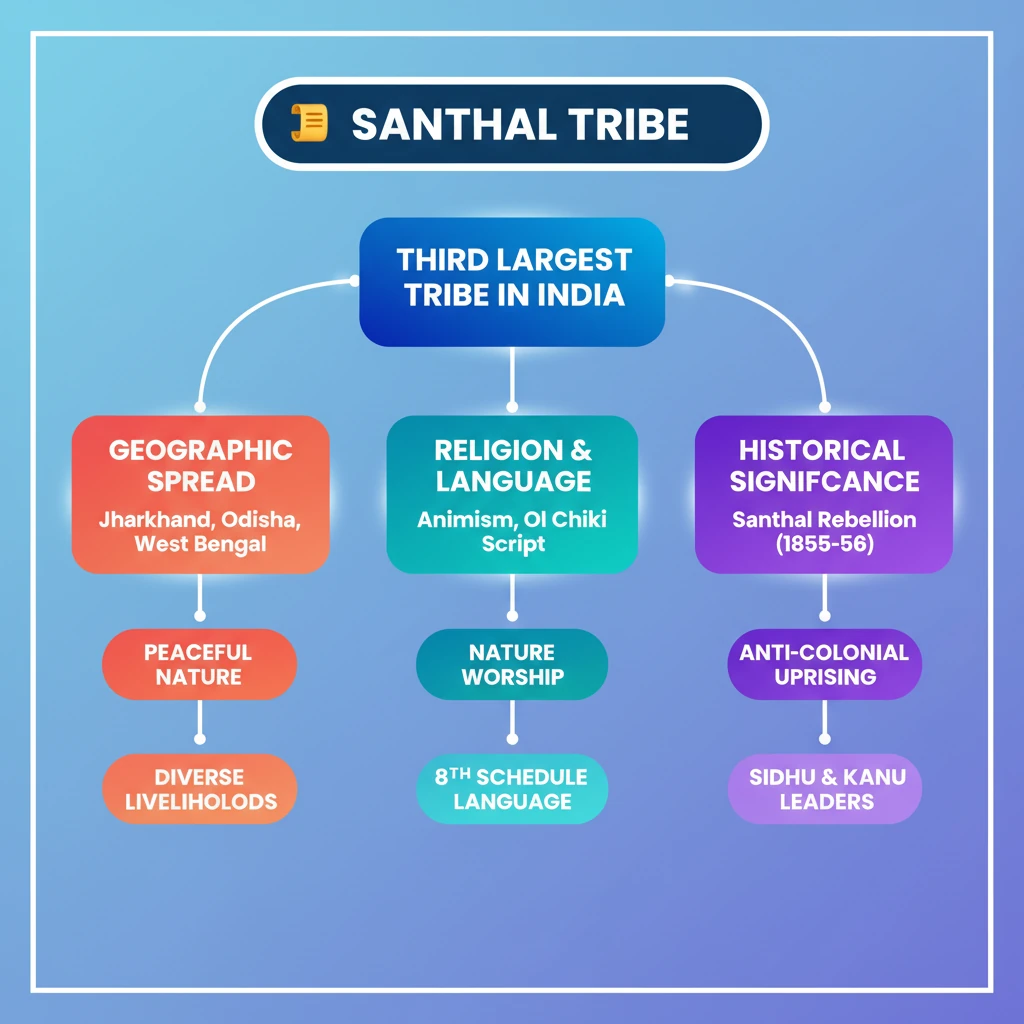
- •Santhals are the third largest Scheduled Tribe in India, known for their peaceful nature.
- •Primarily located in Jharkhand, Odisha, and West Bengal, with diverse livelihoods.
- •They follow an animistic religion, worshipping nature in sacred groves.
- •Their language is Santhali, with a unique script 'Ol Chiki', recognized in the Eighth Schedule.
- •The Santhal Rebellion (Hul) of 1855-56 was a significant anti-colonial uprising.
- •Their distinct art forms (Phuta Katcha) and attractive Olah houses are cultural hallmarks.
🧠 Memory Techniques
95% Verified Content
📚 Reference Sources
•NCERT History Textbooks (Class 8, 12)
•Ministry of Tribal Affairs, Government of India reports
•The Constitution of India (Eighth Schedule)
•Academic articles on Tribal Movements in India