Guru Gobind Singh Ji - History | UPSC Learning
Topics
0 topics • 0 completed
🔍
No topics match your search
Guru Gobind Singh Ji
Medium⏱️ 7 min read
history
📖 Introduction
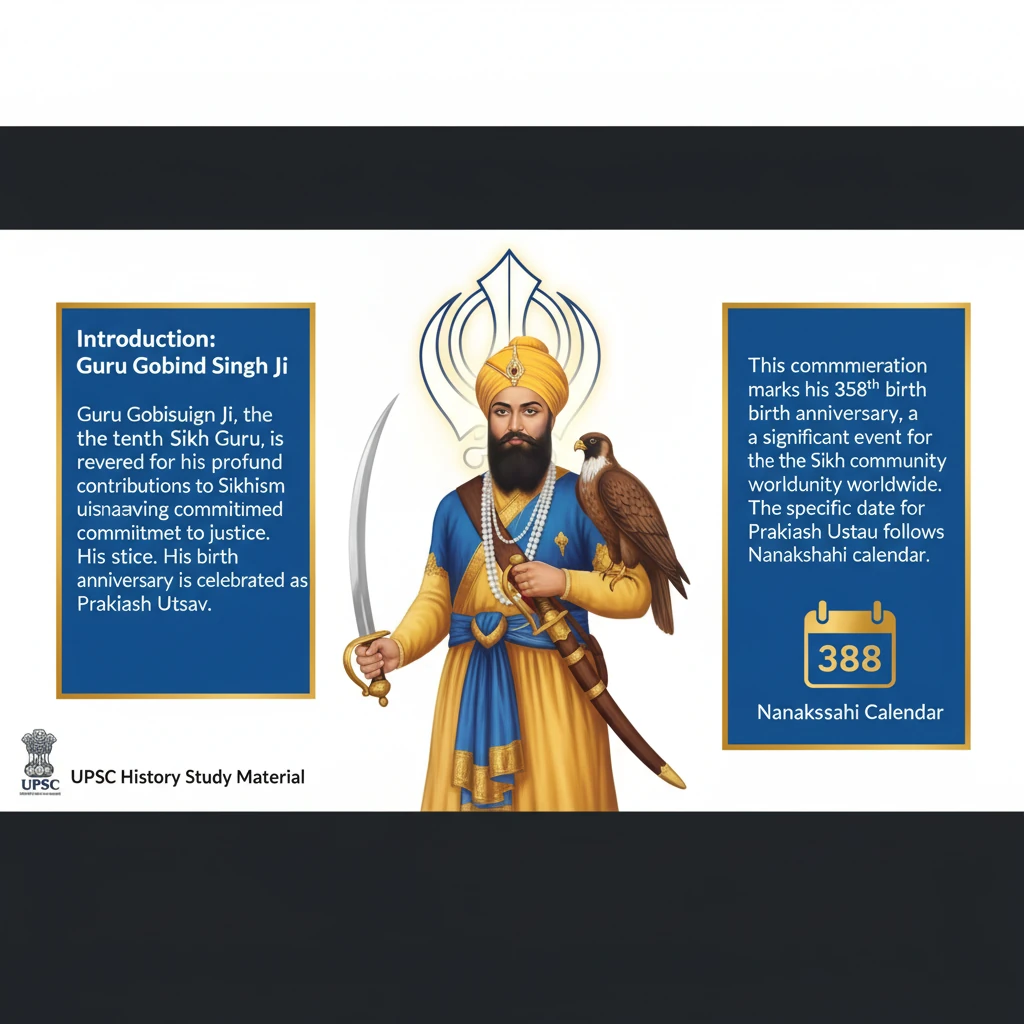
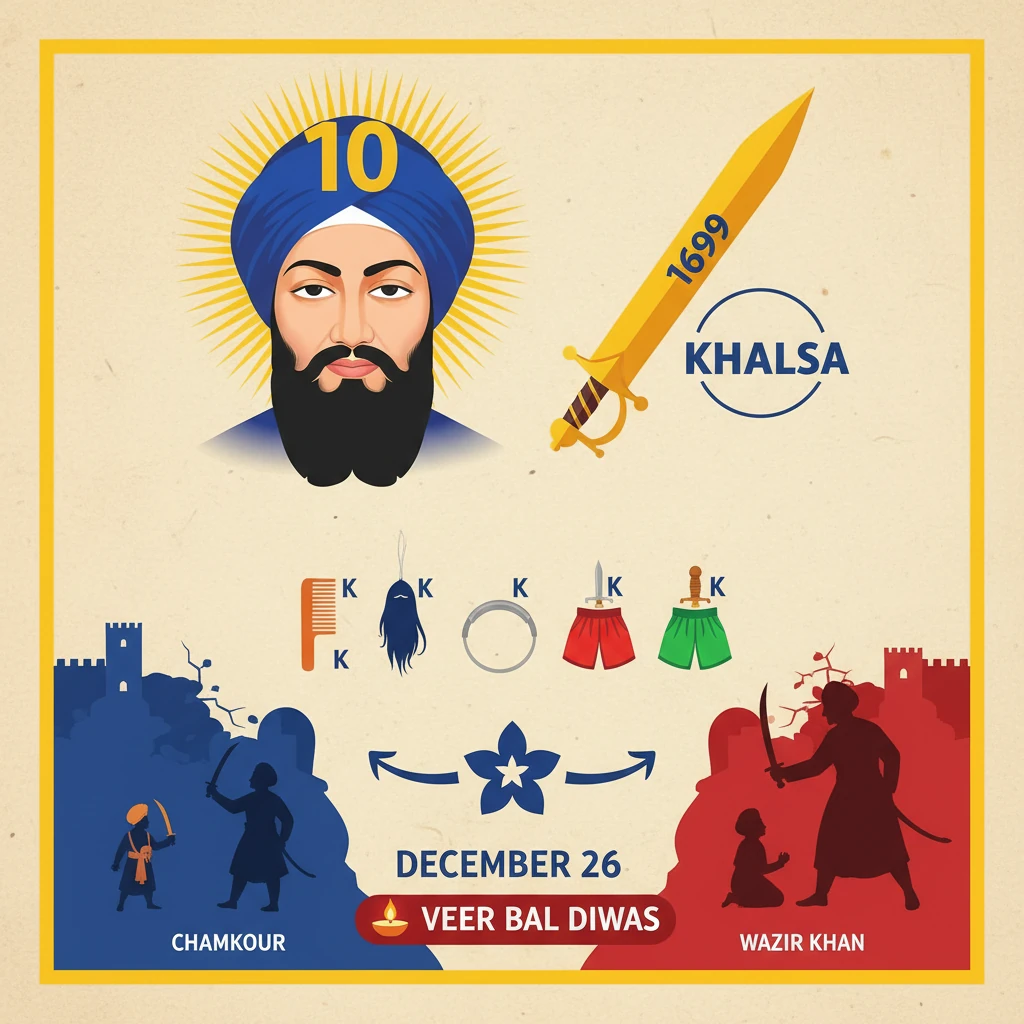
<h4>Introduction: Guru Gobind Singh Ji</h4><p><strong>Guru Gobind Singh Ji</strong>, the <strong>tenth Sikh Guru</strong>, is revered for his profound contributions to Sikhism and his unwavering commitment to justice. His birth anniversary is celebrated as <strong>Prakash Utsav</strong>.</p><p>This commemoration marks his <strong>358th birth anniversary</strong>, a significant event for the Sikh community worldwide. The specific date for Prakash Utsav follows the <strong>Nanakshahi calendar</strong>.</p><div class='info-box'><p><strong>Prakash Parv</strong> is a general term used to refer to the birth anniversaries of the Sikh Gurus. For <strong>Guru Gobind Singh Ji</strong>, this will fall on <strong>6th January in 2025</strong> according to the <strong>Nanakshahi calendar</strong>, which follows the solar year.</p></div><h4>Birth and Succession</h4><p><strong>Guru Gobind Singh Ji</strong> was born on <strong>22nd December 1666</strong>, in <strong>Patna Sahib, Bihar</strong>. His early life was marked by the spiritual legacy of his predecessors.</p><p>He succeeded his father, <strong>Guru Teg Bahadur</strong>, who was the <strong>ninth Sikh Guru</strong>. This succession occurred at a challenging time, following his father's martyrdom.</p><h4>Establishment of the Khalsa</h4><p>In <strong>1699</strong>, <strong>Guru Gobind Singh Ji</strong> established the <strong>Khalsa</strong>, a revolutionary move that transformed the Sikh community into a disciplined warrior collective.</p><div class='key-point-box'><p>The primary purpose of the <strong>Khalsa</strong> was to protect the Sikh faith and uphold justice against oppression. It instilled a sense of courage and self-respect among its followers.</p></div><h4>The Five K's (Panj Kakke)</h4><p>As part of the Khalsa initiation, <strong>Guru Gobind Singh Ji</strong> introduced the <strong>Five K's</strong>, which serve as external symbols of Sikh identity and commitment.</p><ul><li><strong>Kangha</strong> (comb): Symbolizes cleanliness and order.</li><li><strong>Kesh</strong> (uncut hair): Represents holiness and spiritual devotion.</li><li><strong>Kara</strong> (steel bracelet): Signifies restraint, strength, and connection to the Guru.</li><li><strong>Kirpan</strong> (sword): Denotes dignity, self-defense, and the fight against injustice.</li><li><strong>Kachhera</strong> (shorts): Represents modesty, agility, and readiness for battle.</li></ul><h4>Sacrifice of the Sahibzadas (Sons)</h4><p><strong>Guru Gobind Singh Ji</strong> endured immense personal sacrifice, including the martyrdom of all four of his sons, known as the <strong>Sahibzadas</strong>.</p><ul><li>His younger sons, <strong>Zorawar Singh</strong> (aged 7) and <strong>Fateh Singh</strong> (aged 9), were brutally executed by <strong>Sarhind's governor Wazir Khan</strong> after they steadfastly refused to convert to Islam.</li><li>His two elder sons, <strong>Ajit Singh</strong> and <strong>Jujhar Singh</strong>, bravely sacrificed their lives in the <strong>Battle of Chamkaur in 1705</strong>. In this battle, a small Sikh force valiantly fought against overwhelming Mughal and hill king armies.</li></ul><div class='info-box'><p>The martyrdom of the younger Sahibzadas is commemorated annually on <strong>26th December</strong>, observed as <strong>‘Veer Bal Diwas’</strong>, to honor their courage and sacrifice.</p></div><h4>Institution of Panj Pyare</h4><p>The concept of <strong>Panj Pyare</strong> (the Five Beloved Ones) was a cornerstone of the Khalsa's formation, signifying ultimate devotion and equality.</p><p><strong>Guru Gobind Singh Ji</strong> famously asked for five heads for sacrifice, and five men willingly stepped forward, demonstrating their unwavering faith and commitment to the Guru's cause.</p>
💡 Key Takeaways
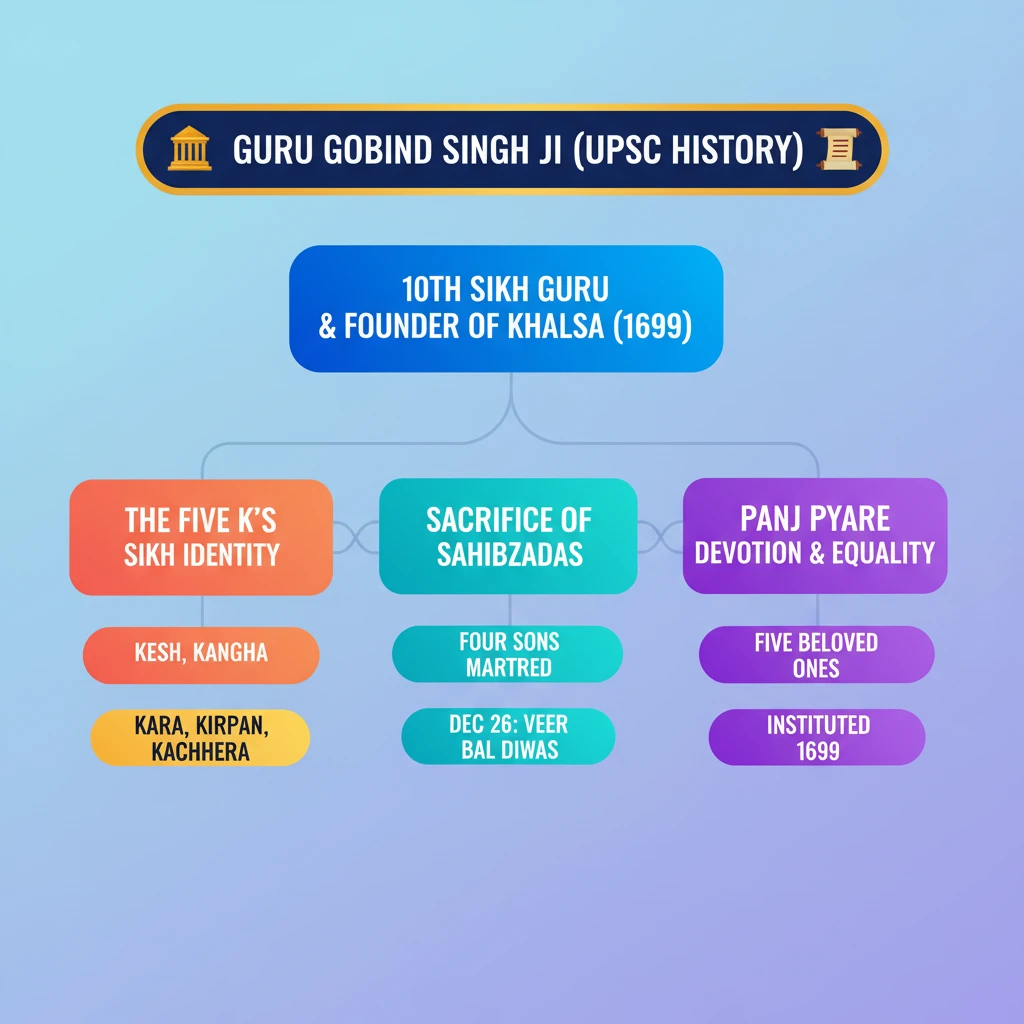
- •Guru Gobind Singh Ji was the 10th Sikh Guru and founder of the Khalsa in 1699.
- •He introduced the Five K's (Kangha, Kesh, Kara, Kirpan, Kachhera) as symbols of Sikh identity.
- •All four of his sons (Sahibzadas) attained martyrdom, two executed by Wazir Khan and two in the Battle of Chamkaur.
- •December 26th is observed as ‘Veer Bal Diwas’ to honor the sacrifice of the younger Sahibzadas.
- •He established the institution of Panj Pyare, symbolizing ultimate devotion and equality within the Khalsa.
🧠 Memory Techniques
95% Verified Content
📚 Reference Sources
•NCERT History Textbooks (relevant chapters on Mughal-Sikh relations)
•General historical accounts of Sikhism and medieval India