What was the 1971 Bangladesh Liberation War? - History | UPSC Learning
Topics
0 topics • 0 completed
🔍
No topics match your search
What was the 1971 Bangladesh Liberation War?
Medium⏱️ 7 min read
history
📖 Introduction
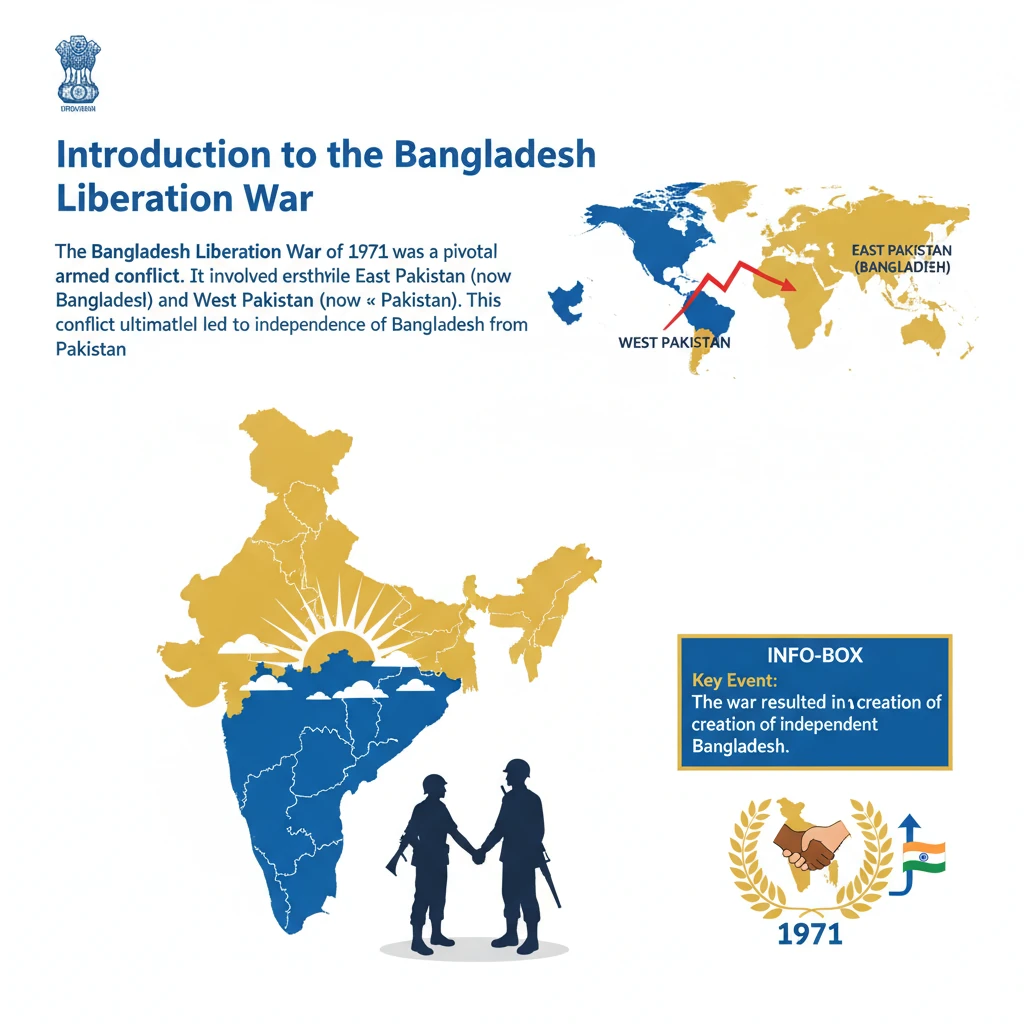
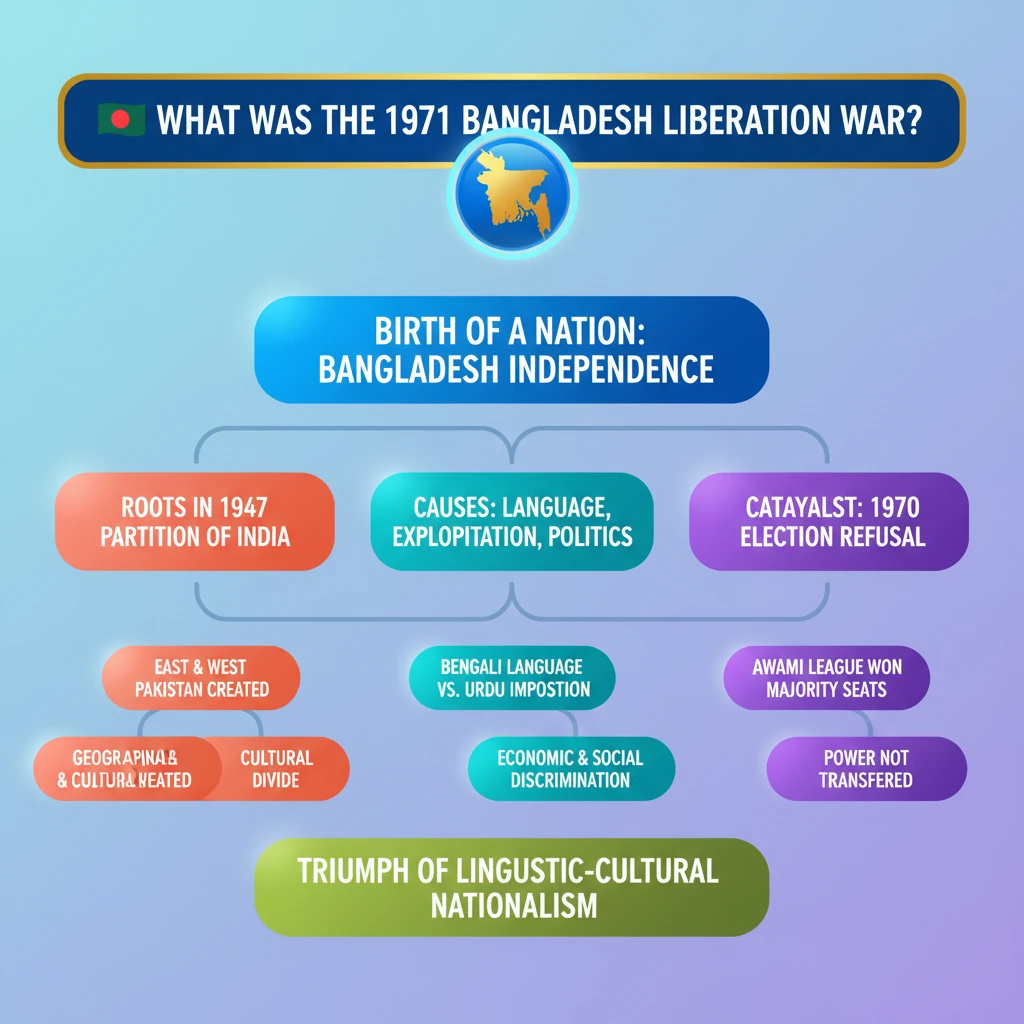
<h4>Introduction to the Bangladesh Liberation War</h4><p>The <strong>Bangladesh Liberation War of 1971</strong> was a pivotal armed conflict. It involved <strong>erstwhile East Pakistan</strong> (now <strong>Bangladesh</strong>) and <strong>West Pakistan</strong> (now <strong>Pakistan</strong>). This conflict ultimately led to the independence of <strong>Bangladesh</strong> from <strong>Pakistan</strong>.</p><div class='info-box'><p><strong>Key Event:</strong> The war resulted in the creation of an independent nation, <strong>Bangladesh</strong>, marking a significant geopolitical shift in South Asia.</p></div><h4>Roots of the Conflict</h4><p>The origins of the <strong>1971 Bangladesh Liberation War</strong> are deeply embedded in the <strong>1947 Partition of India</strong>. This historical event divided the subcontinent primarily along religious lines.</p><p><strong>Pakistan</strong> was established as a Muslim-majority state, fulfilling the demand of <strong>Muhammad Ali Jinnah</strong>. However, this new nation comprised two geographically separate wings: <strong>East Pakistan</strong> and <strong>West Pakistan</strong>.</p><p>Despite being united by religion, profound geographical, cultural, and linguistic differences existed between <strong>East Pakistan</strong> and <strong>West Pakistan</strong>. These disparities gradually sowed seeds of discord and alienation among the populace.</p><h4>Key Causes of the 1971 War</h4><p>Several underlying factors contributed to the outbreak of the war, stemming from systematic discrimination against <strong>East Pakistan</strong> by the West Pakistani establishment.</p><h5>Social Exploitation and Cultural Inferiority</h5><p>Post-independence, <strong>West Pakistan</strong> often perceived <strong>East Pakistan</strong> as culturally inferior. This perception was largely due to <strong>East Pakistan's</strong> historical ties with the Hindu-dominated elite before the <strong>Partition</strong>.</p><p>This view fueled systematic discrimination against the Bengali population, impacting their social and cultural development.</p><h5>Linguistic Marginalisation</h5><p>A major point of contention was the imposition of <strong>Urdu</strong> as <strong>Pakistan’s national language</strong>. This policy completely disregarded <strong>Bengali</strong>, which was the predominant language spoken by the majority population in <strong>East Pakistan</strong>.</p><p>This linguistic marginalisation led to widespread unrest and significant protests, most notably the <strong>Bengali Language Movement</strong>.</p><div class='key-point-box'><p><strong>Important Concept:</strong> The <strong>Bengali Language Movement</strong> (early 1950s) was a crucial precursor, highlighting the strong cultural identity of <strong>East Pakistan</strong> and their resistance to West Pakistani dominance.</p></div><h5>Political Discrimination</h5><p><strong>West Pakistan</strong> maintained a dominant position in the central government, with political power largely concentrated among the <strong>Punjabi elite</strong>. This meant that decision-making was heavily skewed.</p><p>Despite having a larger population, <strong>East Pakistan</strong> received minimal representation and influence in national policy and governance, leading to deep political grievances.</p><p>The <strong>1970 general elections</strong> became a flashpoint. The <strong>Awami League</strong>, led by <strong>Sheikh Mujibur Rahman</strong>, won a decisive victory, securing a majority in the National Assembly. However, the West Pakistani establishment refused to transfer power, escalating tensions dramatically.</p><div class='exam-tip-box'><p><strong>UPSC Insight:</strong> Understanding the multi-faceted causes – <strong>social, linguistic, and political</strong> – is crucial for essay questions on nation-building, regional conflicts, and India's role in South Asian geopolitics. Focus on the <strong>1947 Partition</strong> as the foundational event.</p></div>
💡 Key Takeaways
- •The 1971 Bangladesh Liberation War led to Bangladesh's independence from Pakistan.
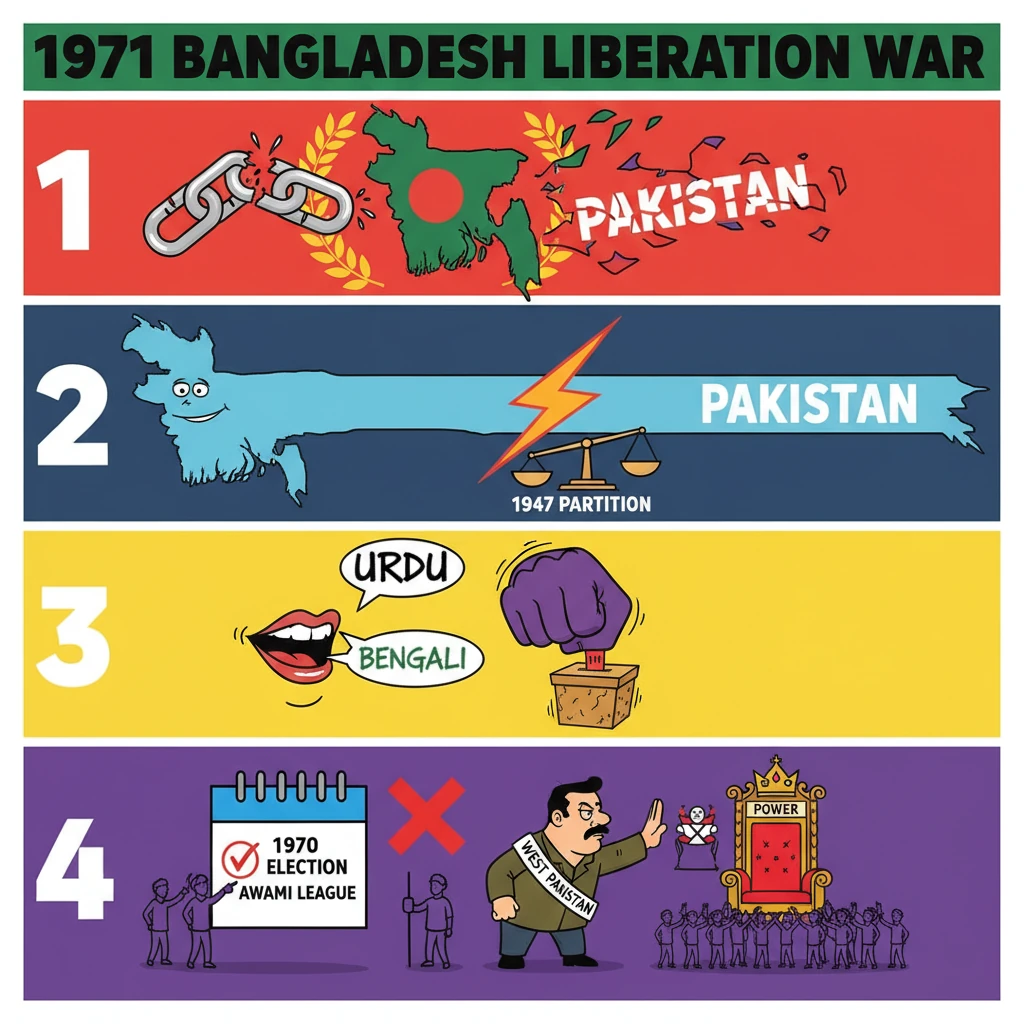
- •Its roots lie in the 1947 Partition of India and the creation of a bifurcated Pakistan.
- •Key causes included social exploitation, linguistic marginalisation (Urdu vs. Bengali), and political discrimination.
- •West Pakistan's refusal to transfer power after the Awami League's 1970 election victory was a major catalyst.
- •The war highlighted the triumph of linguistic-cultural nationalism over religious nationalism in East Pakistan.
- •India played a crucial role in supporting Bangladesh's liberation.
🧠 Memory Techniques
95% Verified Content
📚 Reference Sources
•Academic texts on the Partition of India and creation of Bangladesh
•Historical accounts of the Bengali Language Movement and 1970 elections