What are the Other Reforms Undertaken by William Bentinck (1828-1835)? - History | UPSC Learning
Topics
0 topics • 0 completed
🔍
No topics match your search
What are the Other Reforms Undertaken by William Bentinck (1828-1835)?
Medium⏱️ 7 min read
history
📖 Introduction
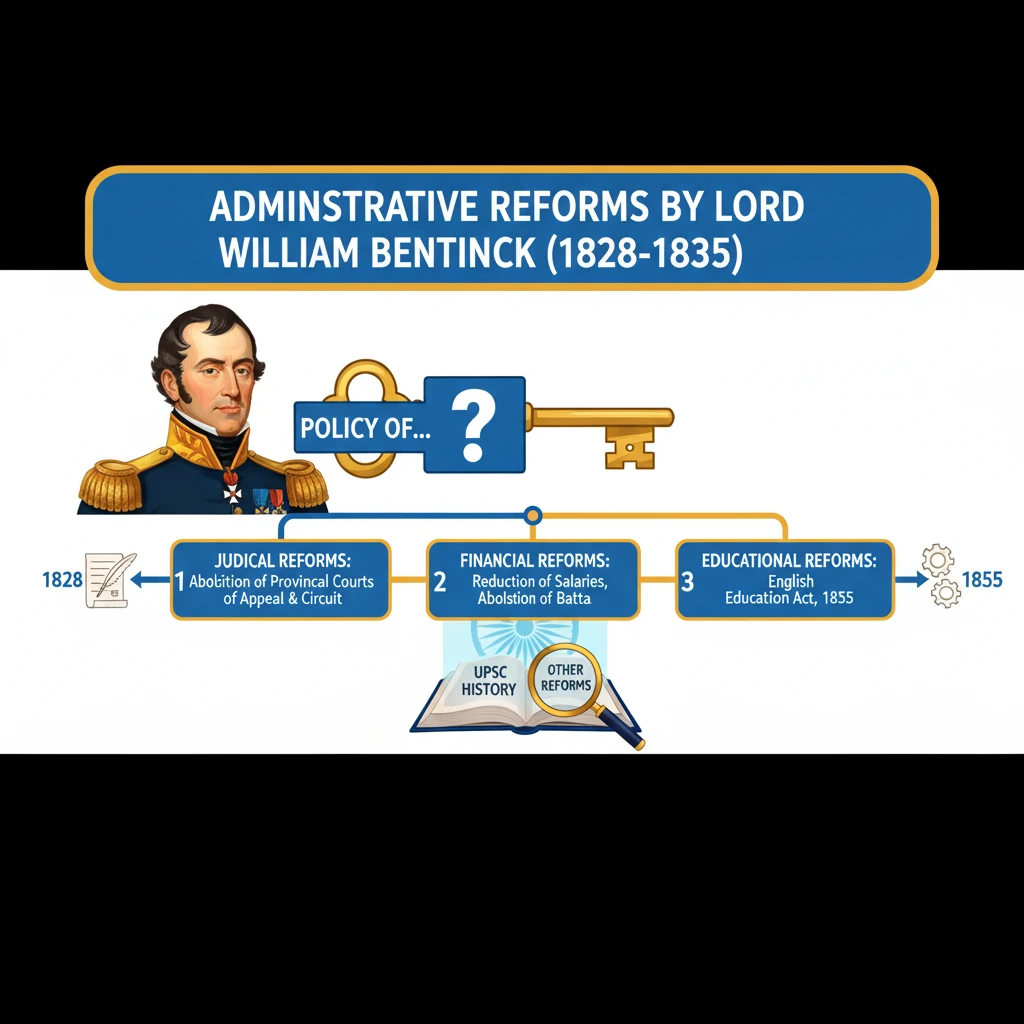
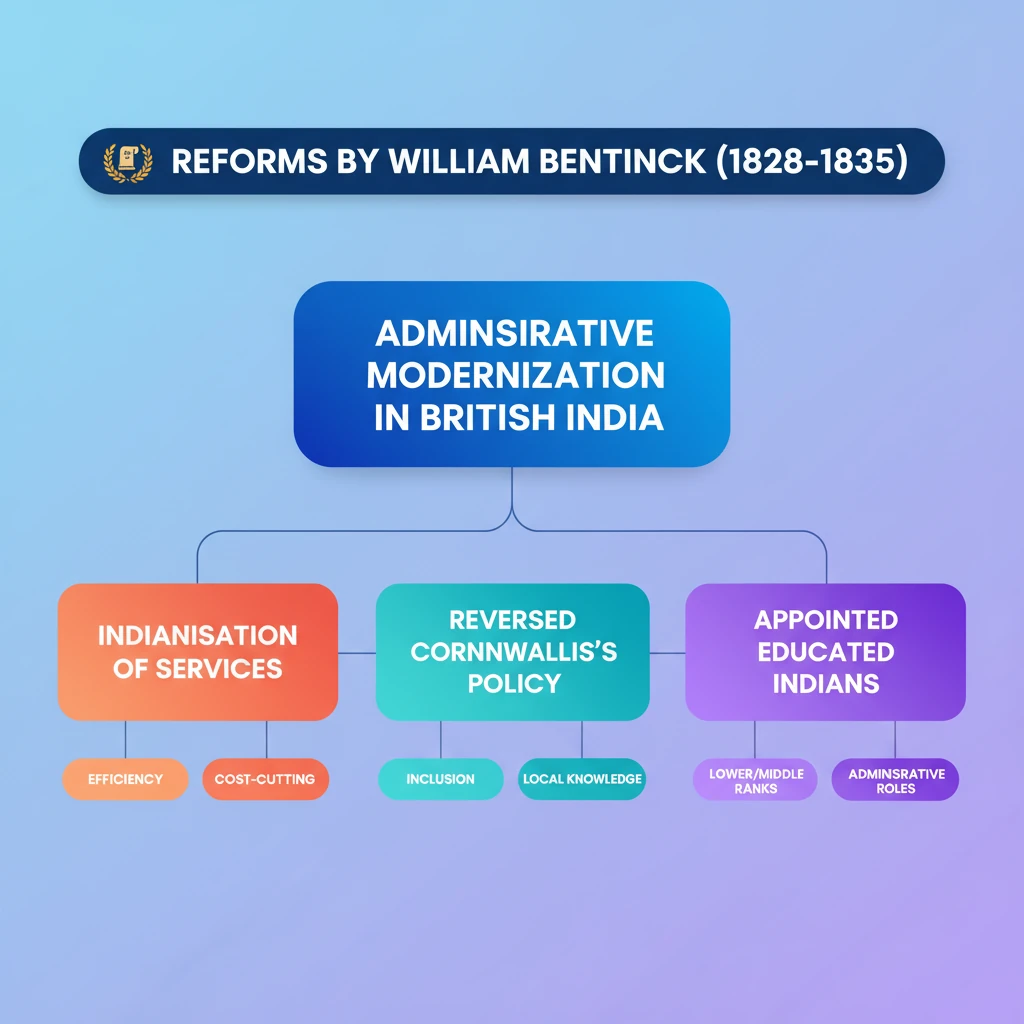
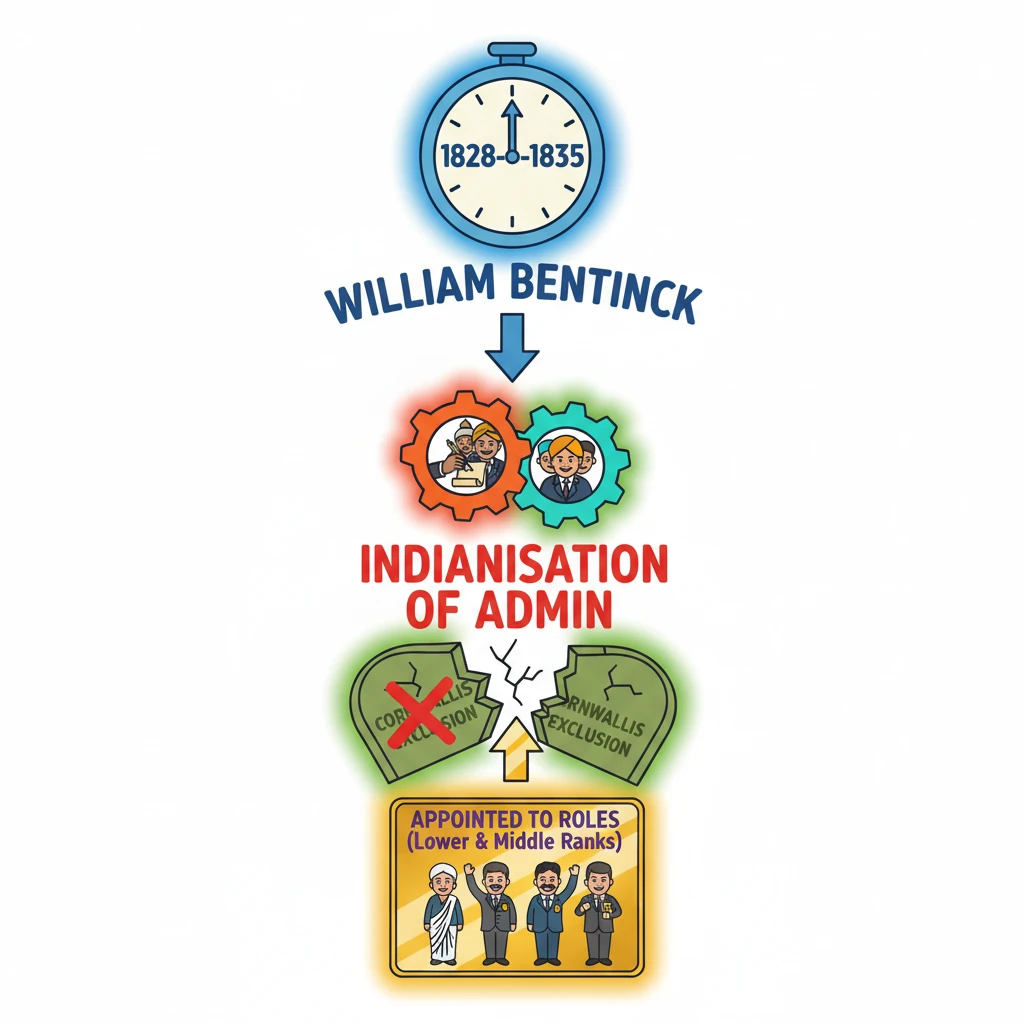
<h4>Lord William Bentinck's Reforms (1828-1835)</h4><p><strong>Lord William Bentinck</strong> served as the <strong>Governor-General of Bengal</strong> from <strong>1828 to 1833</strong> and then as the first <strong>Governor-General of India</strong> from <strong>1833 to 1835</strong>. His tenure is marked by a series of significant administrative, judicial, financial, educational, and social reforms.</p><p>These reforms aimed at improving governance, enhancing efficiency, and addressing prevalent social issues, laying foundational changes in British India.</p><h4>Administrative Reforms</h4><h5>Indianisation of Administration</h5><p><strong>Bentinck</strong> reversed <strong>Lord Cornwallis’s</strong> policy of excluding <strong>Indians</strong> from administrative roles.</p><p>He appointed educated <strong>Indians</strong> as <strong>Deputy Magistrates</strong> and <strong>Deputy Collectors</strong>, marking a significant move towards <strong>Indianising</strong> the government service.</p><div class='key-point-box'><p>This policy aimed to utilize local talent, reduce administrative costs, and improve understanding of local customs and needs.</p></div><h5>Land Revenue Settlement</h5><p><strong>Lord William Bentinck</strong> reviewed and updated the <strong>Mahalwari system</strong> of land revenue in <strong>1833</strong>.</p><p>This involved detailed surveys and negotiations with <strong>landholders</strong> and <strong>village communities</strong>, leading to increased revenue for the state.</p><div class='info-box'><p>The <strong>Mahalwari system</strong> was primarily implemented in parts of the <strong>North-Western Provinces</strong>, <strong>Central Provinces</strong>, and <strong>Punjab</strong>, aiming for a more equitable assessment.</p></div><h5>Administrative Divisions</h5><p>Bentinck reorganised the <strong>Presidency of Bengal</strong> into <strong>twenty divisions</strong>.</p><p>Each division was overseen by a <strong>Commissioner</strong>, which significantly enhanced administrative efficiency and oversight.</p><h4>Judicial Reforms</h4><h5>Abolition of Provincial Courts</h5><p>Bentinck abolished the existing <strong>Provincial Courts of Appeal and Circuit</strong>, which were often slow and inefficient.</p><p>He established a new hierarchy of courts to expedite judicial processes.</p><p>A <strong>Supreme Court</strong> was established in <strong>Agra</strong> for civil and criminal appeals, improving judicial accessibility, especially for the <strong>North-Western Provinces</strong>.</p><h5>Judicial Empowerment</h5><p>He created separate <strong>Sadar Diwani Adalat</strong> (for civil cases) and <strong>Sadar Nizamat Adalat</strong> (for criminal cases) at <strong>Allahabad</strong>.</p><p>This decentralization aimed at improving judicial accessibility for the public in the region.</p><h5>Reduction of Punishments</h5><p>Bentinck reduced the severity of punishments and abolished inhumane practices.</p><p>Practices such as <strong>flogging</strong> were abolished, reflecting a more humane approach to justice.</p><h5>Language of the Courts</h5><p>Bentinck ordered the use of <strong>vernacular languages</strong> in local courts, making justice more accessible and understandable to common people.</p><p>In higher courts, <strong>Persian</strong> was replaced by <strong>English</strong> as the official language.</p><p>Qualified <strong>Indians</strong> were appointed as <strong>Munsiffs</strong> and <strong>Sadar Amins</strong>, integrating them into the judicial system at various levels.</p><h4>Financial Reforms</h4><h5>Cost-Cutting Measures</h5><p>Bentinck formed two committees, one <strong>military</strong> and one <strong>civil</strong>, to examine rising expenditure.</p><p>Following their recommendations, he significantly reduced the salaries and allowances of officials and cut travel expenses.</p><div class='info-box'><p>These stringent measures led to substantial annual savings for the <strong>East India Company</strong>, addressing its financial strain.</p></div><h5>Revenue Recovery</h5><p>He investigated land grants in <strong>Bengal</strong>, where many <strong>rent-free landholders</strong> were found to possess <strong>forged title deeds</strong>.</p><p>By recovering these unlawfully held lands, he enhanced the <strong>Company's revenue</strong>, contributing to financial stability.</p><h4>Educational Reforms</h4><h5>Medium of Instruction</h5><p>Influenced by <strong>Lord Macaulay's Minute on Indian Education (1835)</strong>, Bentinck strongly supported <strong>English</strong> as the medium of instruction.</p><div class='key-point-box'><p>This decision had profound and long-lasting impacts on the Indian education system, promoting Western learning and administrative efficiency.</p></div><h4>Social Reforms</h4><p>While <strong>William Bentinck</strong> is most famously associated with the abolition of <strong>Sati (1829)</strong>, the provided source also highlights other social reform efforts, some of which materialized after his tenure but reflect the progressive spirit of the era.</p><h5>Child Marriage</h5><p>The movement against child marriage gained momentum during and after Bentinck's era, culminating in significant legislative actions:</p><ul><li>The <strong>Age of Consent Act, 1891</strong>, forbade the marriage of girls below the age of <strong>12</strong>.</li><li>The <strong>Child Marriage Restraint Act, 1929 (Sarda Act)</strong>, pushed up the marriage age to <strong>18</strong> for boys and <strong>14</strong> for girls.</li><li>The <strong>Child Marriage Restraint (Amendment) Act 1978</strong> further raised the age of marriage for girls from <strong>15 to 18 years</strong> and for boys from <strong>18 to 21</strong>.</li></ul><div class='exam-tip-box'><p>While these specific acts are post-Bentinck, understanding their chronological progression is crucial for <strong>UPSC Prelims</strong>, illustrating the long-term impact of social reform movements.</p></div><h5>Education of Women</h5><p>The push for female education also saw foundational steps during this period:</p><ul><li>The <strong>Calcutta Female Juvenile Society</strong>, established in <strong>1819</strong>, marked the beginning of a broader movement towards female education.</li><li>The <strong>Bethune School</strong>, founded in <strong>1849</strong> by <strong>J.E.D. Bethune</strong>, became a pivotal institution for women’s education in India.</li></ul><div class='key-point-box'><p>These initiatives, though some after Bentinck's direct influence, reflect the evolving social consciousness that his reformist administration helped foster.</p></div>
💡 Key Takeaways
- •Bentinck (1828-1835) was a reformist Governor-General, driven by Utilitarian and Liberal principles.
- •He initiated Indianisation of administration, appointing Indians as Deputy Magistrates/Collectors.
- •Judicial reforms included abolishing Provincial Courts, establishing a Supreme Court in Agra, and using vernacular languages in local courts.
- •Financial reforms focused on cost-cutting (salaries, allowances) and revenue recovery (forged land deeds).
- •He supported English as the medium of instruction, influenced by Macaulay.
- •His era fostered a climate for social reforms, including later legislative actions against child marriage and the promotion of women's education.
🧠 Memory Techniques
90% Verified Content