Quit India Movement: Causes - Failure of Cripps Mission - History | UPSC Learning
Topics
0 topics • 0 completed
🔍
No topics match your search
Quit India Movement: Causes - Failure of Cripps Mission
Medium⏱️ 8 min read
history
📖 Introduction
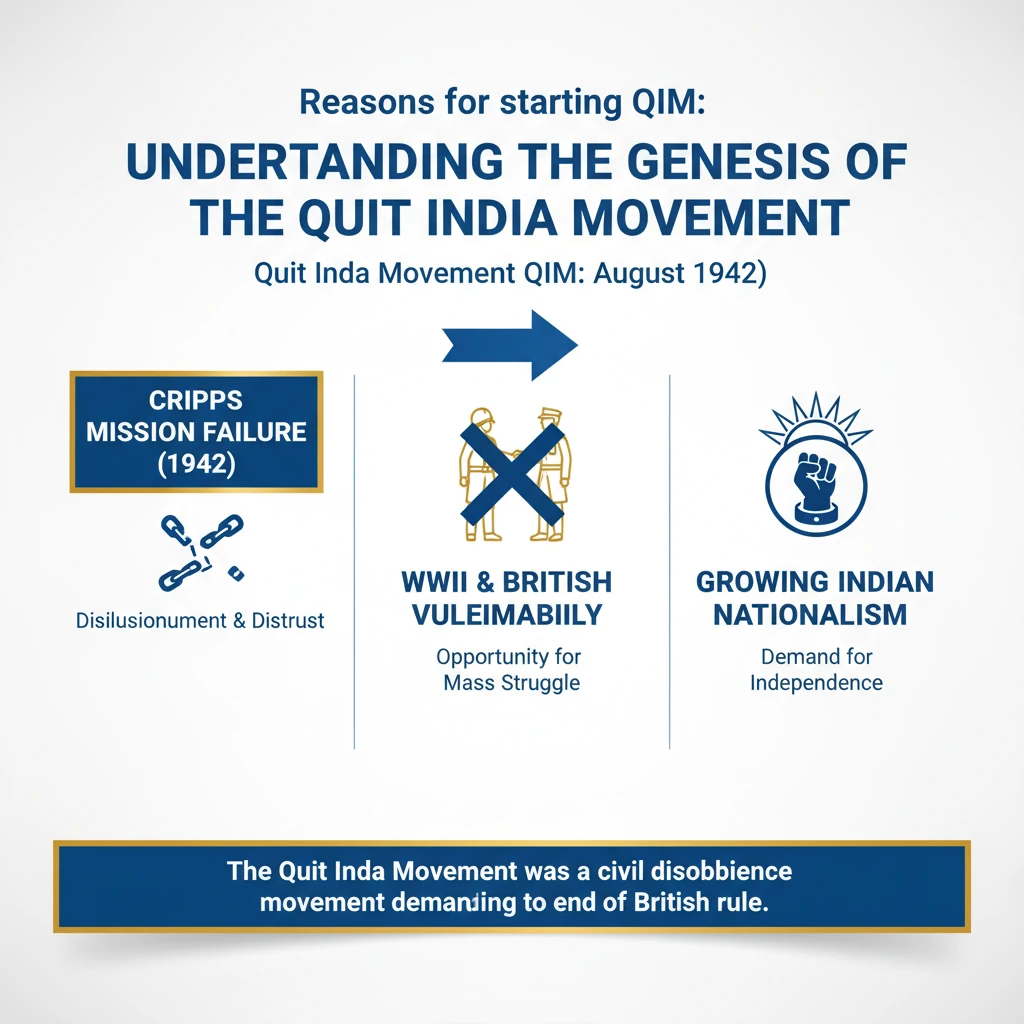
<h4>Understanding the Genesis of the Quit India Movement</h4><p>The <strong>Quit India Movement (QIM)</strong>, launched in <strong>August 1942</strong>, marked a pivotal moment in India's struggle for independence. Its initiation was a direct response to several critical factors, primarily the disillusionment caused by the <strong>Cripps Mission</strong>.</p><div class='key-point-box'><p>The <strong>Quit India Movement</strong> was a civil disobedience movement demanding an end to British rule in India, launched by <strong>Mahatma Gandhi</strong> during <strong>World War II</strong>.</p></div><h4>The Failure of the Cripps Mission (1942)</h4><p>The <strong>Cripps Mission</strong>, led by <strong>Sir Stafford Cripps</strong>, arrived in India in <strong>March 1942</strong>. Its primary objective was to secure India's full cooperation and support for the British war effort in <strong>World War II</strong>. However, the proposals put forth by the mission were met with widespread rejection by Indian political parties.</p><div class='info-box'><p><strong>Cripps Mission (1942) Key Facts:</strong></p><ul><li><strong>Leader:</strong> Sir Stafford Cripps</li><li><strong>Objective:</strong> Secure Indian support for <strong>WWII</strong>.</li><li><strong>Outcome:</strong> Failed due to rejection by major Indian political parties.</li></ul></div><h4>Britain's Unchanged Stance on Constitutional Advance</h4><p>One of the most significant reasons for the mission's failure, and consequently for the launch of the QIM, was Britain's persistent reluctance to grant <strong>complete independence</strong>. The proposals clearly exposed Britain's unchanged, conservative attitude towards India's constitutional future.</p><p>Indian leaders perceived that any continued silence or passive acceptance of these proposals would imply acknowledging Britain's inherent right to determine India's destiny without genuine consultation or consent from its people.</p><h4>Proposals of Dominion Status vs. Complete Independence</h4><p>The <strong>Cripps Mission</strong> offered <strong>Dominion Status</strong> to India after the war. This proposal was a major point of contention. Indian nationalist leaders, particularly the <strong>Indian National Congress</strong>, were now unequivocally demanding <strong>Purna Swaraj</strong> or <strong>complete independence</strong>.</p><div class='info-box'><p><strong>Dominion Status:</strong> A semi-independent nation within the <strong>British Commonwealth</strong>, retaining the British monarch as head of state but with self-governing powers.</p><p><strong>Complete Independence (Purna Swaraj):</strong> Total sovereignty, free from any external control or allegiance to the British Crown.</p></div><p>The offer of anything less than full independence was seen as insufficient and a betrayal of the aspirations of millions of Indians who had struggled for decades.</p><h4>Threat to National Unity: The Right to Secede</h4><p>Another highly contentious proposal was the provision allowing provinces the <strong>right to secede</strong> from the proposed Indian Union. This clause was vehemently opposed by the <strong>Indian National Congress</strong>.</p><div class='key-point-box'><p>The provision for provinces to <strong>secede</strong> directly contradicted the fundamental principle of <strong>national unity</strong> that the Congress championed. It was seen as a deliberate attempt to fragment India.</p></div><p>This proposal raised fears of balkanization and undermined the vision of a strong, united India. It fueled suspicions that Britain intended to divide India further, rather than consolidate it.</p><div class='exam-tip-box'><p>For UPSC Mains, when discussing the <strong>Quit India Movement</strong>, always highlight the <strong>Cripps Mission's failure</strong> as a catalyst. Emphasize the issues of <strong>Dominion Status</strong> vs. <strong>Complete Independence</strong> and the threat to <strong>national unity</strong> posed by the secession clause.</p></div>
💡 Key Takeaways
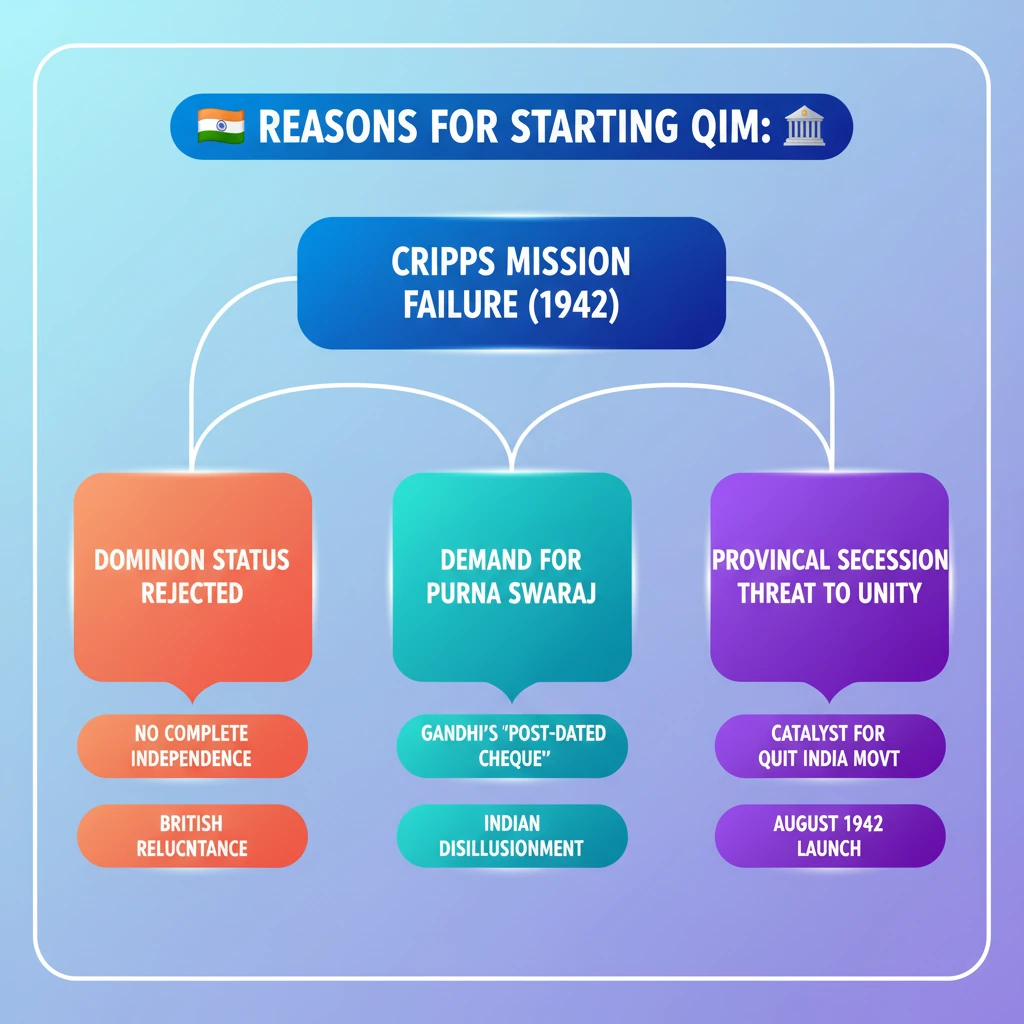
- •The Cripps Mission (1942) failed primarily due to Britain's reluctance to grant complete independence.
- •Its offer of Dominion Status was rejected as Indian leaders demanded Purna Swaraj (Complete Independence).
- •The provision allowing provinces to secede was seen as a threat to India's national unity.
- •The failure of the Cripps Mission was a direct and significant catalyst for the launch of the Quit India Movement in August 1942.
- •Mahatma Gandhi's 'post-dated cheque' remark encapsulated the Indian disillusionment with British promises.
🧠 Memory Techniques
98% Verified Content
📚 Reference Sources
•India's Struggle for Independence by Bipan Chandra
•A Brief History of Modern India by Spectrum Books
•NCERT History Textbooks (Class XII - Themes in Indian History Part III)
•The Story of My Experiments with Truth by M.K. Gandhi