Maritime Activity Under the Chola Rule - History | UPSC Learning
Topics
0 topics • 0 completed
🔍
No topics match your search
Maritime Activity Under the Chola Rule
Medium⏱️ 5 min read
history
📖 Introduction
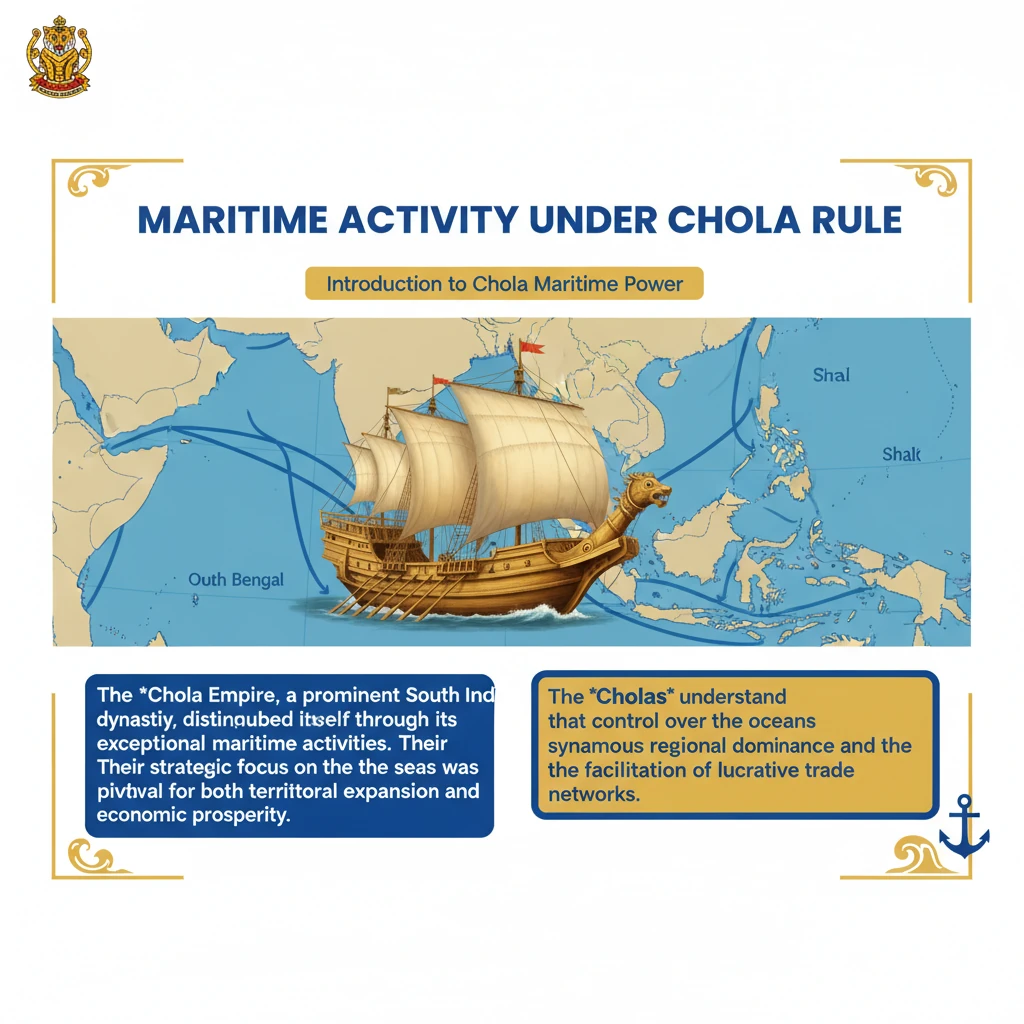
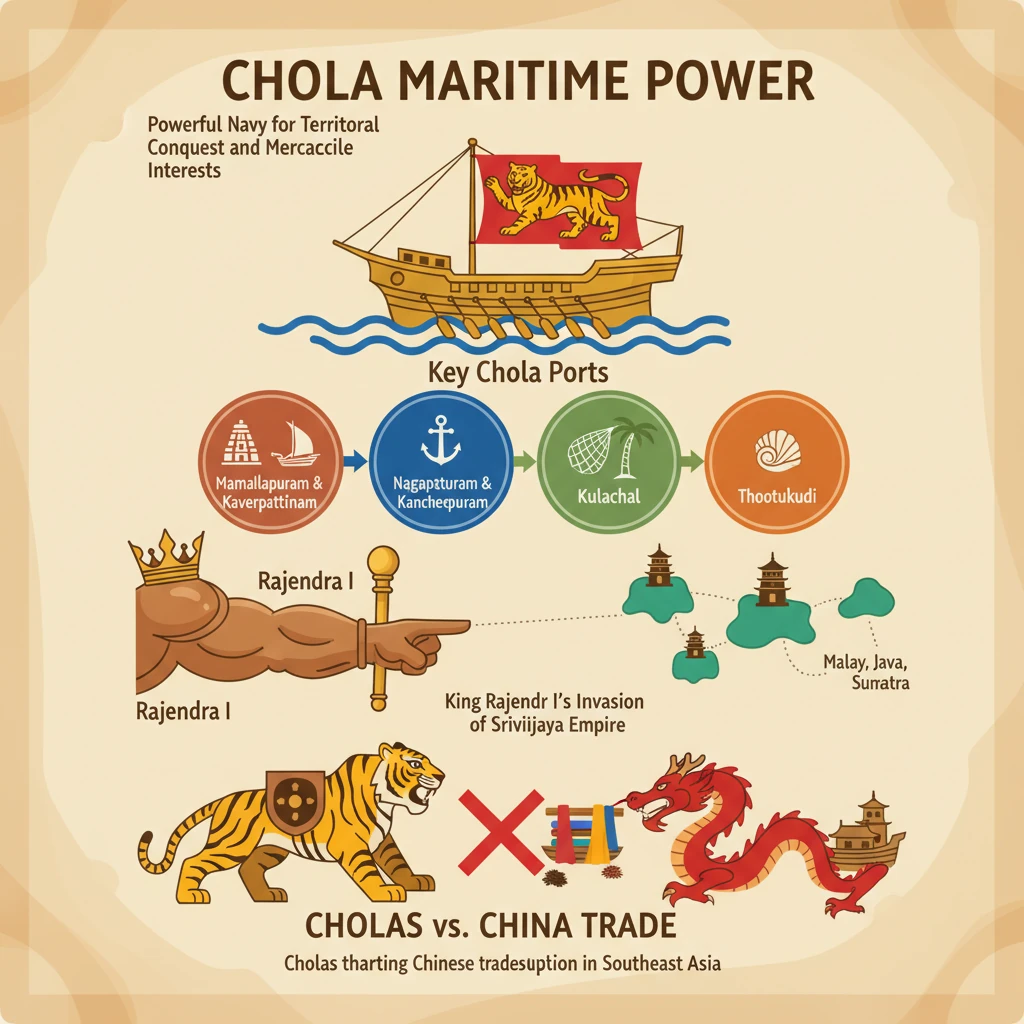
<h4>Introduction to Chola Maritime Power</h4><p>The <strong>Chola Empire</strong>, a prominent South Indian dynasty, distinguished itself through its exceptional <strong>maritime activities</strong>. Their strategic focus on the seas was pivotal for both territorial expansion and economic prosperity.</p><div class='key-point-box'><p>The <strong>Cholas</strong> understood that control over the oceans was synonymous with regional dominance and the facilitation of lucrative trade networks.</p></div><h4>The Mighty Chola Navy</h4><p>The <strong>Cholas</strong> meticulously built and maintained a <strong>powerful navy</strong>. This naval force was not merely for defense but was actively used to project power across vast distances.</p><p>Its primary objectives included the <strong>conquest of distant territories</strong> and the vigorous promotion of their <strong>mercantile interests</strong> throughout Southeast Asia and beyond.</p><h4>Strategic Chola Ports</h4><p>A network of well-developed ports was crucial to the Chola's maritime success. These ports served as vital hubs for trade, naval operations, and cultural exchange.</p><div class='info-box'><p>Key <strong>Chola ports</strong> included:<ul><li><strong>Mamallapuram</strong> (Mahabalipuram)</li><li><strong>Kaveripattinam</strong> (Poompuhar)</li><li><strong>Nagapattinam</strong></li><li><strong>Kancheepuram</strong></li><li><strong>Kulachal</strong></li><li><strong>Thootukudi</strong> (Tuticorin)</li></ul>These ports facilitated extensive trade routes.</p></div><h4>Expansion into Southeast Asia</h4><p>Under the reign of <strong>King Rajendra I</strong>, the Chola navy undertook a monumental overseas expedition. This involved a successful <strong>invasion of the Srivijaya Empire</strong> in Southeast Asia.</p><p>This campaign brought significant territories under <strong>Chola control</strong>, including the <strong>Malay Peninsula</strong>, <strong>Java</strong>, and <strong>Sumatra</strong>. This demonstrated their unparalleled naval reach and strategic ambition.</p><h4>Trade Dominance and Chinese Rivalry</h4><p>The <strong>Cholas</strong> were keen protectors of their established trade routes, particularly those connecting India with <strong>Southeast Asia</strong>. They actively thwarted any attempts by other powers to disrupt these vital economic lifelines.</p><div class='key-point-box'><p>Notably, the <strong>Cholas</strong> successfully countered <strong>Chinese attempts</strong> to interfere with their lucrative trade relations in the region, asserting their maritime supremacy.</p></div><h4>Advanced Shipbuilding Technology</h4><p>The sophistication of Chola maritime capabilities was underpinned by their advanced knowledge in <strong>shipbuilding</strong>. This technological prowess allowed them to construct robust and efficient vessels for both war and trade.</p><div class='info-box'><p>The existence of a treatise known as <strong>Kappal Sastiram</strong>, specifically dedicated to <strong>shipbuilding</strong>, highlights the advanced maritime technology and engineering expertise possessed by the <strong>Cholas</strong>.</p></div>
💡 Key Takeaways
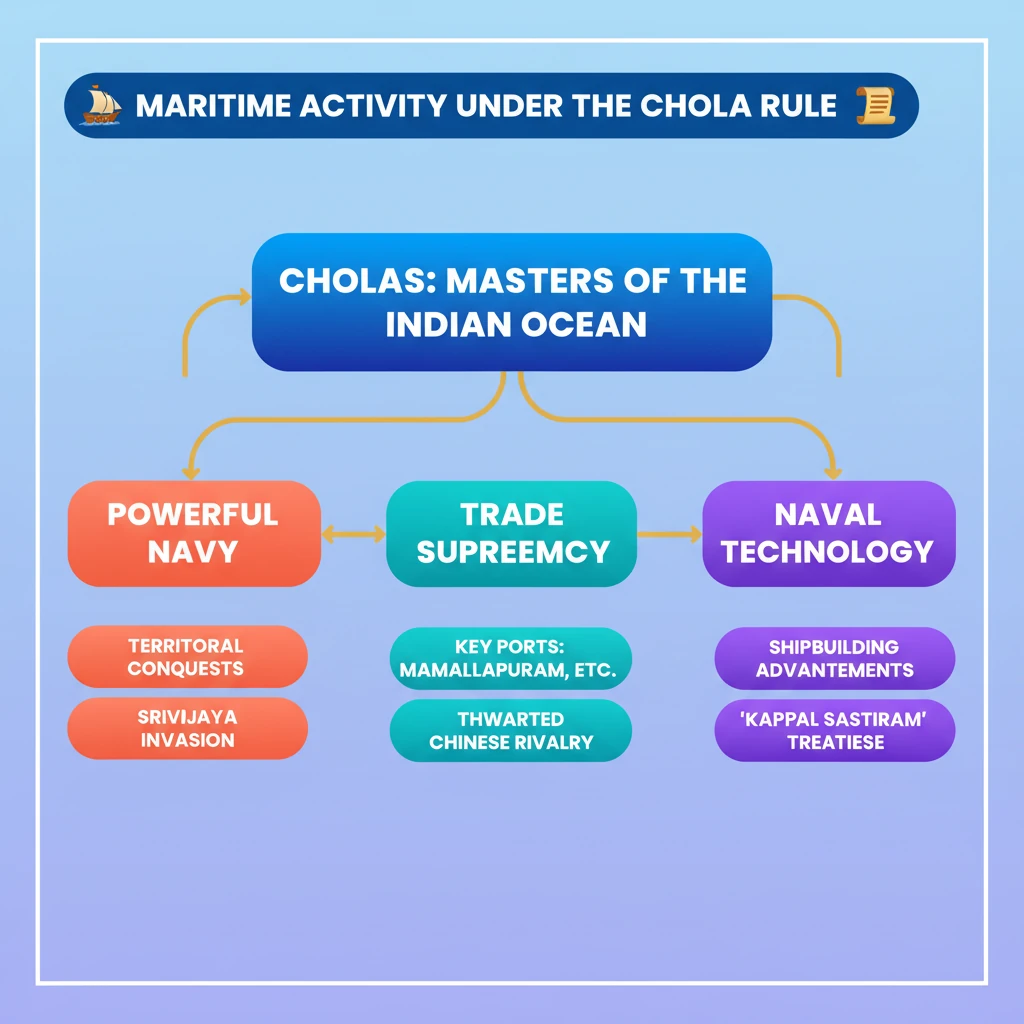
- •Cholas built a powerful navy for territorial conquest and promoting mercantile interests.
- •Key Chola ports included Mamallapuram, Kaveripattinam, Nagapattinam, Kancheepuram, Kulachal, and Thootukudi.
- •King Rajendra I's invasion of the Srivijaya Empire brought Malay Peninsula, Java, and Sumatra under Chola control.
- •Cholas successfully thwarted Chinese attempts to disrupt their trade with Southeast Asia.
- •Advanced shipbuilding technology is evidenced by the treatise 'Kappal Sastiram'.
🧠 Memory Techniques
95% Verified Content
📚 Reference Sources
•NCERT History Textbooks (Class XI/XII - Themes in Indian History Part I)
•Upinder Singh: A History of Ancient and Early Medieval India
•K.A. Nilakanta Sastri: The Cholas