Shatadhanvan (195–187 BCE) - History | UPSC Learning
Topics
0 topics • 0 completed
🔍
No topics match your search
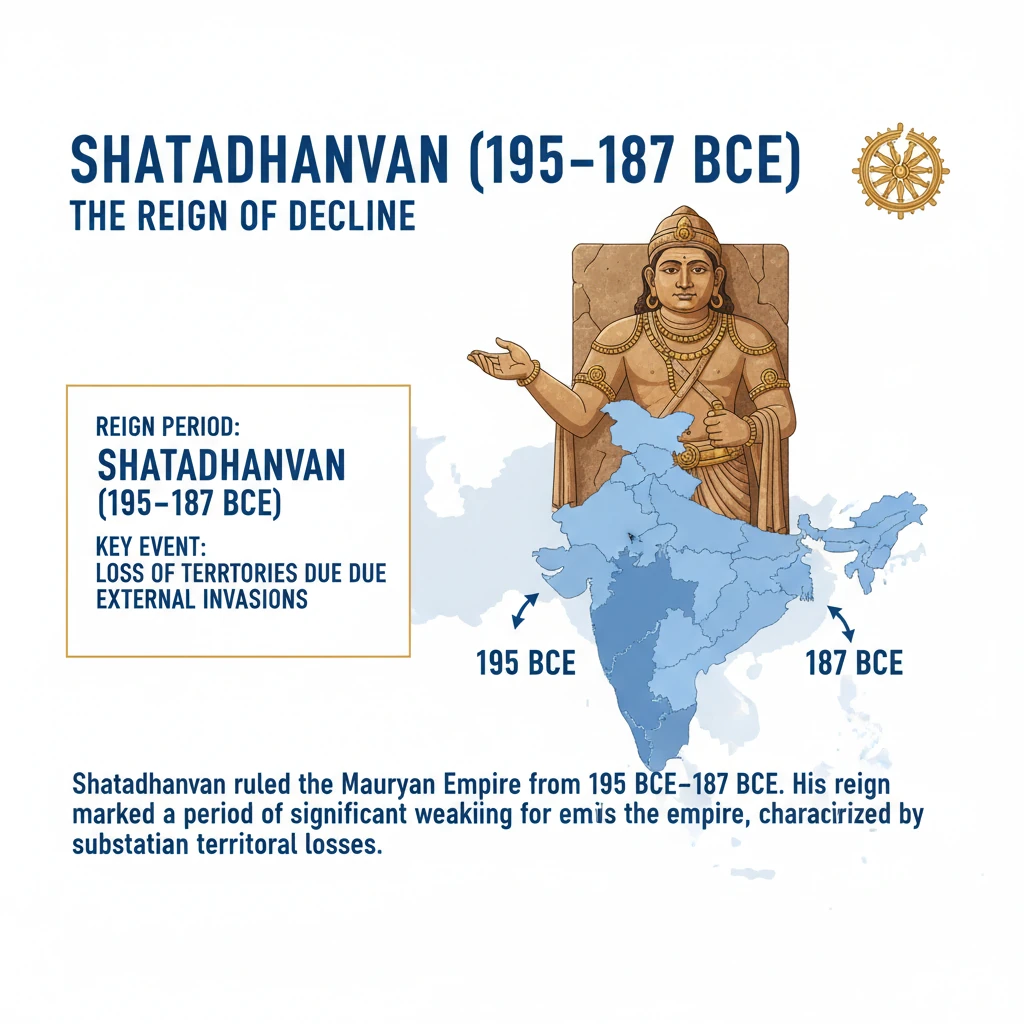
Shatadhanvan (195–187 BCE)
Medium⏱️ 6 min read
history
📖 Introduction
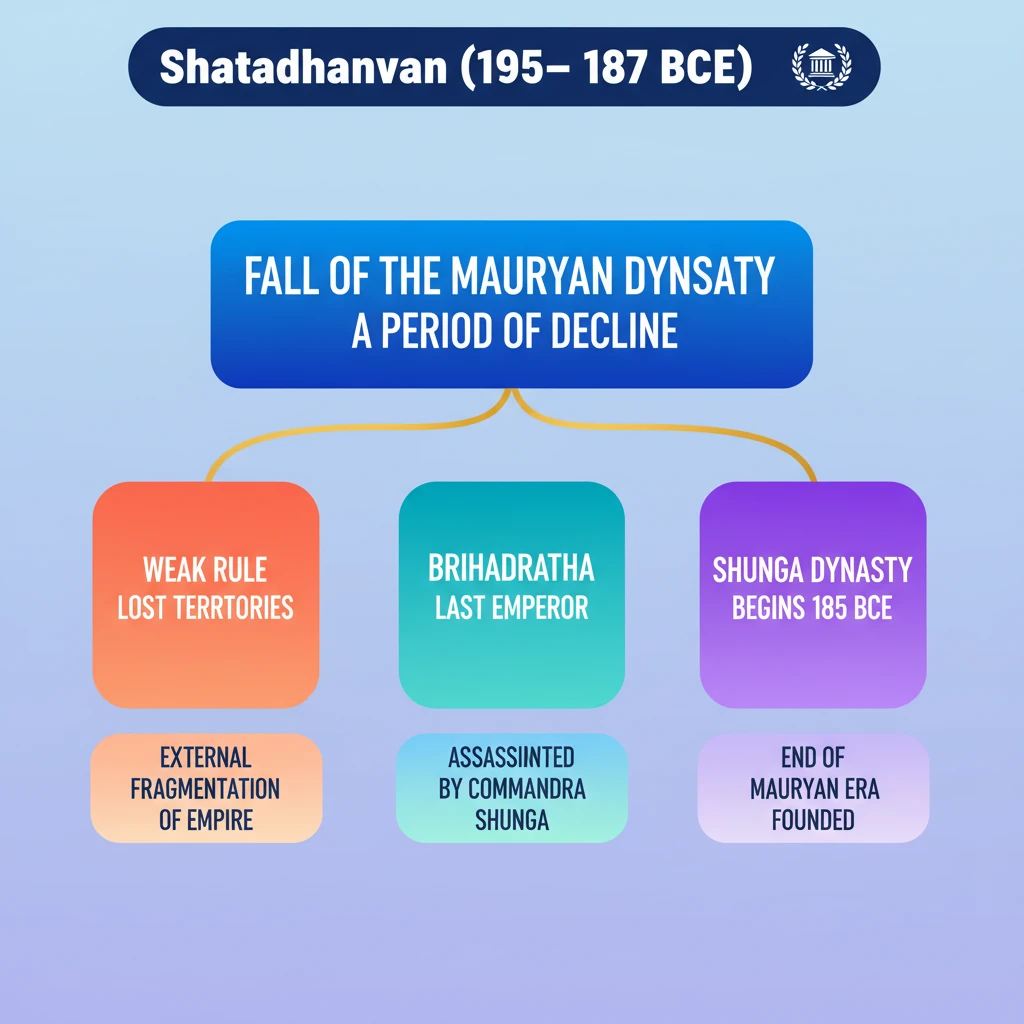
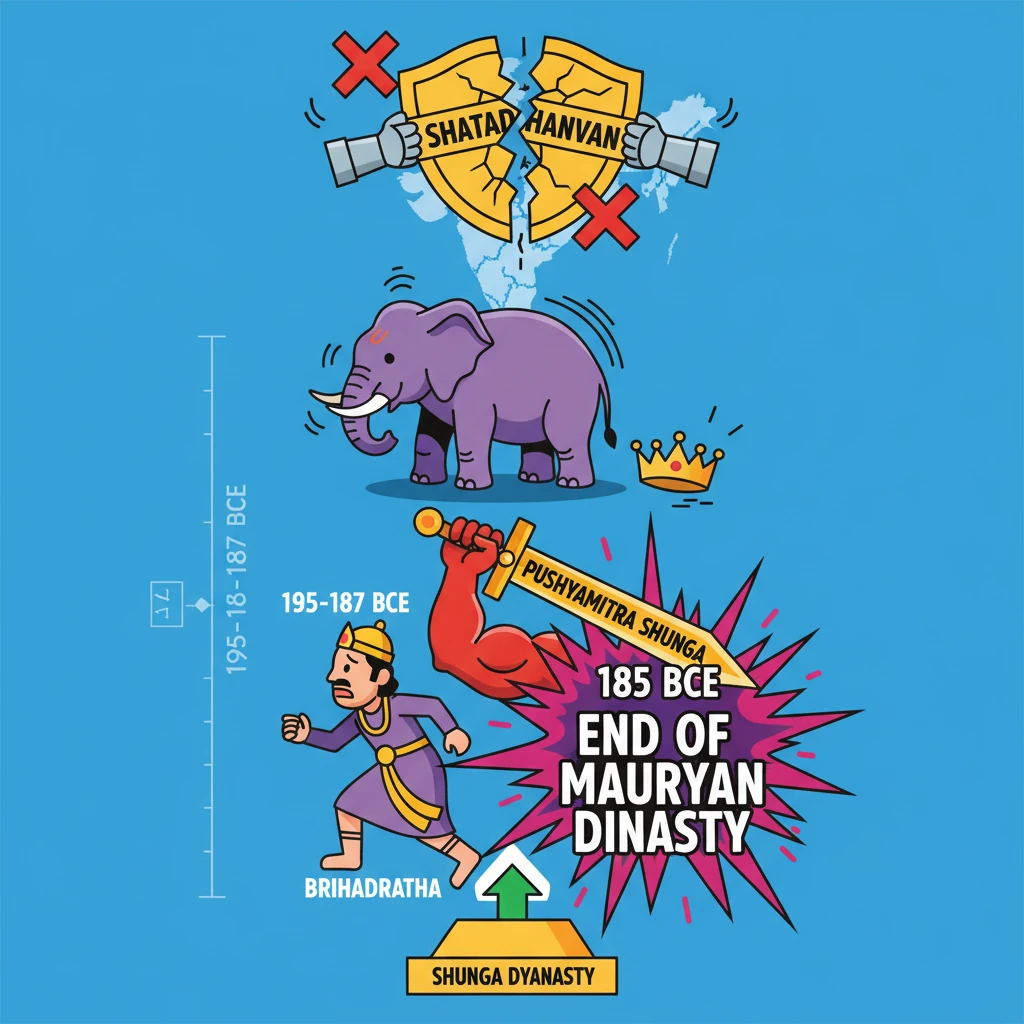
<h4>Shatadhanvan: The Reign of Decline</h4><p><strong>Shatadhanvan</strong> ruled the <strong>Mauryan Empire</strong> from <strong>195 BCE to 187 BCE</strong>. His reign marked a period of significant weakening for the empire, characterized by substantial territorial losses.</p><div class='info-box'><p><strong>Reign Period:</strong> <strong>Shatadhanvan</strong> (<strong>195–187 BCE</strong>)</p><p><strong>Key Event:</strong> Loss of territories due to external invasions.</p></div><p>During his rule, the central authority of the Mauryas diminished considerably. This allowed various peripheral regions to assert independence or fall prey to external pressures.</p><div class='key-point-box'><p>The decline under <strong>Shatadhanvan</strong> highlights the challenges faced by large empires in maintaining control over vast territories, especially when central power wanes and external threats emerge.</p></div><h4>Brihadratha: The Final Mauryan Emperor</h4><p><strong>Brihadratha</strong> succeeded <strong>Shatadhanvan</strong> and was the <strong>last Mauryan emperor</strong>, reigning from <strong>187 BCE to 185 BCE</strong>. His short rule brought the illustrious <strong>Mauryan dynasty</strong> to an abrupt and violent end.</p><div class='info-box'><p><strong>Reign Period:</strong> <strong>Brihadratha</strong> (<strong>187–185 BCE</strong>)</p><p><strong>Key Event:</strong> Assassination by <strong>Pushyamitra Shunga</strong>.</p></div><p><strong>Brihadratha</strong> was assassinated by his own commander-in-chief, <strong>Pushyamitra Shunga</strong>. This act of regicide occurred during a military parade, signaling a clear internal power struggle.</p><div class='exam-tip-box'><p>The assassination of <strong>Brihadratha</strong> by <strong>Pushyamitra Shunga</strong> is a critical turning point in ancient Indian history. It not only ended the <strong>Mauryan dynasty</strong> but also ushered in the <strong>Shunga dynasty</strong>, marking a shift in political power and cultural focus. This event is frequently asked about in <strong>UPSC Prelims</strong> and forms a crucial part of answers in <strong>Mains GS Paper I</strong>.</p></div><p>The rise of <strong>Pushyamitra Shunga</strong>, a Brahmin general, also signifies a change in the religious and social dynamics of the ruling elite following the Buddhist-patronizing Mauryas.</p>
💡 Key Takeaways
- •<strong>Shatadhanvan</strong> (195–187 BCE) was a weak Mauryan ruler who lost significant territories due to external invasions.
- •<strong>Brihadratha</strong> (187–185 BCE) was the last Mauryan emperor.
- •<strong>Brihadratha</strong> was assassinated by his commander-in-chief, <strong>Pushyamitra Shunga</strong>.
- •The assassination of <strong>Brihadratha</strong> in <strong>185 BCE</strong> marked the end of the <strong>Mauryan dynasty</strong>.
- •The event led to the establishment of the <strong>Shunga dynasty</strong> by <strong>Pushyamitra Shunga</strong>.
🧠 Memory Techniques
98% Verified Content
📚 Reference Sources
•A History of Ancient and Early Medieval India by Upinder Singh
•India's Ancient Past by R.S. Sharma
•Ancient India by D.N. Jha