Reforms in the Sati System - History | UPSC Learning
Topics
0 topics • 0 completed
🔍
No topics match your search

Reforms in the Sati System
Medium⏱️ 6 min read
history
📖 Introduction
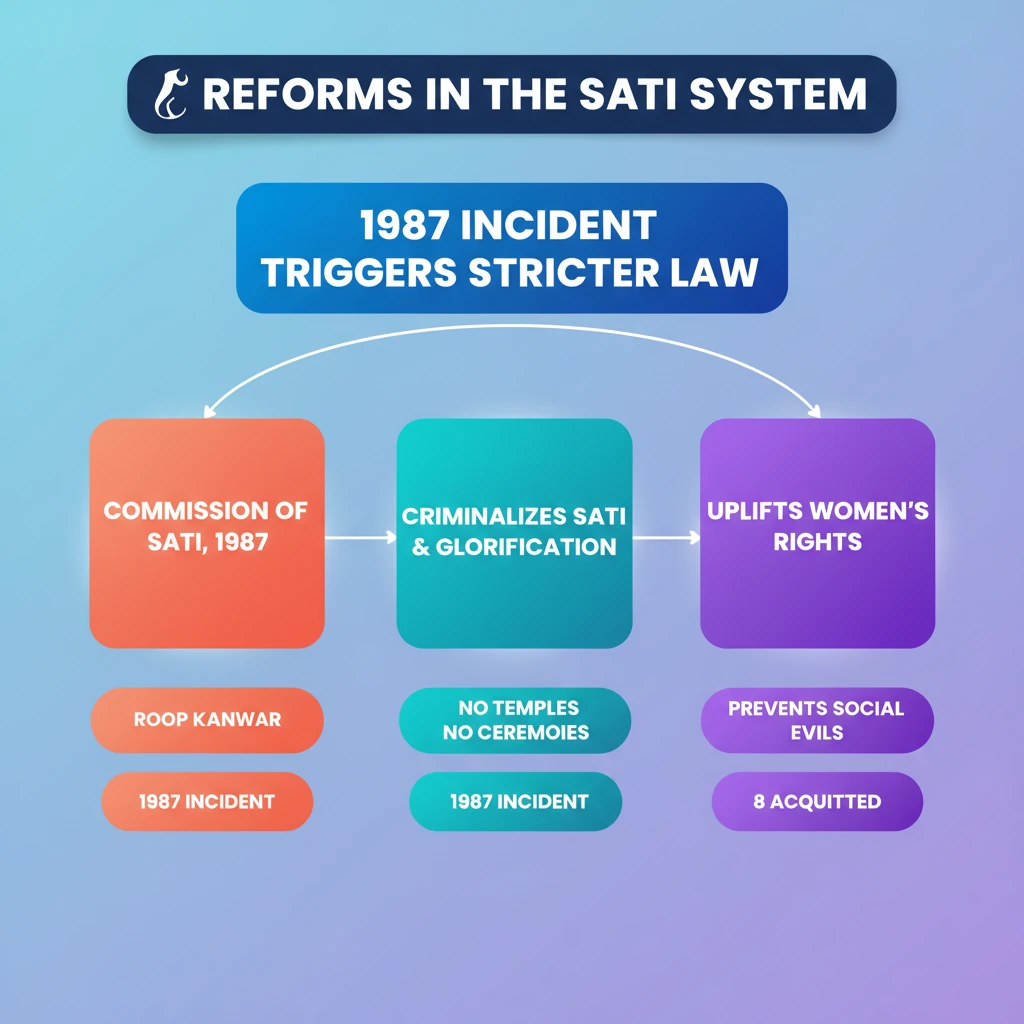
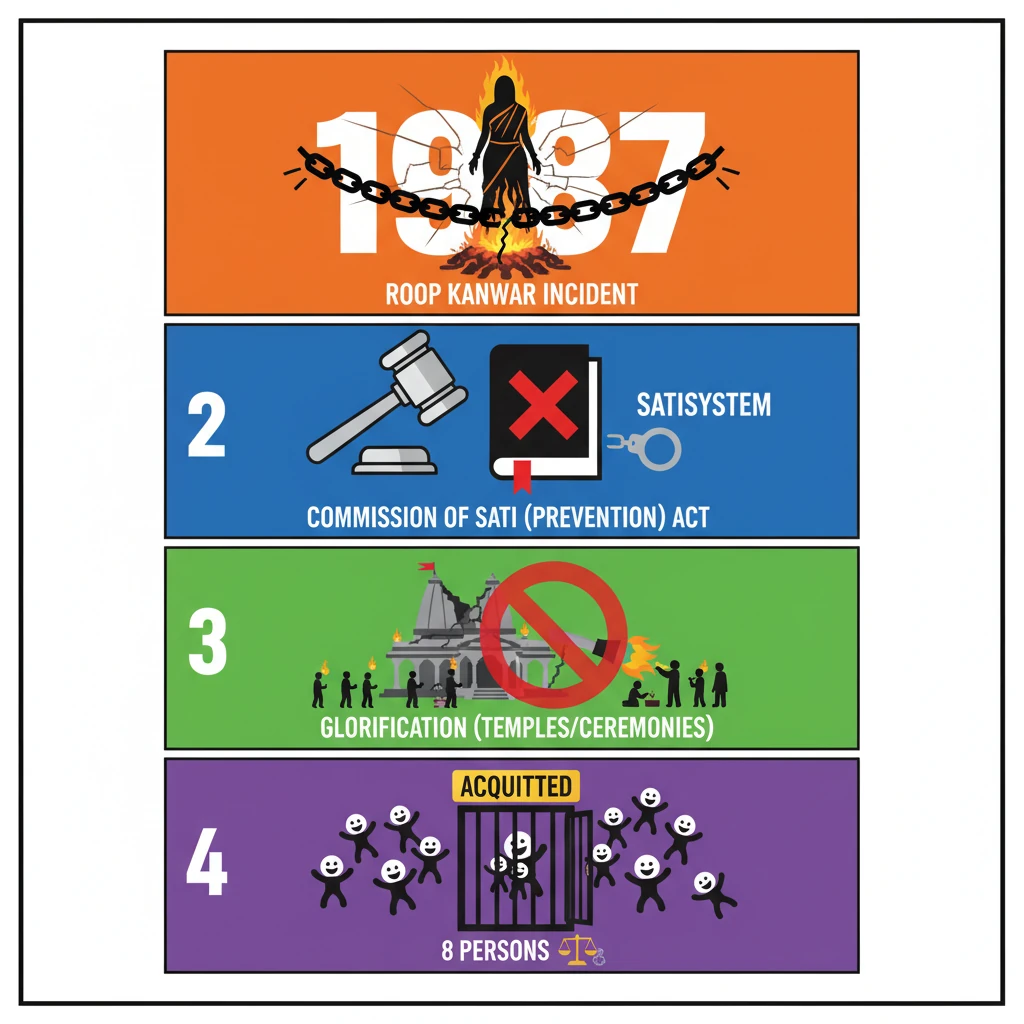
<h4>Introduction to Reforms in the Sati System</h4><p>The practice of <strong>Sati</strong>, an ancient and deeply problematic ritual, has been a subject of significant social and legal reform in India. While largely abolished in the <strong>19th century</strong>, isolated incidents continued to challenge societal norms and legal frameworks, necessitating further legislative action.</p><div class='key-point-box'><p>The reform efforts against <strong>Sati</strong> highlight India's ongoing struggle against harmful traditional practices and its commitment to human rights, particularly for women.</p></div><h4>The Roop Kanwar Incident (1987)</h4><p>A pivotal moment in the modern history of anti-Sati legislation was the tragic incident involving <strong>Roop Kanwar</strong>. This event occurred on <strong>4th September 1987</strong> in <strong>Rajasthan</strong>, drawing widespread national and international condemnation.</p><div class='info-box'><ul><li><strong>Date:</strong> 4th September 1987</li><li><strong>Location:</strong> Rajasthan</li><li><strong>Key Figure:</strong> Roop Kanwar</li></ul><p>The incident ignited a fierce debate on the persistence of such practices and the adequacy of existing laws to prevent them.</p></div><h4>Legislative Response: The Commission of Sati (Prevention) Act, 1987</h4><p>In direct response to the outrage and public demand following the <strong>Roop Kanwar case</strong>, the <strong>Union government</strong> enacted a comprehensive law. This legislation aimed to explicitly prohibit the practice of <strong>Sati</strong> and its glorification.</p><div class='info-box'><p><strong>Act Enacted:</strong> The <strong>Commission of Sati (Prevention) Act, 1987</strong></p><p>This Act provided a stronger legal framework to combat the practice and any attempts to romanticize or promote it.</p></div><div class='exam-tip-box'><p>Remember the specific year <strong>1987</strong> and the full name of the Act: <strong>The Commission of Sati (Prevention) Act</strong>. This is a crucial detail for <strong>UPSC Prelims</strong> and <strong>Mains GS Paper I (Indian Society/History)</strong>.</p></div><h4>Legal Action Against Glorification of Sati</h4><p>Beyond preventing the act itself, the law also targets the glorification of <strong>Sati</strong>. This includes acts such as constructing temples or holding ceremonies that honor individuals who committed <strong>Sati</strong>.</p><p>In a related legal development, <strong>8 persons were acquitted</strong> in connection with glorifying the act of <strong>Sati</strong>. This acquittal was specifically linked to their involvement in constructing temples in the name of those who committed <strong>Sati</strong>.</p><div class='key-point-box'><p>The concept of <strong>'glorification'</strong> is central to the <strong>Commission of Sati (Prevention) Act, 1987</strong>, as it seeks to eradicate the social acceptance and veneration that can perpetuate the practice.</p></div>
💡 Key Takeaways
- •The Roop Kanwar Sati incident in 1987 led to stronger legislation.
- •The Commission of Sati (Prevention) Act, 1987, criminalizes Sati and its glorification.
- •Glorification includes building temples or performing ceremonies honoring Sati.
- •Eight persons were acquitted in a case related to glorifying Sati.
- •The Act is crucial for upholding women's rights and preventing social evils.
🧠 Memory Techniques
95% Verified Content