Mauryan Dynasty - History | UPSC Learning
Topics
0 topics • 0 completed
🔍
No topics match your search
Mauryan Dynasty
Medium⏱️ 10 min read
history
📖 Introduction
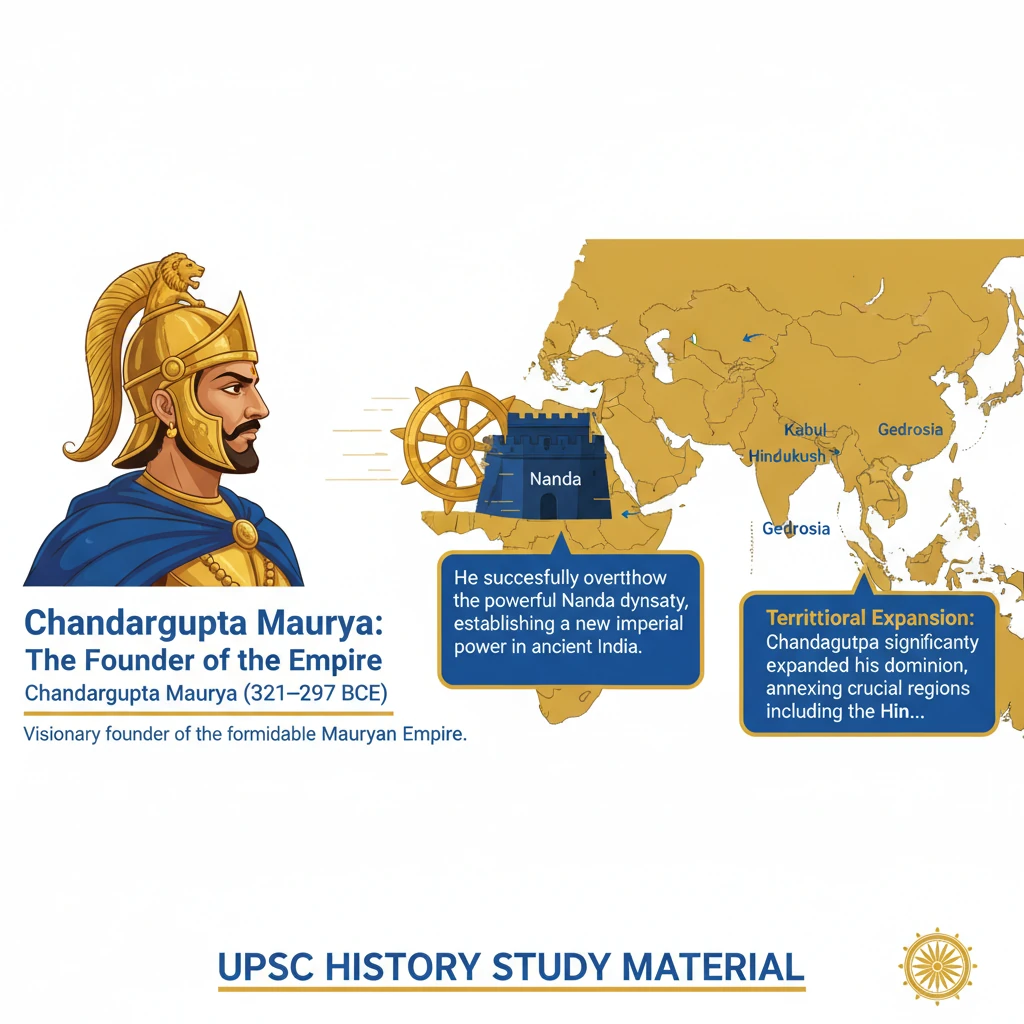
<h4>Chandragupta Maurya: The Founder of the Empire</h4><p><strong>Chandragupta Maurya</strong> (<strong>321–297 BCE</strong>) was the visionary founder of the formidable <strong>Mauryan Empire</strong>.</p><p>He successfully overthrew the powerful <strong>Nanda dynasty</strong>, establishing a new imperial power in ancient India.</p><div class='info-box'><p><strong>Territorial Expansion:</strong> Chandragupta significantly expanded his dominion, annexing crucial regions including the <strong>Hindu Kush</strong> mountains.</p></div><p>In <strong>305 BCE</strong>, he engaged in a conflict with <strong>Seleucus Nicator</strong>, the Greek Seleucid king.</p><div class='key-point-box'><p>This conflict concluded with a significant treaty, granting Chandragupta additional territories and solidifying his western borders.</p></div><p>Towards the later part of his life, <strong>Chandragupta</strong> embraced <strong>Jainism</strong>, becoming a devoted disciple of the faith.</p><h4>Chanakya: The Architect of Mauryan Statecraft</h4><p><strong>Chanakya</strong>, also known as <strong>Kautilya</strong> or <strong>Vishnugupta</strong>, served as the influential <strong>prime minister</strong>.</p><p>He was a key advisor during the reigns of <strong>Chandragupta Maurya</strong> (<strong>322 BCE - 297 BCE</strong>) and his successor, <strong>Bindusara</strong>.</p><div class='key-point-box'><p>Chanakya's strategic acumen and political theories, famously codified in the <strong>Arthashastra</strong>, were instrumental in the empire’s success and efficient administration.</p></div><h4>Bindusara: The Expander to the Deccan</h4><p><strong>Bindusara</strong> (<strong>298–272 BCE</strong>) succeeded his father, Chandragupta, and continued the empire's expansionist policies.</p><p>He is credited with extending the <strong>Mauryan Empire</strong> further into the <strong>Deccan</strong> region of India.</p><div class='info-box'><p><strong>Title:</strong> Bindusara was known by the epithet <strong>“Amitraghata,”</strong> which translates to <strong>“slayer of enemies,”</strong> reflecting his military prowess.</p></div><p>He showed an inclination towards the <strong>Ajivika sect</strong>, a prominent heterodox philosophical school of ancient India.</p><p>The Greek ambassador <strong>Deimachus</strong> was present at <strong>Bindusara's</strong> royal court, indicating active diplomatic relations with Hellenistic kingdoms.</p><h4>Ashoka: The Great Transformer and Dhamma Propagator</h4><p><strong>Ashoka</strong> (<strong>272-232 BCE</strong>) is arguably the most celebrated ruler of the <strong>Mauryan Dynasty</strong>, known for his profound personal and political transformation.</p><p>His early reign was marked by the brutal <strong>Kalinga War</strong>, which led to massive casualties and widespread devastation.</p><div class='key-point-box'><p>The immense suffering caused by the <strong>Kalinga War</strong> deeply impacted Ashoka, leading him to renounce warfare and embrace <strong>Buddhism</strong>.</p></div><p>Following his conversion, <strong>Ashoka</strong> dedicated his efforts to promoting peace and moral governance through his unique policy of <strong>Dhamma</strong> (moral laws).</p><p>He played a crucial role in organizing the <strong>3rd Buddhist Council</strong>, which aimed to purify and propagate Buddhist teachings.</p><div class='info-box'><p><strong>Global Spread of Buddhism:</strong> Ashoka was instrumental in spreading <strong>Buddhism globally</strong>, sending emissaries to various countries and constructing numerous stupas and viharas.</p></div><h4>Later Mauryan Rulers: Decline and Succession</h4><p>After Ashoka, the vast <strong>Mauryan Empire</strong> gradually entered a phase of decline, marked by territorial losses and internal instability.</p><ol><li><p><strong>Dasharatha</strong> (<strong>232–224 BCE</strong>): He was the last Mauryan ruler to issue <strong>imperial inscriptions</strong>, but faced significant territorial losses during his reign.</p></li><li><p><strong>Samprati</strong> (<strong>224–215 BCE</strong>): He attempted to re-establish <strong>Mauryan control</strong> over disintegrated territories and was a known patron of <strong>Jainism</strong>.</p></li><li><p><strong>Shalishuka</strong> (<strong>215–202 BCE</strong>): This ruler is known in historical accounts for his negative reputation as a <strong>quarrelsome ruler</strong>.</p></li><li><p><strong>Devavarman</strong> (<strong>202–195 BCE</strong>): He had a brief reign and is primarily mentioned in the ancient Hindu texts known as the <strong>Puranas</strong>.</p></li></ol><div class='exam-tip-box'><p>Understanding the contributions and challenges of later Mauryan rulers helps in analyzing the factors contributing to the <strong>decline of great empires</strong>, a recurring theme in UPSC history questions.</p></div>
💡 Key Takeaways
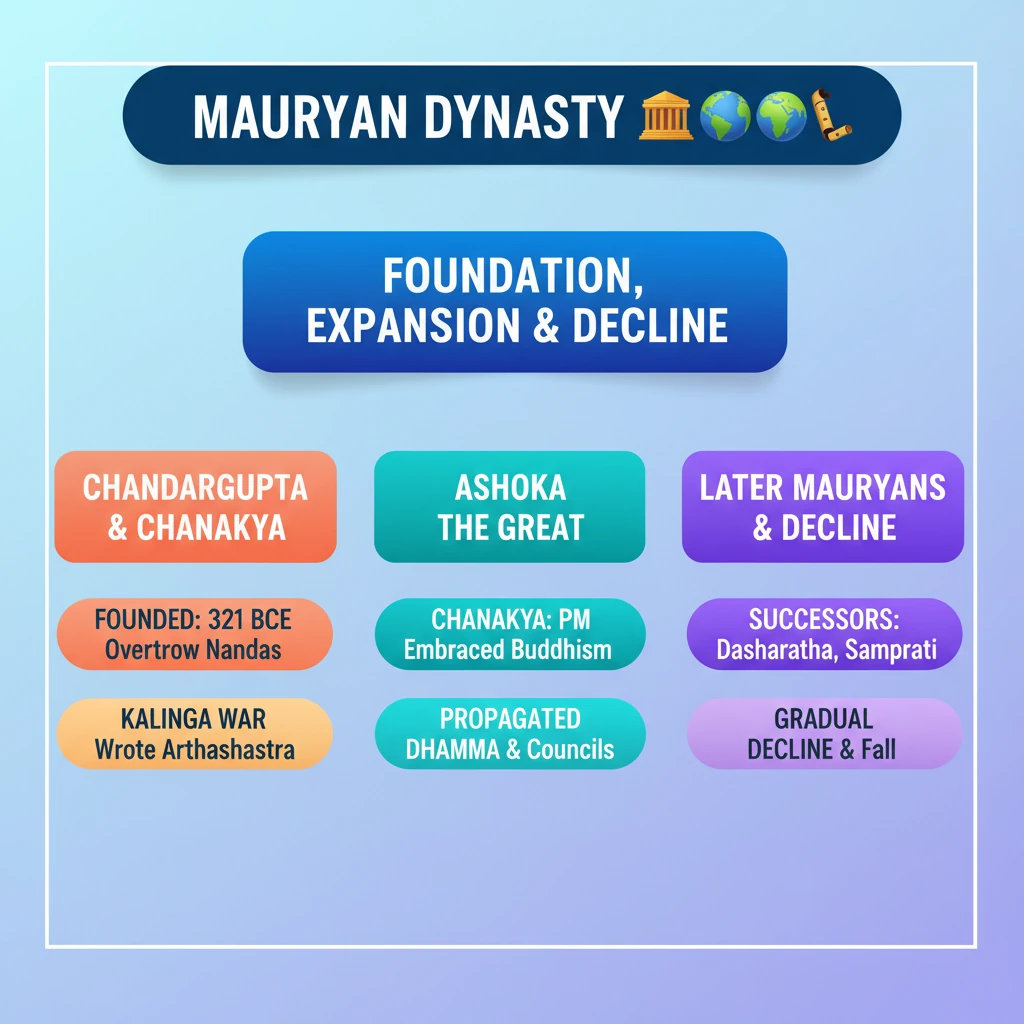
- •Chandragupta Maurya founded the empire (321 BCE), overthrew Nandas, expanded to Hindu Kush, and made a treaty with Seleucus Nicator.
- •Chanakya (Kautilya) was the prime minister, crucial for empire's success, known for the Arthashastra.
- •Bindusara expanded the empire to the Deccan and was called 'Amitraghata'.
- •Ashoka transformed after the Kalinga War, embraced Buddhism, propagated Dhamma, and organized the 3rd Buddhist Council.
- •Later Mauryan rulers like Dasharatha, Samprati, Shalishuka, and Devavarman oversaw the empire's gradual decline.
- •The Mauryan Dynasty established the first large, unified empire in ancient India, known for its centralized administration and significant cultural shifts.
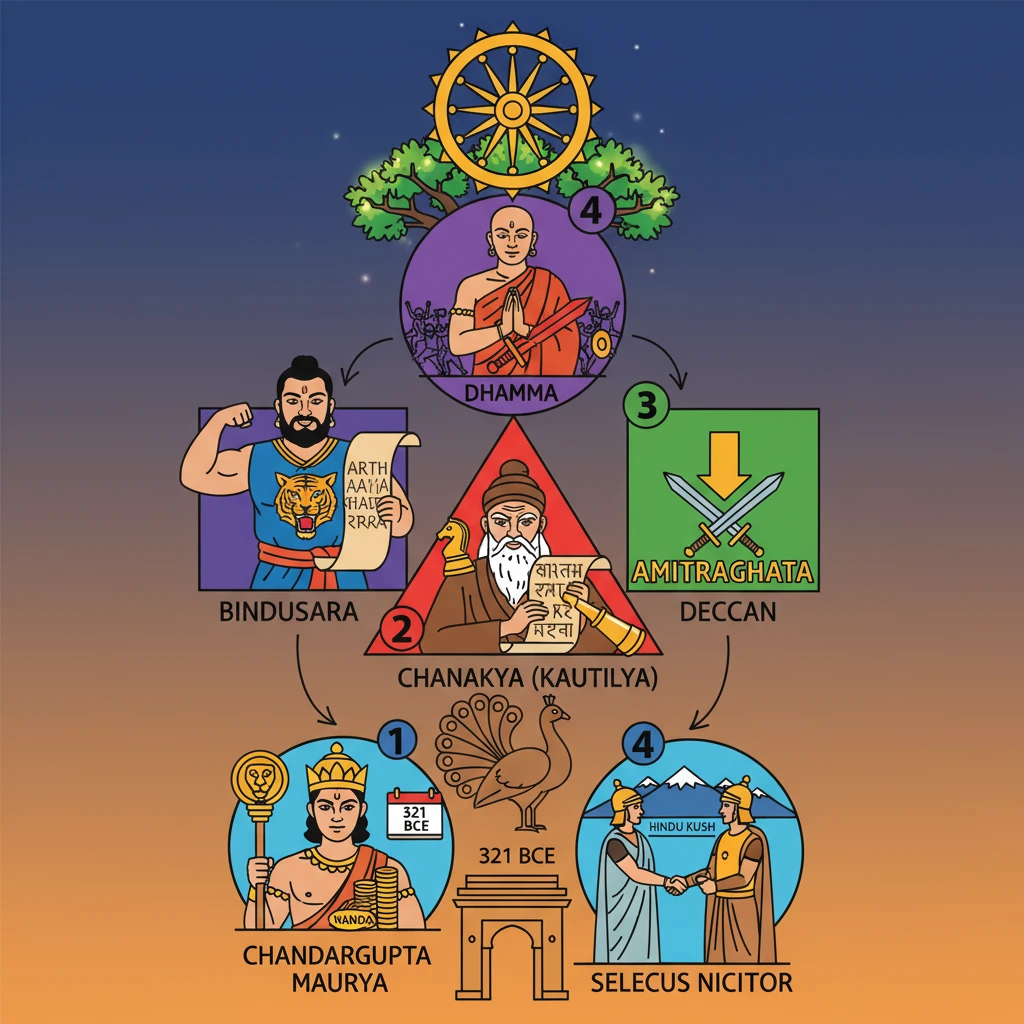
🧠 Memory Techniques
95% Verified Content
📚 Reference Sources
•NCERT History Textbooks (Class XI & XII)
•Upinder Singh, 'A History of Ancient and Early Medieval India'
•Romila Thapar, 'Ashoka and the Decline of the Mauryas'