What are the Key Highlights of the Mauryan Art and Architecture? - History | UPSC Learning
Topics
0 topics • 0 completed
🔍
No topics match your search
What are the Key Highlights of the Mauryan Art and Architecture?
Medium⏱️ 8 min read
history
📖 Introduction
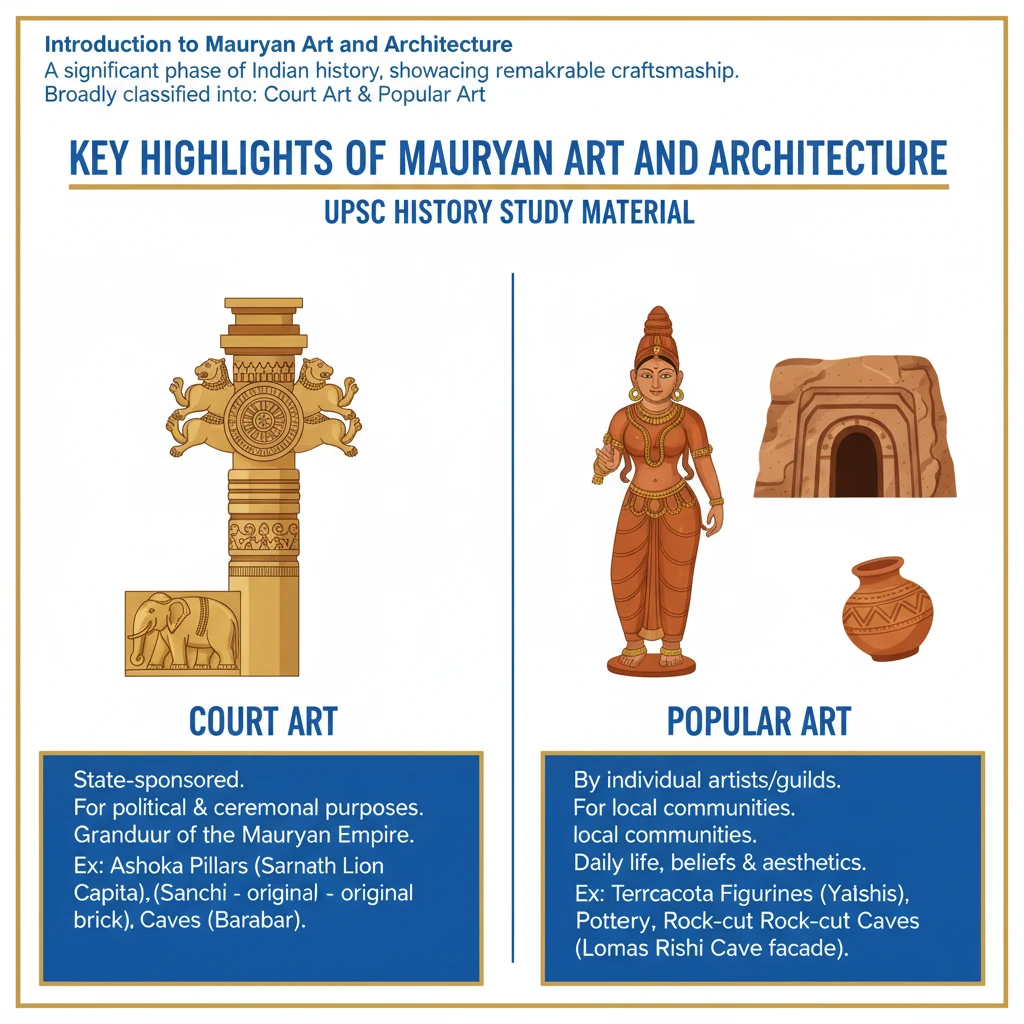
<h4>Introduction to Mauryan Art and Architecture</h4><p><strong>Mauryan art and architecture</strong> represents a significant phase in Indian history, showcasing remarkable craftsmanship and imperial patronage.</p><p>It is broadly classified into two distinct categories: <strong>Court Art</strong> and <strong>Popular Art</strong>.</p><div class='info-box'><p><strong>Court Art</strong> was primarily state-sponsored, designed for political and ceremonial purposes, reflecting the grandeur of the Mauryan Empire.</p><p><strong>Popular Art</strong>, in contrast, was more widely accessible and influenced by local traditions and craftsmanship.</p></div><h4>Mauryan Court Art: Palaces</h4><p>The <strong>Mauryan palaces</strong> were considered architectural marvels, drawing immense praise from foreign travelers and historians.</p><p>The Greek historian <strong>Megasthenes</strong> lauded them as extraordinary creations, while the Chinese traveler <strong>Fa Hien</strong> described them as "god-gifted monuments."</p><p>The design of <strong>Chandragupta Maurya's palace</strong> notably incorporated influences from the grand <strong>Achaemenid palaces</strong> at <strong>Persepolis</strong>, the capital of the <strong>Achaemenid Empire</strong>.</p><p>Interestingly, <strong>wood</strong> served as the primary construction material for these magnificent structures.</p><div class='info-box'><p>Key examples include <strong>Ashoka’s palace at Kumrahar</strong> (near Pataliputra) and the aforementioned <strong>Chandragupta’s palace</strong>.</p></div><h4>Mauryan Court Art: Pillars</h4><p><strong>Mauryan pillars</strong> are iconic examples of imperial art, characterized by their immense height, free-standing nature, and monolithic structure.</p><p>They were typically carved from high-quality <strong>sandstone</strong>, primarily quarried from <strong>Chunar</strong>.</p><p>A distinguishing feature is their highly <strong>lustrous polish</strong>, often referred to as 'Mauryan polish'.</p><p>These pillars also show clear architectural influence from <strong>Achaemenian pillars</strong>.</p><div class='key-point-box'><p>A crucial distinction is that <strong>Mauryan pillars</strong> are <strong>monolithic</strong> and <strong>rock-cut</strong>, demonstrating exceptional carving skills from a single stone block.</p><p>In contrast, <strong>Achaemenian pillars</strong> were constructed by joining multiple pieces.</p></div><p><strong>Ashoka's pillars</strong> are widely distributed across North India and are renowned for their intricate <strong>capitals</strong>.</p><p>These capitals frequently feature majestic <strong>animal figures</strong>, such as <strong>lions</strong> and <strong>bulls</strong>, which often symbolized the power and authority of the Mauryan state.</p><p>The primary purpose of these pillars was to disseminate <strong>Buddhist teachings</strong> (Dhamma) and imperial <strong>court orders</strong>.</p><p>Their inscriptions were written in various languages, including <strong>Pali</strong>, <strong>Prakrit</strong>, <strong>Greek</strong>, and <strong>Aramaic</strong>, to reach a diverse populace.</p><div class='info-box'><p>The typical structure of a <strong>Mauryan pillar</strong> comprises four main parts:</p><ul><li>A tall, <strong>monolithic shaft</strong> forming the main body.</li><li>A <strong>lotus- or bell-shaped capital</strong> (inverted lotus).</li><li>An <strong>abacus</strong>, a square or circular slab above the capital.</li><li>A crowning <strong>capital figure</strong>, usually an animal sculpture.</li></ul></div><p>Similarities with <strong>Achaemenian pillars</strong> from Iran include the use of <strong>polished stones</strong>, decorative motifs like the <strong>lotus</strong>, and the practice of inscribing royal <strong>proclamations</strong>.</p><h4>Mauryan Court Art: Stupas</h4><p><strong>Stupas</strong> are significant Buddhist architectural forms, typically featuring a distinct structural composition.</p><p>They consist of a <strong>cylindrical drum</strong>, a hemispherical mound known as the <strong>anda</strong>, a square railing called the <strong>harmika</strong>, and a central pillar supporting a triple umbrella form, the <strong>chhatra</strong>.</p><p>These elements collectively represent various <strong>Buddhist principles</strong>.</p><p>The construction involved an inner core of <strong>unburnt bricks</strong>, with the outer surface made of <strong>burnt bricks</strong>.</p><p>This exterior was then covered with <strong>plaster</strong> and often adorned with intricate <strong>wooden sculptures</strong>.</p><div class='info-box'><p>The <strong>Sanchi Stupa</strong> in <strong>Madhya Pradesh</strong> is the most renowned example of an <strong>Ashokan stupa</strong>, though its current form is largely post-Mauryan.</p><p>The <strong>Piprahwa Stupa</strong> in <strong>Uttar Pradesh</strong> is considered one of the oldest stupas, potentially pre-dating Ashoka.</p></div><p>Other significant stupas, believed to have been built shortly after <strong>Buddha’s Mahaparinirvana</strong>, include those at:</p><ul><li><strong>Rajagriha</strong></li><li><strong>Vaishali</strong></li><li><strong>Kapilavastu</strong></li><li><strong>Allakappa</strong></li><li><strong>Ramagrama</strong></li><li><strong>Vethadipa</strong></li><li><strong>Pava</strong></li><li><strong>Kushinagar</strong></li><li><strong>Pippalivana</strong></li></ul><h4>Mauryan Popular Art: Cave Architecture</h4><p><strong>Cave architecture</strong> flourished as a form of <strong>Popular Art</strong> during the Mauryan era, primarily serving as dwellings or monasteries (<strong>viharas</strong>) for <strong>Jain</strong> and <strong>Buddhist monks</strong>.</p><p>These caves are distinguished by their remarkably <strong>highly polished interiors</strong> and often feature elaborately <strong>decorative gateways</strong>.</p><div class='info-box'><p>A prime example is the <strong>Barabar Caves</strong> in Bihar, dedicated by <strong>Emperor Ashoka</strong> to the <strong>Ajivika sect</strong>.</p></div>
💡 Key Takeaways
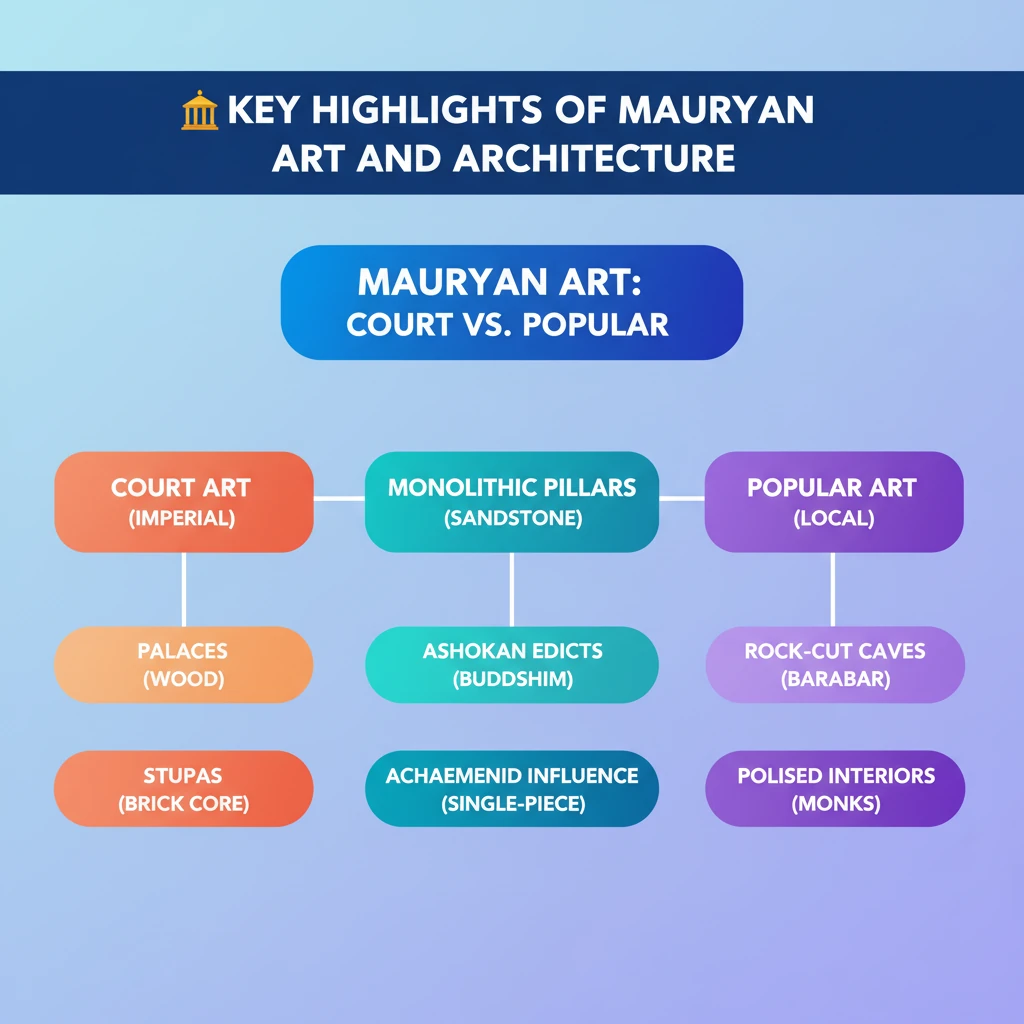
- •Mauryan art is categorized into Court Art (imperial) and Popular Art (local).
- •Court Art includes palaces (wood), monolithic polished pillars (sandstone, e.g., Ashoka's pillars), and stupas (brick core).
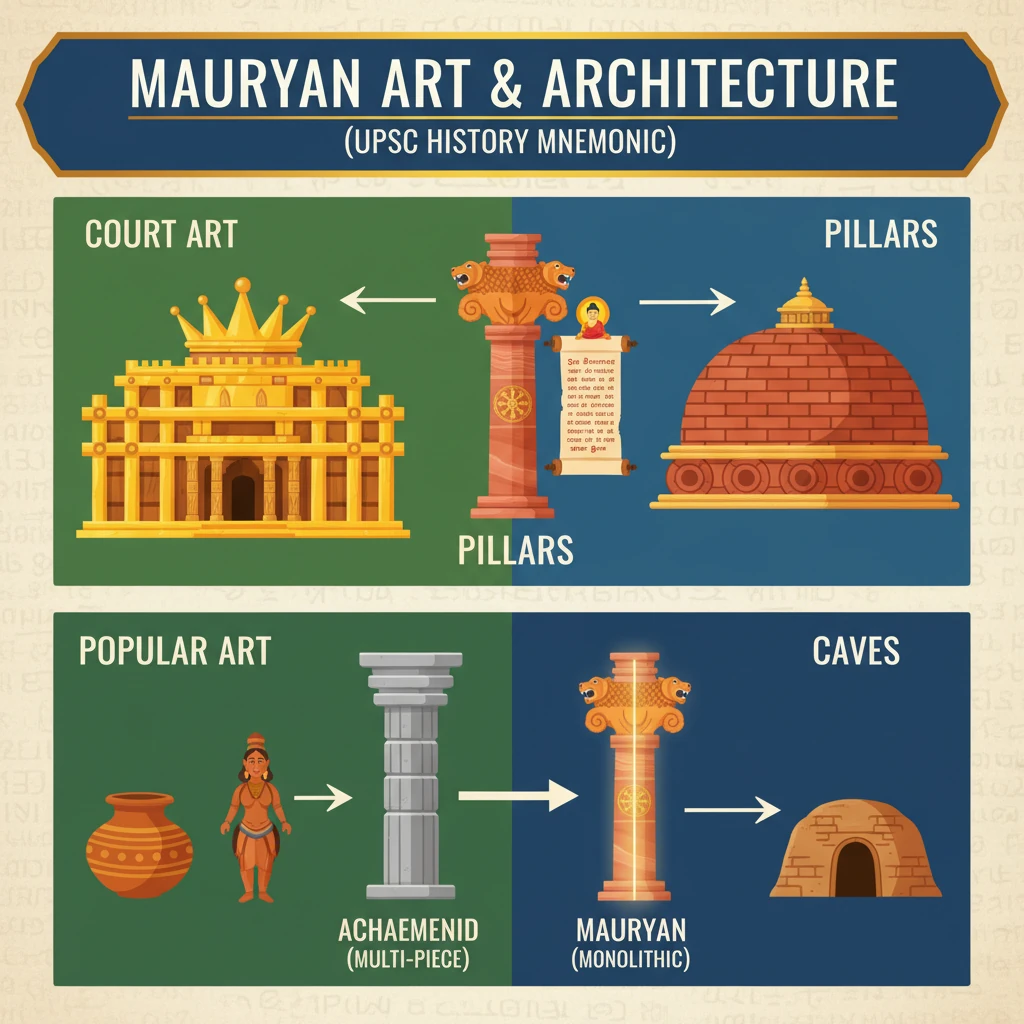
- •Mauryan pillars show Achaemenid influence but are monolithic, unlike Achaemenid multi-piece pillars.
- •Ashokan pillars served to disseminate Buddhist teachings and court orders.
- •Popular Art includes rock-cut caves (e.g., Barabar Caves) for monks, known for polished interiors.
- •The Lion Capital of Sarnath and Ashoka Chakra are enduring symbols of India's national identity.
🧠 Memory Techniques
95% Verified Content
📚 Reference Sources
•NCERT Class XI: An Introduction to Indian Art
•Upinder Singh: A History of Ancient and Early Medieval India