Raja Raja I and Chola Administration - History | UPSC Learning
Topics
0 topics • 0 completed
🔍
No topics match your search
Raja Raja I and Chola Administration
Medium⏱️ 10 min read
history
📖 Introduction
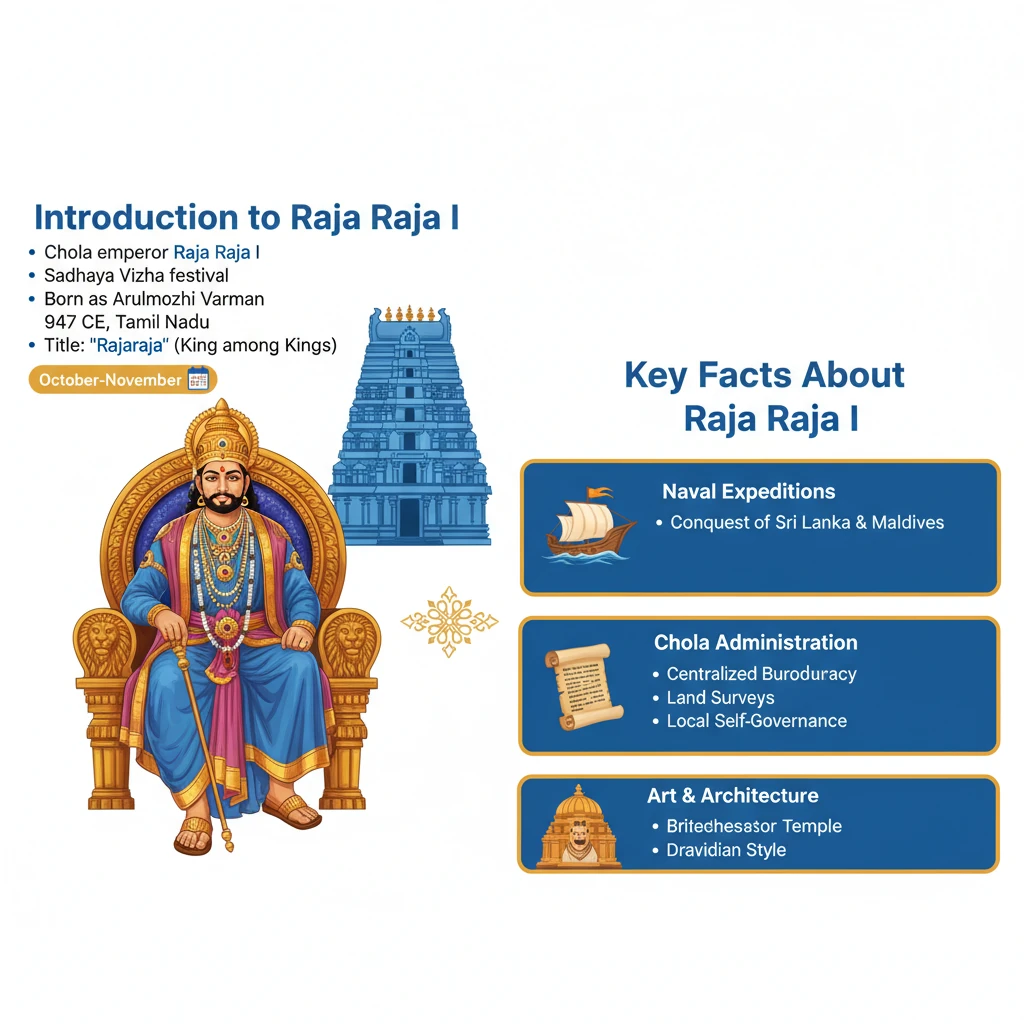
<h4>Introduction to Raja Raja I</h4><p>The birth anniversary of <strong>Chola emperor Raja Raja I</strong> is celebrated during the <strong>Sadhaya Vizha festival</strong>, typically held from mid-October to mid-November, in <strong>Thanjavur, Tamil Nadu</strong>.</p><p>Born as <strong>Arulmozhi Varman</strong> in <strong>947 CE</strong>, he later adopted the significant title <strong>"Rajaraja,"</strong> which translates to "King among Kings."</p><h4>Key Facts About Raja Raja I</h4><div class='info-box'><p><strong>Parentage:</strong> Raja Raja I was the <strong>third child</strong> of <strong>Parantaka Chola II</strong> and <strong>Vanavan Mahadevi</strong>.</p><p><strong>Reign Period:</strong> He ruled the Chola empire from <strong>985 CE to 1014 CE</strong>.</p><p><strong>Succession:</strong> The <strong>Thiruvalangadu inscription</strong> credits his predecessor, <strong>Uttama Chola</strong>, with recognizing his extraordinary potential and appointing him as his successor.</p></div><div class='key-point-box'><p>His reign was characterized by exceptional <strong>military prowess</strong> and a profound <strong>administrative vision</strong>, laying the groundwork for the Chola empire's zenith.</p></div><h4>Notable Military Conquests</h4><ul><li><strong>Battle of Kandalur Salai (988 CE):</strong> This significant <strong>naval battle</strong> against the <strong>Cheras</strong> (located in central and northern Kerala) marked his first major military achievement. It led to the destruction of Chera naval forces and ports.</li><li><strong>Conquest of Kandalur and the Pandyas:</strong> According to the <strong>Senur inscription</strong> (Tamil Nadu), Raja Raja Chola I successfully destroyed the <strong>Pandya capital Madurai</strong> and conquered <strong>Kollam</strong>.</li><li><strong>Titles after Pandya Victory:</strong> After this victory, he adopted the title <strong>"Pandya Kulasani"</strong> (thunderbolt to the Pandyas) and renamed the conquered region as <strong>"Rajaraja Mandalam."</strong> He also took the title <strong>"Mummudi Chola"</strong> (Chola who wears the three crowns) to signify his dominance over the <strong>Cholas, Pandyas, and Cheras</strong>.</li><li><strong>Victory in Sri Lanka (993 CE):</strong> Raja Raja Chola I invaded <strong>Sri Lanka</strong>, capturing its northern half. He established <strong>Jananathamangalam</strong> as the provincial capital there. The full conquest was later completed by his son, <strong>Rajendra Chola I</strong>, in <strong>1017 CE</strong>.</li><li><strong>Conflict with the Chalukyas:</strong> He also defeated the <strong>Chalukyas</strong> in <strong>Karnataka</strong>, annexing crucial regions like <strong>Gangavadi</strong> and <strong>Nolambapadi</strong>.</li><li><strong>Strategic Alliances:</strong> Raja Raja I fostered alliances through strategic marriages, notably his daughter <strong>Kundavai's</strong> union with <strong>Vimaladitya of Vengi</strong>.</li></ul><h4>The Mighty Chola Navy</h4><p><strong>Raja Raja Chola I</strong> significantly strengthened the <strong>Chola navy</strong>, which became so dominant that the <strong>Bay of Bengal</strong> earned the moniker <strong>"Chola Lake."</strong></p><div class='info-box'><p><strong>Main Port:</strong> <strong>Nagapattinam</strong> in Tamil Nadu served as the primary port for the Chola navy.</p><p>This powerful naval force facilitated successful campaigns in <strong>Sri Lanka</strong> and the <strong>Maldives</strong>, extending Chola influence far across the seas.</p></div><h4>Chola Administration under Raja Raja I</h4><div class='key-point-box'><p>Raja Raja I introduced significant administrative reforms, moving towards a more centralized system. He replaced <strong>hereditary lords</strong> with <strong>dependent officials</strong>, exercising direct control over the provinces.</p></div><p>He also greatly strengthened the existing system of <strong>local self-government</strong>, a hallmark of Chola administration.</p><p>A robust system of <strong>audit and control</strong> was installed, ensuring public bodies were constantly monitored and accountable.</p><h4>Art and Culture Patronage</h4><p>Though a dedicated <strong>Shaivite</strong>, Raja Raja Chola I demonstrated religious tolerance by also dedicating several temples to <strong>Lord Vishnu</strong>.</p><div class='info-box'><p><strong>Brihadeshwara Temple:</strong> In <strong>1010 CE</strong>, he commissioned the construction of the magnificent <strong>Brihadeshwara Temple</strong> (also known as <strong>Rajarajeshwaram temple</strong>) at <strong>Thanjavur</strong>. This grand temple is dedicated to <strong>Lord Shiva</strong>.</p><p>It stands as a perfect example of <strong>Dravidian temple architecture</strong> and is part of the <strong>UNESCO World Heritage Site</strong> known as the <strong>"Great Living Chola Temples."</strong></p><p>The other two temples in this UNESCO group are the <strong>Gangaikonda Cholapuram</strong> and <strong>Airavatesvara temple</strong>.</p></div><p>A notable piece of Chola sculpture from this era is the iconic representation of <strong>Nataraja</strong> in the <strong>Tandava dance posture</strong>.</p><div class='exam-tip-box'><p>The <strong>Brihadeshwara Temple</strong> is a crucial topic for <strong>UPSC Prelims and Mains (Art & Culture)</strong>. Understand its architectural features and historical significance.</p></div><h4>Coinage Reforms</h4><p>Raja Raja Chola I introduced new coinage, moving away from the older <strong>tiger-emblem coins</strong>.</p><div class='info-box'><p>His new coins featured a <strong>standing king</strong> on one side and a <strong>seated goddess</strong> on the other.</p><p>These distinctive coins were so influential that they were also copied by the kings of <strong>Sri Lanka</strong>.</p></div>
💡 Key Takeaways
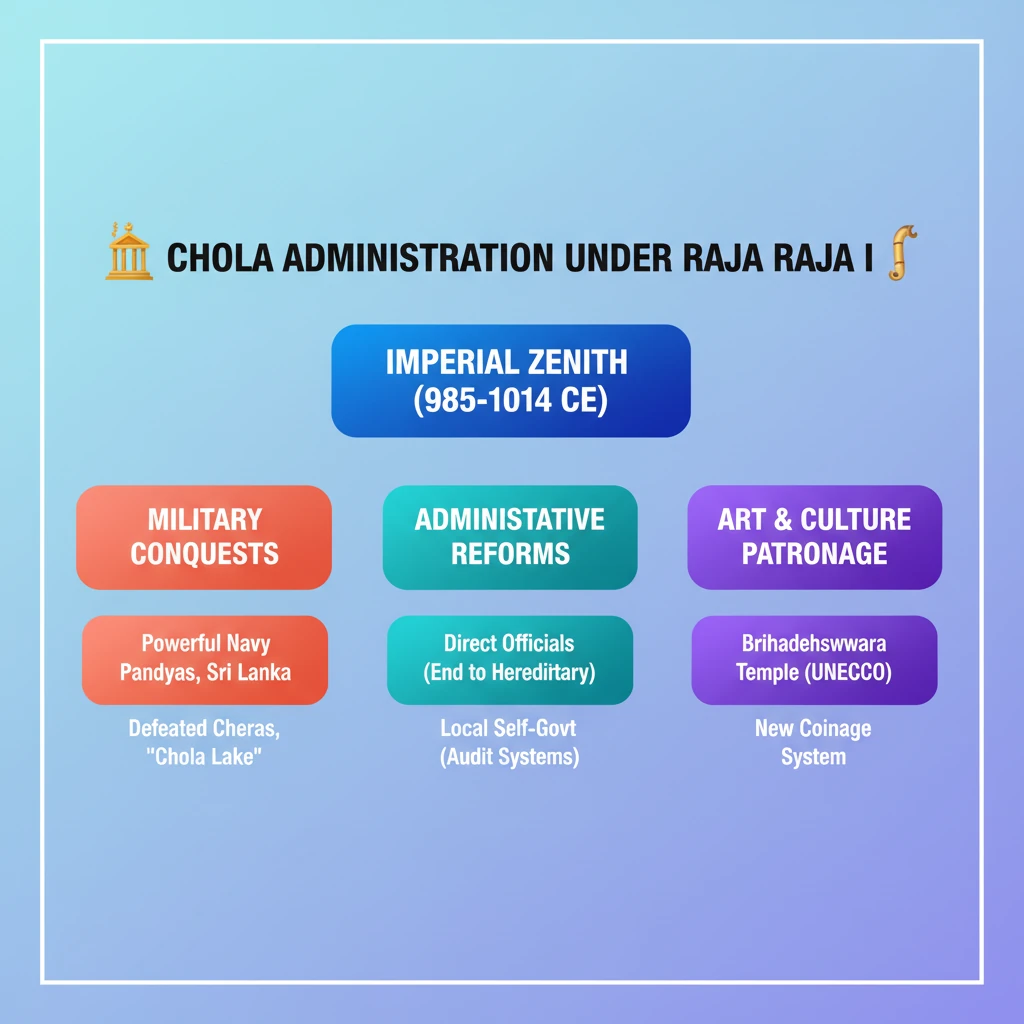
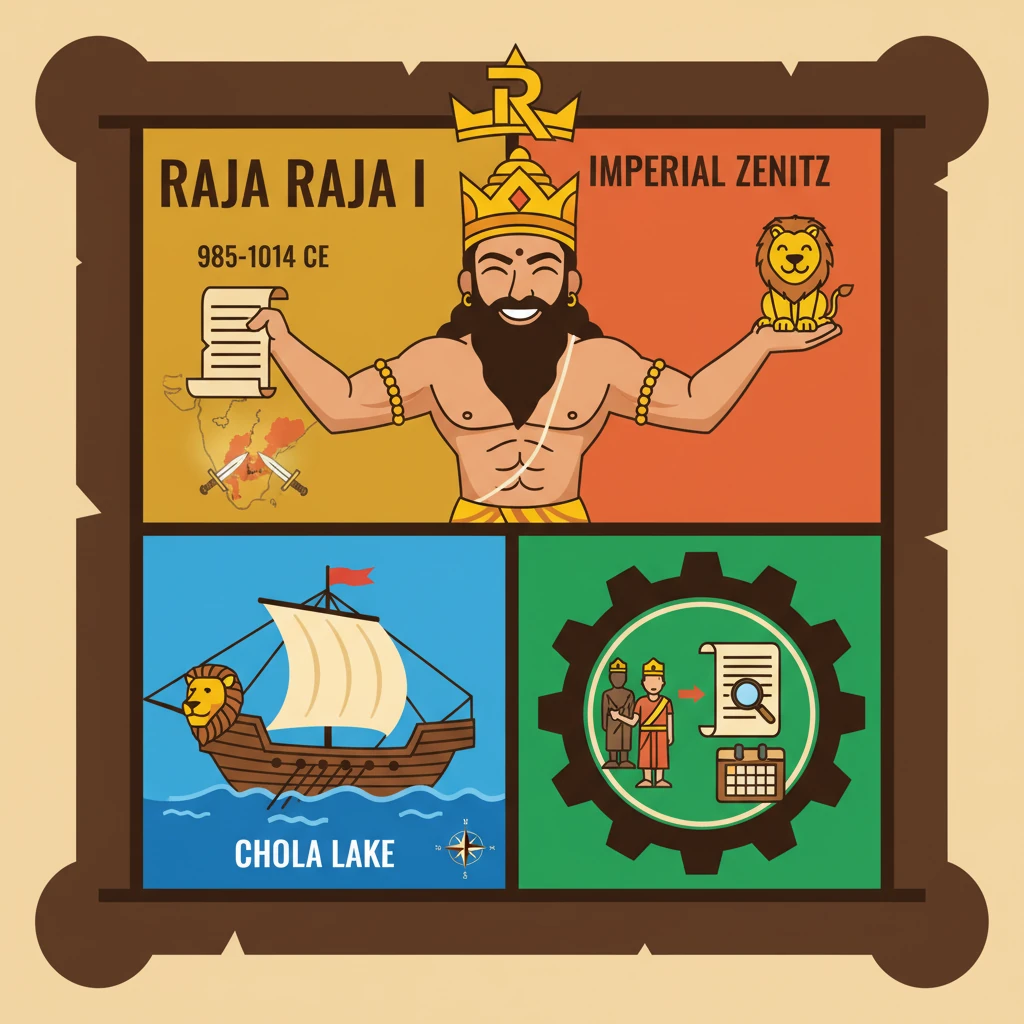
- •Raja Raja I (Arulmozhi Varman) ruled the Chola empire from 985-1014 CE, marking its imperial zenith.
- •His reign was characterized by extensive military conquests, including Cheras, Pandyas, Sri Lanka, and parts of Chalukya territory.
- •He built a powerful Chola Navy, earning the Bay of Bengal the title 'Chola Lake', facilitating overseas expeditions.
- •Key administrative reforms included replacing hereditary lords with direct officials and strengthening local self-government with audit systems.
- •He was a great patron of art and culture, commissioning the iconic Brihadeshwara Temple at Thanjavur (a UNESCO site) and introducing new coinage.
🧠 Memory Techniques
95% Verified Content