What are the Contributions of Pt. Jawaharlal Nehru? - History | UPSC Learning
Topics
0 topics • 0 completed
🔍
No topics match your search
What are the Contributions of Pt. Jawaharlal Nehru?
Medium⏱️ 8 min read
history
📖 Introduction
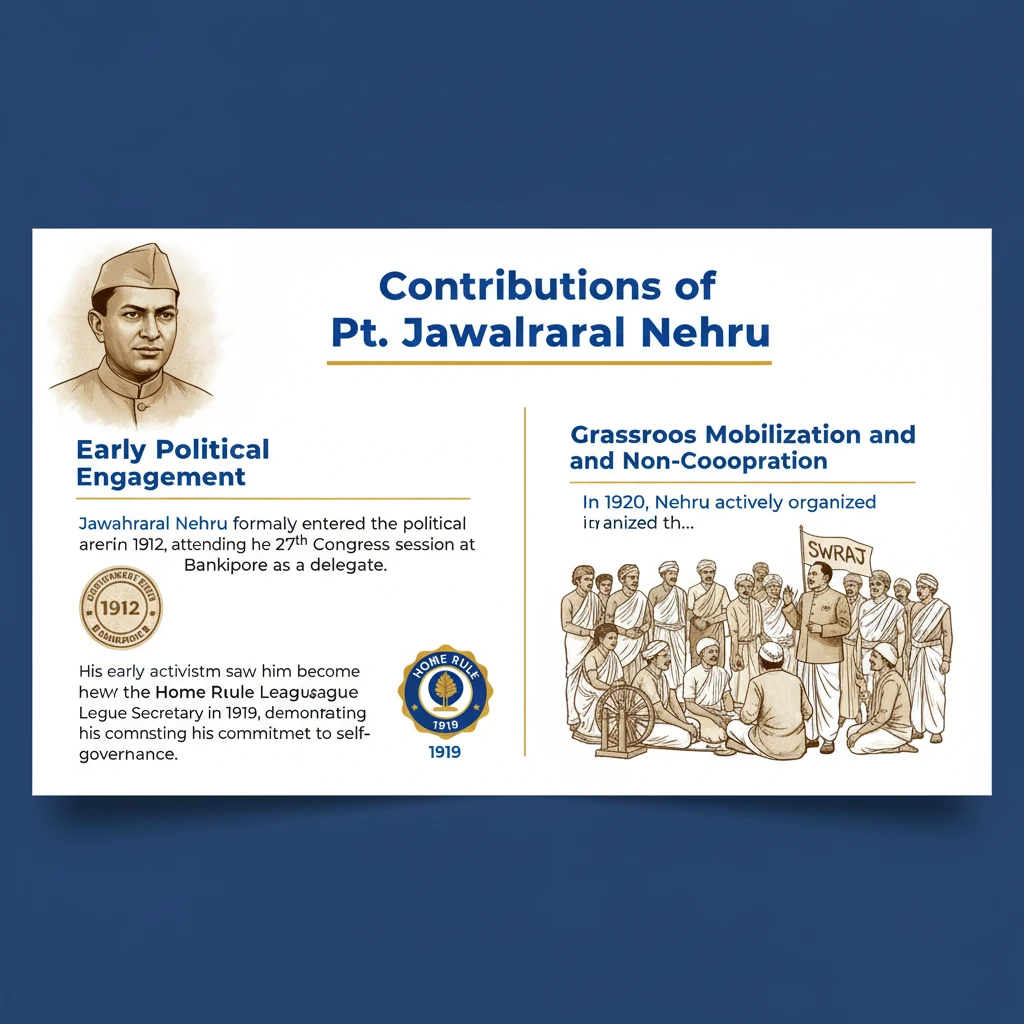
<h4>Early Political Engagement</h4><p><strong>Jawaharlal Nehru</strong> formally entered the political arena in <strong>1912</strong>, attending the <strong>27th Congress session</strong> at <strong>Bankipore</strong> as a delegate.</p><p>His early activism saw him become the <strong>Home Rule League Secretary</strong> in <strong>1919</strong>, demonstrating his commitment to self-governance.</p><h4>Grassroots Mobilization and Non-Cooperation</h4><p>In <strong>1920</strong>, Nehru actively organized the first <strong>Kisan March</strong> in <strong>Pratapgarh, Uttar Pradesh</strong>, highlighting agrarian issues.</p><p>He faced imprisonment twice during the significant <strong>Non-Cooperation Movement (1920-22)</strong>, showcasing his dedication to the national cause.</p><h4>Rising through Congress Ranks</h4><p>His organizational skills led to his appointment as <strong>General Secretary</strong> of the <strong>All India Congress Committee (AICC)</strong> in <strong>1923</strong>.</p><p>In <strong>1928</strong>, Nehru strongly advocated for complete independence at the <strong>Madras Congress</strong>, pushing the party's agenda forward.</p><h4>Protests and Constitutional Efforts</h4><p>He bravely led a procession against the <strong>Simon Commission</strong> in <strong>Lucknow</strong> in <strong>1928</strong>, enduring a lathi-charge.</p><div class='info-box'><p>In <strong>1928</strong>, Nehru played a crucial role in the <strong>Nehru Report</strong>, a proposal for constitutional reforms drafted by his father, <strong>Motilal Nehru</strong>.</p></div><p>To further the cause of full independence, he established the <strong>Independence for India League</strong> in <strong>1928</strong>.</p><h4>Purna Swaraj and Quit India</h4><p>The pivotal <strong>Lahore Congress of 1929</strong> saw <strong>Nehru elected President</strong>, where the Congress officially adopted <strong>complete independence</strong> as its goal, known as the <strong>Purna Swaraj Resolution</strong>.</p><div class='key-point-box'><p>On <strong>August 7, 1942</strong>, <strong>Nehru moved the historic Quit India Resolution</strong> at the <strong>AICC session in Bombay</strong>, marking a decisive phase in the freedom struggle.</p></div><h4>Vision for Modern India as PM</h4><p>As <strong>India’s first Prime Minister (1947–1964)</strong>, <strong>Nehru</strong> was instrumental in establishing a <strong>modern democratic state</strong>.</p><p>He championed <strong>secularism</strong>, promoted <strong>scientific advancement</strong>, and laid the groundwork for India's <strong>industrialization</strong>.</p><h4>Social Reforms: Hindu Code Bill</h4><p>A cornerstone of his social reform agenda was the <strong>Hindu Code Bill</strong>, aiming to replace religious laws with a <strong>secular civil code</strong>.</p><div class='info-box'><p>Key provisions of the <strong>Hindu Code Bill</strong> included outlawing <strong>polygamy</strong>, granting women <strong>property and divorce rights</strong>, amending <strong>inheritance laws</strong>, and introducing provisions for <strong>inter-caste marriage</strong>.</p></div><h4>Tribal Welfare: Panchsheel</h4><p><strong>Jawaharlal Nehru’s Tribal Panchsheel</strong> outlined a policy for tribal development based on respect and self-governance.</p><ul><li><strong>Self-development</strong> and respect for <strong>tribal rights</strong>.</li><li>Minimal external imposition and local participation in administration.</li><li>Focus on <strong>human-centred outcomes</strong> over financial metrics.</li></ul><h4>Economic Development and Institutions</h4><p>Nehru established vital institutions crucial for India's progress, emphasizing a planned economy.</p><div class='info-box'><p>Key institutions founded include the <strong>Indian Institutes of Technology (IITs)</strong>, the <strong>Indian Institutes of Management (IIMs)</strong>, and the <strong>Indian Space Research Organisation (ISRO)</strong>.</p></div><p>He spearheaded <strong>industrialization</strong> through <strong>Five-Year Plans</strong>, aiming for national <strong>self-sufficiency</strong>.</p><p>He also promoted a <strong>scientific temperament</strong> to combat religious obscurantism, continuing the legacy of reformers like <strong>Raja Ram Mohan Roy</strong>.</p><h4>Institutionalization of Democracy</h4><p>Nehru’s <strong>‘Objective Resolution’</strong> played a guiding role for the <strong>Constituent Assembly</strong> in drafting the <strong>Constitution</strong>.</p><p>It significantly shaped the <strong>Preamble</strong> and the fundamental philosophy of the <strong>Constitution of India</strong>.</p><h4>Foreign Policy of Non-Alignment</h4><p>India's <strong>non-alignment policy</strong>, championed by Nehru, aimed to maintain neutrality during the <strong>Cold War</strong>.</p><div class='key-point-box'><p>He was pivotal in forming the <strong>Non-Aligned Movement (NAM)</strong>, advocating for global peace at conferences like <strong>Bandung (1955)</strong> and <strong>Belgrade (1961)</strong>.</p></div><p>The <strong>Panchsheel Principle</strong>, or the <strong>Five Principles of Peaceful Coexistence</strong>, were partly formulated by India and China in the <strong>1950s</strong>.</p><ul><li><strong>Mutual Respect</strong> for Each other’s <strong>Territorial Integrity and Sovereignty</strong>.</li><li><strong>Mutual Non-Aggression</strong>.</li></ul>
💡 Key Takeaways
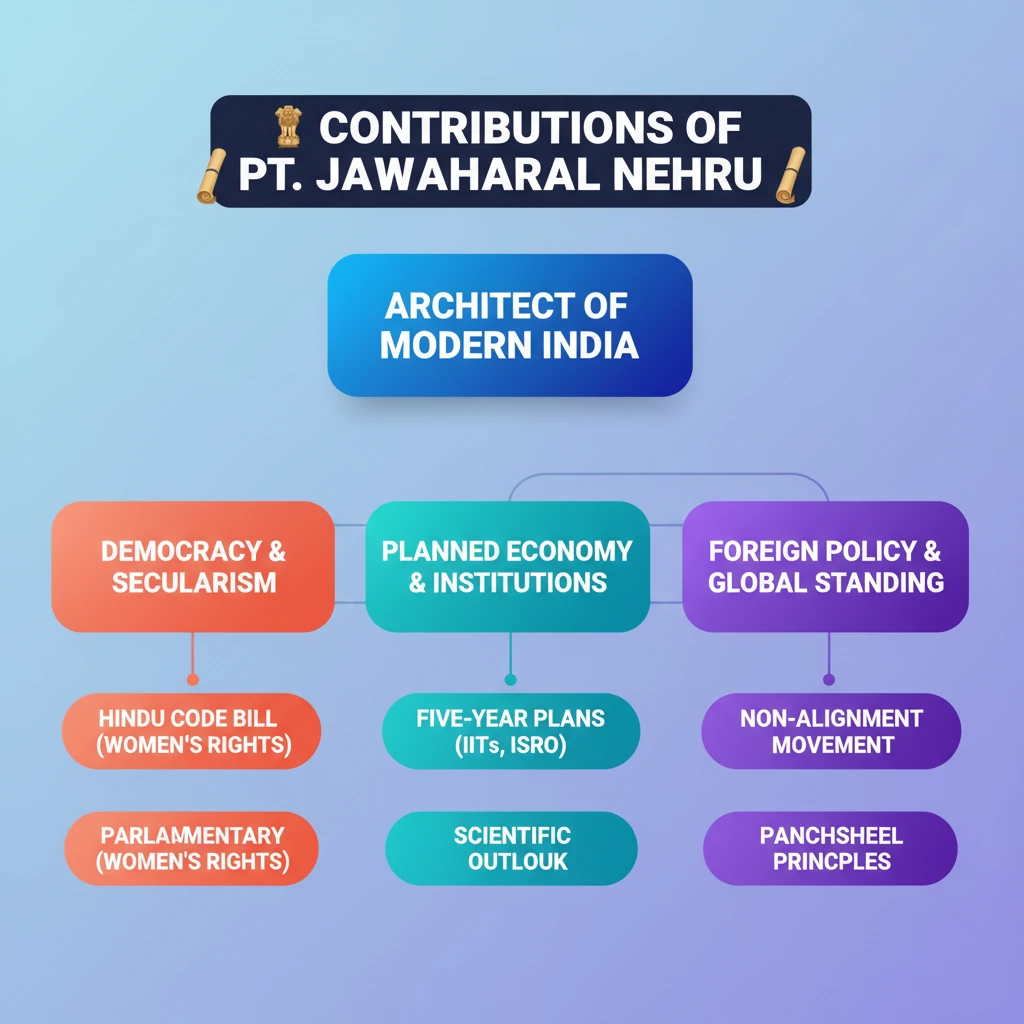
- •Nehru was a key figure in both India's independence struggle and its post-1947 nation-building.
- •His vision established India as a modern, democratic, secular, and scientifically-oriented state.
- •Major social reforms include the Hindu Code Bill, advancing women's rights.
- •He championed planned economic development through Five-Year Plans and established premier institutions like IITs and ISRO.
- •His foreign policy of Non-Alignment and Panchsheel shaped India's global standing during the Cold War.
🧠 Memory Techniques
95% Verified Content