What was the Role of Mahatma Gandhi in Satyagraha in South Africa? - History | UPSC Learning
Topics
0 topics • 0 completed
🔍
No topics match your search
What was the Role of Mahatma Gandhi in Satyagraha in South Africa?
Medium⏱️ 6 min read
history
📖 Introduction
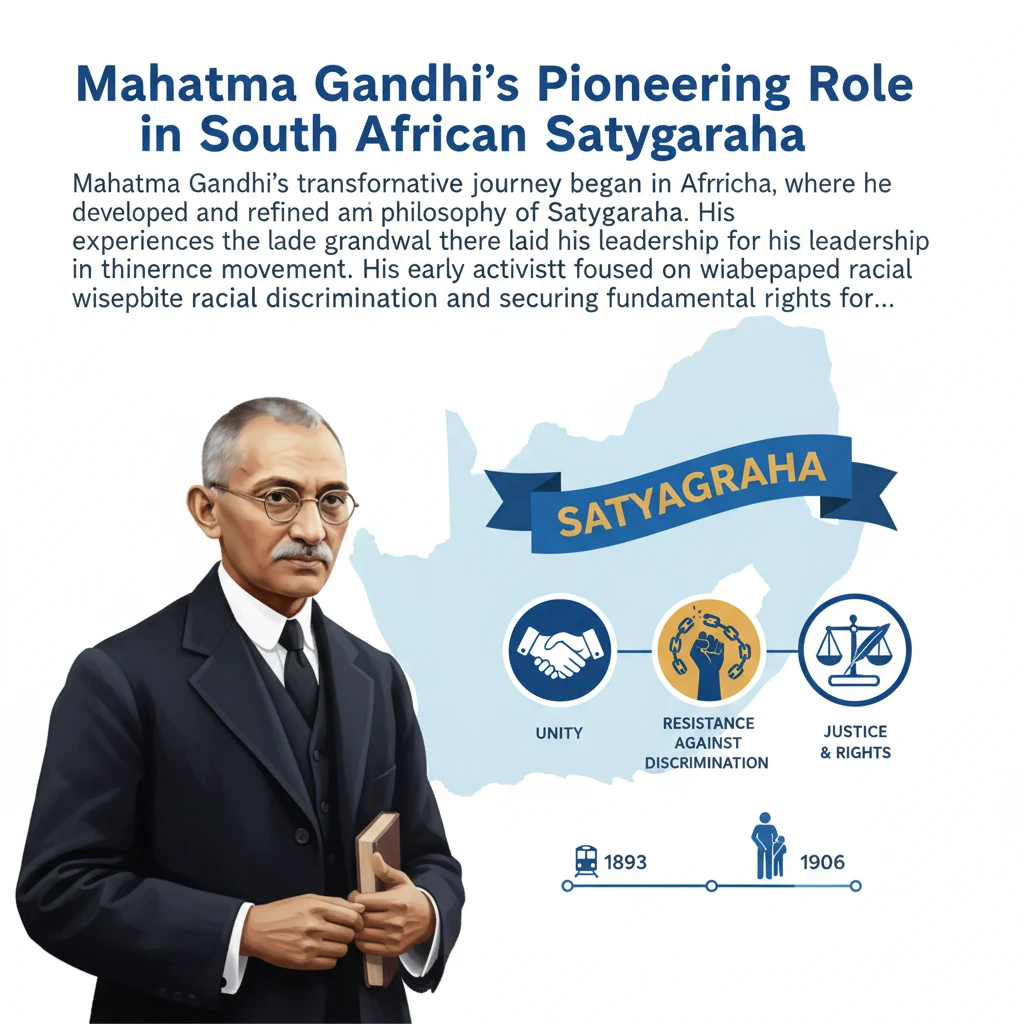
<h4>Mahatma Gandhi's Pioneering Role in South African Satyagraha</h4><p><strong>Mahatma Gandhi's</strong> transformative journey began in <strong>South Africa</strong>, where he developed and refined the philosophy of <strong>Satyagraha</strong>. His experiences there laid the groundwork for his leadership in the <strong>Indian independence movement</strong>.</p><p>His early activism focused on combating widespread <strong>racial discrimination</strong> and securing fundamental rights for the <strong>Indian community</strong> in the region.</p><h4>The Defining Moment: Pietermaritzburg Incident (1893)</h4><p>A pivotal event occurred on <strong>7th June 1893</strong>, when <strong>Mahatma Gandhi</strong> was forcibly removed from a <strong>first-class train compartment</strong> at <strong>Pietermaritzburg railway station</strong>.</p><p>This act of blatant <strong>racial discrimination</strong> deeply affected Gandhi, igniting his resolve to challenge injustice through non-violent means.</p><div class='key-point-box'><p>This incident is widely regarded as the catalyst for Gandhi's lifelong commitment to <strong>civil disobedience</strong> and <strong>non-violent protest</strong>, marking the genesis of his <strong>Natal Satyagraha</strong>.</p></div><h4>Formation of the Natal Indian Congress (NIC)</h4><p>Following his initial experiences with discrimination, Gandhi established the <strong>Natal Indian Congress (NIC)</strong> in <strong>1894</strong>. The primary aim was to politically organize and unite the diverse <strong>Indian community</strong> in <strong>Natal</strong>.</p><p>The <strong>NIC</strong> actively campaigned against various discriminatory laws, including those impacting <strong>voting rights</strong> and other civil liberties of Indians.</p><div class='info-box'><p>The <strong>NIC</strong> served as a crucial platform for collective action, raising awareness and advocating for the rights of Indians in <strong>South Africa</strong>.</p></div><h4>The Transvaal British Indian Association (1903)</h4><p>As restrictions intensified in the <strong>Transvaal region</strong>, <strong>Gandhi</strong> founded the <strong>Transvaal British Indian Association</strong> in <strong>1903</strong>.</p><p>This organization specifically focused on addressing the unique challenges faced by Indians in <strong>Transvaal</strong>, advocating for their rights against increasingly restrictive policies.</p><h4>The First Satyagraha Campaign (1906)</h4><p>In <strong>1906</strong>, <strong>Gandhi</strong> launched his first official <strong>Satyagraha campaign</strong> in <strong>Johannesburg</strong>. This historic movement was a direct response to the oppressive <strong>Asiatic Registration Act</strong>.</p><p>The campaign involved widespread <strong>mass protests</strong> and acts of <strong>civil disobedience</strong>.</p><div class='info-box'><p>The <strong>Asiatic Registration Act of 1906</strong> (Transvaal) mandated that all <strong>male Asians</strong> (primarily <strong>Indians</strong> and <strong>Chinese</strong>) must:</p><ul><li><strong>Register</strong> and provide <strong>fingerprints</strong>.</li><li>Carry a <strong>registration certificate</strong> at all times.</li><li>Submit to <strong>physical examinations</strong>.</li></ul><p>Its core purpose was to control and restrict the entry and movement of Asians.</p></div><p>Indians in <strong>South Africa</strong> strongly resisted this discriminatory legislation by forming the <strong>Passive Resistance Association</strong> to coordinate their non-violent opposition.</p><div class='exam-tip-box'><p>UPSC often asks about the <strong>chronology</strong> and <strong>specific acts</strong> that triggered Gandhi's early movements. Remember the <strong>Asiatic Registration Act of 1906</strong> as the target of his first formal <strong>Satyagraha</strong>.</p></div><h4>Evolution of Indian Organizations in South Africa</h4><p>From the <strong>1920s</strong>, the <strong>Natal Indian Congress (NIC)</strong> operated under the umbrella of the <strong>South African Indian Congress (SAIC)</strong>, consolidating efforts for Indian rights.</p><p>The leadership of these organizations underwent a significant shift towards more <strong>radical approaches</strong> in the <strong>1930s-1940s</strong>.</p><p><strong>Dr. G.M. Naicker</strong> emerged as a prominent figure, becoming the leader of the <strong>NIC</strong> in <strong>1945</strong>, advocating for a more assertive stance.</p><p>The increased militancy led to severe state repression, resulting in the <strong>imprisonment of several leaders</strong> throughout the <strong>1950s</strong> and <strong>1960s</strong>.</p><p>Despite not being officially banned, intense <strong>repression and harassment</strong> forced the <strong>NIC</strong> to halt its overt activities for a period.</p><p>The organization was eventually revived in <strong>1971</strong>, shifting its focus towards <strong>civic work</strong> and community engagement.</p><p>In the mid-<strong>1980s</strong>, the <strong>NIC</strong> played a crucial role in the formation of the <strong>United Democratic Front (UDF)</strong>, a broad-based anti-apartheid coalition.</p><div class='info-box'><p>The <strong>UDF's</strong> overarching objective was to establish a <strong>"non-racial, united South Africa,"</strong> reflecting the enduring spirit of equality that Gandhi had championed decades earlier.</p></div>
💡 Key Takeaways
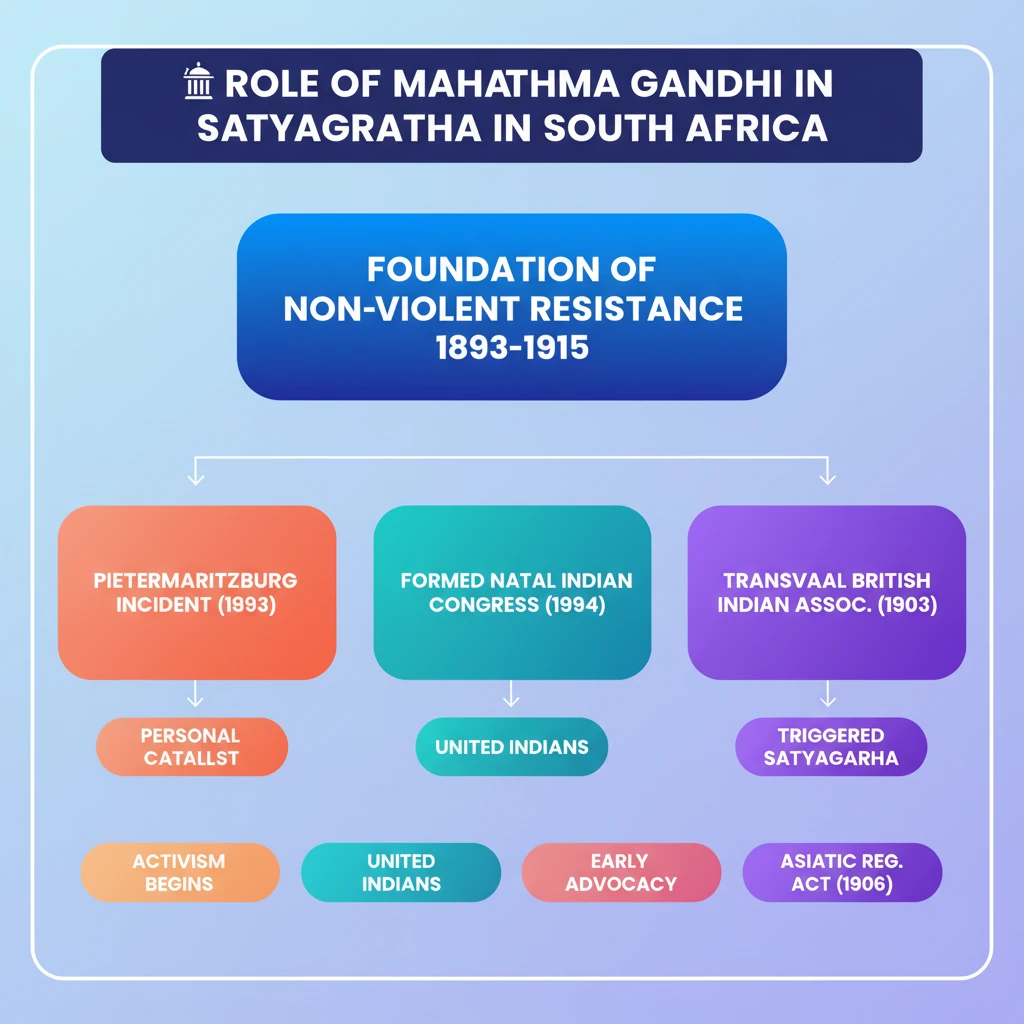
- •Gandhi's South African experience (1893-1915) was crucial for developing Satyagraha.
- •The Pietermaritzburg incident (1893) was a personal catalyst for his activism.
- •He formed the Natal Indian Congress (1894) and Transvaal British Indian Association (1903) to unite Indians.
- •The Asiatic Registration Act (1906) triggered his first formal Satyagraha campaign.
- •His methods of non-violent resistance and civil disobedience were refined in South Africa before being applied in India.
🧠 Memory Techniques

98% Verified Content