100 Years of Vaikom Satyagraha - History | UPSC Learning
Topics
0 topics • 0 completed
🔍
No topics match your search
100 Years of Vaikom Satyagraha
Medium⏱️ 10 min read
history
📖 Introduction
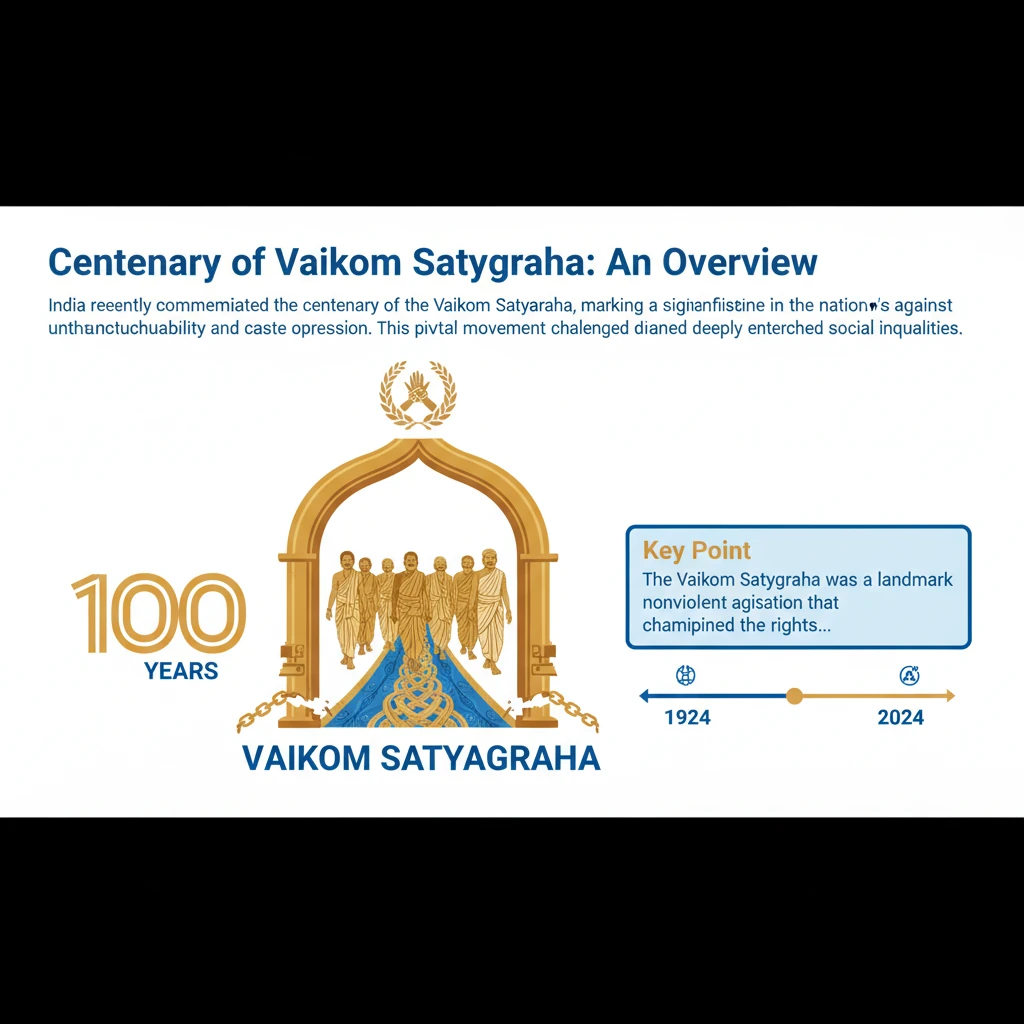
<h4>Introduction to Vaikom Satyagraha Centenary</h4><p>India commemorated the <strong>centenary</strong> of the <strong>Vaikom Satyagraha</strong>, a crucial movement in its history.</p><p>This agitation significantly challenged <strong>untouchability</strong> and <strong>caste oppression</strong>.</p><p>It remains a symbol of social reform and resistance against discrimination.</p><h4>Genesis and Location</h4><p>The <strong>Vaikom Satyagraha</strong> was a <strong>nonviolent agitation</strong> that took place in <strong>Vaikom</strong>.</p><p>Vaikom is situated within the erstwhile <strong>princely state of Travancore</strong>, located in present-day <strong>Kerala</strong>.</p><p>The movement spanned from <strong>March 30, 1924</strong>, to <strong>November 23, 1925</strong>.</p><div class='info-box'><p><strong>Duration:</strong> 30th March 1924 – 23rd November 1925 (approx. 600 days)</p><p><strong>Location:</strong> Vaikom, Travancore (Kerala)</p></div><h4>Core Issue: Untouchability and Road Access</h4><p>The movement primarily protested against the deeply entrenched practices of <strong>untouchability</strong> and <strong>caste discrimination</strong>.</p><p>It was specifically triggered by the prohibition of oppressed classes, particularly the <strong>Ezhavas</strong>, from using roads surrounding the <strong>Vaikom Mahadeva temple</strong>.</p><p>These roads were considered sacred and restricted to upper castes.</p><h4>Pioneering Temple Entry Movement</h4><p>The <strong>Vaikom Satyagraha</strong> holds the distinction of being the <strong>first among the temple entry movements</strong> in India.</p><p>It effectively paved the way and set a precedent for similar social reform movements across the entire country.</p><div class='exam-tip-box'><p>The <strong>Vaikom Satyagraha</strong> is a critical example for questions on <strong>social reform movements</strong> and <strong>Gandhian methods</strong> in <strong>UPSC Mains GS Paper I</strong>.</p></div><h4>Integration with Nationalist Aspirations</h4><p>The movement emerged during a period of a burgeoning <strong>nationalist movement</strong> in India.</p><p>It aimed to bring <strong>social reform</strong> to the forefront, alongside the prevailing political aspirations for independence.</p><p>This demonstrated the interconnectedness of social emancipation and political freedom.</p><h4>Key Leaders and Influences</h4><p>The Satyagraha was spearheaded by visionary leaders from <strong>Kerala</strong>.</p><p>Prominent figures included <strong>Ezhava leader T.K. Madhavan</strong>, <strong>K.P. Kesava Menon</strong>, and <strong>K. Kelappan</strong>.</p><div class='info-box'><p><strong>Local Leaders:</strong> <strong>T.K. Madhavan</strong> (Ezhava leader), <strong>K.P. Kesava Menon</strong>, <strong>K. Kelappan</strong>.</p></div><h4>Periyar's Pivotal Role</h4><p><strong>Erode Venkatappa Ramasamy</strong>, widely known as <strong>Periyar</strong> or <strong>Thanthai Periyar</strong>, played an exceptionally crucial role.</p><p>He mobilized volunteers, delivered powerful speeches, and endured imprisonment for the cause.</p><p>His significant contributions earned him the esteemed title <strong>'Vaikom Hero'</strong>.</p><h4>Mahatma Gandhi's Intervention</h4><p>The movement gained significant momentum and national attention with the arrival of <strong>Mahatma Gandhi</strong> in <strong>Vaikom</strong> in <strong>March 1925</strong>.</p><p><strong>Gandhi</strong> held crucial discussions with leaders from various caste groups, lending his moral authority and strategic guidance.</p><p>His involvement underscored the national importance of the struggle.</p><h4>Strategies Employed</h4><p>The Satyagraha initially concentrated on opening the roads surrounding the <strong>Vaikom temple</strong> to people from <strong>all castes</strong>.</p><p>Leaders deliberately adopted <strong>nonviolent methods</strong>, deeply inspired by <strong>Gandhian principles of protest</strong>.</p><p>This adherence to nonviolence was a hallmark of the movement's strategy.</p><h4>Significant Outcome and Partial Success</h4><p>The <strong>Vaikom Satyagraha</strong> ultimately led to notable reforms in the region.</p><p>Three out of the four roads surrounding the <strong>Vaikom Mahadeva temple</strong> were opened to people of <strong>all castes</strong>.</p><p>While not a complete victory, it was a significant step towards dismantling caste barriers.</p><h4>Long-term Legacy: Temple Entry Proclamation</h4><p>The momentum generated by the Satyagraha continued, culminating in a historic event in <strong>November 1936</strong>.</p><p>The <strong>Maharaja of Travancore</strong> signed the landmark <strong>Temple Entry Proclamation</strong>.</p><p>This proclamation completely removed the age-old ban on the entry of <strong>marginalized castes</strong> into all state-owned temples of <strong>Travancore</strong>.</p><div class='key-point-box'><p>The <strong>Temple Entry Proclamation of 1936</strong> was a direct and profound consequence, significantly expanding the rights of marginalized communities.</p></div><h4>Divergent Interpretations of the Movement</h4><p>The <strong>Vaikom Satyagraha</strong> has been subject to varying interpretations over time.</p><p>Some view it primarily as a <strong>Hindu reformist movement</strong>, aiming to purify and broaden the scope of Hinduism.</p><p>Others perceive it fundamentally as a crucial fight against pervasive <strong>caste-based atrocities</strong> and discrimination.</p><h4>Commemoration and Remembrance</h4><p>The enduring significance of the movement is honored through various memorials.</p><p>These include the <strong>Vaikom Satyagraha Memorial Museum</strong> and <strong>Periyar's Memorial</strong>.</p><p>Such memorials ensure that the struggle and its lessons are not forgotten.</p>
💡 Key Takeaways
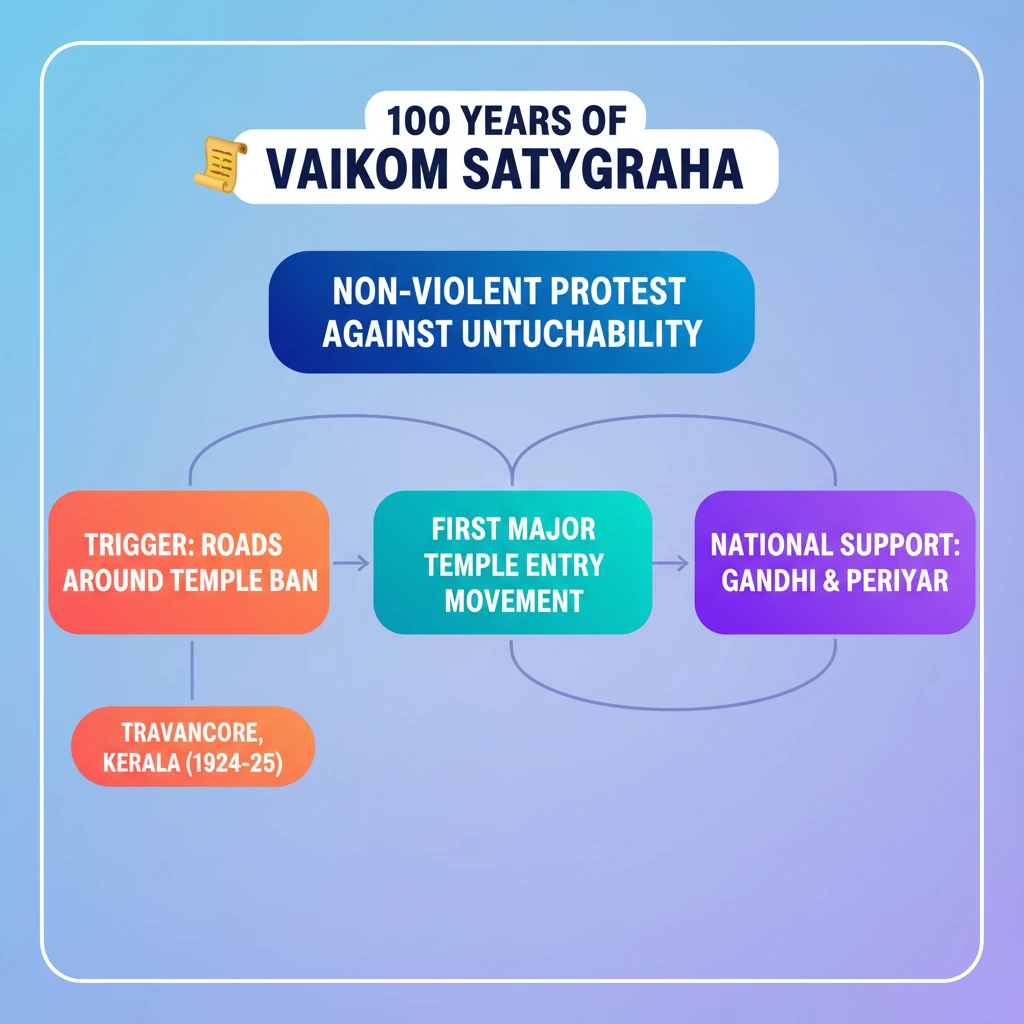
- •Vaikom Satyagraha (1924-1925) was a nonviolent protest against untouchability and caste discrimination in Travancore, Kerala.
- •It was India's first major temple entry movement, inspiring subsequent social reforms.
- •Key leaders included T.K. Madhavan, K.P. Kesava Menon, K. Kelappan, with significant contributions from Periyar and Mahatma Gandhi.
- •Achieved partial success initially, leading to the opening of three out of four temple roads.
- •Its lasting legacy culminated in the historic Travancore Temple Entry Proclamation of 1936, opening all state temples to marginalized castes.
🧠 Memory Techniques
95% Verified Content