Vijayanagara Empire: Decline After the Battle of Talikota, 1565 - History | UPSC Learning
Topics
0 topics • 0 completed
🔍
No topics match your search
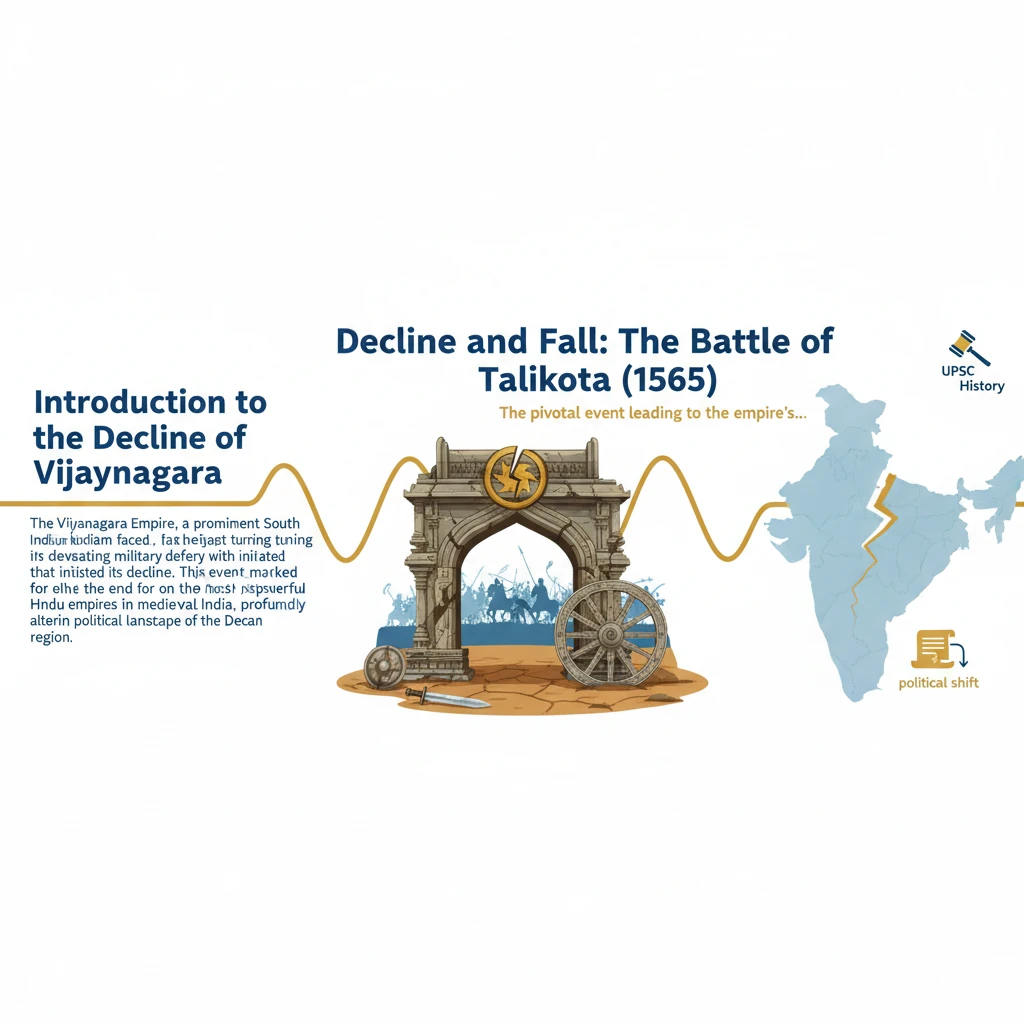
Vijayanagara Empire: Decline After the Battle of Talikota, 1565
Medium⏱️ 6 min read
history
📖 Introduction
<h4>Introduction to the Decline of Vijayanagara</h4><p>The <strong>Vijayanagara Empire</strong>, a prominent South Indian kingdom, faced a significant turning point in its history with a devastating military defeat that initiated its decline.</p><p>This event marked the beginning of the end for one of the most powerful Hindu empires in medieval India, profoundly altering the political landscape of the Deccan region.</p><h4>The Battle of Talikota (1565)</h4><p>The pivotal event leading to the empire's downfall was the <strong>Battle of Talikota</strong>, fought in <strong>1565</strong>. This battle is also known by other names, reflecting its historical significance and geographical context.</p><div class='info-box'><p><strong>Alternative Names:</strong> The Battle of Talikota is also referred to as the <strong>Battle of Rakkasagi-Tangadagi</strong>. These names derive from the villages near which the conflict took place.</p></div><p>The battle saw the <strong>Vijayanagara army</strong> suffer a decisive defeat at the hands of an alliance of the <strong>Deccan Sultanates</strong>. This coalition represented a formidable challenge to Vijayanagara's dominance.</p><div class='key-point-box'><p><strong>Key Outcome:</strong> The <strong>Vijayanagara army</strong> was comprehensively routed, leading to the sacking of its capital, <strong>Hampi</strong>, and marking a critical juncture in the empire's history.</p></div><h4>The Allied Deccan Sultanates</h4><p>The alliance that confronted Vijayanagara comprised several powerful Muslim kingdoms of the Deccan plateau. Their combined strength proved overwhelming.</p><ul><li><strong>Ahmednagar Sultanate</strong></li><li><strong>Bijapur Sultanate</strong></li><li><strong>Golconda Sultanate</strong></li><li><strong>Bidar Sultanate</strong></li></ul><p>The fifth sultanate, <strong>Berar</strong>, did not participate in this alliance, maintaining its neutrality during the conflict.</p><div class='exam-tip-box'><p><strong>UPSC Insight:</strong> Understanding the <strong>Battle of Talikota</strong> is crucial for Mains (<strong>GS Paper I: Indian History</strong>) as it signifies a major shift in power dynamics in South India. Focus on its causes, key players, and long-term consequences for the <strong>Vijayanagara Empire</strong> and the Deccan region.</p></div>
💡 Key Takeaways
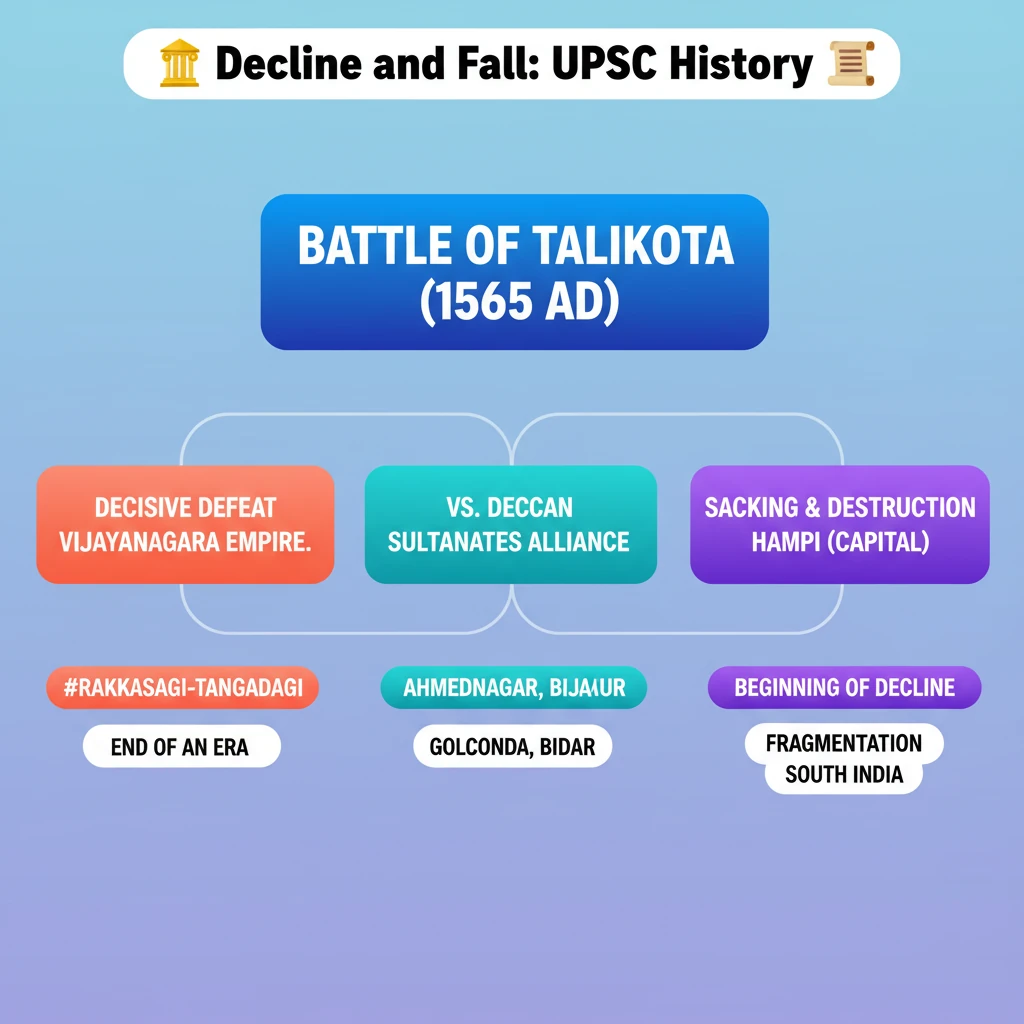
- •The <strong>Battle of Talikota</strong> (<strong>1565</strong>) was a decisive defeat for the <strong>Vijayanagara Empire</strong>.
- •It is also known as the <strong>Battle of Rakkasagi-Tangadagi</strong>.
- •The <strong>Vijayanagara army</strong> was defeated by an alliance of four <strong>Deccan Sultanates</strong> (Ahmednagar, Bijapur, Golconda, Bidar).
- •The battle led to the sacking and destruction of the capital city, <strong>Hampi</strong>.
- •This event marked the beginning of the empire's decline and subsequent fragmentation of South India.
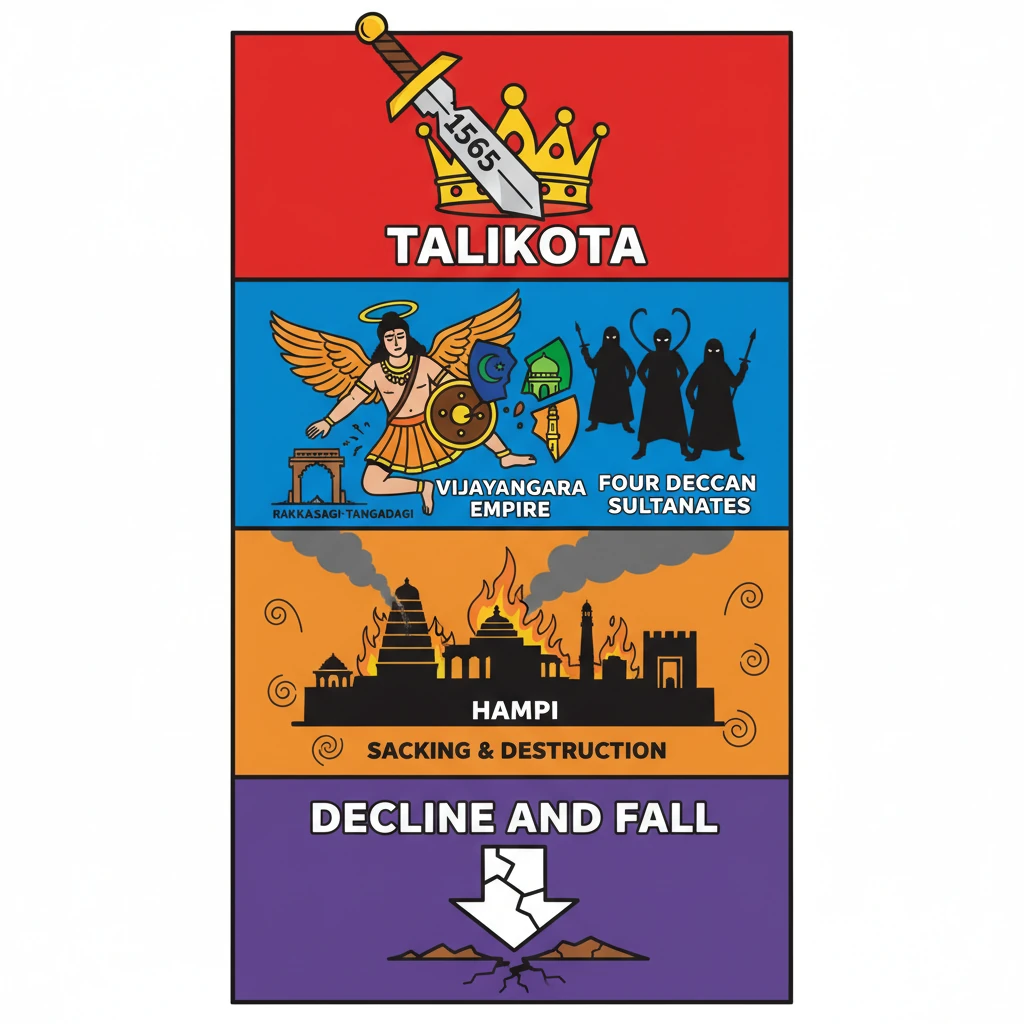
🧠 Memory Techniques
95% Verified Content
📚 Reference Sources
•A History of South India by K.A. Nilakanta Sastri
•The Cambridge Economic History of India, Vol. I
•NCERT History Textbooks (Class XI & XII)