What was the Role of Other Leaders in Integration of Princely States? - History | UPSC Learning
Topics
0 topics • 0 completed
🔍
No topics match your search
What was the Role of Other Leaders in Integration of Princely States?
Medium⏱️ 5 min read
history
📖 Introduction
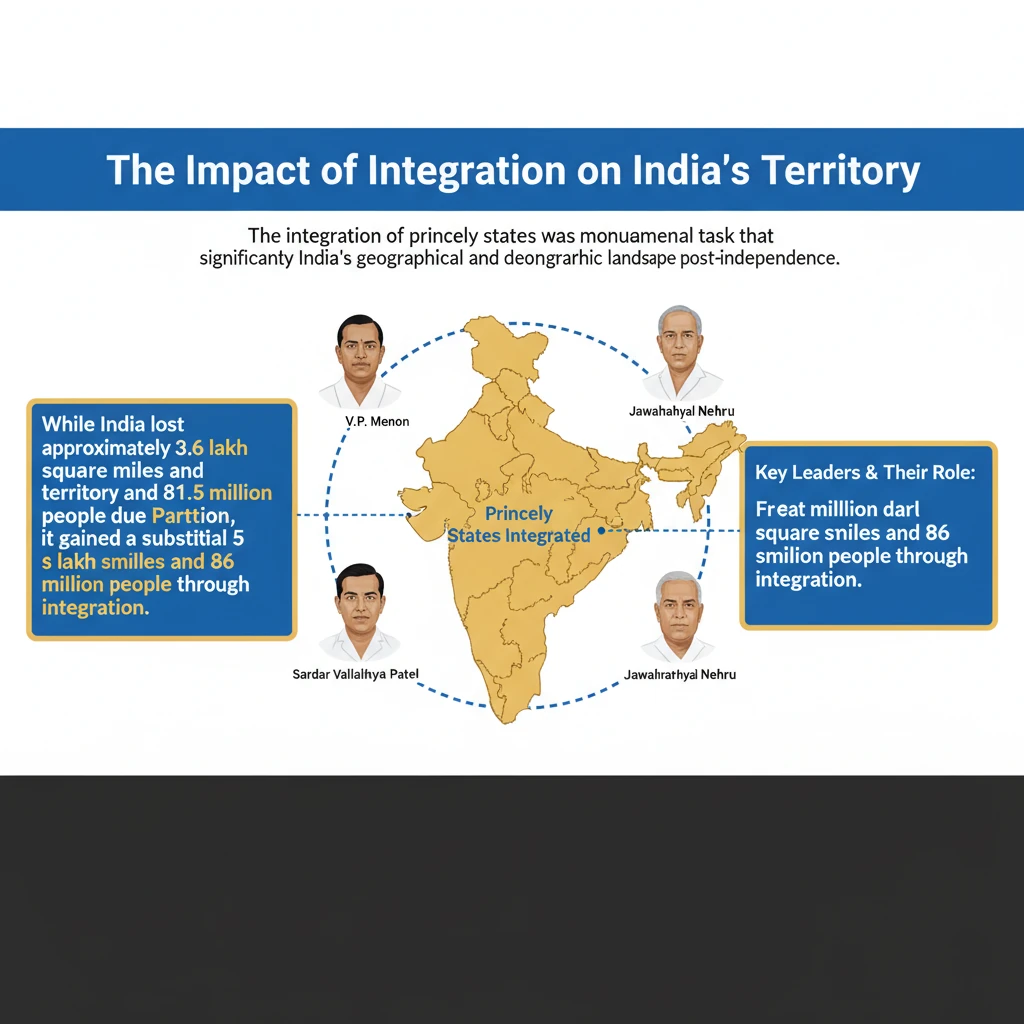
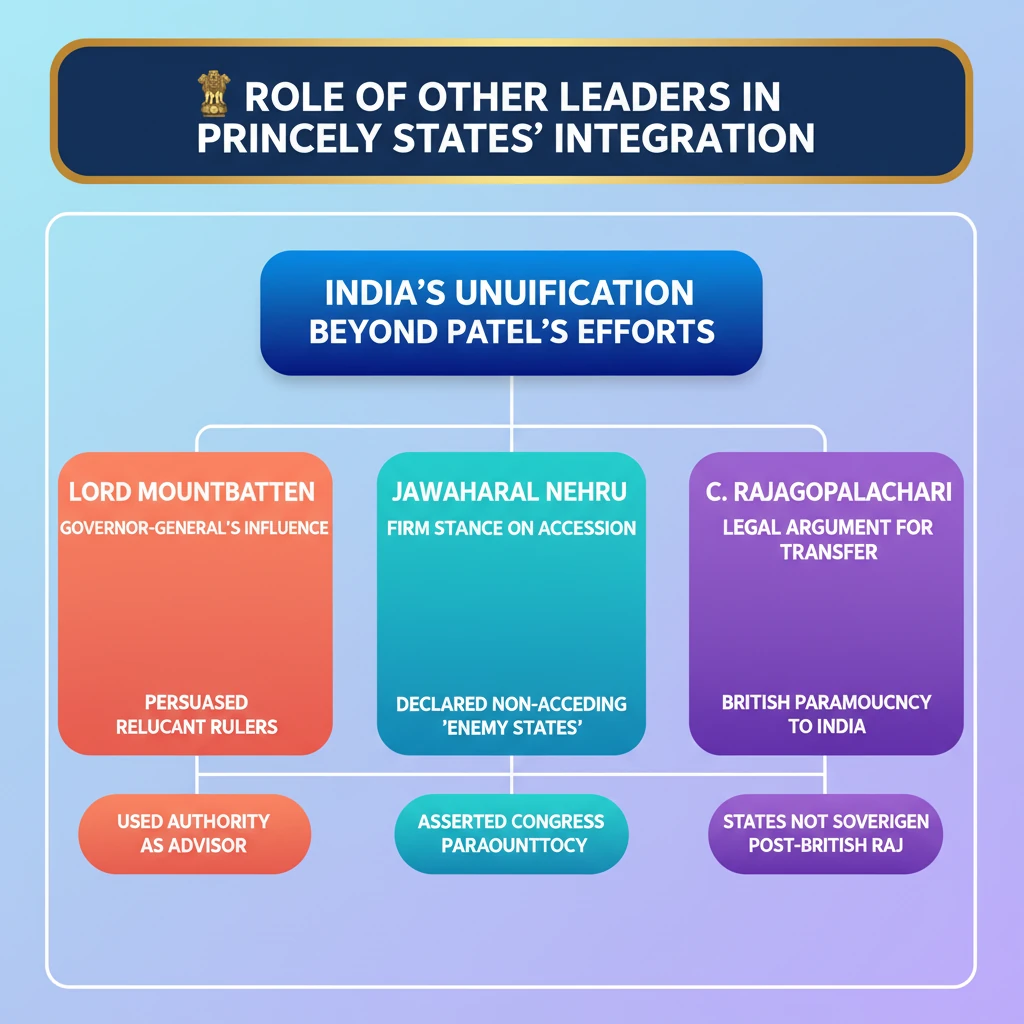
<h4>The Impact of Integration on India's Territory</h4><p>The <strong>integration of princely states</strong> was a monumental task that significantly reshaped India's geographical and demographic landscape post-independence.</p><div class='info-box'><p>While <strong>India</strong> lost approximately <strong>3.6 lakh square miles</strong> of territory and <strong>81.5 million people</strong> due to <strong>Partition</strong>, it gained a substantial <strong>5 lakh square miles</strong> and <strong>86.5 million people</strong> through the successful integration of these states.</p></div><h4>Lord Mountbatten's Role in Persuasion</h4><p><strong>Lord Mountbatten</strong>, the last Viceroy and first Governor-General of independent India, played a pivotal role in the accession process. His influence was crucial in convincing many reluctant monarchs.</p><div class='key-point-box'><p>Mountbatten's position as the <strong>first Governor-General of India</strong> lent credibility to the agreements. Princely rulers believed he could guarantee that independent India would uphold the terms of accession.</p></div><h4>Jawaharlal Nehru's Confrontational Approach</h4><p><strong>Jawaharlal Nehru</strong>, India's first Prime Minister, adopted a firmer stance towards the princely states. His approach was more assertive and less conciliatory than Mountbatten's.</p><p>In <strong>January 1947</strong>, Nehru unequivocally rejected the concept of the <strong>divine right of kings</strong>, signaling that traditional claims to sovereignty would not be recognized by the new Indian government.</p><div class='key-point-box'><p>By <strong>May 1947</strong>, Nehru declared that any <strong>princely state</strong> that refused to join the <strong>Constituent Assembly</strong> would be treated as an <strong>enemy state</strong>. This strong warning underscored the Union's determination.</p></div><h4>C. Rajagopalachari's Legal Argument</h4><p><strong>C. Rajagopalachari</strong>, a prominent Congress leader, provided a crucial legal and political argument for the integration. He challenged the notion of princely states' independence.</p><p>He contended that <strong>British control over princely states</strong> was based on practical reality and historical dominance, rather than a formal treaty or agreement. Therefore, this control would naturally transfer to <strong>independent India</strong> as the legitimate successor to the British Raj.</p><h4>The Congress Organisation's Stance</h4><p>The <strong>Indian National Congress</strong>, as a unified political entity, consistently maintained a clear position on the future of princely states. It asserted that these states were not truly sovereign.</p><div class='key-point-box'><p>The Congress argued that the states could not unilaterally opt for <strong>independence</strong> once <strong>British paramountcy</strong> lapsed. Their future was inextricably linked with the Indian Union, reflecting the will of their people.</p></div>
💡 Key Takeaways
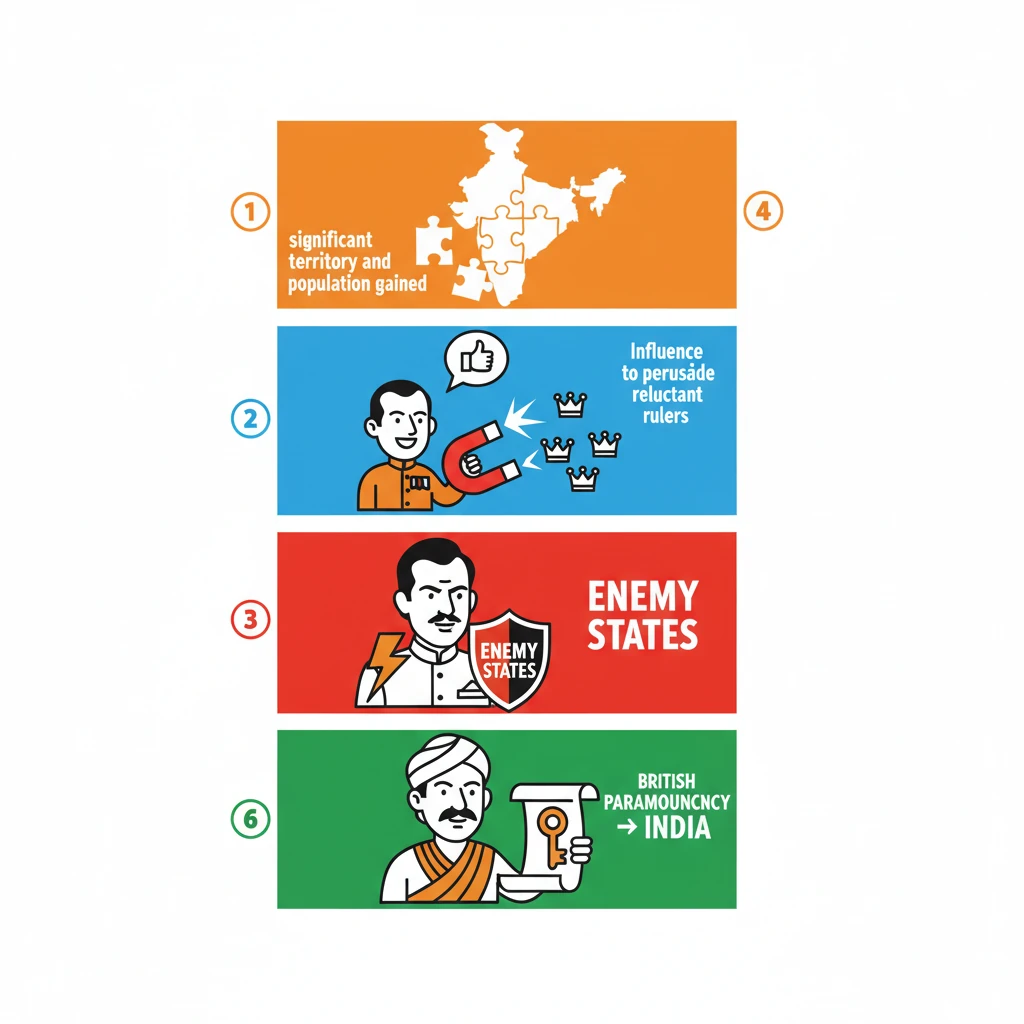
- •India gained significant territory and population through princely state integration despite Partition losses.
- •Lord Mountbatten used his influence as Governor-General to persuade reluctant rulers.
- •Jawaharlal Nehru adopted a firm stance, declaring non-acceding states as 'enemy states'.
- •C. Rajagopalachari provided a legal argument, stating British paramountcy's transfer to independent India.
- •The Congress asserted that princely states were not sovereign and could not remain independent post-paramountcy.
- •Integration was crucial for India's territorial integrity and national unity.
🧠 Memory Techniques
95% Verified Content