What are the Key Features of Lodi Architecture? - History | UPSC Learning
Topics
0 topics • 0 completed
🔍
No topics match your search
What are the Key Features of Lodi Architecture?
Medium⏱️ 8 min read
history
📖 Introduction
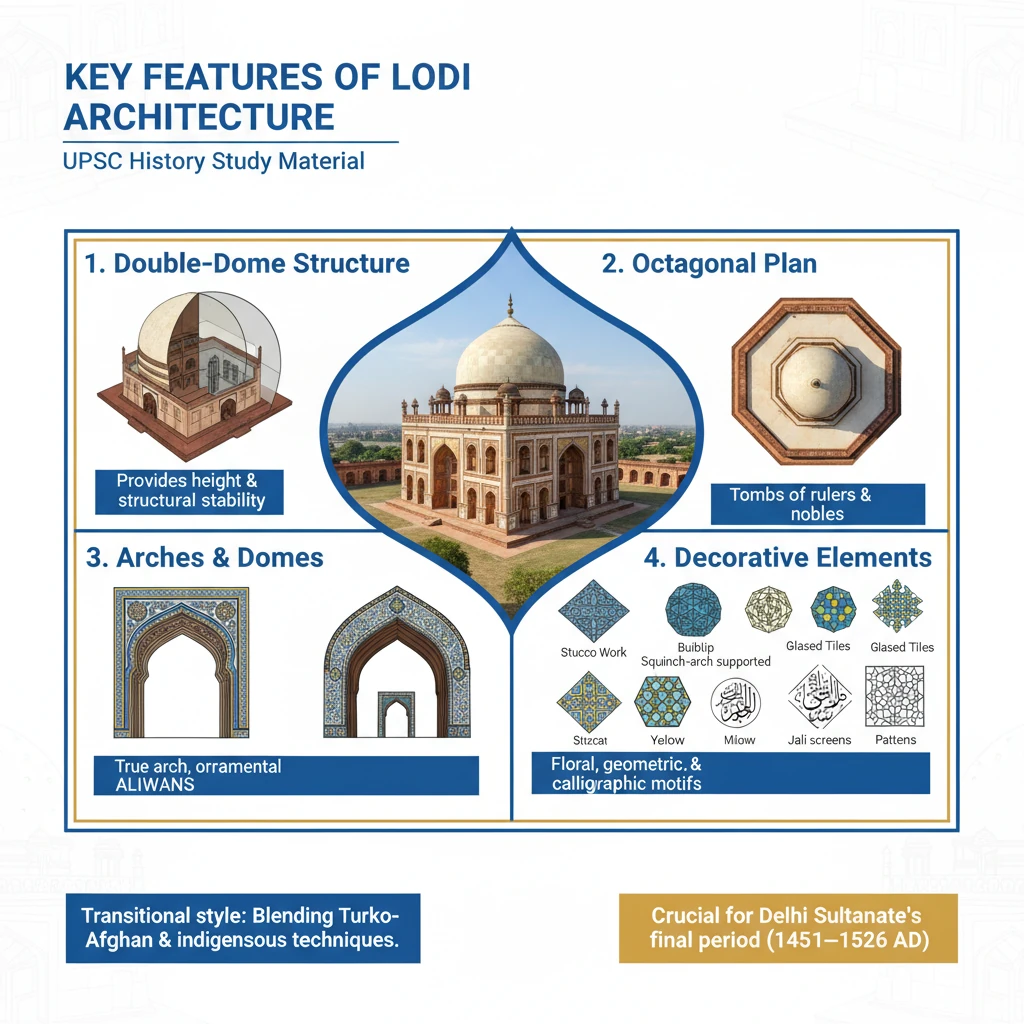
<h4>Introduction to Lodi Architecture</h4><p><strong>Lodi architecture</strong>, flourishing during the <strong>Lodi Dynasty</strong> (<strong>1451–1526 AD</strong>), marks a distinct phase in <strong>Indo-Islamic architectural history</strong>. It is characterized by a unique blend of structural techniques and decorative elements, reflecting the cultural synthesis prevalent in the <strong>Delhi Sultanate</strong>'s final period.</p><p>This style served as a crucial transitional bridge, incorporating elements from earlier Sultanate periods while foreshadowing the grandeur of subsequent <strong>Mughal architecture</strong>.</p><h4>Architectural Synthesis: Arch and Lintel-and-Beam</h4><p>A defining feature of <strong>Lodi constructions</strong> was their sophisticated approach to structural design. The architects skillfully employed both the <strong>arch</strong> and the <strong>lintel-and-beam methods</strong> in their buildings.</p><p>This dual mastery allowed for greater flexibility and strength, demonstrating an advanced understanding of engineering principles. It represented a fusion of Islamic arched construction with indigenous Indian trabeate (lintel-and-beam) systems.</p><div class='info-box'><p><strong>Arch Method:</strong> Utilizes curved structural members to span an opening, transferring weight outwards and downwards. Common in Islamic architecture.</p><p><strong>Lintel-and-Beam Method:</strong> Employs horizontal beams (lintels) supported by vertical columns (beams) to span openings. Prevalent in traditional Indian architecture.</p></div><h4>Regional Influences and Adaptations</h4><p><strong>Lodi architecture</strong> was not insular; it actively adopted and integrated elements from various regional Indian styles. Notably, influences from <strong>Rajasthani</strong> and <strong>Gujarati architecture</strong> are clearly discernible.</p><p>These adaptations enriched the visual vocabulary and aesthetic appeal of Lodi buildings, creating a truly syncretic style.</p><ul><li><strong>Balconies:</strong> Often projecting, providing ventilation and aesthetic relief.</li><li><strong>Kiosks (Chhatris):</strong> Small, open, domed pavilions, typically supported by pillars.</li><li><strong>Eaves (Chhajjas):</strong> Projecting ornamental or protective overhangs, common in Indian temple architecture.</li></ul><h4>The Dominance of Tomb Construction</h4><p>A striking characteristic of the <strong>Lodi period</strong> is the almost exclusive focus on the construction of <strong>tombs</strong>. Unlike earlier Sultanate periods that saw mosques and madrasas, the Lodi era primarily commissioned funerary architecture.</p><div class='key-point-box'><p>During the entire <strong>Lodi period (1451–1526 AD)</strong>, almost <strong>only tombs were commissioned</strong>, making them the quintessential architectural expression of the dynasty.</p></div><p>These tombs were typically designed with specific features, reflecting both functional requirements and symbolic significance.</p><div class='info-box'><p><strong>Lodi Tombs Specifications:</strong></p><ul><li><strong>Hard, Bare Design:</strong> Emphasized solidity and simplicity over elaborate ornamentation.</li><li><strong>Octagonal Plan:</strong> Many prominent tombs adopted an <strong>octagonal design</strong>, a departure from earlier square plans.</li><li><strong>Diameter:</strong> Often about <strong>15 meters in diameter</strong>, indicating a substantial scale.</li><li><strong>Sloping Verandah:</strong> Characterized by a distinctive <strong>sloping verandah</strong> encircling the central structure, adding to its unique silhouette.</li></ul></div><div class='exam-tip-box'><p><strong>UPSC Insight:</strong> When asked about <strong>Lodi architecture</strong>, remember to highlight the <strong>fusion of arch and lintel-and-beam</strong>, the incorporation of <strong>regional elements</strong>, and the <strong>predominance of octagonal tombs</strong>. This demonstrates a comprehensive understanding of its unique identity.</p></div>
💡 Key Takeaways
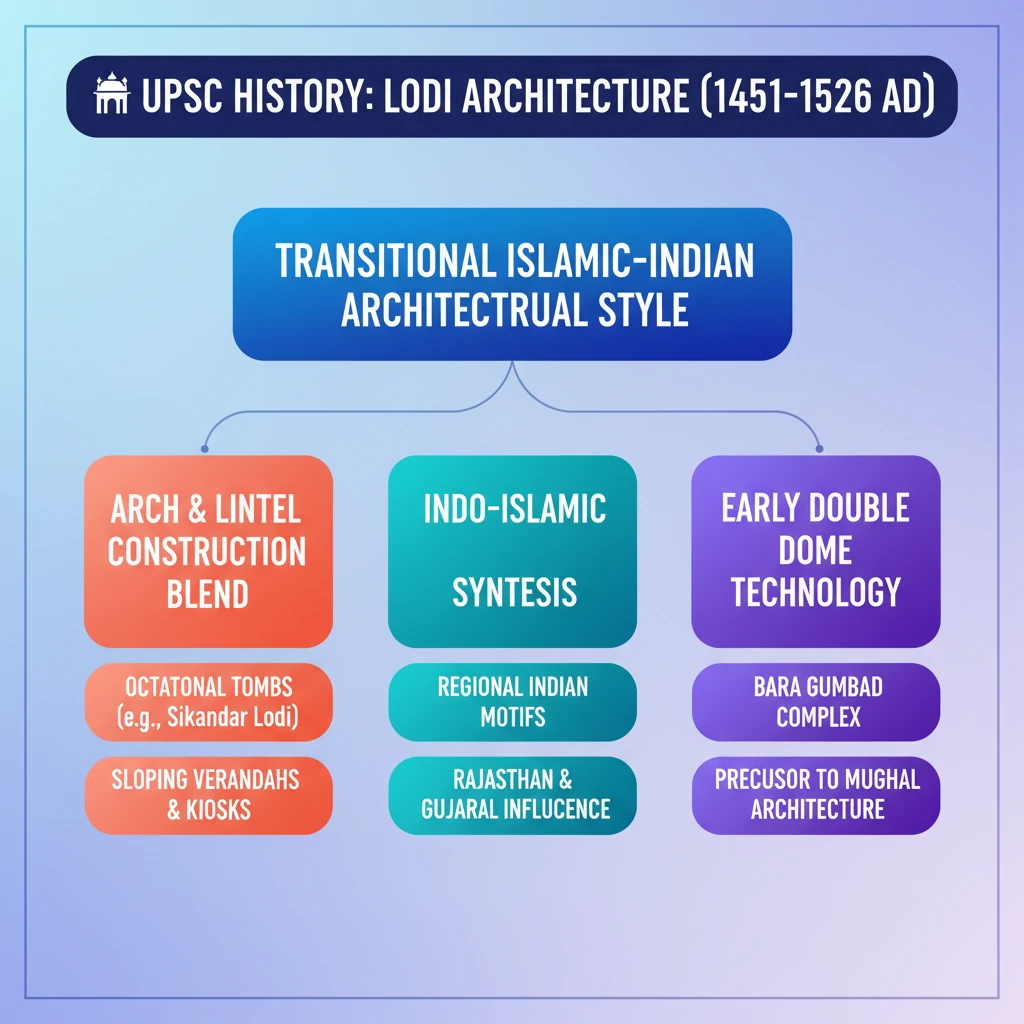
- •Lodi architecture (1451-1526 AD) is known for its blend of arch and lintel-and-beam construction methods.
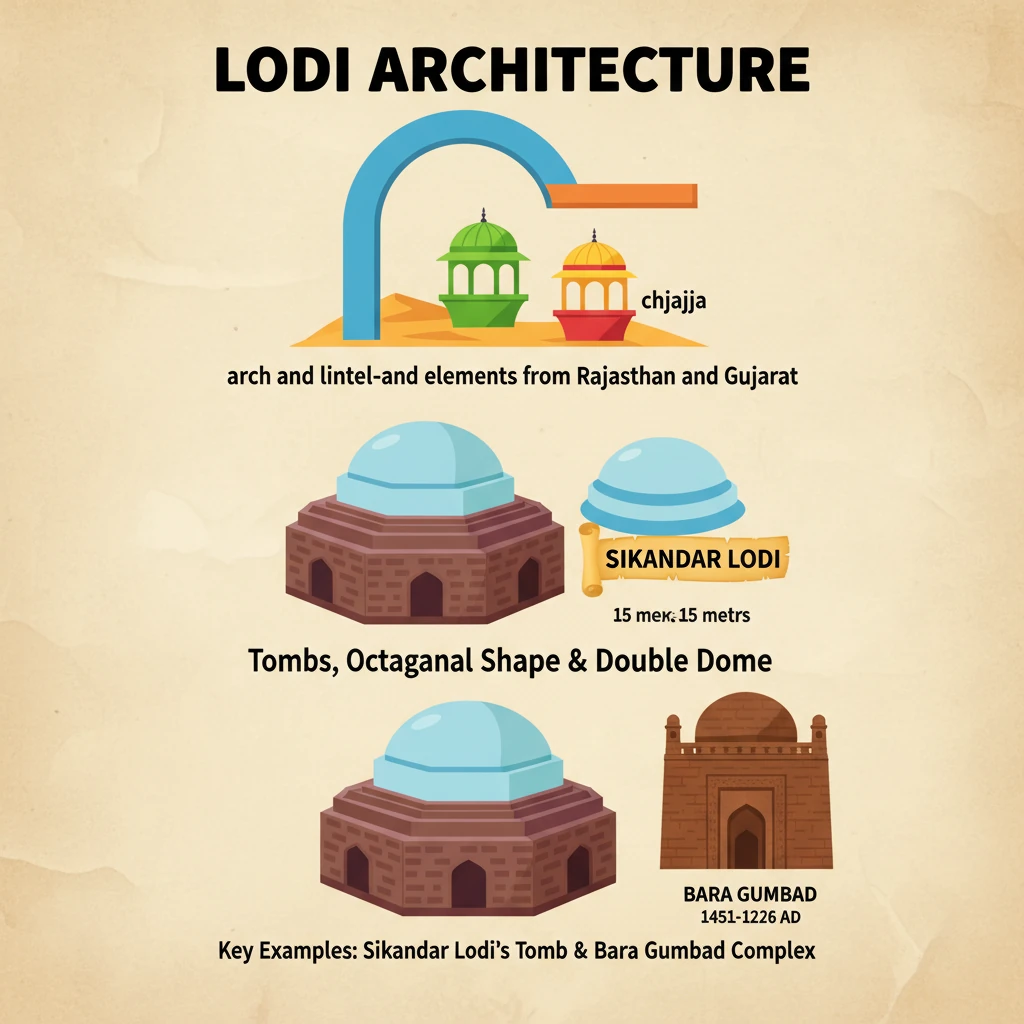
- •It incorporated regional Indian architectural elements like balconies, kiosks, and eaves from Rajasthan and Gujarat.
- •The period primarily saw the construction of tombs, often octagonal, about 15 meters in diameter, with sloping verandahs.
- •Key examples include the Tomb of Sikandar Lodi (featuring an early double dome) and the Bara Gumbad complex.
- •Lodi architecture represents a transitional phase, influencing later Mughal architectural innovations.
🧠 Memory Techniques
95% Verified Content
📚 Reference Sources
•Archaeological Survey of India (ASI) official records for Lodi Garden monuments
•NCERT textbooks on Indian History and Art & Culture