Pt. Jawaharlal Nehru - History | UPSC Learning
Topics
0 topics • 0 completed
🔍
No topics match your search
Pt. Jawaharlal Nehru
Medium⏱️ 8 min read
history
📖 Introduction
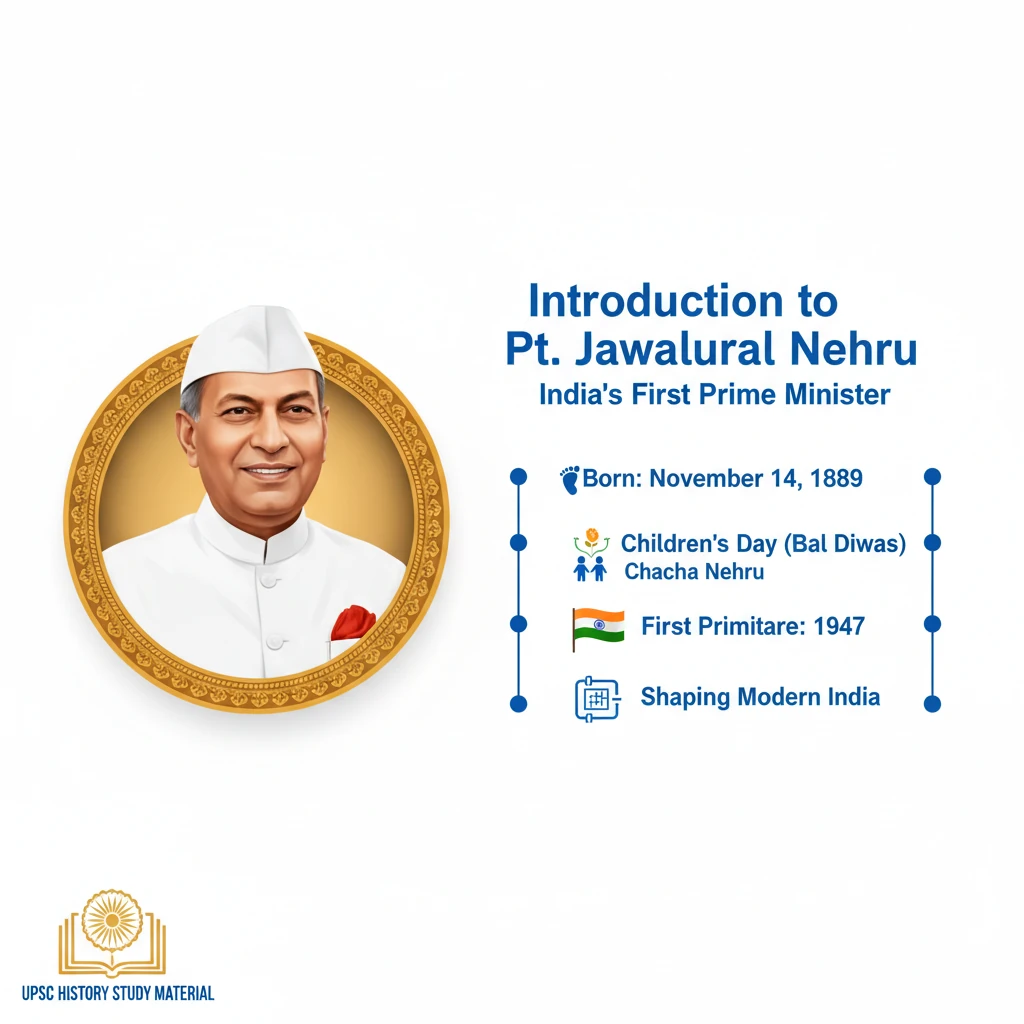
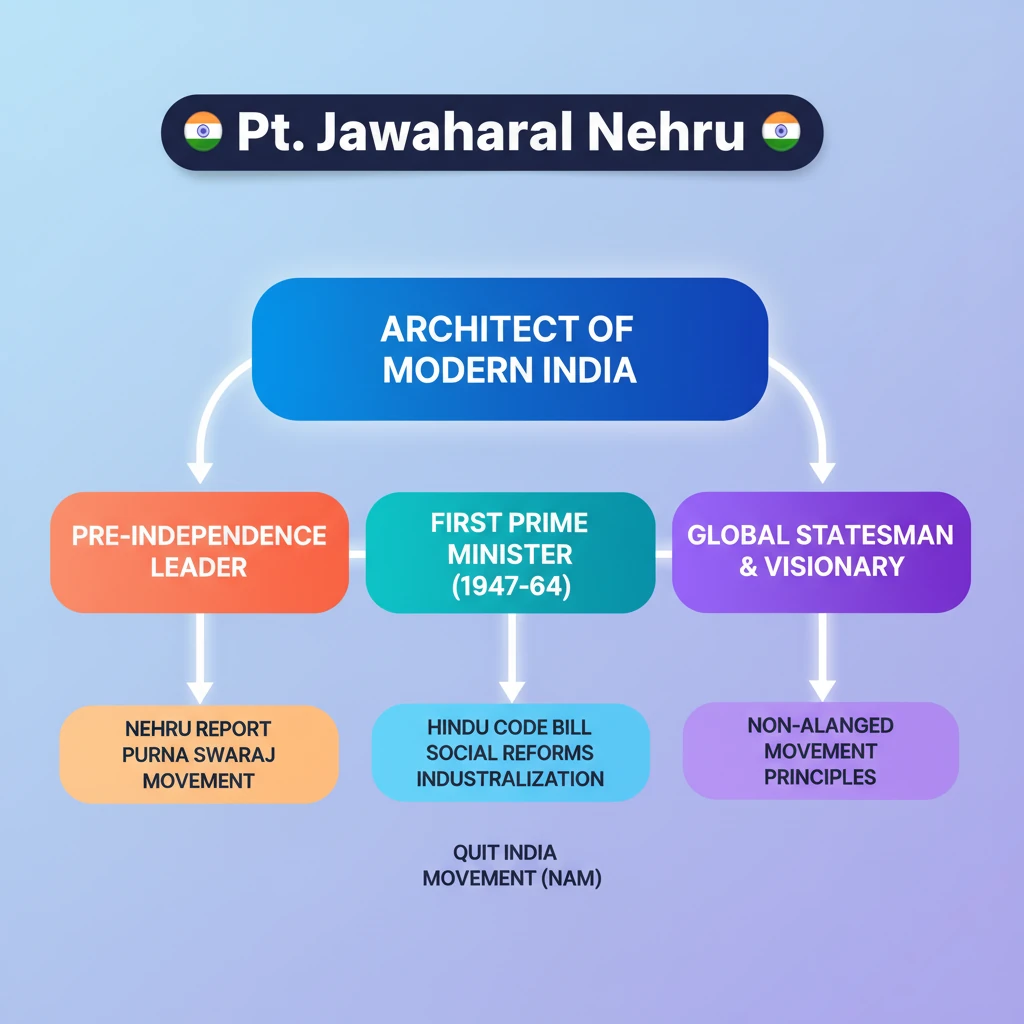
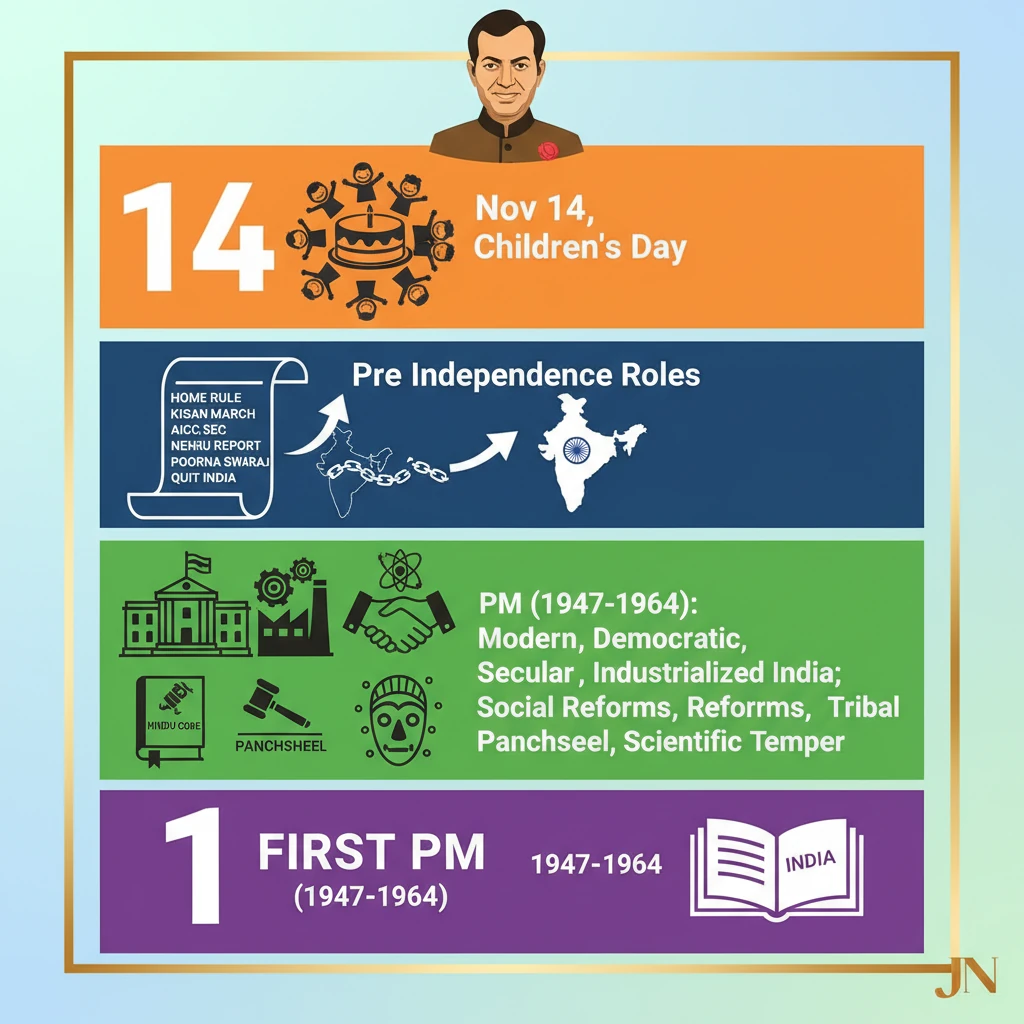
<h4>Introduction to Pt. Jawaharlal Nehru</h4><p><strong>Pt. Jawaharlal Nehru</strong>, born on <strong>November 14, 1889</strong>, was India's <strong>first Prime Minister</strong>. His birth anniversary is celebrated annually as <strong>Children's Day (Bal Diwas)</strong>, reflecting his deep affection for children, who lovingly called him <strong>Chacha Nehru</strong>.</p><p>Nehru's life was marked by significant contributions both during India's struggle for independence and in shaping the newly independent nation.</p><div class='info-box'><p><strong>Key Fact:</strong> <strong>Children's Day</strong> is observed on <strong>November 14th</strong> each year in India to honor <strong>Jawaharlal Nehru's</strong> birthday and his commitment to child welfare.</p></div><h4>Pre-Independence Era Contributions (1889-1947)</h4><p>Nehru's political journey began early, demonstrating a strong commitment to India's freedom struggle. He actively participated in various movements and held crucial positions within the Indian National Congress.</p><ul><li><strong>1912:</strong> Entered politics as a delegate at the <strong>27th Congress session at Bankipore</strong>.</li><li><strong>1919:</strong> Became <strong>Home Rule League Secretary</strong>, advocating for self-rule.</li><li><strong>1920:</strong> Organized the <strong>first Kisan March in Pratapgarh, Uttar Pradesh</strong>, highlighting agrarian issues.</li><li><strong>1920-22:</strong> Imprisoned twice during the <strong>Non-Cooperation Movement</strong>, a testament to his active involvement.</li></ul><div class='key-point-box'><p><strong>Leadership Role:</strong> Nehru quickly rose through the ranks, becoming <strong>General Secretary of the All India Congress Committee (AICC)</strong> in <strong>1923</strong>.</p></div><p>His vision for complete independence was clear and unwavering, pushing the Congress towards more assertive demands.</p><ul><li><strong>1926:</strong> Committed the Congress to the goal of <strong>independence</strong> at the <strong>Madras Congress</strong>.</li><li><strong>1928:</strong> Faced a <strong>lathi-charge</strong> while leading a procession against the <strong>Simon Commission in Lucknow</strong>, showcasing his defiance against British authority.</li><li><strong>1928:</strong> Played a crucial role in the <strong>Nehru Report</strong> (drafted by his father, <strong>Motilal Nehru</strong>), a proposal for constitutional reforms.</li><li><strong>1928:</strong> Established the <strong>Independence for India League</strong> to advocate for <strong>full independence</strong>.</li><li><strong>1929:</strong> Elected <strong>President of the Lahore Congress</strong>, where the Congress officially adopted <strong>Purna Swaraj (complete independence)</strong> as its goal.</li><li><strong>1942:</strong> Moved the historic <strong>Quit India Resolution</strong> at the <strong>AICC session in Bombay</strong>, demanding immediate British withdrawal.</li></ul><h4>Achievements as India's First Prime Minister (1947-1964)</h4><p>As the <strong>first Prime Minister of India</strong>, <strong>Jawaharlal Nehru</strong> laid the foundational principles for a modern, democratic, and self-reliant nation. His tenure from <strong>1947 to 1964</strong> was pivotal in shaping India's domestic and foreign policies.</p><h5>Vision for Modern India</h5><p>Nehru envisioned India as a progressive nation built on democratic values, secularism, and scientific advancement. He tirelessly worked towards establishing a robust framework for its future growth.</p><div class='key-point-box'><p><strong>Core Vision:</strong> Established a <strong>modern democratic state</strong>, promoted <strong>secularism</strong> and <strong>scientific advancement</strong>, and laid the groundwork for <strong>industrialization</strong>.</p></div><h5>Social Reforms: The Hindu Code Bill</h5><p>A significant aspect of Nehru's reformist agenda was the modernization of personal laws to ensure equality and justice, particularly for women.</p><ul><li>The <strong>Hindu Code Bill</strong> aimed to replace traditional religious laws with a <strong>secular civil code</strong>.</li><li>It sought to <strong>outlaw polygamy</strong>, grant women <strong>property and divorce rights</strong>, amend <strong>inheritance laws</strong>, and introduce provisions for <strong>inter-caste marriage</strong>.</li></ul><h5>Tribal Panchsheel</h5><p>Nehru's approach to tribal development was marked by respect for indigenous cultures and a focus on self-determination, encapsulated in the <strong>Tribal Panchsheel</strong>.</p><div class='info-box'><p><strong>Five Principles:</strong> Emphasized <strong>self-development</strong>, respect for <strong>tribal rights</strong>, minimal <strong>external imposition</strong>, <strong>local participation</strong> in administration, and <strong>human-centered outcomes</strong> over financial metrics.</p></div><h5>Economic Development and Institutions</h5><p>Nehru understood that robust institutions and planned economic growth were crucial for India's self-sufficiency and progress.</p><ul><li>Established premier institutions like the <strong>Indian Institutes of Technology (IITs)</strong>, the <strong>Indian Institute of Management (IIM)</strong>, and the <strong>Indian Space Research Organisation (ISRO)</strong>.</li><li>Championed <strong>industrialization</strong> through <strong>Five-Year Plans</strong>, aiming for self-sufficiency and economic growth.</li><li>Promoted a <strong>scientific temperament</strong> to combat religious obscurantism and superstition, continuing the legacy of reformers like <strong>Raja Ram Mohan Roy</strong>.</li></ul><h5>Institutionalization of Democracy</h5><p>Nehru's intellectual contributions significantly shaped the philosophical underpinnings of India's Constitution.</p><div class='key-point-box'><p>His <strong>'Objective Resolution'</strong> guided the <strong>Constituent Assembly</strong> in drafting the constitution, profoundly influencing the <strong>Preamble</strong> and the overall philosophy of the <strong>Constitution of India</strong>.</p></div><h5>Foreign Policy of Non-Alignment</h5><p>In a world divided by the Cold War, Nehru carved out a unique path for India through its non-alignment policy, advocating for global peace and cooperation.</p><ul><li>India's <strong>non-alignment policy</strong> aimed to maintain neutrality during the <strong>Cold War</strong>.</li><li>He was pivotal in forming the <strong>Non-Aligned Movement (NAM)</strong>, promoting global peace and cooperation.</li><li>Key conferences for NAM were <strong>Bandung (1955)</strong> and <strong>Belgrade (1961)</strong>.</li></ul><h5>Panchsheel Principle</h5><p>The <strong>Panchsheel Principles</strong>, or <strong>Five Principles of Peaceful Coexistence</strong>, were partly formulated by India and China in the 1950s, forming the bedrock of India's foreign policy.</p><div class='info-box'><p><strong>The Five Principles include:</strong></p><ul><li><strong>Mutual Respect</strong> for Each other’s <strong>Territorial Integrity and Sovereignty</strong>.</li><li><strong>Mutual Non-Aggression</strong>.</li><li>Mutual Non-Interference in each other’s internal affairs.</li><li>Equality and Mutual Benefit.</li><li>Peaceful Coexistence.</li></ul></div><div class='exam-tip-box'><p><strong>UPSC Insight:</strong> Nehru's contributions span across <strong>Indian History (Modern)</strong>, <strong>Polity</strong> (Constitution making, democratic institutions), <strong>Economy</strong> (Five-Year Plans, institutions), and <strong>International Relations</strong> (NAM, Panchsheel). A holistic understanding is crucial for Mains answers.</p></div>
💡 Key Takeaways
- •Jawaharlal Nehru, India's first PM, born Nov 14, 1889, celebrated as Children's Day.
- •Key pre-independence roles: Home Rule League, Kisan March, AICC General Secretary, Nehru Report, Purna Swaraj Resolution, Quit India Movement.
- •As PM (1947-1964), he laid foundations for a modern, democratic, secular, and industrialized India.
- •Introduced social reforms like the Hindu Code Bill, championed Tribal Panchsheel, and promoted scientific temper.
- •Architect of India's foreign policy: Non-Aligned Movement (NAM) and Panchsheel Principles.
- •Established premier institutions like IITs, IIMs, and paved the way for ISRO.
🧠 Memory Techniques
95% Verified Content
📚 Reference Sources
•NCERT Textbooks (History, Political Science)
•Official government archives (for policy details)