Harappan Economy: Trade, Barter System, and External Commerce - History | UPSC Learning
Topics
0 topics • 0 completed
🔍
No topics match your search
Harappan Economy: Trade, Barter System, and External Commerce
Medium⏱️ 9 min read
history
📖 Introduction
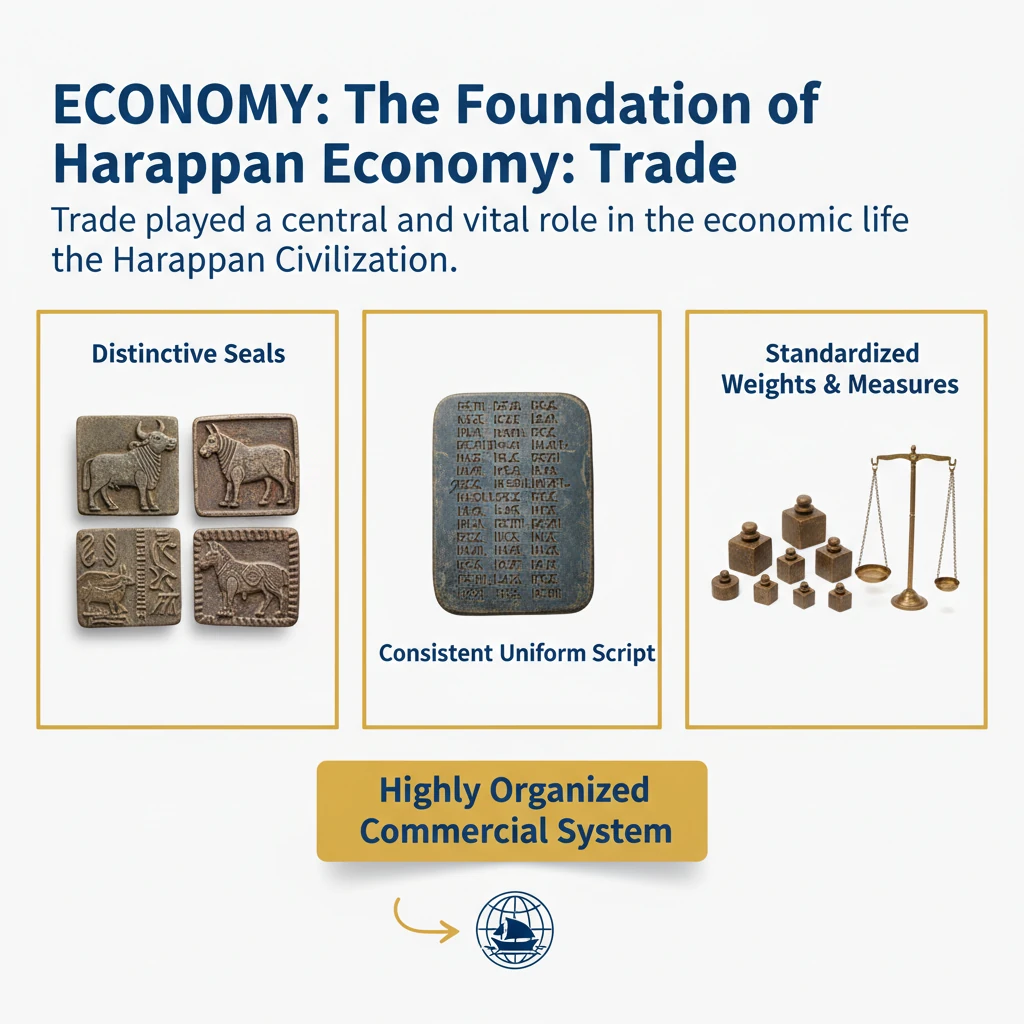
<h4>The Foundation of Harappan Economy: Trade</h4><p><strong>Trade</strong> played a central and vital role in the economic life of the <strong>Harappan Civilization</strong>. This is evident from various archaeological findings across different sites.</p><p>The widespread use of distinctive <strong>seals</strong>, a consistent <strong>uniform script</strong>, and precisely <strong>standardized weights and measures</strong> across the civilization all point to a highly organized commercial system.</p><div class='key-point-box'><p>The presence of these standardized elements suggests a sophisticated administrative and economic control over internal and external trade activities.</p></div><h4>Major Trade Commodities and Barter System</h4><p>The primary items exchanged in Harappan trade included essential raw materials such as <strong>stone</strong>, various <strong>metals</strong>, and valuable <strong>shell</strong>. These were crucial for crafting tools, ornaments, and other goods.</p><p>The <strong>barter system</strong> was the prevalent mode of exchange for goods and services. There is no archaeological evidence to suggest the existence of a formal <strong>metal currency</strong> during this period.</p><div class='info-box'><p><strong>Barter System:</strong> An economic system where goods or services are directly exchanged for other goods or services without the use of money.</p></div><h4>Navigational Practices and Trade Routes</h4><p>The Harappans were adept seafarers, actively practicing <strong>navigation</strong> along the extensive <strong>Arabian Sea coast</strong>. This maritime capability facilitated coastal trade and connections with distant regions.</p><p>Their long-distance trade routes extended significantly beyond the Indian subcontinent. A crucial <strong>trading colony</strong> was established in <strong>northern Afghanistan</strong>.</p><p>This Afghan outpost served as a vital hub, facilitating <strong>commerce with Central Asia</strong> and providing access to valuable resources from that region.</p><h4>International Trade: Connections with Mesopotamia</h4><p>The Harappan civilization maintained robust <strong>trade relations with Mesopotamia</strong>, an ancient civilization situated in the fertile <strong>Tigris-Euphrates region</strong> (modern-day Iraq).</p><p>Archaeological discoveries, such as Harappan seals found in Mesopotamian cities and Mesopotamian artifacts at Indus sites, conclusively confirm this extensive international interaction.</p><div class='info-box'><p><strong>Mesopotamia:</strong> An ancient region in the eastern Mediterranean, often referred to as the "cradle of civilization," home to early urban societies like Sumer, Akkad, Assyria, and Babylonia.</p></div><h4>Lapis Lazuli: A Symbol of Status</h4><p><strong>Long-distance trade</strong> in <strong>lapis lazuli</strong>, a beautiful <strong>blue semi-precious stone</strong>, held particular significance. This valuable commodity was likely imported from regions such as <strong>Badakhshan</strong> in Afghanistan.</p><p>The acquisition and display of <strong>lapis lazuli</strong> are believed to have played a significant role in <strong>enhancing the social status of the ruling class</strong>. It served as a powerful symbol of wealth and power.</p><div class='exam-tip-box'><p>When discussing the Harappan economy, remember to highlight not just the mechanics of trade but also its socio-political implications, such as the role of <strong>lapis lazuli</strong> in reinforcing social hierarchies and elite status.</p></div>
💡 Key Takeaways
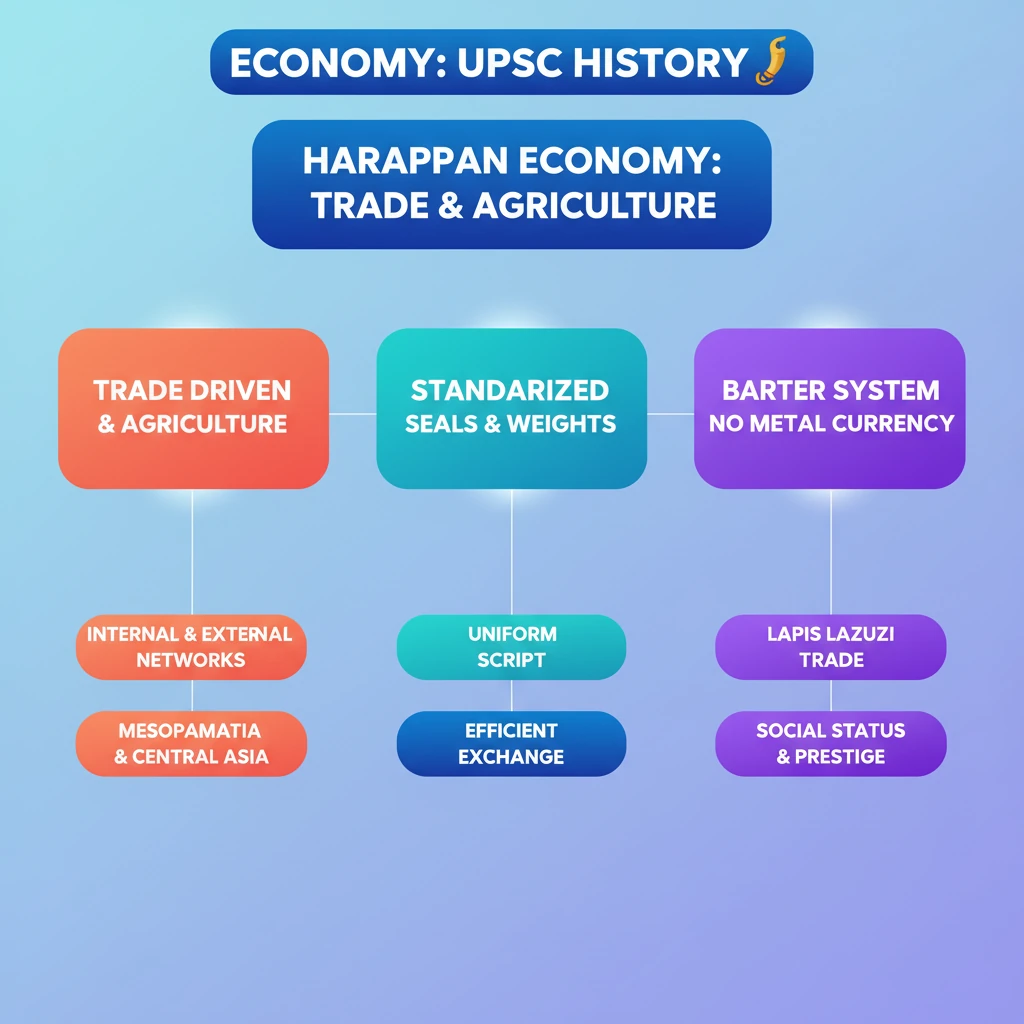
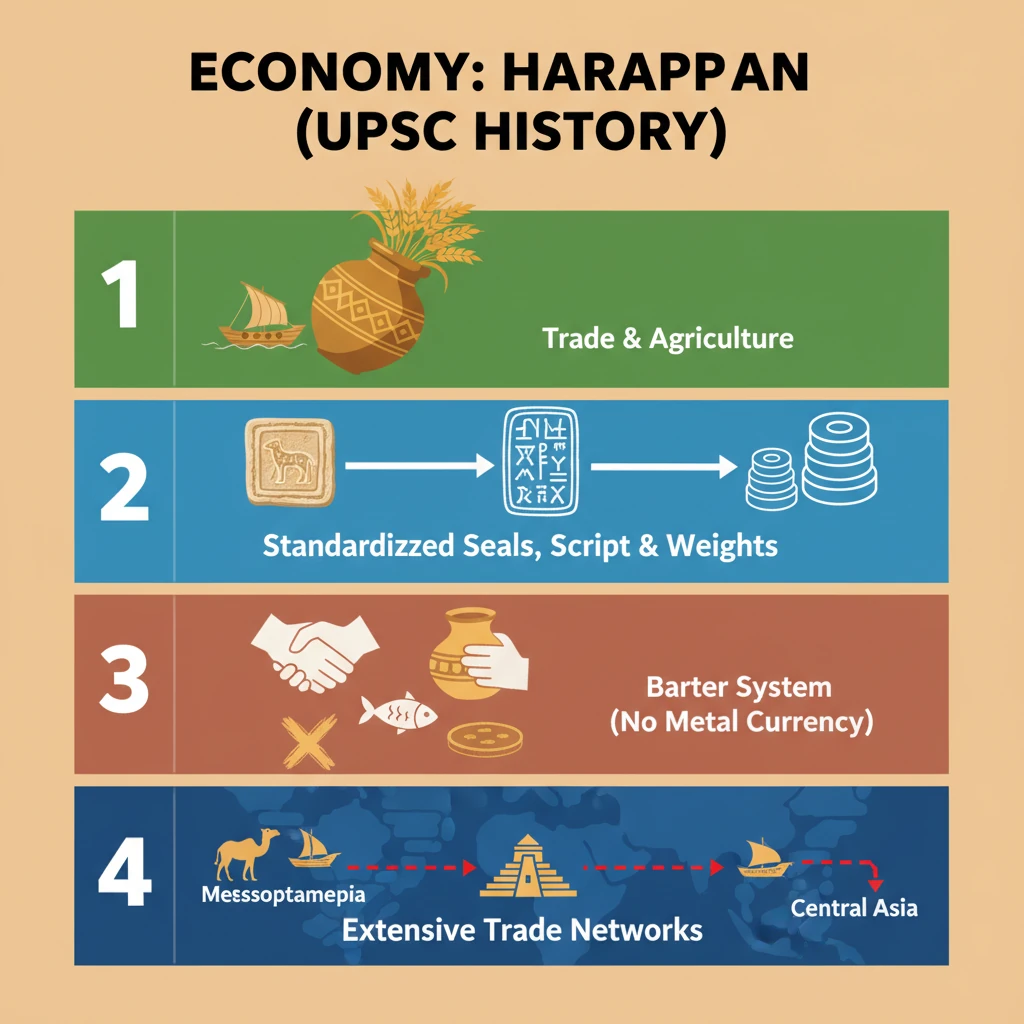
- •The Harappan economy was significantly driven by trade, complementing its agricultural base.
- •Standardized seals, a uniform script, and consistent weights/measures were crucial for efficient trade.
- •The barter system was the primary mode of exchange; no metal currency existed.
- •Extensive internal and external trade networks connected Harappan sites and reached Mesopotamia and Central Asia.
- •Lapis lazuli trade was vital, contributing to the social status and prestige of the ruling class.
- •Harappans demonstrated advanced navigational skills along the Arabian Sea coast.
🧠 Memory Techniques
98% Verified Content
📚 Reference Sources
•NCERT Class 11 History: An Introduction to Indian Art (Chapter 1 - Harappan Art)
•Upinder Singh, A History of Ancient and Early Medieval India: From the Stone Age to the 12th Century (Chapter 3 - The Harappan Civilization)
•Romila Thapar, Early India: From the Origins to AD 1300 (Chapter 2 - The Harappan Civilization)