100 Years of Vaikom Satyagraha - History | UPSC Learning
Topics
0 topics • 0 completed
🔍
No topics match your search
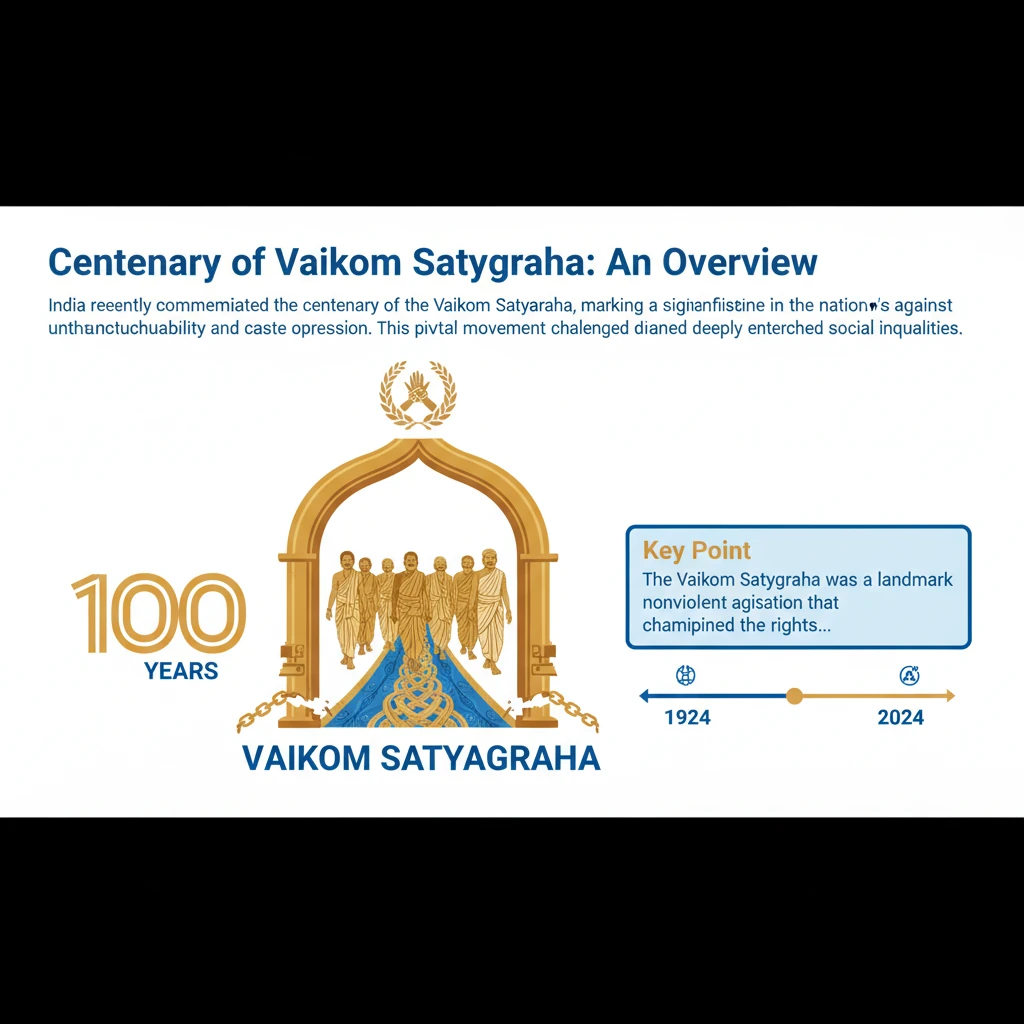
100 Years of Vaikom Satyagraha
Medium⏱️ 8 min read
history
📖 Introduction
<h4>Centenary of Vaikom Satyagraha: An Overview</h4><p>India recently commemorated the <strong>centenary</strong> of the <strong>Vaikom Satyagraha</strong>, marking a significant milestone in the nation's struggle against <strong>untouchability</strong> and <strong>caste oppression</strong>. This pivotal movement challenged deeply entrenched social inequalities.</p><div class='key-point-box'><p>The <strong>Vaikom Satyagraha</strong> was a landmark nonviolent agitation that championed the rights of oppressed communities to access public spaces, particularly roads around temples.</p></div><h4>Background and Duration of the Movement</h4><p>The <strong>Vaikom Satyagraha</strong> unfolded in <strong>Vaikom</strong>, a town within the erstwhile <strong>princely state of Travancore</strong>, located in present-day <strong>Kerala</strong>. It spanned precisely a century ago, from <strong>30th March 1924</strong> to <strong>23rd November 1925</strong>.</p><div class='info-box'><p><strong>Location:</strong> Vaikom, Travancore (modern-day Kerala)<strong>Dates:</strong> 30th March 1924 – 23rd November 1925</p></div><p>This movement represented a formidable protest against the widespread practices of <strong>untouchability</strong> and severe <strong>caste discrimination</strong> that had long afflicted Indian society.</p><h4>Core Issues and Triggers</h4><p>The primary catalyst for the movement was the strict prohibition of people from <strong>oppressed classes</strong>, notably the <strong>Ezhavas</strong>, from using the public roads surrounding the sacred <strong>Vaikom Mahadeva temple</strong>. These roads were considered 'sacred' and restricted to 'upper castes'.</p><p>Initial attempts were made to negotiate with the authorities, including the <strong>Maharani Regent of Travancore</strong>, to secure the opening of these temple roads for all sections of society.</p><h4>Key Significance and Impact</h4><p>The <strong>Vaikom Satyagraha</strong> holds the distinction of being the <strong>first among the temple entry movements</strong> in India. Its success and methodology subsequently inspired and paved the way for similar social reform movements across various parts of the country.</p><div class='exam-tip-box'><p>The <strong>Vaikom Satyagraha</strong> is crucial for UPSC as it exemplifies early non-violent social reform and the intersection of social and political awakening. It's a key topic for <strong>GS Paper I: History</strong> and <strong>Social Issues</strong>.</p></div><h4>Interplay with Nationalist Movement</h4><p>The movement emerged at a time of a burgeoning <strong>nationalist movement</strong> in India. It effectively aimed to foreground the importance of <strong>social reform</strong> alongside the broader political aspirations for independence.</p><p>This dual focus highlighted that true national liberation required not just political freedom but also the eradication of deep-seated social injustices like untouchability.</p>
💡 Key Takeaways
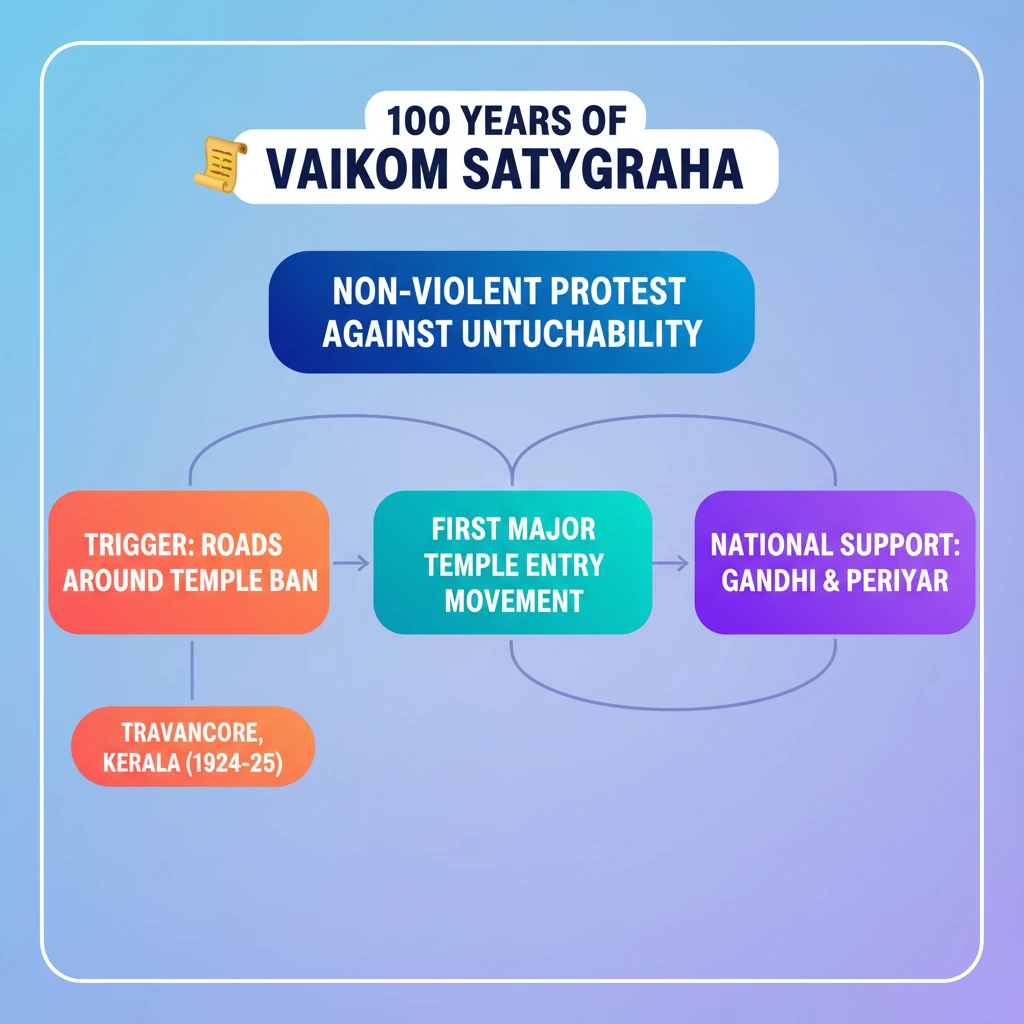
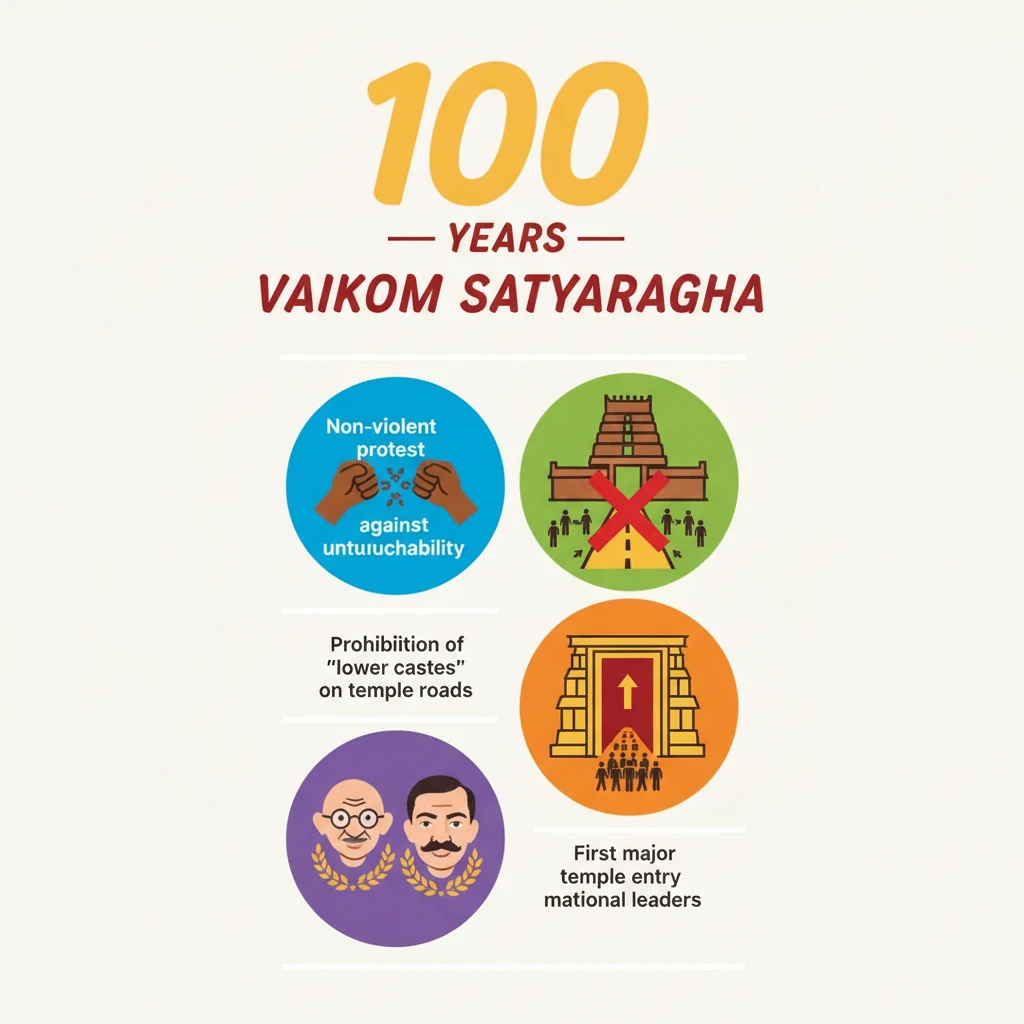
- •Vaikom Satyagraha (1924-1925) was a non-violent protest against untouchability in Travancore, Kerala.
- •It was triggered by the prohibition of 'lower castes' from using roads around Vaikom Mahadeva temple.
- •It holds the distinction of being the first major temple entry movement in India.
- •The movement received support from national leaders like Mahatma Gandhi and Periyar E.V. Ramasamy.
- •It significantly influenced subsequent social reform and temple entry movements across India.
- •Its centenary highlights the ongoing relevance of fighting caste discrimination and upholding social justice.
🧠 Memory Techniques
98% Verified Content
📚 Reference Sources
•NCERT History Textbooks (relevant chapters on Social Reform Movements)
•Standard reference books on Modern Indian History (e.g., Bipan Chandra, Spectrum)