What are Key Facts about Rash Behari Bose? - History | UPSC Learning
Topics
0 topics • 0 completed
🔍
No topics match your search

What are Key Facts about Rash Behari Bose?
Medium⏱️ 7 min read
history
📖 Introduction
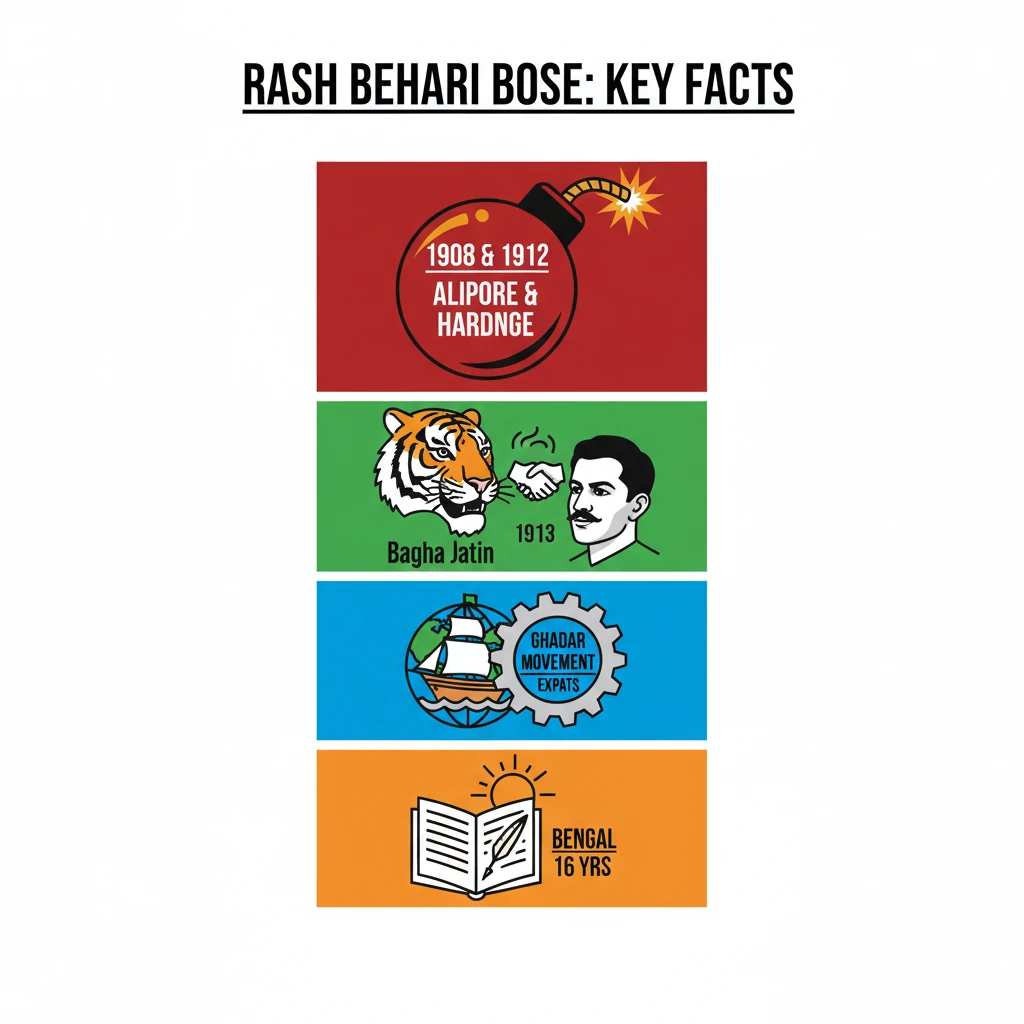
<h4>Early Life and Revolutionary Inspiration</h4><p><strong>Rash Behari Bose</strong> was born in <strong>Bengal</strong>, a region that was a hotbed of nationalist sentiment. From a very young age, he was deeply inspired by <strong>revolutionary ideals</strong>. This early exposure shaped his commitment to India's freedom.</p><p>He formally joined the <strong>independence movement</strong> when he was just <strong>16 years old</strong>, dedicating his life to the cause of overthrowing British rule.</p><h4>Prominent Revolutionary Activities</h4><p>Bose quickly rose to prominence due to his active involvement in significant revolutionary events. One of his early notable involvements was in the <strong>Alipore Bomb Case of 1908</strong>, which highlighted the growing militancy among Indian nationalists.</p><p>A more direct and audacious act was his participation in the <strong>bomb plot to assassinate Viceroy Charles Hardinge in 1912</strong>. This daring attempt underscored the revolutionaries' resolve to target high-ranking British officials.</p><div class='info-box'><p><strong>Key Event:</strong> The <strong>Delhi Bomb Plot (1912)</strong> targeted <strong>Viceroy Charles Hardinge</strong> during his state entry into Delhi. Though Hardinge was injured, he survived the attack, making it a significant but ultimately unsuccessful assassination attempt.</p></div><h4>Key Associations and Mentorship</h4><p>In <strong>1913</strong>, <strong>Rash Behari Bose</strong> met <strong>Jatin Mukherjee</strong>, famously known as <strong>Bagha Jatin</strong>. This meeting proved to be a pivotal moment in Bose's revolutionary journey.</p><p>Under <strong>Bagha Jatin's mentorship</strong>, Bose's determination to fight for India’s freedom intensified. He gained valuable insights and strategic guidance from the seasoned revolutionary.</p><h4>Involvement in the Ghadar Movement</h4><p><strong>Rash Behari Bose</strong> became a central figure in the <strong>Ghadar Movement</strong>. This was a crucial <strong>international political movement</strong> initiated by <strong>Indian expatriates</strong>, primarily in North America.</p><p>The primary objective of the <strong>Ghadar Movement</strong> was to organize and mobilize Indians abroad to orchestrate a widespread rebellion to overthrow <strong>British rule</strong> in India.</p><div class='key-point-box'><p>The <strong>Ghadar Movement</strong> was significant for its efforts to unite the Indian diaspora and its focus on armed insurrection, making it a formidable challenge to British authority.</p></div><h4>Meeting Subhas Chandra Bose in Japan</h4><p>Later in his life, <strong>Rash Behari Bose</strong> moved to <strong>Japan</strong>, where he continued his efforts for India's independence from abroad. In <strong>1924</strong>, he had a significant meeting with another prominent nationalist leader, <strong>Subhas Chandra Bose</strong>.</p><p>This crucial meeting between the two leaders was facilitated by <strong>Veer Savarkar</strong>, highlighting the network of Indian revolutionaries operating globally.</p>

💡 Key Takeaways
- •Rash Behari Bose, born in Bengal, joined the independence movement at 16, inspired by revolutionary ideals.
- •He gained prominence for his involvement in the Alipore Bomb Case (1908) and masterminded the 1912 bomb plot against Viceroy Charles Hardinge.
- •Mentored by Jatin Mukherjee (Bagha Jatin) in 1913, his resolve for India's freedom deepened.
- •He was a key figure in the Ghadar Movement, an international effort by Indian expatriates to overthrow British rule.
- •In Japan in 1924, he met Subhas Chandra Bose, a meeting facilitated by Veer Savarkar, linking two major revolutionary figures.
🧠 Memory Techniques
98% Verified Content
📚 Reference Sources
•NCERT Textbooks (Class 12: Themes in Indian History Part III)
•Bipan Chandra, India's Struggle for Independence
•Spectrum, A Brief History of Modern India