What are Key Facts about the Chola Administration? - History | UPSC Learning
Topics
0 topics • 0 completed
🔍
No topics match your search
What are Key Facts about the Chola Administration?
Medium⏱️ 8 min read
history
📖 Introduction
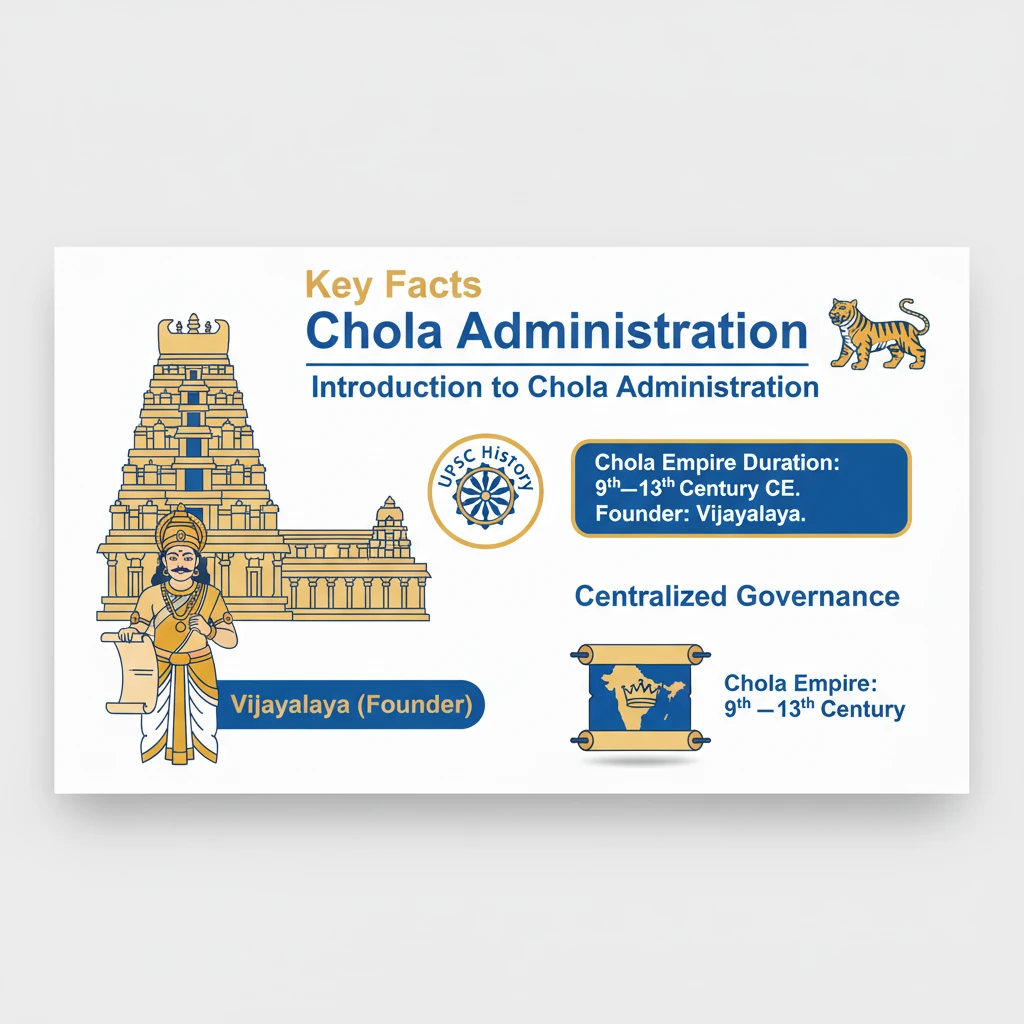
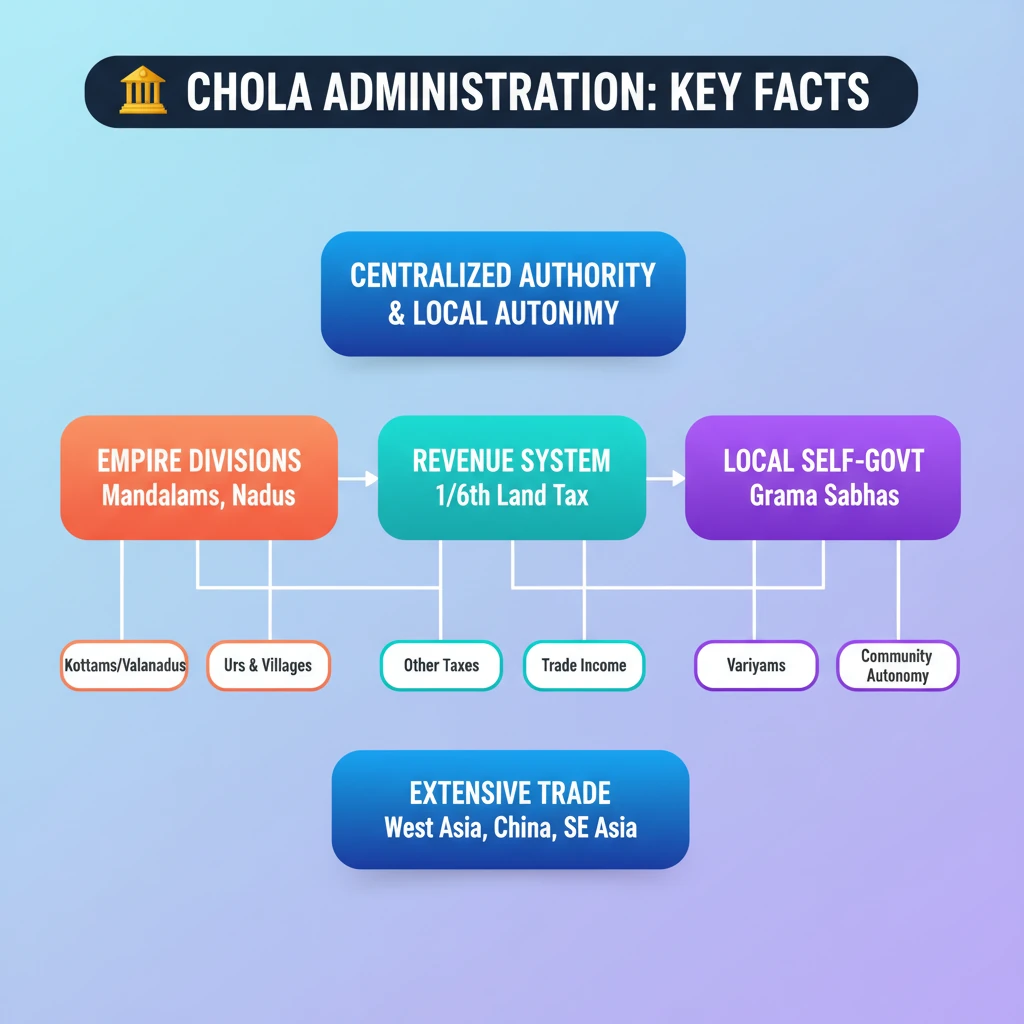
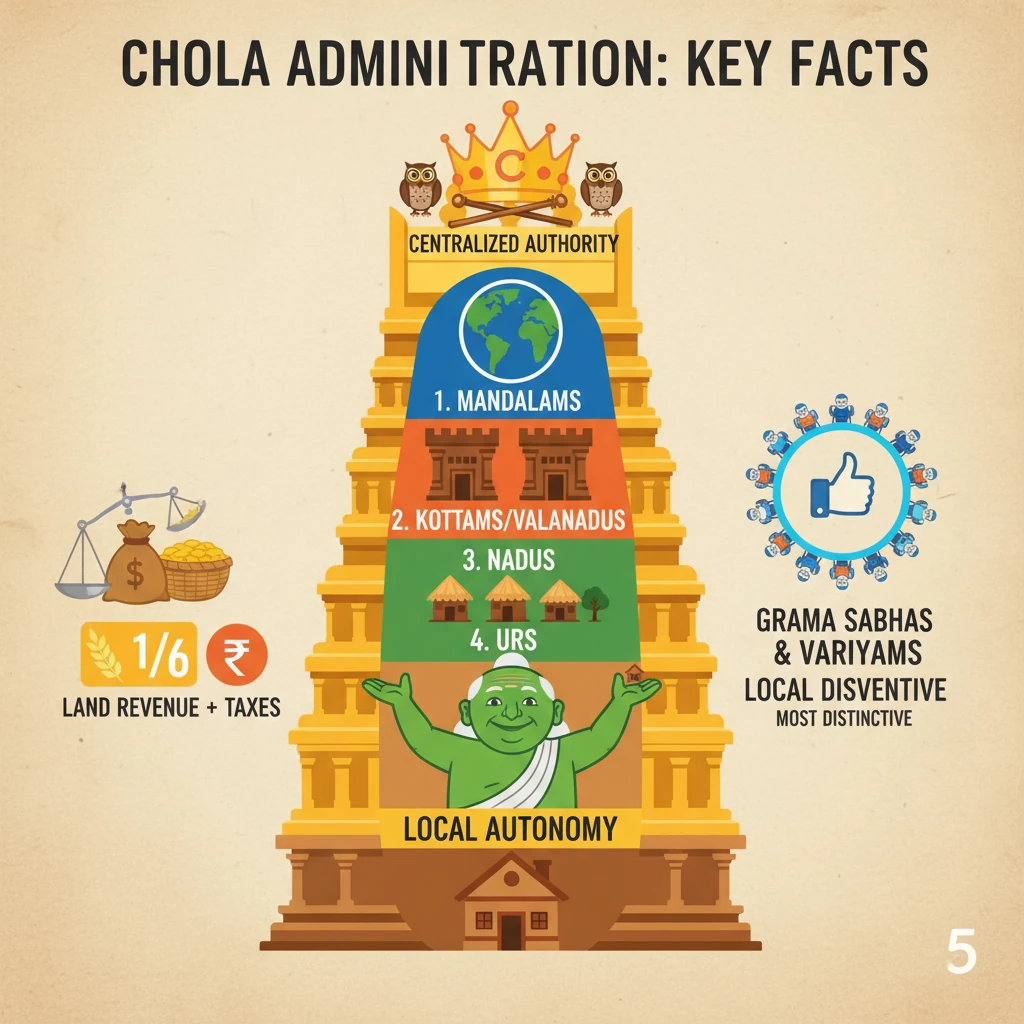
<h4>Introduction to Chola Administration</h4><p>The <strong>Chola Empire</strong>, founded by <strong>Vijayalaya</strong>, rose to prominence by defeating the <strong>Pallavas</strong>. Their reign spanned over five centuries, from the <strong>9th to the 13th Century</strong>, establishing a powerful and enduring administrative system.</p><div class='info-box'><strong>Chola Empire Duration:</strong> 9th–13th Century CE. <strong>Founder:</strong> Vijayalaya.</div><h4>Centralized Governance</h4><p>At the apex of the <strong>Chola administrative structure</strong> was the <strong>King</strong>, whose extensive powers were carefully balanced by a <strong>council of ministers</strong>. The <strong>Central Government</strong> comprised a structured council with two main categories of officials.</p><div class='info-box'><strong>Higher Officials:</strong> Known as <strong>Peruntaram</strong>. <strong>Lower Officials:</strong> Known as <strong>Siruntaram</strong>.</div><h4>Provincial Administration</h4><p>The vast <strong>Chola Empire</strong> was systematically divided into <strong>nine provinces</strong>, each known as a <strong>Mandalam</strong>. These <strong>Mandalams</strong> were further subdivided into smaller units called <strong>Kottams</strong> or <strong>Valanadus</strong>.</p><div class='info-box'>Further Subdivisions: <strong>Nadus</strong> (districts) and then <strong>Urs</strong> (villages). This hierarchical structure ensured efficient governance.</div><h4>Revenue System</h4><p>The primary source of income for the <strong>Chola administration</strong> was <strong>land revenue</strong>. A general rate of <strong>1/6th of the land yield</strong> was collected as tax. This could be paid in <strong>cash, kind, or a combination of both</strong>.</p><div class='info-box'>Other Taxes: <strong>Customs, tolls, mines, ports, forests, salt pans, professional taxes, and house taxes</strong> were also levied.</div><h4>Local Administration: A Distinctive Feature</h4><p>The most remarkable aspect of <strong>Chola administration</strong> was its highly developed <strong>local governance system</strong>. This system granted substantial autonomy to local units, particularly the <strong>Nadus</strong> and <strong>Villages</strong>.</p><div class='key-point-box'>The <strong>Nadu</strong> was a crucial administrative unit, possessing its own assembly and headed by the <strong>Nattar</strong>. The council of <strong>Nattars</strong> was known as the <strong>Nattavai</strong>.</div><p>At the village level, the <strong>Grama Sabha</strong> played a vital role, responsible for maintaining public infrastructure and regulating markets. Village assemblies were supported by various <strong>Variyams</strong> (committees), each tasked with specific administrative duties.</p><h4>Trade under the Chola Dynasty</h4><p><strong>Local Trade:</strong> The <strong>Chola Empire</strong> experienced significant growth in internal trade, facilitated by robust <strong>mercantile corporations</strong> and organized <strong>guilds</strong>. These powerful and autonomous merchant guilds were often referred to as <strong>“nanadesis”</strong>.</p><div class='info-box'>In major trade centers like <strong>Kanchipuram</strong> and <strong>Mamallapuram</strong>, local merchant organizations called <strong>“nagaram”</strong> coordinated trade and market activities.</div><p><strong>Maritime Trade:</strong> The <strong>Chola dynasty</strong> established extensive trade relations with regions including <strong>West Asia, China, and Southeast Asia</strong>. They actively engaged in the lucrative trade of valuable commodities such as <strong>spices, precious stones, and textiles</strong>, which were highly sought after across Asia.</p><h4>The Brihadisvara Temple: A Chola Architectural Marvel</h4><p>The iconic <strong>Brihadisvara Temple</strong> was constructed by <strong>Rajaraja I</strong>. It was inaugurated in his <strong>19th regnal year (1003-1004 CE)</strong> and consecrated in his <strong>25th year (1009-1010 CE)</strong>.</p><div class='key-point-box'>The temple stands as a prime example of the pure form of <strong>Dravidian temple design</strong>.</div><h4>Architectural Features of Brihadisvara Temple</h4><p><strong>Design:</strong> The temple features a massive <strong>colonnaded prakara</strong> (enclosure) adorned with sub-shrines dedicated to the <strong>eight guardian deities (ashtadikpalas)</strong>. <strong>Gopuram:</strong> Its grand gateway is known as <strong>Rajarajan tiruvasal</strong>, serving as an impressive entrance to the complex. <strong>Circumambulatory Path:</strong> A dedicated pathway encircles the sanctum, allowing devotees to perform <strong>pradakshina</strong> (circumambulation) around the sacred <strong>shivlinga</strong>.</p><h4>Artistic Elements of Brihadisvara Temple</h4><p><strong>Mural Paintings:</strong> The temple walls are richly decorated with expansive and exquisite <strong>mural paintings</strong>. These murals include <strong>81 of the 108 Karanas</strong> (dance poses) from <strong>Bharatanatyam</strong>.</p><div class='info-box'>A notable mural depicts <strong>Raja Raja I</strong> and his guru <strong>Karuvurarur</strong>, found within the temple in <strong>Tamil Nadu</strong>.</div><p><strong>Inscriptions:</strong> The temple contains numerous <strong>inscriptions</strong> detailing <strong>Rajaraja Chola I's military achievements, temple grants, and administrative orders</strong>.</p>
💡 Key Takeaways
- •Chola administration was a blend of centralized authority (King & Council) and strong local autonomy.
- •The empire was divided into Mandalams, Kottams/Valanadus, Nadus, and Urs.
- •Land revenue (1/6th yield) was the main income, supplemented by various other taxes.
- •Local self-governance, through Grama Sabhas and Variyams, was the most distinctive feature.
- •Cholas fostered extensive local (nanadesis, nagaram) and maritime trade (West Asia, China, SE Asia).
- •The Brihadisvara Temple, built by Rajaraja I, exemplifies pure Dravidian architecture and Chola artistic achievements.
🧠 Memory Techniques
95% Verified Content
📚 Reference Sources
•NCERT History Textbooks (Class XI/XII)
•Standard reference books on Ancient and Medieval Indian History