What is Jainism? - History | UPSC Learning
Topics
0 topics • 0 completed
🔍
No topics match your search
What is Jainism?
Medium⏱️ 6 min read
history
📖 Introduction
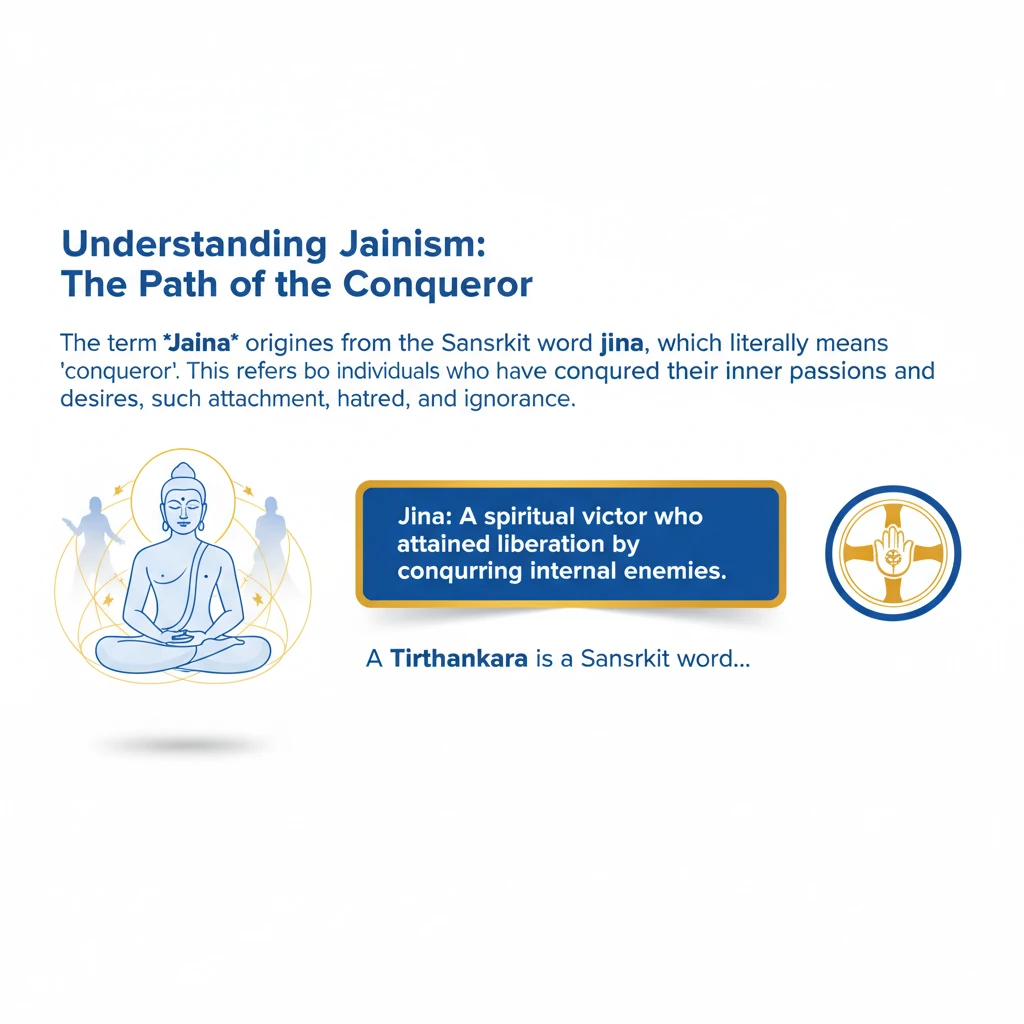
<h4>Understanding Jainism: The Path of the Conqueror</h4><p>The term <strong>Jaina</strong> originates from the Sanskrit word <strong>jina</strong>, which literally means 'conqueror'. This refers to individuals who have conquered their inner passions and desires, such as attachment, hatred, and ignorance.</p><div class='info-box'><p><strong>Jina:</strong> A spiritual victor who has attained liberation by conquering internal enemies.</p></div><p>A <strong>Tirthankara</strong> is a Sanskrit word meaning 'ford maker'. In Jain philosophy, a Tirthankara is an enlightened being who has successfully crossed the river of earthly life, guiding others across the perpetual flow of birth and rebirth.</p><div class='key-point-box'><p><strong>Tirthankara:</strong> A spiritual teacher and saviour who shows the path to liberation (moksha).</p></div><h4>Core Principle: Ahimsa (Non-violence)</h4><p><strong>Jainism</strong> places paramount importance on <strong>Ahimsa</strong>, or non-violence. This principle extends not only to humans but to all living beings, reflecting a deep respect for life in its myriad forms.</p><div class='info-box'><p><strong>Ahimsa:</strong> The fundamental ethical principle of non-harm to any living being.</p></div><h4>The Five Mahavratas (Great Vows)</h4><p>Jainism prescribes five great vows, known as <strong>Mahavratas</strong>, for its ascetics. These vows are central to the ethical conduct required for spiritual progress.</p><ul><li><strong>Ahimsa</strong> (Non-violence): Not to cause harm to any living being.</li><li><strong>Satya</strong> (Truth): To speak the truth and be honest in all dealings.</li><li><strong>Asteya</strong> or <strong>Acharya</strong> (Non-stealing): Not to take anything that is not freely given.</li><li><strong>Aparigraha</strong> (Non-attachment/Non-possession): To limit possessions and detach from worldly desires.</li><li><strong>Brahmacharya</strong> (Celibacy/Chastity): To practice sexual restraint.</li></ul><div class='key-point-box'><p><strong>UPSC Insight:</strong> It is crucial to remember that the vow of <strong>Brahmacharya</strong> was specifically added by <strong>Mahavira</strong>, the 24th Tirthankara, to the existing four vows.</p></div><h4>The Three Jewels (Triratna) of Jainism</h4><p>The path to liberation in Jainism is encapsulated in its three jewels, or <strong>Triratna</strong>. These represent the right attitude, knowledge, and conduct necessary for spiritual emancipation.</p><ul><li><strong>Samyak Darshana</strong> (Right Faith): Believing in the truths of Jainism and its Tirthankaras.</li><li><strong>Samyak Gyana</strong> (Right Knowledge): Having accurate and complete knowledge of Jain philosophy.</li><li><strong>Samyak Charitra</strong> (Right Conduct): Following the ethical principles and vows of Jainism.</li></ul><h4>Sectarian Division: Shvetambaras and Digambaras</h4><p>Over time, Jainism experienced a significant schism, leading to the formation of two major sects. This division arose primarily due to differing interpretations of monastic practices and rules.</p><div class='info-box'><p><strong>Shvetambaras:</strong> Led by <strong>Sthalabhadra</strong>, they wear white clothes. They believe women can achieve liberation.</p><p><strong>Digambaras:</strong> Led by <strong>Bhadrabahu</strong>, they are 'sky-clad' (naked). They believe women cannot achieve liberation without being reborn as men.</p></div><div class='exam-tip-box'><p><strong>UPSC Focus:</strong> Understanding the key differences between <strong>Shvetambaras</strong> and <strong>Digambaras</strong>, especially regarding clothing and the status of women, is a frequently tested concept in <strong>GS Paper I</strong>.</p></div><h4>Core Philosophical Tenets</h4><p>A fundamental idea in Jainism is that the entire world is animated. This means that even seemingly inanimate objects like <strong>stones, rocks, and water</strong> are believed to possess life and consciousness.</p><p>Central to Jain philosophy is the principle of <strong>non-injury</strong> to living beings. This extends to humans, animals, plants, and even insects, dictating a lifestyle of minimal harm.</p><p>According to Jain teachings, the soul's journey through the <strong>cycle of birth and rebirth</strong> (samsara) is determined by <strong>karma</strong>. Actions, both good and bad, accumulate karma, which clings to the soul.</p><p>To achieve the liberation of the soul (moksha) and free oneself from the cycle of karma, <strong>asceticism</strong> and intense <strong>penance</strong> are deemed essential. These practices help shed accumulated karmic particles.</p><h4>Santhara/Sallekhana: Fasting Unto Death</h4><p>The practice of <strong>Santhara</strong> (or <strong>Sallekhana</strong>) is a significant aspect of Jainism. It is a ritual of fasting unto death, undertaken voluntarily by individuals who feel they have completed their life's purpose or are nearing the end of their natural life.</p><div class='info-box'><p><strong>Santhara:</strong> Term used by <strong>Shvetambara Jains</strong> for the ritual fast unto death.</p><p><strong>Sallekhana:</strong> Term used by <strong>Digambara Jains</strong> for the same ritual fast unto death.</p></div><div class='exam-tip-box'><p><strong>Legal Context:</strong> The practice of Santhara became a subject of legal debate in the <strong>Nikhil Soni vs Union Of India Case</strong>. The <strong>Rajasthan High Court</strong> declared it an offense punishable under the <strong>Indian Penal Code (IPC)</strong>. However, the matter is currently <strong>sub-judice</strong> in the <strong>Supreme Court</strong>, highlighting a conflict between religious freedom and the right to life.</p></div>
💡 Key Takeaways
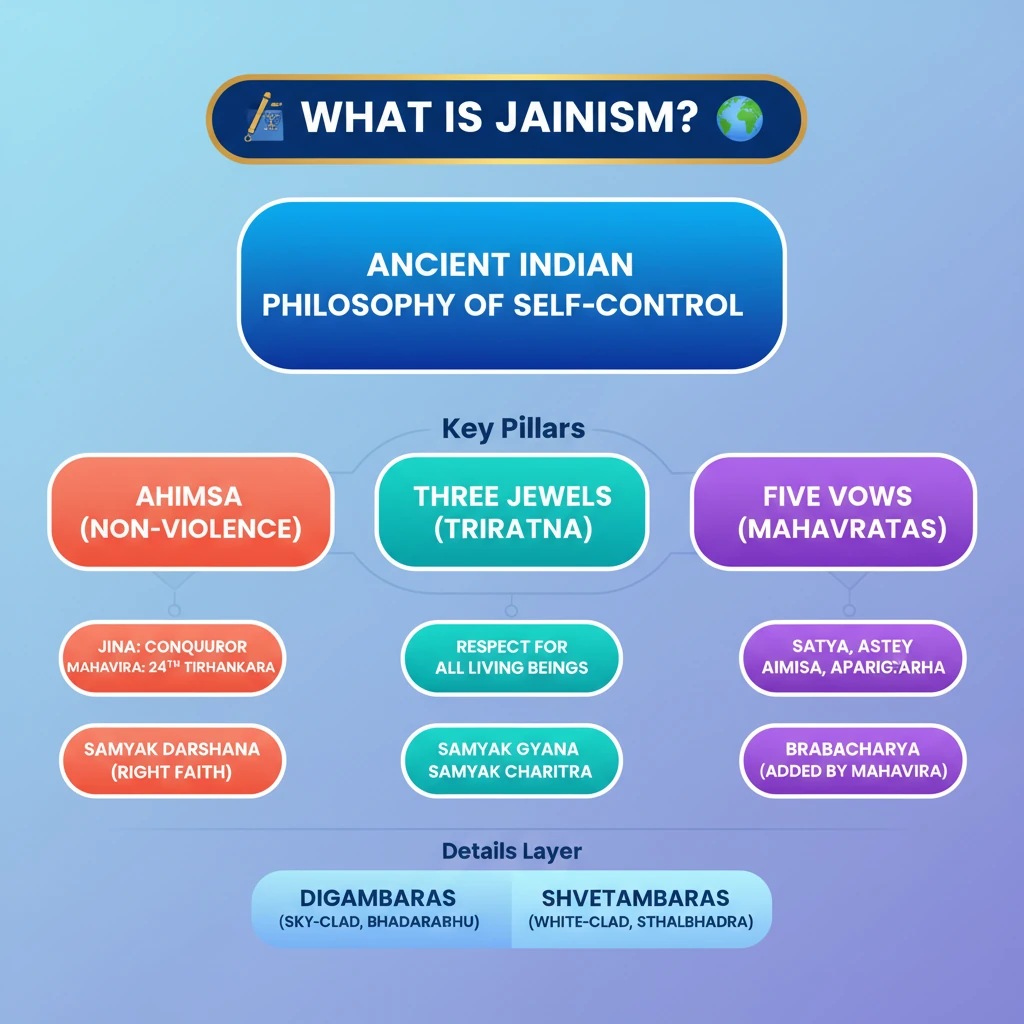
- •Jainism is based on 'Jina' (conqueror) and propagated by 'Tirthankaras' (ford-makers), with Mahavira being the 24th.
- •Central tenet is Ahimsa (non-violence) to all living beings.
- •Five Mahavratas (vows): Ahimsa, Satya, Asteya, Aparigraha, and Brahmacharya (added by Mahavira).
- •Three Jewels (Triratna): Samyak Darshana, Samyak Gyana, Samyak Charitra.
- •Divided into Shvetambaras (white-clad, Sthalabhadra) and Digambaras (sky-clad, Bhadrabahu).
- •Belief in animated world, karma, and liberation through asceticism and penance.
- •Santhara/Sallekhana is a ritual fast unto death, currently sub-judice in the Supreme Court.
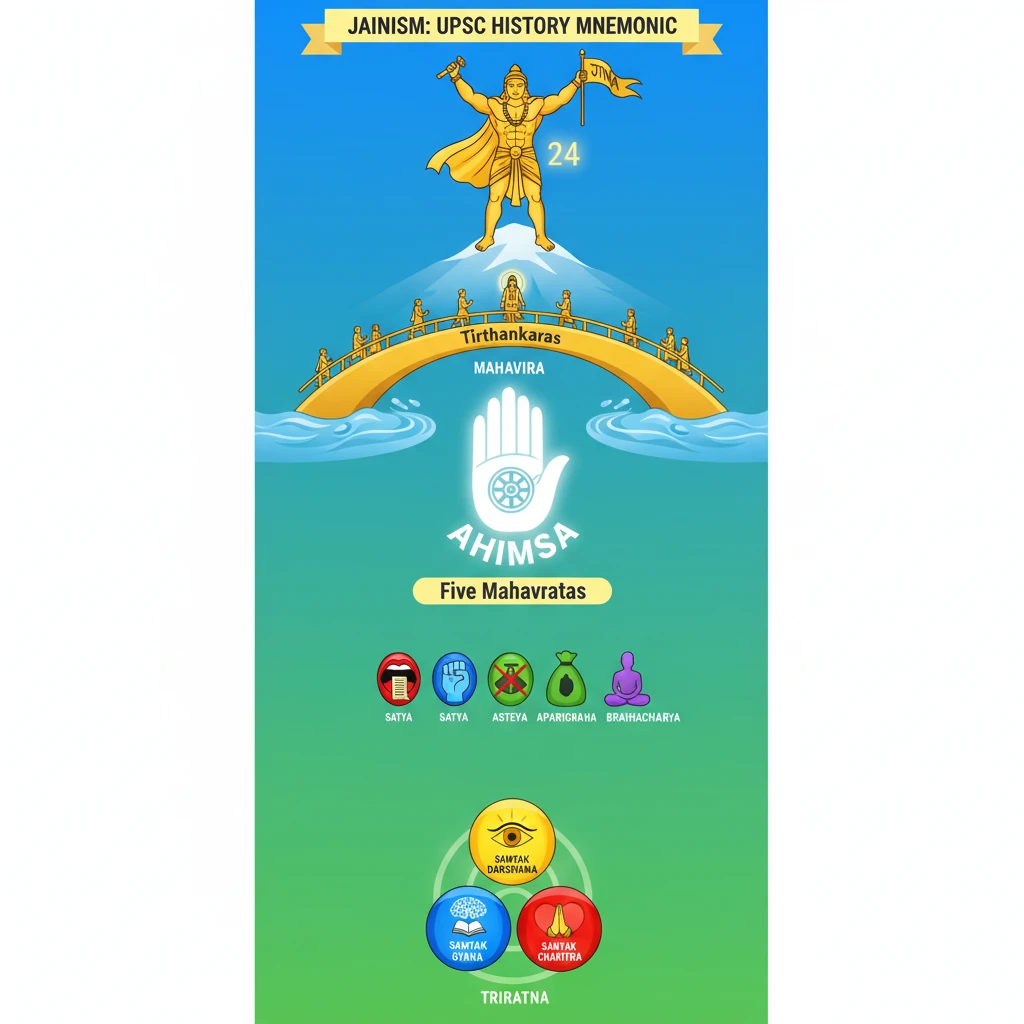
🧠 Memory Techniques
98% Verified Content