What are the Key Highlights of the Accession of Hyderabad to India? - History | UPSC Learning
Topics
0 topics • 0 completed
🔍
No topics match your search
What are the Key Highlights of the Accession of Hyderabad to India?
Medium⏱️ 7 min read
history
📖 Introduction
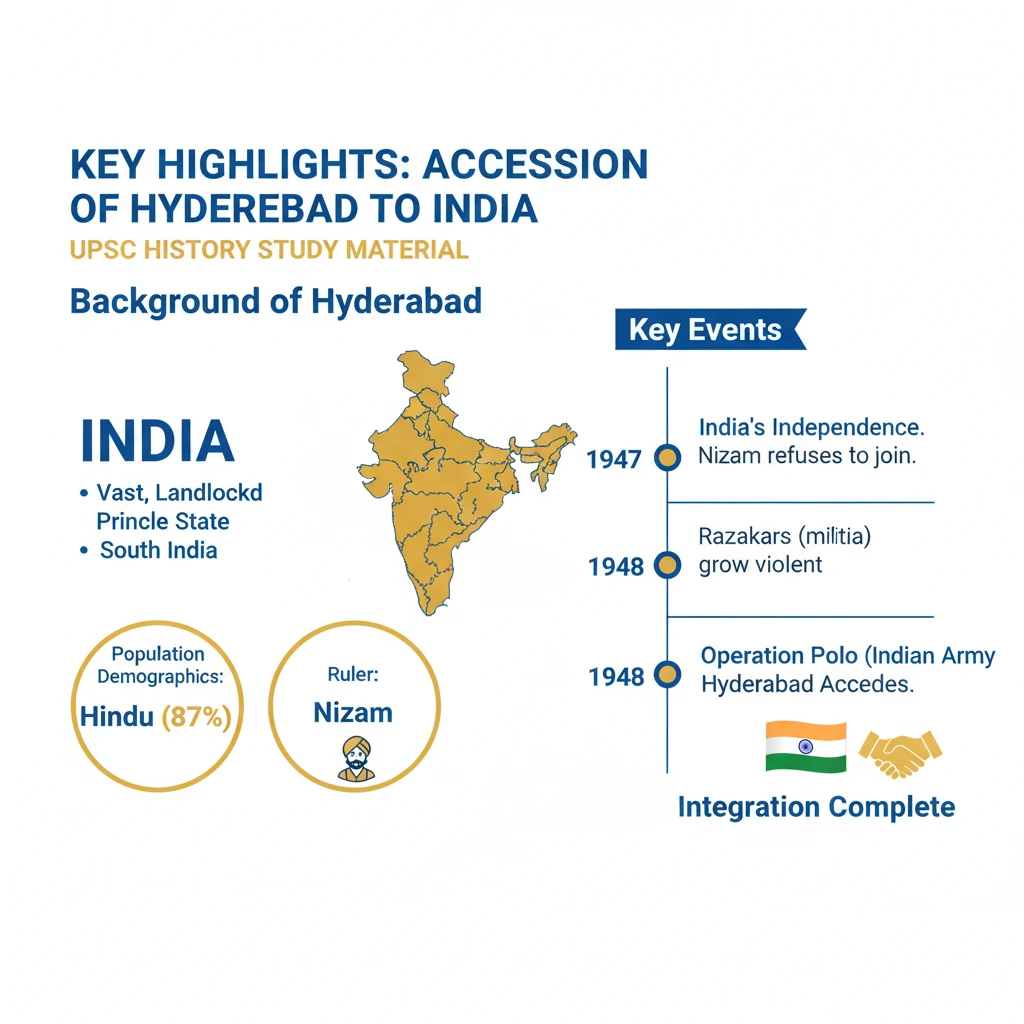
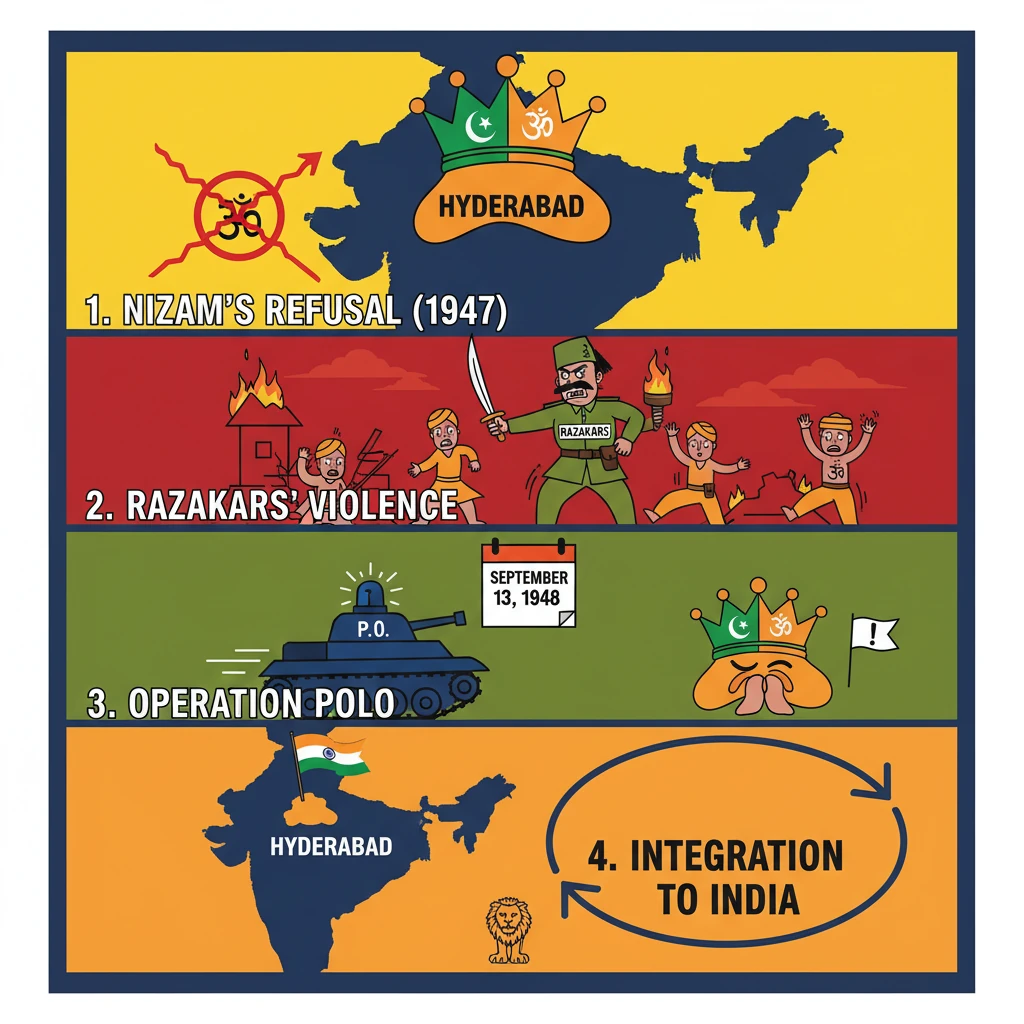
<h4>Background of Hyderabad</h4><p><strong>Hyderabad</strong> was a vast, landlocked <strong>princely state</strong> located in South India. Its territory encompassed parts of present-day <strong>Telangana</strong>, <strong>Andhra Pradesh</strong>, <strong>Karnataka</strong>, and the <strong>Marathwada region of Maharashtra</strong>.</p><div class='info-box'><p><strong>Population Demographics:</strong> The state's population was predominantly <strong>Hindu (87%)</strong>.</p><p><strong>Ruler:</strong> The ruler was <strong>Nizam Osman Ali Khan</strong>, a Muslim, who was supported by a Muslim elite.</p></div><p>The <strong>Nizam</strong> and the <strong>Ittehad-ul-Muslimeen</strong>, a pro-Nizam Muslim political party, advocated for <strong>Hyderabad's independence</strong>. They aimed for Hyderabad to hold a status equal to that of <strong>India</strong> and <strong>Pakistan</strong>.</p><h4>Nizam's Declaration of Independence</h4><p>In <strong>June 1947</strong>, <strong>Nizam Osman Ali Khan</strong> issued a <strong>firman</strong>, a royal decree, formally declaring <strong>Hyderabad's intention to remain independent</strong>. This declaration came after the British transfer of power in India.</p><div class='key-point-box'><p><strong>India's Stance:</strong> India vehemently rejected Hyderabad's claim to independence. Its primary argument was the state's critical <strong>strategic location</strong>, which was deemed vital for India's national security.</p></div><p>To gain time and avoid immediate confrontation, a temporary <strong>Standstill Agreement</strong> was signed. This agreement aimed to maintain the existing status quo between India and Hyderabad. However, despite this, Hyderabad still did not accede to India.</p><h4>Hyderabad's Moves Towards Independence</h4><p>The <strong>Nizam</strong> took several actions that heightened India's suspicions regarding his intentions. He reportedly provided <strong>Rs. 200 million to Pakistan</strong> and stationed a <strong>bomber squadron</strong> there.</p><div class='info-box'><p><strong>Actions by Hyderabad:</strong></p><ul><li>Banned <strong>Indian currency</strong> within the state.</li><li>Imported <strong>arms from Pakistan</strong>.</li><li>Significantly expanded its <strong>military forces</strong>, particularly the notorious <strong>Razakars militia</strong>.</li><li>Hired <strong>Australian aviator Sidney Cotton</strong> to smuggle weapons into Hyderabad.</li></ul></div><h4>Role of the Razakars</h4><p>The <strong>Razakars</strong> were a paramilitary militia closely aligned with the <strong>Ittehad-ul-Muslimeen</strong>, also known as the <strong>All India Council for Unity of Muslims</strong>. They were led by <strong>Qasim Razvi</strong>.</p><div class='key-point-box'><p><strong>Razakars' Objective:</strong> Their primary goal was to protect the <strong>Muslim ruling class</strong> and suppress any uprisings or opposition within Hyderabad.</p></div><p>The <strong>Razakars</strong> were infamous for their <strong>violent suppression of opposition</strong>. They committed numerous atrocities, particularly against the <strong>Hindu population</strong>, which further escalated tensions. They also targeted <strong>Hyderabadi Muslims</strong> who favored integration with India.</p><h4>Political Agitation within Hyderabad</h4><p>Internally, <strong>Hyderabad</strong> faced significant unrest. A widespread <strong>Communist uprising</strong> erupted in the <strong>Telangana region</strong>, which the <strong>Nizam's forces</strong> struggled to quell. This internal revolt severely weakened his position.</p><p>Simultaneously, the <strong>Hyderabad State Congress</strong>, an organization affiliated with the <strong>Indian National Congress</strong>, launched a strong <strong>political agitation</strong>. Their objective was the immediate <strong>integration of Hyderabad with India</strong>.</p><h4>International Appeals by the Nizam</h4><p>The <strong>Nizam</strong> initially sought diplomatic support from the <strong>British government</strong>. When these efforts proved unsuccessful, he attempted to involve international powers, including <strong>US President Harry Truman</strong> and the <strong>United Nations</strong>.</p><div class='exam-tip-box'><p><strong>Diplomatic Failure:</strong> After <strong>Lord Mountbatten's</strong> efforts for a negotiated settlement failed, the <strong>Nizam</strong>, fearing an imminent Indian invasion, appealed to the <strong>UN Security Council</strong> and the <strong>International Court of Justice</strong> in <strong>August 1948</strong>. These international appeals ultimately did not prevent India's action.</p></div><h4>Operation Polo (Hyderabad Police Action)</h4><p><strong>Sardar Patel</strong>, India's Deputy Prime Minister, grew increasingly anxious as negotiations with the <strong>Nizam</strong> dragged on without resolution.</p><p>On <strong>13th September 1948</strong>, the <strong>Indian Army</strong> launched a military operation code-named <strong>“Operation Polo”</strong>. India justified this action by citing grave concerns over internal law and order within Hyderabad, particularly the escalating violence of the Razakars.</p>
💡 Key Takeaways
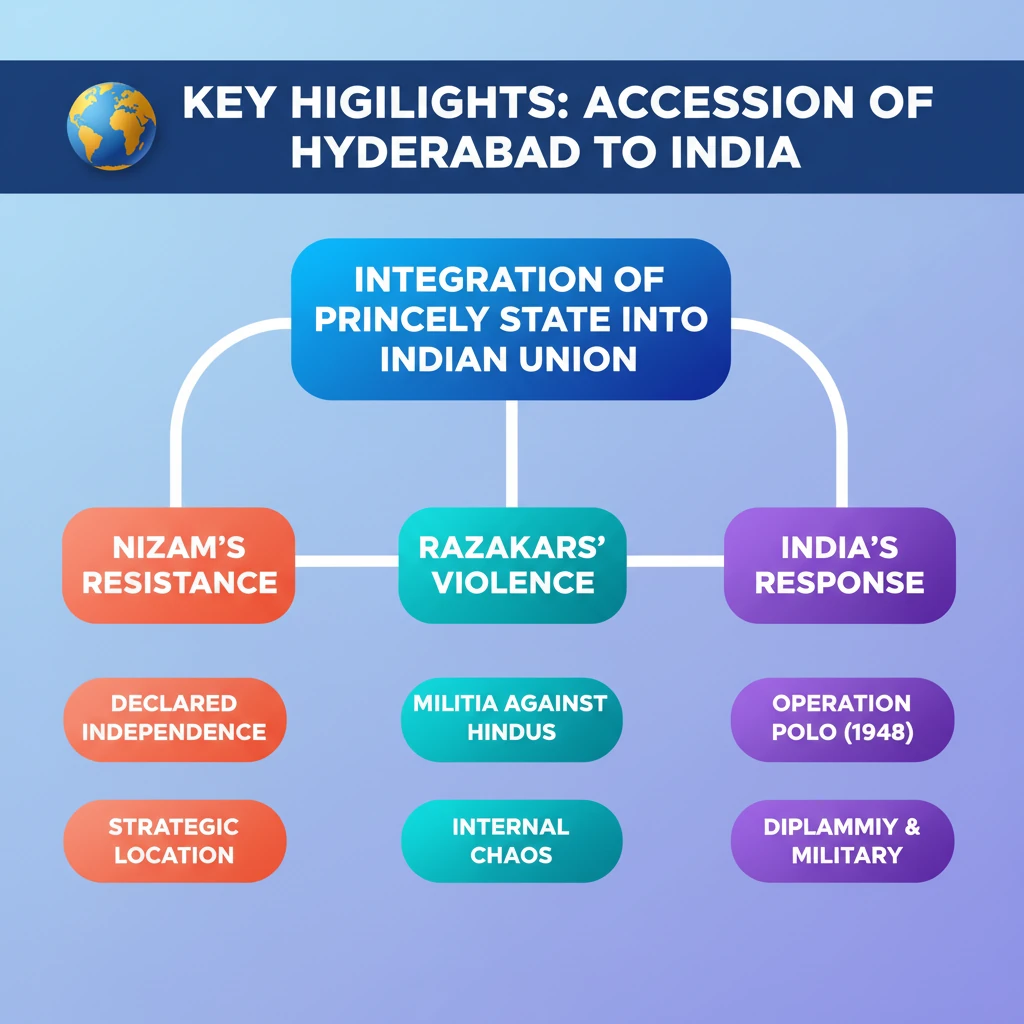
- •Hyderabad was a large princely state with a Hindu majority ruled by Muslim Nizam Osman Ali Khan.
- •The Nizam declared independence in 1947, rejecting accession to India due to strategic location concerns.
- •The Razakars, a pro-Nizam militia, used violence against Hindus and pro-India Muslims, creating internal chaos.
- •India launched 'Operation Polo' (Police Action) on 13th September 1948, integrating Hyderabad after the Nizam's surrender.
- •The accession highlighted India's resolve for national unity and the blend of diplomatic and military strategies.
🧠 Memory Techniques
95% Verified Content